
BuddhistCatholicContemplativeEvangelicalGeneral ChristianHinduJewishLatter-day SaintMuslimNew VisionsProgressive Christian
Beliefs
- Buddhist
- Catholic
- Contemplative
- Evangelical
- General Christian
- Hindu
- Jewish
- Latter-day Saint
- More Voices
- Muslim
- New Visions
- Pagan
- Progressive Christian
Topics
- Religion News
- Food and Religion
- Sports and Religion
- Religious Art
- Religious Music and Entertainment
- Religious Events
- History and Religion
- Style and Religion
- Politics and Religion
- Women in Religion
- Recreation Outdoors and Religion
- Business Finance and Religion
- Careers Workplace and Religion
- Education and Religion
- Family Parenting and Religion
- Health Fitness and Religion
- Home and Religion
- Relationships and Religion
- Technology and Religion
- Travel and Religion
Columnists
- Buddhist Columnists
- Business Finance and Religion Columnists
- Careers Workplace and Religion Columnists
- Catholic Columnists
- Contemplative Columnists
- Education and Religion Columnists
- Evangelists Columnists
- Family Parenting and Religion Columnists
- General Christian Columnists
- Health Fitness and Religion Columnists
- Hindu Columnists
- History and Religion Columnists
- Home and Religion Columnists
- Jewish Columnists
- More Voices Columnists
- Latter Day Columnists
- Muslim Columnists
- New Visions Columnists
- Nonreligious Columnists
- Pagan Columnists
- Politics and Religion Columnists
- Progressive Columnists
- Recreation Outdoors and Religion Columnists
- Relationships and Religion Columnists
- Religion News Columnists
- Religious Art Columnists
- Religious Events Columnists
- Religious Music and Entertainment Columnists
- Sports and Religion Columnists
- Style and Religion Columnists
- Technology and Religion Columnists
- Travel and Religion Columnists
- Women in Religion Columnists
Resource Library
- 2026 Calendar
- Library of World Religions
- The 100 Most Holy Places on Earth
- Patheos Answers
- Podcasts
- Videos
- Faith Leaders Database
- Anglican Episcopalian
- Bahai
- Baptist
- Buddhism
- Christianity
- Confucianism
- Eastern Orthodoxy
- Hinduism
- Holiness and Pentecostal
- ISKCON
- Islam
- Judaism
- Lutheran
- Methodist
- The Church of Jesus Christ of Latter-day Saints
- New Age
- Paganism
- Presbytarian and Reformed
- Protestantism
- Religion Behind the Scenes
- Roman Catholic
- Scientology
- Shia Islam
- Sikhism
- Sufism
- Sunni Islam
- Taoism
- Zen
- See all religions
Research Tools
 Ad-Free & Subscriber Log-In Subscription Support
Ad-Free & Subscriber Log-In Subscription Support
Follow Patheos 

- Trending:
- Forgiveness
- |
- Marriage
- |
- Consciousness
- |
- Death Penalty
- |
- Election
- |
- Halloween
 Christian Crier
- Home
- Evangelical
- What Is The Difference Between New Wine And Old Wine In The Bible?
What Is The Difference Between New Wine And Old Wine In The Bible?
Last updated on: August 22, 2015 at 10:59 am by Jack Wellman
What Is The Difference Between New Wine And Old Wine In The Bible? 2015-08-22T10:59:53-05:00 Jack Wellman
Patheos Explore the world's faith through different perspectives on religion and spirituality! Patheos has the views of the prevalent religions and spiritualities of the world.
What is the difference between new wine and old wine in the Bible? Why does Jesus talk about the new wine and the old wine?
The Old Wine
When the Bible speaks about old wine, it may be referring to the Old Covenant teachings and the new wine, the New Covenant. The Pharisees and scribes were grumbling about the fact that John the Baptist’s disciples fasted but Jesus’ disciples ate and drank (Luke 5:33) and so Jesus tells them “Can you make wedding guests fast while the bridegroom is with them? The days will come when the bridegroom is taken away from them, and then they will fast in those days” (Luke 5:34-35). What was Jesus trying to tell them? He gives them a parable right after this, probably to clarify what He had just told them, saying “No one tears a piece from a new garment and puts it on an old garment. If he does, he will tear the new, and the piece from the new will not match the old” (Luke 5:36). Then He says “And no one puts new wine into old wineskins. If he does, the new wine will burst the skins and it will be spilled, and the skins will be destroyed. But new wine must be put into fresh wineskins” (Luke 5:37-38). Jesus point was that “no one after drinking old wine desires new, for he says, ‘The old is good’” (Luke 5:39). The old could have been the ministry of John the Baptist, the last of the Old Testament prophets. Does the Old Covenant represent the old wine and Jesus’ new and better covenant represent the new wine? The Old Covenant will not fit into the mold of the New Covenant because they are not the same and like putting new wine in old wineskins, it’s going to keep expanding (by fermentation) and burst the old wineskins.
The New Wine
During the Day of Pentecost when the Holy Spirit came over the believers, they began to speak in other languages and those who heard them speak in other people’s language they accused the believers being drunk, saying “These men are full of new wine” (Acts 2:13). It was an insult to be sure. Today, non-believers are still insulting believers by accusing them of being under some influence. Yes, we are under the influence…of the Holy Spirit and that is the new wine of the new age of grace that Jesus paid for with His own blood. It shouldn’t surprise us that people don’t understand it because naturally people will believe that after tasting the old wine, the new is not better for they will say “The old is good” (Luke 5:39). Remember who Jesus was talking too. He was interacting with the scribes and the Pharisees who were still living in and under the Old Covenant and thought “The old is good” and this new is undesirable. This is why Jesus used the parable of trying to put on a new patch onto an old garment. The new patch will shrink and pull away the threads from the already stretched garment that’s older. The new and the old cannot go together. In the same way, old wineskins cannot take the stretching that new wine will cause because it will burst the old wineskins and thus, they are not compatible with one another so the Old Covenant is not compatible with the new and better covenant brought about by Jesus Christ.
The Differences
The differences between the Old and the New Covenant is given in Hebrews 8:6 where it says “Christ has obtained a ministry that is as much more excellent than the old as the covenant he mediates is better, since it is enacted on better promises.” You cannot fit the old covenant of animal sacrifices into the new because Jesus’ perfect and once-and-for-all sacrifice voids or nullifies the need for the Old Covenant sacrifices. Those only covered sin but Jesus shed blood takes away sins and does so forever. This is what Jesus meant at the last Passover Meal He had with the disciples before He went to the cross, saying “This cup is the new covenant in my blood, which is poured out for you” (Luke 22:20) and as such, “Jesus has become the guarantor of a better covenant” (Heb 7:22). This was long ago prophesied and repeated for emphasis by the author of Hebrews when he wrote that “The days are coming, declares the Lord, when I will make a new covenant with the people of Israel and with the people of Judah” (Heb 8:8) It is “By calling this covenant “new,” he has made the first one obsolete; and what is obsolete and outdated will soon disappear” (Heb 8:13) because of “Jesus the mediator of a new covenant, and to the sprinkled blood that speaks a better word than the blood of Abel” (Heb 12:24). How is it better than the blood of Abel? Remember Able was a keeper of sheep (Gen 4:2) and made blood sacrifices so Jesus’ sacrifice is infinitely more superior than Able’s (or animal sacrifices) for it doesn’t have to be repeated over and over again.
Conclusion
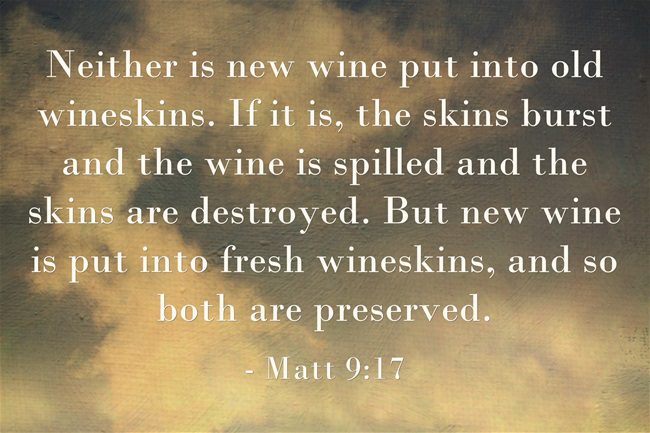
The gospel of Jesus Christ cannot be fit into the Old Testament’s Mosaic Law and covenantal sacrificial systems because these are insufficient to take away sins. This explains Jesus’ statement that “Neither is new wine put into old wineskins. If it is, the skins burst and the wine is spilled and the skins are destroyed. But new wine is put into fresh wineskins, and so both are preserved” (Matt 9:17). Just as “new wine is for fresh wineskins” (Mark 2:22b) the New Covenant is for new converts and those who have repented and trusted in Christ and have not trusted in their own righteousness by the deeds or works of the law like the scribes and the Pharisees did. They cannot be saved by the old wine. There is only one way to be saved and that is through Jesus Christ and Him alone (Acts 4:12) “Therefore, if anyone is in Christ, he is a new creation. The old has passed away; behold, the new has come” (2nd Cor 5:17).
Article by Jack Wellman
Jack Wellman is Pastor of the Mulvane Brethren church in Mulvane Kansas. Jack is also the Senior Writer at What Christians Want To Know whose mission is to equip, encourage, and energize Christians and to address questions about the believer’s daily walk with God and the Bible. You can follow Jack on Google Plus or check out his book Blind Chance or Intelligent Design available on Amazon.
Previous Post

August 21, 2015
What Is The Difference Between Wealth And Riches In The Bible?
Next Post
August 22, 2015 Why Atheists Call Christianity “Foolishness”
Browse Our Archives
Select a Category Bible Answers Bible Definitions Bible Story Bible Study Bible Verses Christian Books Christian Entertainment Christian Fathers Christian Mothers Christian Quotes Devotional Famous Christians Music News Parables Prayers Quotes Sunday School Lesson Uncategorized Youth Sermons
Select a Month October 2019 September 2019 August 2019 July 2019 June 2019 May 2019 April 2019 March 2019 February 2019 January 2019 December 2018 November 2018 October 2018 September 2018 August 2018 July 2018 June 2018 May 2018 April 2018 March 2018 February 2018 January 2018 December 2017 November 2017 October 2017 September 2017 August 2017 July 2017 June 2017 May 2017 April 2017 March 2017 February 2017 January 2017 December 2016 November 2016 October 2016 September 2016 August 2016 July 2016 June 2016 May 2016 March 2016 February 2016 January 2016 December 2015 November 2015 October 2015 September 2015 August 2015 July 2015 June 2015 May 2015 April 2015 March 2015 February 2015 January 2015 December 2014 November 2014 October 2014 September 2014 August 2014 July 2014 June 2014 May 2014 April 2014 March 2014 February 2014 January 2014 December 2013 November 2013 October 2013 September 2013 August 2013 July 2013 June 2013 May 2013 April 2013 March 2013
Follow Us!
TAKE THE
Religious Wisdom Quiz
Who cried at the tomb of Lazarus?
Select your answer to see how you score.
John Peter Jesus David
Related posts from Christian Crier

What Does The Bible Say About Our Thoughts?

Do Colors Have Special Meaning In The Bible?

The Glass – Half Empty Or Half Full?

TRENDING AT PATHEOS Evangelical

The REST of Your Life: A Creative Wrestles...
This week I had a conversation with a good friend from church....

How the author of the world's best hymn...
I've been working with John Newton for a while now. This makes...

Long before this Lectio Divina, Psalm 130 - the song - started...

What About the Trees? Another Living Parable
After I finished writing the last article about falling leaves as a...

Why Classical Education Is a Conversation, Not a...
Come and Read: Joy in Classical Education When I was a little...

Cornell University has received a great deal of negative publicity and intense...
view all Evangelical blogs
Ad-Free & Subscriber Log-In Subscription Support
- About Us
- 2026 Calendar
- Videos
- Podcasts
- Library of World Religions
- Faith In Media Tracker
- Advertise With Us
- Write for Us
- Privacy Policy
- Terms of Service
- Do Not Sell My Data
- Contact Us
- Radiant Digital
- Manage Newsletter Subscriptions
- Unsubscribe From Notifications
- Sitemap
Copyright 2008-2026, Patheos. All rights reserved.
Subscription Support Ad-Free & Subscriber Log-In
Follow Patheos