
BuddhistCatholicContemplativeEvangelicalGeneral ChristianHinduJewishLatter-day SaintMuslimNew VisionsProgressive Christian
Beliefs
- Buddhist
- Catholic
- Contemplative
- Evangelical
- General Christian
- Hindu
- Jewish
- Latter-day Saint
- More Voices
- Muslim
- New Visions
- Pagan
- Progressive Christian
Topics
- Religion News
- Food and Religion
- Sports and Religion
- Religious Art
- Religious Music and Entertainment
- Religious Events
- History and Religion
- Style and Religion
- Politics and Religion
- Women in Religion
- Recreation Outdoors and Religion
- Business Finance and Religion
- Careers Workplace and Religion
- Education and Religion
- Family Parenting and Religion
- Health Fitness and Religion
- Home and Religion
- Relationships and Religion
- Technology and Religion
- Travel and Religion
Columnists
- Buddhist Columnists
- Business Finance and Religion Columnists
- Careers Workplace and Religion Columnists
- Catholic Columnists
- Contemplative Columnists
- Education and Religion Columnists
- Evangelists Columnists
- Family Parenting and Religion Columnists
- General Christian Columnists
- Health Fitness and Religion Columnists
- Hindu Columnists
- History and Religion Columnists
- Home and Religion Columnists
- Jewish Columnists
- More Voices Columnists
- Latter Day Columnists
- Muslim Columnists
- New Visions Columnists
- Nonreligious Columnists
- Pagan Columnists
- Politics and Religion Columnists
- Progressive Columnists
- Recreation Outdoors and Religion Columnists
- Relationships and Religion Columnists
- Religion News Columnists
- Religious Art Columnists
- Religious Events Columnists
- Religious Music and Entertainment Columnists
- Sports and Religion Columnists
- Style and Religion Columnists
- Technology and Religion Columnists
- Travel and Religion Columnists
- Women in Religion Columnists
Resource Library
- 2026 Calendar
- Library of World Religions
- The 100 Most Holy Places on Earth
- Patheos Answers
- Podcasts
- Videos
- Faith Leaders Database
- Anglican Episcopalian
- Bahai
- Baptist
- Buddhism
- Christianity
- Confucianism
- Eastern Orthodoxy
- Hinduism
- Holiness and Pentecostal
- ISKCON
- Islam
- Judaism
- Lutheran
- Methodist
- The Church of Jesus Christ of Latter-day Saints
- New Age
- Paganism
- Presbytarian and Reformed
- Protestantism
- Religion Behind the Scenes
- Roman Catholic
- Scientology
- Shia Islam
- Sikhism
- Sufism
- Sunni Islam
- Taoism
- Zen
- See all religions
Research Tools
 Ad-Free & Subscriber Log-In Subscription Support
Ad-Free & Subscriber Log-In Subscription Support
Follow Patheos 

- Trending:
- Forgiveness
- |
- Marriage
- |
- Consciousness
- |
- Death Penalty
- |
- Election
- |
- Halloween
 Christian Crier
- Home
- Evangelical
- Who Was Nehemiah In The Bible? A Christian Study
Who Was Nehemiah In The Bible? A Christian Study
Last updated on: July 21, 2015 at 8:26 pm by Jack Wellman
Who Was Nehemiah In The Bible? A Christian Study 2015-07-21T20:26:30-05:00 Jack Wellman
Patheos Explore the world's faith through different perspectives on religion and spirituality! Patheos has the views of the prevalent religions and spiritualities of the world.
Who was Nehemiah? What was it about his character that gives us reason to study his life in the Scriptures?
Who was Nehemiah?
Nehemiah was a high official in the Persian court of King Artaxerxes and was the king’s cupbearer (Neh 1:11c). A cupbearer doesn’t sound like a very great position of authority but think of it this way; the king trusted him with his life since the cupbearer was often the first one to taste the king’s food and drink to ensure that it wasn’t poisoned. He had access to the king like no one else. The cupbearer had to be the most trusted man in the kingdom because of his accessibility to the king and he heard every plan and every secret counsel that the king ever heard so Nehemiah was placed in a strategic place by the sovereignty of God for a very special reason as we shall read.
The Fallen Walls of Jerusalem
When Nehemiah heard the report that “The wall of Jerusalem is broken down, and its gates are destroyed by fire” (Neh 1:3b) he “sat down and wept and mourned for days, and I continued fasting and praying before the God of heaven” (Neh 1:4). Why did Nehemiah react like this? That’s because this was the city of God, the place where God had placed His name and to Nehemiah, it was a sacred site. That’s why he fell down on his face and began to pray to God and asked Him to “hear the prayer of your servant that I now pray before you day and night for the people of Israel your servants, confessing the sins of the people of Israel, which we have sinned against you. Even I and my father’s house have sinned. We have acted very corruptly against you and have not kept the commandments, the statutes, and the rules that you commanded your servant Moses” (Neh 1:6-7). He was seeking God’s forgiveness and confessing the sins of his people. He knew that this was a judgment form God, thus this was why he fell down on his face and began to pray to God.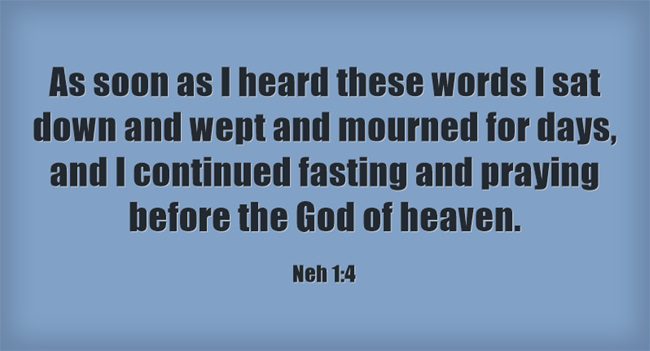
Nehemiah’s Risk
No one ever had a sad countenance in the king’s presence. It could be sudden death but Nehemiah could not help himself. When the king noticed this, he said “Why is your face sad, seeing you are not sick? This is nothing but sadness of the heart.” Then I was very much afraid” (Neh 2: 2:2) meaning that it could cost him his life. The term “very much afraid” could be stated “he was terrified.” Then Nehemiah courageously asked the king “If it pleases the king, and if your servant has found favor in your sight, that you send me to Judah, to the city of my fathers’ graves, that I may rebuild it” (Neh 2:5). The king not only granted Nehemiah permission to return to Jerusalem to rebuild the walls and the gates (Neh 2:8b) but also gave him “letters to the governors of the province Beyond the River, that they may let me pass through until I come to Judah, and a letter to Asaph, the keeper of the king’s forest, that he may give me timber to make beams for the gates of the fortress of the temple, and for the wall of the city, and for the house that I shall occupy” (Neh 2:7-8a). Just like that, Nehemiah had a pagan king’s blessing and provisions to rebuild Jerusalem proving the proverb is true; “The king’s heart is a stream of water in the hand of the Lord; he turns it wherever he will” (Prov 21:1).
Rebuilding the walls of Jerusalem
Nehemiah is believed to have returned to Jerusalem about 445 B.C. as the provincial governor, further indicating Nehemiah’s position of authority in the Persian court of King Artaxerxes was more than most people think for a cupbearer. He quickly began assembling the manpower necessary. He had to set up guards to defend and protect the workers against the continuous threat of those who were opposed to their efforts. The opponents included the armies of Samaria, the Ammonites and the Ashdodites, no small force, yet they “built the wall. And all the wall was joined together to half its height, for the people had a mind to work” (Neh 4:6). Nehemiah, even though he was the governor, never once took advantage of his office to allocate food, land, or laborers for his own needs and in fact, he paid out of his own pocket (Neh 5:14-19). Not only that, he had seen how the landowners and nobles had taken advantage of the people and he rebuked them for that saying “You are exacting interest, each from his brother” (Neh 5:7) and “The thing that you are doing is not good. Ought you not to walk in the fear of our God to prevent the taunts of the nations our enemies” (Neh 5:9) so the people had their properties returned.
Failed Conspiracy
Sanballat and Tobiah and Geshem the Arab continually conspired to destroy the work, instill fear in the workers, and even tried to deceive Nehemiah by trying to set up a meeting with him but Nehemiah knew “they intended to do me harm” (Neh 6:2c). Despite all the best attempt of Nehemiah’s enemies, “the wall was finished on the twenty-fifth day of the month Elul, in fifty-two days” (Neh 6:15). Amazingly, due to the hurried work of repairing and rebuilding Jerusalem’s walls and the gates it was completed in only fifty-two days, which even by today’s engineering technological capabilities and standards, is extraordinary.
Conclusion
The lessons we can learn from Nehemiah are that great rewards often take great risks, like when he approached the king and ask for help; that being continually in prayer is vital to any success; that just because someone is in a position of power they don’t need to take advantage of others (like the nobles did); that perseverance against the enemy is essential; and that God can do some amazing things when we seek Him and to do it for His glory.
Article by Jack Wellman
Jack Wellman is Pastor of the Mulvane Brethren church in Mulvane Kansas. Jack is also the Senior Writer at What Christians Want To Know whose mission is to equip, encourage, and energize Christians and to address questions about the believer’s daily walk with God and the Bible. You can follow Jack on Google Plus or check out his book Blind Chance or Intelligent Design available on Amazon.
Previous Post

July 21, 2015
Who Was Deborah In The Bible? A Character Study
Next Post
July 21, 2015 Who Were The Moabites In The Bible?
Browse Our Archives
Select a Category Bible Answers Bible Definitions Bible Story Bible Study Bible Verses Christian Books Christian Entertainment Christian Fathers Christian Mothers Christian Quotes Devotional Famous Christians Music News Parables Prayers Quotes Sunday School Lesson Uncategorized Youth Sermons
Select a Month October 2019 September 2019 August 2019 July 2019 June 2019 May 2019 April 2019 March 2019 February 2019 January 2019 December 2018 November 2018 October 2018 September 2018 August 2018 July 2018 June 2018 May 2018 April 2018 March 2018 February 2018 January 2018 December 2017 November 2017 October 2017 September 2017 August 2017 July 2017 June 2017 May 2017 April 2017 March 2017 February 2017 January 2017 December 2016 November 2016 October 2016 September 2016 August 2016 July 2016 June 2016 May 2016 March 2016 February 2016 January 2016 December 2015 November 2015 October 2015 September 2015 August 2015 July 2015 June 2015 May 2015 April 2015 March 2015 February 2015 January 2015 December 2014 November 2014 October 2014 September 2014 August 2014 July 2014 June 2014 May 2014 April 2014 March 2014 February 2014 January 2014 December 2013 November 2013 October 2013 September 2013 August 2013 July 2013 June 2013 May 2013 April 2013 March 2013
Follow Us!
TAKE THE
Religious Wisdom Quiz
How many brothers did Joseph have?
Select your answer to see how you score.
Two Eleven One Five
Related posts from Christian Crier
Blind Bartimaeus And The Salvation Of The Sinner

The Exodus And Christian Conversion

The Book Of Esther And God’s Providence
TRENDING AT PATHEOS Evangelical

The REST of Your Life: A Creative Wrestles...
This week I had a conversation with a good friend from church....

How the author of the world's best hymn...
I've been working with John Newton for a while now. This makes...

Long before this Lectio Divina, Psalm 130 - the song - started...

What About the Trees? Another Living Parable
After I finished writing the last article about falling leaves as a...

Why Classical Education Is a Conversation, Not a...
Come and Read: Joy in Classical Education When I was a little...

Cornell University has received a great deal of negative publicity and intense...
view all Evangelical blogs
Ad-Free & Subscriber Log-In Subscription Support
- About Us
- 2026 Calendar
- Videos
- Podcasts
- Library of World Religions
- Faith In Media Tracker
- Advertise With Us
- Write for Us
- Privacy Policy
- Terms of Service
- Do Not Sell My Data
- Contact Us
- Radiant Digital
- Manage Newsletter Subscriptions
- Unsubscribe From Notifications
- Sitemap
Copyright 2008-2026, Patheos. All rights reserved.
Subscription Support Ad-Free & Subscriber Log-In
Follow Patheos