
BuddhistCatholicContemplativeEvangelicalGeneral ChristianHinduJewishLatter-day SaintMuslimNew VisionsProgressive Christian
Beliefs
- Buddhist
- Catholic
- Contemplative
- Evangelical
- General Christian
- Hindu
- Jewish
- Latter-day Saint
- More Voices
- Muslim
- New Visions
- Pagan
- Progressive Christian
Topics
- Religion News
- Food and Religion
- Sports and Religion
- Religious Art
- Religious Music and Entertainment
- Religious Events
- History and Religion
- Style and Religion
- Politics and Religion
- Women in Religion
- Recreation Outdoors and Religion
- Business Finance and Religion
- Careers Workplace and Religion
- Education and Religion
- Family Parenting and Religion
- Health Fitness and Religion
- Home and Religion
- Relationships and Religion
- Technology and Religion
- Travel and Religion
Columnists
- Buddhist Columnists
- Business Finance and Religion Columnists
- Careers Workplace and Religion Columnists
- Catholic Columnists
- Contemplative Columnists
- Education and Religion Columnists
- Evangelists Columnists
- Family Parenting and Religion Columnists
- General Christian Columnists
- Health Fitness and Religion Columnists
- Hindu Columnists
- History and Religion Columnists
- Home and Religion Columnists
- Jewish Columnists
- More Voices Columnists
- Latter Day Columnists
- Muslim Columnists
- New Visions Columnists
- Nonreligious Columnists
- Pagan Columnists
- Politics and Religion Columnists
- Progressive Columnists
- Recreation Outdoors and Religion Columnists
- Relationships and Religion Columnists
- Religion News Columnists
- Religious Art Columnists
- Religious Events Columnists
- Religious Music and Entertainment Columnists
- Sports and Religion Columnists
- Style and Religion Columnists
- Technology and Religion Columnists
- Travel and Religion Columnists
- Women in Religion Columnists
Resource Library
- 2026 Calendar
- Library of World Religions
- The 100 Most Holy Places on Earth
- Patheos Answers
- Podcasts
- Videos
- Faith Leaders Database
- Anglican Episcopalian
- Bahai
- Baptist
- Buddhism
- Christianity
- Confucianism
- Eastern Orthodoxy
- Hinduism
- Holiness and Pentecostal
- ISKCON
- Islam
- Judaism
- Lutheran
- Methodist
- The Church of Jesus Christ of Latter-day Saints
- New Age
- Paganism
- Presbytarian and Reformed
- Protestantism
- Religion Behind the Scenes
- Roman Catholic
- Scientology
- Shia Islam
- Sikhism
- Sufism
- Sunni Islam
- Taoism
- Zen
- See all religions
Research Tools
 Ad-Free & Subscriber Log-In Subscription Support
Ad-Free & Subscriber Log-In Subscription Support
Follow Patheos 

- Trending:
- Forgiveness
- |
- Marriage
- |
- Consciousness
- |
- Death Penalty
- |
- Election
- |
- Halloween
 Christian Crier
- Home
- Evangelical
- What Is The Book Of James About? A Bible Study
What Is The Book Of James About? A Bible Study
Last updated on: July 21, 2015 at 2:44 pm by Jack Wellman
What Is The Book Of James About? A Bible Study 2015-07-21T14:44:45-05:00 Jack Wellman
Patheos Explore the world's faith through different perspectives on religion and spirituality! Patheos has the views of the prevalent religions and spiritualities of the world.
What exactly is the Book of James about? What was the purpose of James writing it?
Who was James?
The Book of James is what many consider part of the “wisdom literature” because there is so much wisdom in this book. The author of this epistle (or letter) is James who most believe is the half-brother of Jesus Christ who only came to believe in Him after His death and resurrection. James is also called James the Just and even “Old Camel Knees” because he was a man of prayer and he spent so much time on his knees and they were very likely calloused so it is not surprising that there is a great deal about prayer in this book. James wrote this to encourage the church which at the time was experiencing the greatest of persecutions. They were losing their jobs, their families disowned them, their property was being confiscated, and many were being martyred. James wrote specifically “To the twelve tribes in the Dispersion” (James 1:1b). The Dispersion was where the Jews were being dispersed all around the Roman Empire and expelled from Rome and even put out of Jerusalem due to the severe persecution of the church, which as you might know, primarily consisted of Jews at the time of James’ writing.
The Wisdom of God
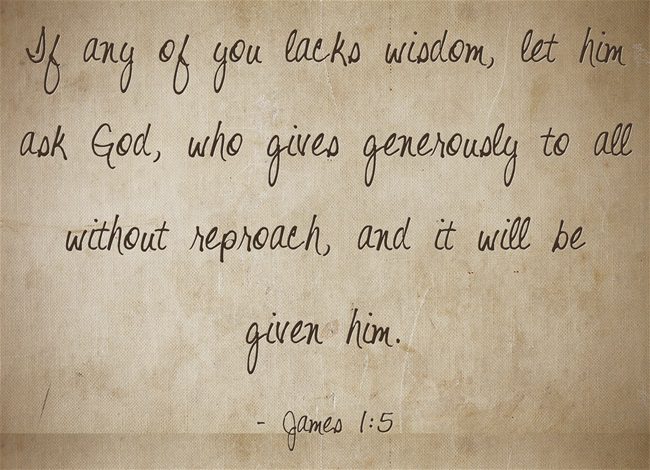
Just as Solomon could have asked for riches and wealth but instead asked for wisdom, James insists that we can ask God for wisdom too as he wrote “If any of you lacks wisdom, let him ask God, who gives generously to all without reproach, and it will be given him” (James 1:5). There is no reason why God would not grant such a prayer request. He also wrote “Who is wise and understanding among you? By his good conduct let him show his works in the meekness of wisdom” (James 3:13) for “the wisdom from above is first pure, then peaceable, gentle, open to reason, full of mercy and good fruits, impartial and sincere” (James 3:17).
The Prayers of the Saints
As much as James wrote about wisdom, he also wrote a lot about prayer that we should “ask in faith, with no doubting, for the one who doubts is like a wave of the sea that is driven and tossed by the wind” (James 1:6) and if anyone was sick “Let him call for the elders of the church, and let them pray over him, anointing him with oil in the name of the Lord. And the prayer of faith will save the one who is sick, and the Lord will raise him up” (James 5:14-15). Since God never changes, He is the same God who answered Elijah’s prayer and points to his example writing “The prayer of a righteous person has great power as it is working. Elijah was a man with a nature like ours, and he prayed fervently that it might not rain, and for three years and six months it did not rain on the earth. Then he prayed again, and heaven gave rain, and the earth bore its fruit” (James 5:16b-18).
Bridling the Tongue
Jesus once said that it wasn’t what went into the stomach that polluted a man (or woman) but what came out of the mouth that defiled him or her (Mark 7:14-23) so Jesus’ half-brother James also focuses on the tongue, writing that “the tongue is a small member, yet it boasts of great things” (James 3:5a) and “How great a forest is set ablaze by such a small fire” for example “the tongue is a fire, a world of unrighteousness. The tongue is set among our members, staining the whole body, setting on fire the entire course of life, and set on fire by hell” (James 3:5b-6). Sadly, what James writes is true that “no human being can tame the tongue. It is a restless evil, full of deadly poison. With it we bless our Lord and Father, and with it we curse people who are made in the likeness of God. From the same mouth come blessing and cursing” (James 3:8-10).
The Suffering of the Saints
Much of the reason that James wrote this book (letter) was to encourage the Christians who were going through severe persecution. James saw suffering as normal for the believer and wanted them (and us) to “Count it all joy, my brothers, when you meet trials of various kinds, for you know that the testing of your faith produces steadfastness. And let steadfastness have its full effect, that you may be perfect and complete, lacking in nothing” (James 1:2-4). Those who suffer are actually blessed if they remain “steadfast under trial, for when he has stood the test he will receive the crown of life, which God has promised to those who love him” (James 1:12) and admonishes us “As an example of suffering and patience, brothers, take the prophets who spoke in the name of the Lord. Behold, we consider those blessed who remained steadfast. You have heard of the steadfastness of Job, and you have seen the purpose of the Lord, how the Lord is compassionate and merciful” (James 5:10-11).
Conclusion
A pastor could spend a year going verse by verse in expository preaching in the Book of James because it contains so much wisdom; so much on how to pray in faith; so much on taming the tongue; and much on why God allows suffering. James also wrote extensively about the relationship between faith and works and that faith with no works isn’t the genuine thing because works necessarily accompany faith. That is why I think the Book of James is worth a good deal of study, for in it, you’ll find godly wisdom.
Article by Jack Wellman
Jack Wellman is Pastor of the Mulvane Brethren church in Mulvane Kansas. Jack is also the Senior Writer at What Christians Want To Know whose mission is to equip, encourage, and energize Christians and to address questions about the believer’s daily walk with God and the Bible. You can follow Jack on Google Plus or check out his book Blind Chance or Intelligent Design available on Amazon.
Previous Post

July 21, 2015
What Is The Book Of Leviticus About? A Bible Study
Next Post
July 21, 2015 7 Powerful Bible Verses From The Book Of Luke
Browse Our Archives
Select a Category Bible Answers Bible Definitions Bible Story Bible Study Bible Verses Christian Books Christian Entertainment Christian Fathers Christian Mothers Christian Quotes Devotional Famous Christians Music News Parables Prayers Quotes Sunday School Lesson Uncategorized Youth Sermons
Select a Month October 2019 September 2019 August 2019 July 2019 June 2019 May 2019 April 2019 March 2019 February 2019 January 2019 December 2018 November 2018 October 2018 September 2018 August 2018 July 2018 June 2018 May 2018 April 2018 March 2018 February 2018 January 2018 December 2017 November 2017 October 2017 September 2017 August 2017 July 2017 June 2017 May 2017 April 2017 March 2017 February 2017 January 2017 December 2016 November 2016 October 2016 September 2016 August 2016 July 2016 June 2016 May 2016 March 2016 February 2016 January 2016 December 2015 November 2015 October 2015 September 2015 August 2015 July 2015 June 2015 May 2015 April 2015 March 2015 February 2015 January 2015 December 2014 November 2014 October 2014 September 2014 August 2014 July 2014 June 2014 May 2014 April 2014 March 2014 February 2014 January 2014 December 2013 November 2013 October 2013 September 2013 August 2013 July 2013 June 2013 May 2013 April 2013 March 2013
Follow Us!
TAKE THE
Religious Wisdom Quiz
How old was Moses when he died?
Select your answer to see how you score.
90 years 110 years 100 years 120 years
Related posts from Christian Crier

What Does The Bible Say About Our Thoughts?

Top 13 Bible Verses About Virtue

Do Colors Have Special Meaning In The Bible?

The Glass – Half Empty Or Half Full?
TRENDING AT PATHEOS Evangelical

The REST of Your Life: A Creative Wrestles...
This week I had a conversation with a good friend from church....

How the author of the world's best hymn...
I've been working with John Newton for a while now. This makes...

Long before this Lectio Divina, Psalm 130 - the song - started...

What About the Trees? Another Living Parable
After I finished writing the last article about falling leaves as a...

Why Classical Education Is a Conversation, Not a...
Come and Read: Joy in Classical Education When I was a little...

Cornell University has received a great deal of negative publicity and intense...
view all Evangelical blogs
Ad-Free & Subscriber Log-In Subscription Support
- About Us
- 2026 Calendar
- Videos
- Podcasts
- Library of World Religions
- Faith In Media Tracker
- Advertise With Us
- Write for Us
- Privacy Policy
- Terms of Service
- Do Not Sell My Data
- Contact Us
- Radiant Digital
- Manage Newsletter Subscriptions
- Unsubscribe From Notifications
- Sitemap
Copyright 2008-2026, Patheos. All rights reserved.
Subscription Support Ad-Free & Subscriber Log-In
Follow Patheos