
BuddhistCatholicContemplativeEvangelicalGeneral ChristianHinduJewishLatter-day SaintMuslimNew VisionsProgressive Christian
Beliefs
- Buddhist
- Catholic
- Contemplative
- Evangelical
- General Christian
- Hindu
- Jewish
- Latter-day Saint
- More Voices
- Muslim
- New Visions
- Pagan
- Progressive Christian
Topics
- Religion News
- Food and Religion
- Sports and Religion
- Religious Art
- Religious Music and Entertainment
- Religious Events
- History and Religion
- Style and Religion
- Politics and Religion
- Women in Religion
- Recreation Outdoors and Religion
- Business Finance and Religion
- Careers Workplace and Religion
- Education and Religion
- Family Parenting and Religion
- Health Fitness and Religion
- Home and Religion
- Relationships and Religion
- Technology and Religion
- Travel and Religion
Columnists
- Buddhist Columnists
- Business Finance and Religion Columnists
- Careers Workplace and Religion Columnists
- Catholic Columnists
- Contemplative Columnists
- Education and Religion Columnists
- Evangelists Columnists
- Family Parenting and Religion Columnists
- General Christian Columnists
- Health Fitness and Religion Columnists
- Hindu Columnists
- History and Religion Columnists
- Home and Religion Columnists
- Jewish Columnists
- More Voices Columnists
- Latter Day Columnists
- Muslim Columnists
- New Visions Columnists
- Nonreligious Columnists
- Pagan Columnists
- Politics and Religion Columnists
- Progressive Columnists
- Recreation Outdoors and Religion Columnists
- Relationships and Religion Columnists
- Religion News Columnists
- Religious Art Columnists
- Religious Events Columnists
- Religious Music and Entertainment Columnists
- Sports and Religion Columnists
- Style and Religion Columnists
- Technology and Religion Columnists
- Travel and Religion Columnists
- Women in Religion Columnists
Resource Library
- 2026 Calendar
- Library of World Religions
- The 100 Most Holy Places on Earth
- Patheos Answers
- Podcasts
- Videos
- Faith Leaders Database
- Anglican Episcopalian
- Bahai
- Baptist
- Buddhism
- Christianity
- Confucianism
- Eastern Orthodoxy
- Hinduism
- Holiness and Pentecostal
- ISKCON
- Islam
- Judaism
- Lutheran
- Methodist
- The Church of Jesus Christ of Latter-day Saints
- New Age
- Paganism
- Presbytarian and Reformed
- Protestantism
- Religion Behind the Scenes
- Roman Catholic
- Scientology
- Shia Islam
- Sikhism
- Sufism
- Sunni Islam
- Taoism
- Zen
- See all religions
Research Tools
 Ad-Free & Subscriber Log-In Subscription Support
Ad-Free & Subscriber Log-In Subscription Support
Follow Patheos 

- Trending:
- Forgiveness
- |
- Marriage
- |
- Consciousness
- |
- Death Penalty
- |
- Election
- |
- Halloween
 Christian Crier
- Home
- Evangelical
- Who Was Stephen In The Bible? A Character Study
Who Was Stephen In The Bible? A Character Study
Last updated on: July 18, 2015 at 6:12 pm by Jack Wellman
Who Was Stephen In The Bible? A Character Study 2015-07-18T18:12:26-05:00 Jack Wellman
Patheos Explore the world's faith through different perspectives on religion and spirituality! Patheos has the views of the prevalent religions and spiritualities of the world.
Who was Stephen in the Bible? What did he do to make such an impact?
What Stephen’s Name Means
Stephen’s name is derived from the Greek name “Stéfanos” and means “honor,” “wreath” or “crown” and Stephen may have been the first Christian martyr in the church. Stephen was a deacon in the 1st century church who was stoned to death for preaching the gospel. He also gave one of the greatest historical and apologetic sermons ever given in the Bible when he stood before the council. This man left a great mark in the church and in church history as we shall see.
The Need for Deacons
The need for deacons arose from the rapid growth of the church as we read in Acts 6:1-3 “Now in these days when the disciples were increasing in number, a complaint by the Hellenists arose against the Hebrews because their widows were being neglected in the daily distribution. And the twelve summoned the full number of the disciples and said, “It is not right that we should give up preaching the word of God to serve tables. Therefore, brothers, pick out from among you seven men of good repute, full of the Spirit and of wisdom, whom we will appoint to this duty.” The Hellenists were Greek-speaking Jews and they came to complain that only the Jewish widows were being taken care of so they decided to select seven men to serve as deacons (literally, “servants” or “waiters”) so “they chose Stephen, a man full of faith and of the Holy Spirit” (Acts 6:5) to be named among the seven.
Stephen Arrested
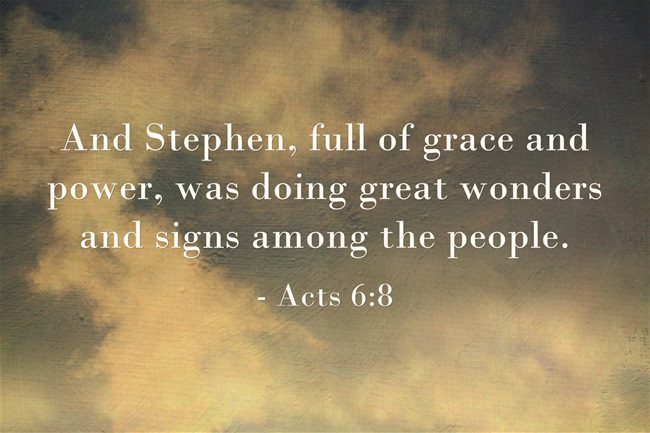
Why was Stephen arrested? It was because he was “full of grace and power, was doing great wonders and signs among the people” (Act 6:8). They could find no charges to bring up against Stephen so “they secretly instigated men who said, “We have heard him speak blasphemous words against Moses and God.” And they stirred up the people and the elders and the scribes, and they came upon him and seized him and brought him before the council, and they set up false witnesses” (Acts 6:11-13a).
Stephen’s Illegal Trial
When Stephen was brought before the council “the high priest said, “Are these things so” (Acts 7:1)? Stephen then began perhaps the lengthiest and most convincing of apologetic, historical defenses of the faith that may have ever been given (Acts 7:2-53). His argument was incontrovertible and the council was not capable of challenging it or proving it wrong. It mattered little to the council because in Stephen’s righteous indignation he said “You stiff-necked people, uncircumcised in heart and ears, you always resist the Holy Spirit. As your fathers did, so do you. Which of the prophets did your fathers not persecute? And they killed those who announced beforehand the coming of the Righteous One, whom you have now betrayed and murdered” (Acts 7:51-52).
Stephen’s Stoning
When Stephen sharply rebuked the council members “they were enraged, and they ground their teeth at him. But he, full of the Holy Spirit, gazed into heaven and saw the glory of God, and Jesus standing at the right hand of God. And he said, “Behold, I see the heavens opened, and the Son of Man standing at the right hand of God.” But they cried out with a loud voice and stopped their ears and rushed together at him” (Acts 7:54-57). They had heard enough; “they cast him out of the city and stoned him. And the witnesses laid down their garments at the feet of a young man named Saul. And as they were stoning Stephen, he called out, “Lord Jesus, receive my spirit.” And falling to his knees he cried out with a loud voice, “Lord, do not hold this sin against them.” And when he had said this, he fell asleep” (Acts 7:58b-60). The wording where it says “he fell asleep” obviously meaning that he died but Jesus once said that God “is not God of the dead, but of the living, for all live to him” (Luke 20:38). We know that Stephen went immediately into the presence of the Lord as to be absent from the body is to be present with the Lord (2nd Cor 5:8). We might also notice that Stephen saw “Jesus standing at the right hand of God” as if to welcome him home, into the kingdom.
Stephen’s Convert?
When Stephen was stoned, those who were stoning him “laid down their garments at the feet of a young man named Saul” so I have often wondered; was Saul, who later became Paul after his own conversion on the Damascus Road, a convert of Stephen? Did the stoning trouble Saul’s conscience? Did this plant the seed that what he was doing was wrong? Paul must have been an eye witness to Stephen’s testimony at the council and Saul must have heard those heart-piercing words “Lord, do not hold this sin against them” which were very similar to Jesus’ statement on the cross “Father, forgive them for they know not what they are doing” (Luke 23:34). We’ll only know the answer to that question when we see Paul in the kingdom. In the meantime, Stephen’s heroic defense of the faith is truly one of the most remarkable and bravest witnesses in the history of the church.
Conclusion
Stephen is a hero of the faith and is greatly admired, even today, for his bold, brave witness to the council, despite the threat of execution by stoning. I know that witnessing before others who are hostile to the truthfulness of the gospel is frightening and will very likely bring severe persecution to those who do it but as Paul said just before he died, “I have fought the good fight, I have finished the race, I have kept the faith. Henceforth there is laid up for me the crown of righteousness, which the Lord, the righteous judge, will award to me on that Day, and not only to me but also to all who have loved his appearing” (2nd Tim 4:7-8). That’s what Stephen’s name means; a crown and there is one waiting for you if you have repented and put your trust in Christ.
Article by Jack Wellman
Jack Wellman is Pastor of the Mulvane Brethren church in Mulvane Kansas. Jack is also the Senior Writer at What Christians Want To Know whose mission is to equip, encourage, and energize Christians and to address questions about the believer’s daily walk with God and the Bible. You can follow Jack on Google Plus or check out his book Blind Chance or Intelligent Design available on Amazon.
Previous Post

July 18, 2015
Who Was Onesimus In The Bible? A Character Study
Next Post
July 18, 2015 Who Was Lazarus In The Bible? A Character Study
Browse Our Archives
Select a Category Bible Answers Bible Definitions Bible Story Bible Study Bible Verses Christian Books Christian Entertainment Christian Fathers Christian Mothers Christian Quotes Devotional Famous Christians Music News Parables Prayers Quotes Sunday School Lesson Uncategorized Youth Sermons
Select a Month October 2019 September 2019 August 2019 July 2019 June 2019 May 2019 April 2019 March 2019 February 2019 January 2019 December 2018 November 2018 October 2018 September 2018 August 2018 July 2018 June 2018 May 2018 April 2018 March 2018 February 2018 January 2018 December 2017 November 2017 October 2017 September 2017 August 2017 July 2017 June 2017 May 2017 April 2017 March 2017 February 2017 January 2017 December 2016 November 2016 October 2016 September 2016 August 2016 July 2016 June 2016 May 2016 March 2016 February 2016 January 2016 December 2015 November 2015 October 2015 September 2015 August 2015 July 2015 June 2015 May 2015 April 2015 March 2015 February 2015 January 2015 December 2014 November 2014 October 2014 September 2014 August 2014 July 2014 June 2014 May 2014 April 2014 March 2014 February 2014 January 2014 December 2013 November 2013 October 2013 September 2013 August 2013 July 2013 June 2013 May 2013 April 2013 March 2013
Follow Us!
TAKE THE
Religious Wisdom Quiz
What Christian tradition is noted for its belief in nonresistance and simple living?
Select your answer to see how you score.
Methodist Anglican Amish Episcopalian
Related posts from Christian Crier

What Does The Bible Say About Our Thoughts?

Do Colors Have Special Meaning In The Bible?

The Glass – Half Empty Or Half Full?

TRENDING AT PATHEOS Evangelical

The REST of Your Life: A Creative Wrestles...
This week I had a conversation with a good friend from church....

How the author of the world's best hymn...
I've been working with John Newton for a while now. This makes...

Long before this Lectio Divina, Psalm 130 - the song - started...

What About the Trees? Another Living Parable
After I finished writing the last article about falling leaves as a...

Why Classical Education Is a Conversation, Not a...
Come and Read: Joy in Classical Education When I was a little...

Cornell University has received a great deal of negative publicity and intense...
view all Evangelical blogs
Ad-Free & Subscriber Log-In Subscription Support
- About Us
- 2026 Calendar
- Videos
- Podcasts
- Library of World Religions
- Faith In Media Tracker
- Advertise With Us
- Write for Us
- Privacy Policy
- Terms of Service
- Do Not Sell My Data
- Contact Us
- Radiant Digital
- Manage Newsletter Subscriptions
- Unsubscribe From Notifications
- Sitemap
Copyright 2008-2026, Patheos. All rights reserved.
Subscription Support Ad-Free & Subscriber Log-In
Follow Patheos