
BuddhistCatholicContemplativeEvangelicalGeneral ChristianHinduJewishLatter-day SaintMuslimNew VisionsProgressive Christian
Beliefs
- Buddhist
- Catholic
- Contemplative
- Evangelical
- General Christian
- Hindu
- Jewish
- Latter-day Saint
- More Voices
- Muslim
- New Visions
- Pagan
- Progressive Christian
Topics
- Religion News
- Food and Religion
- Sports and Religion
- Religious Art
- Religious Music and Entertainment
- Religious Events
- History and Religion
- Style and Religion
- Politics and Religion
- Women in Religion
- Recreation Outdoors and Religion
- Business Finance and Religion
- Careers Workplace and Religion
- Education and Religion
- Family Parenting and Religion
- Health Fitness and Religion
- Home and Religion
- Relationships and Religion
- Technology and Religion
- Travel and Religion
Columnists
- Buddhist Columnists
- Business Finance and Religion Columnists
- Careers Workplace and Religion Columnists
- Catholic Columnists
- Contemplative Columnists
- Education and Religion Columnists
- Evangelists Columnists
- Family Parenting and Religion Columnists
- General Christian Columnists
- Health Fitness and Religion Columnists
- Hindu Columnists
- History and Religion Columnists
- Home and Religion Columnists
- Jewish Columnists
- More Voices Columnists
- Latter Day Columnists
- Muslim Columnists
- New Visions Columnists
- Nonreligious Columnists
- Pagan Columnists
- Politics and Religion Columnists
- Progressive Columnists
- Recreation Outdoors and Religion Columnists
- Relationships and Religion Columnists
- Religion News Columnists
- Religious Art Columnists
- Religious Events Columnists
- Religious Music and Entertainment Columnists
- Sports and Religion Columnists
- Style and Religion Columnists
- Technology and Religion Columnists
- Travel and Religion Columnists
- Women in Religion Columnists
Resource Library
- 2026 Calendar
- Library of World Religions
- The 100 Most Holy Places on Earth
- Patheos Answers
- Podcasts
- Videos
- Faith Leaders Database
- Anglican Episcopalian
- Bahai
- Baptist
- Buddhism
- Christianity
- Confucianism
- Eastern Orthodoxy
- Hinduism
- Holiness and Pentecostal
- ISKCON
- Islam
- Judaism
- Lutheran
- Methodist
- The Church of Jesus Christ of Latter-day Saints
- New Age
- Paganism
- Presbytarian and Reformed
- Protestantism
- Religion Behind the Scenes
- Roman Catholic
- Scientology
- Shia Islam
- Sikhism
- Sufism
- Sunni Islam
- Taoism
- Zen
- See all religions
Research Tools
 Ad-Free & Subscriber Log-In Subscription Support
Follow Patheos 

- Trending:
- Advent
- |
- Forgiveness
- |
- Thanksgiving
- |
- Election
- |
- Seasonal Holidays
- |
- Marriage
 Christian Crier
- Home
- Evangelical
- What Does Oil Represent In The Bible? A Christian Study
What Does Oil Represent In The Bible? A Christian Study
Last updated on: July 17, 2015 at 6:05 pm by Jack Wellman
What Does Oil Represent In The Bible? A Christian Study 2015-07-17T18:05:17-05:00 Jack Wellman
Patheos Explore the world's faith through different perspectives on religion and spirituality! Patheos has the views of the prevalent religions and spiritualities of the world.
What does oil represent in the Bible? Is there significance to its meaning?
The Anointing of the Priests
The real symbol of oil becomes clear when we read about Aaron, Israel’s first priest, who was anointed with oil as it consecrated him and his sons to serve as priests for God which we read about in Exodus 30:30-32 “You shall anoint Aaron and his sons, and consecrate them, that they may serve me as priests. And you shall say to the people of Israel, ‘This shall be my holy anointing oil throughout your generations. It shall not be poured on the body of an ordinary person, and you shall make no other like it in composition. It is holy, and it shall be holy to you.” This oil was not to “be poured on the body of an ordinary person” because that office which the priest held was a holy position before the Lord. By this, they were consecrated which means to be declared sacred and they are set apart or dedicated to the service of God for a holy purpose. Today, God still anoints people but it is not with oil but by His Spirt and that makes them no ordinary person because they then become the children of God through faith in Jesus Christ (Gal 3:26).
The Anointing of the Kings
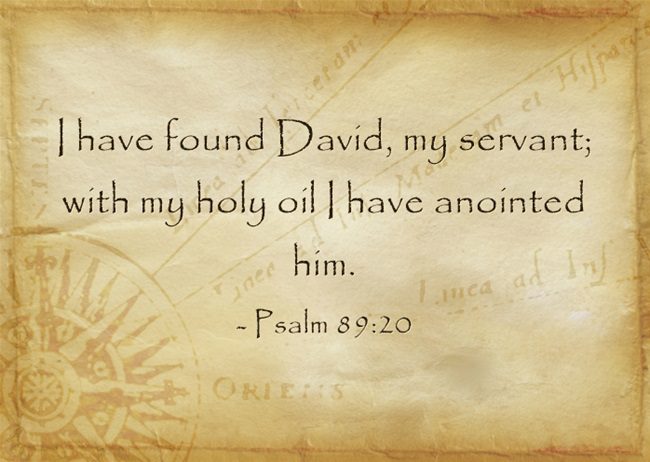
The kings of ancient Israel were always anointed with oil as a way of God designating the man of His choice which is what Psalm 89:19b-21 says; “I have exalted one chosen from the people. I have found David, my servant with my holy oil I have anointed him, so that my hand shall be established with him; my arm also shall strengthen him.” The words “holy oil” can just as well be thought of as the “Holy Spirit” because the only way we can be made holy is to be designated and declared as such by God as we read in 2nd Corinthians 5:21 “For our sake he made him to be sin who knew no sin, so that in him we might become the righteousness of God.”
The Unity of the Spirit
Psalm 133:1-2 says “Behold, how good and pleasant it is when brothers dwell in unity. It is like the precious oil on the head, running down on the beard, on the beard of Aaron, running down on the collar of his robes!” The first of these two verses are among the favorites of many because they see that when brothers and sisters dwell in unity it is so good and pleasant and what’s it like? It’s just “like the precious oil on the head, running down on the beard, on the beard of Aaron” which means three things at least; the oil symbolizes the Holy Spirit; and it is God’s anointing that signifies the selecting of the priest; and finally, it also represents the unity of the Spirit that only He can bring among a diverse body of believers that is called the church. This is what Paul meant when he wrote that we ought to be “eager to maintain the unity of the Spirit in the bond of peace” (Eph 4:3). Today, God calls men into the pastorate by His special calling or anointing, meaning that He chooses who will be in the ministry. The calling must be from God.
The Presence of the Spirit
The Holy Spirit is often depicted as oil as we read in the Parable of the Ten Virgins in Matthew 25 where Jesus says “Then all those virgins rose and trimmed their lamps. And the foolish said to the wise, ‘Give us some of your oil, for our lamps are going out.’ But the wise answered, saying, ‘Since there will not be enough for us and for you, go rather to the dealers and buy for yourselves” (Matthew 25:7-8). In these verses Jesus seems to be talking about the presence of the Holy Spirit. These virgins were waiting for the Bridegroom, which pictures Christ’s coming for His bride the church to which He is presently betrothed (or engaged) to. Five were ready when the Bridegroom arrived and already had the oil in their lamps but the other five, the foolish ones, had to run out and buy some more oil but they were too late. They had procrastinated and failed to betroth themselves to Christ and now it was too late, so when they got back they came, “saying, ‘Lord, lord, open to us.’ But he answered, ‘Truly, I say to you, I do not know you.’ Watch therefore, for you know neither the day nor the hour” (Matt 25:11b-13). Some might say “I know the Lord” but the most important question is “does He know you” for it not, He will say to you “I do not know you.” You might also read Matthew 7:21-23.
The Anointing to Preach
In Luke 4:18 we can see that the Spirit of God gives the anointing to preach, which is just what Jesus said when he began His earthly ministry “The Spirit of the Lord is upon me, because he has anointed me to proclaim good news to the poor.” In the Book of Acts it was written that “God anointed Jesus of Nazareth with the Holy Spirit and with power, who went about doing good and healing all who were oppressed by the devil, for God was with Him” (10:38). For everyone who has repented and trusted in Christ, they too have the Spirit of God which is why John wrote “But you have been anointed by the Holy One, and you all have knowledge” (1st John 2:20), therefore you too should be proclaiming the good news to the poor.
Conclusion
Oil in the Bible has great significance and symbolism. The oil also pictures the work and anointing of the Holy Spirit for without the Holy Spirit, no one can be saved because the Spirit convicts the lost soul of their sins and points them to Christ and makes them realize that they need Jesus as their Savior, for there is absolutely no other way to enter the kingdom (Acts 4:12).
Article by Jack Wellman
Jack Wellman is Pastor of the Mulvane Brethren church in Mulvane Kansas. Jack is also the Senior Writer at What Christians Want To Know whose mission is to equip, encourage, and energize Christians and to address questions about the believer’s daily walk with God and the Bible. You can follow Jack on Google Plus or check out his book Blind Chance or Intelligent Design available on Amazon.
Previous Post

July 17, 2015
Top 7 Bible Verses That Show God’s Character
Next Post
July 17, 2015 What Does Water Represent In The Bible? A Christian Study
Browse Our Archives
Select a Category Bible Answers Bible Definitions Bible Story Bible Study Bible Verses Christian Books Christian Entertainment Christian Fathers Christian Mothers Christian Quotes Devotional Famous Christians Music News Parables Prayers Quotes Sunday School Lesson Uncategorized Youth Sermons
Select a Month October 2019 September 2019 August 2019 July 2019 June 2019 May 2019 April 2019 March 2019 February 2019 January 2019 December 2018 November 2018 October 2018 September 2018 August 2018 July 2018 June 2018 May 2018 April 2018 March 2018 February 2018 January 2018 December 2017 November 2017 October 2017 September 2017 August 2017 July 2017 June 2017 May 2017 April 2017 March 2017 February 2017 January 2017 December 2016 November 2016 October 2016 September 2016 August 2016 July 2016 June 2016 May 2016 March 2016 February 2016 January 2016 December 2015 November 2015 October 2015 September 2015 August 2015 July 2015 June 2015 May 2015 April 2015 March 2015 February 2015 January 2015 December 2014 November 2014 October 2014 September 2014 August 2014 July 2014 June 2014 May 2014 April 2014 March 2014 February 2014 January 2014 December 2013 November 2013 October 2013 September 2013 August 2013 July 2013 June 2013 May 2013 April 2013 March 2013
Follow Us!
TAKE THE
Religious Wisdom Quiz
What was the result of Jesus meeting the Gerasene demoniac?
Select your answer to see how you score.
A storm calmed Bread multiplied Demons cast into pigs A man healed of leprosy
Related posts from Christian Crier

What Does The Bible Say About Our Thoughts?

Top 13 Bible Verses About Virtue

Do Colors Have Special Meaning In The Bible?
The Greatest Father In History
TRENDING AT PATHEOS Evangelical

Making Stones Into Bread: Choosing the “Right” Work
I was on my online arts ministry Zoom meeting with the International...

Ukraine’s exhausted Christians face fifth winter of war
By Julian Lukins The full-scale war in Ukraine is taking “a serious...

Russell Brand's Conviction is not anti-Christian Persecution
How do we shed the reputation that the Church is OK with...

Have you ever caught yourself saying, “I’ll do it tomorrow,” or “Now...

Write Your Story: A Great Way to Find...
A few month’s back, my son was scrolling around Facebook and saw...

Throughout history, people have pursued pleasure, possessions, relationships, and success in an...
view all Evangelical blogs
Ad-Free & Subscriber Log-In Subscription Support
- About Us
- 2026 Calendar
- Videos
- Podcasts
- Library of World Religions
- Faith In Media Tracker
- Advertise With Us
- Write for Us
- Privacy Policy
- Terms of Service
- Do Not Sell My Data
- Contact Us
- Radiant Digital
- Manage Newsletter Subscriptions
- Unsubscribe From Notifications
- Sitemap
Copyright 2008-2026, Patheos. All rights reserved.
Subscription Support Ad-Free & Subscriber Log-In
Follow Patheos