
BuddhistCatholicContemplativeEvangelicalGeneral ChristianHinduJewishLatter-day SaintMuslimNew VisionsProgressive Christian
Beliefs
- Buddhist
- Catholic
- Contemplative
- Evangelical
- General Christian
- Hindu
- Jewish
- Latter-day Saint
- More Voices
- Muslim
- New Visions
- Pagan
- Progressive Christian
Topics
- Religion News
- Food and Religion
- Sports and Religion
- Religious Art
- Religious Music and Entertainment
- Religious Events
- History and Religion
- Style and Religion
- Politics and Religion
- Women in Religion
- Recreation Outdoors and Religion
- Business Finance and Religion
- Careers Workplace and Religion
- Education and Religion
- Family Parenting and Religion
- Health Fitness and Religion
- Home and Religion
- Relationships and Religion
- Technology and Religion
- Travel and Religion
Columnists
- Buddhist Columnists
- Business Finance and Religion Columnists
- Careers Workplace and Religion Columnists
- Catholic Columnists
- Contemplative Columnists
- Education and Religion Columnists
- Evangelists Columnists
- Family Parenting and Religion Columnists
- General Christian Columnists
- Health Fitness and Religion Columnists
- Hindu Columnists
- History and Religion Columnists
- Home and Religion Columnists
- Jewish Columnists
- More Voices Columnists
- Latter Day Columnists
- Muslim Columnists
- New Visions Columnists
- Nonreligious Columnists
- Pagan Columnists
- Politics and Religion Columnists
- Progressive Columnists
- Recreation Outdoors and Religion Columnists
- Relationships and Religion Columnists
- Religion News Columnists
- Religious Art Columnists
- Religious Events Columnists
- Religious Music and Entertainment Columnists
- Sports and Religion Columnists
- Style and Religion Columnists
- Technology and Religion Columnists
- Travel and Religion Columnists
- Women in Religion Columnists
Resource Library
- 2026 Calendar
- Library of World Religions
- The 100 Most Holy Places on Earth
- Patheos Answers
- Podcasts
- Videos
- Faith Leaders Database
- Anglican Episcopalian
- Bahai
- Baptist
- Buddhism
- Christianity
- Confucianism
- Eastern Orthodoxy
- Hinduism
- Holiness and Pentecostal
- ISKCON
- Islam
- Judaism
- Lutheran
- Methodist
- The Church of Jesus Christ of Latter-day Saints
- New Age
- Paganism
- Presbytarian and Reformed
- Protestantism
- Religion Behind the Scenes
- Roman Catholic
- Scientology
- Shia Islam
- Sikhism
- Sufism
- Sunni Islam
- Taoism
- Zen
- See all religions
Research Tools
 Ad-Free & Subscriber Log-In Subscription Support
Ad-Free & Subscriber Log-In Subscription Support
Follow Patheos 

- Trending:
- Forgiveness
- |
- Marriage
- |
- Consciousness
- |
- Death Penalty
- |
- Election
- |
- Halloween
 Christian Crier
- Home
- Evangelical
- What Does The Bible Say About Wolves In Sheep’s Clothing?
What Does The Bible Say About Wolves In Sheep’s Clothing?
Last updated on: July 25, 2015 at 9:33 pm by Jack Wellman
What Does The Bible Say About Wolves In Sheep’s Clothing? 2015-07-25T21:33:43-05:00 Jack Wellman
Patheos Explore the world's faith through different perspectives on religion and spirituality! Patheos has the views of the prevalent religions and spiritualities of the world.
What does the bible say about wolves dressed in sheep’s clothing? How can we spot a wolf?
Wolves among the Sheep
The church is often referred to as sheep and Jesus is the Great Shepherd. We read this analogy in John 10 where the believers are the sheepfold but Jesus has a warning for us; “he who does not enter the sheepfold by the door but climbs in by another way, that man is a thief and a robber” (John 10:1). Jesus makes it clear that He is the door, saying “I am the door of the sheep” (John 10:7) and there are plenty of thieves and robbers today entering the church but they are dressed as wolves and wolves among the sheep are a dangerous combination. Typically “The sheep hear his voice, and he calls his own sheep by name and leads them out” (John 10:3) “and the sheep follow him, for they know his voice” (John 10:4). The thief only wants to come “and steal, kill, and destroy” (John 10:10) but “The good shepherd lays down his life for the sheep” (John 10:11). Jesus, our Great Shepherd, dies for His sheep but here is the problem “the hired hand [is] not a shepherd [and] does not own the sheep [and when] he sees the wolf coming [he] leaves the sheep and flees, and the wolf snatches them and scatters them” (John 10:12). Jesus says there is “one flock [and] one shepherd” (John 10:16) and Jesus is the True Shepherd, and even though I’m a pastor, I am an under-shepherd to the Great Shepherd. Today in many churches, the wolves have infiltrated the sheep and they dress like sheep and they sound like sheep, but inwardly, they are ravenous wolves and they seem to be growing in numbers, putting the sheep in ever increasing danger.
Old Testament References of Wolves
We might think that wolves have only been around in the church until recently, but this imagery of a dangerously ravenous wolf is nothing new. In the Old Testament, God inspired Ezekiel to write about the leaders of Israel as “Her officials within her are like wolves tearing their prey; they shed blood and kill people to make unjust gain” (Ezk 22:27). Wolves are never a symbol of good things because God warned about wolves coming into devour Israel who time and again fell into idolatry, even to the point of sacrificing their own children to a pagan god. God eventually sent in the Babylonians, sometimes referred to as the Chaldeans, who were “dreaded and fearsome” (Hab 1:7) whose “horses are swifter than leopards, more fierce than the evening wolves” (Hab 1:8) and “They all come for violence, all their faces forward” (Hab 1:9). The imagery of the Scriptures where wolves are mentioned could well be why Jesus and Paul referred to false prophets as wolves.
Paul’s Warning
Just before Paul was about to leave the church at Ephesus he spoke to the elders and told them to “Pay careful attention to yourselves and to all the flock, in which the Holy Spirit has made you overseers, to care for the church of God, which he obtained with his own blood” (Acts 20:28) saying “I know that after I leave, savage wolves will come in among you and will not spare the flock” (Acts 20:29). Where would these deadly wolves come from? He said that they would come “from among your own selves will arise men speaking twisted things, to draw away the disciples after them” (Acts 20:30). These wolves wouldn’t be an outside threat but the enemy would come from within…within the church itself. This explains why he said that “for three years I did not cease night or day to admonish every one with tears” (Acts 20:31). How can you recognize these wolves, sometimes referred to as false prophets? They would say things like “I got a word from God” or “God spoke to me and….” but unless it comes from Scripture or matches up with the Word of God, it is certainly not a word from God but from the leader of the wolf pack; Satan himself!
Jesus Warning about Wolves
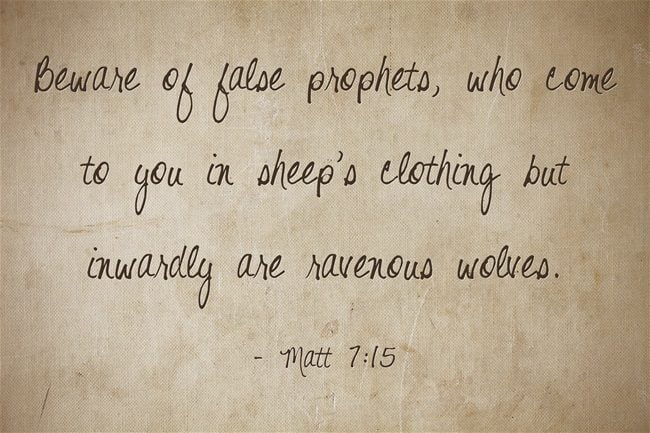
Just like after Paul would leave Ephesus, Jesus knew what would happen after he was gone which is why in Matthew 7:15 he said “Beware of false prophets, who come to you in sheep’s clothing but inwardly are ravenous wolves.” Why did Jesus use the word “beware?” The Greek word Jesus used for beware was “prosechō” and means “be attentive too” or “to devote thought to” so obviously He was saying that you’ve got to give much thought and attention to what someone teaches or believes. These wolves will come dressed in church-garb, looking very much like sheep but inside they are nothing more than ravenous wolves. Ravenous wolves are hungry to devour…in this case sheep! Paul used the word “savage” in describing these wolves and that is a very good description of their tendencies but Jesus used the word ravenous which in the Greek usage (“harpax”) means “an extortioner” or “a robber” and why call them extortioners and robbers? Because they are only wanting to, as Paul says, “draw away the disciples after them” (Acts 20:30). Once they’ve separated the sheep from the fold, they are in greater danger than ever before of being robbed, much like wealth and prosperity preachers do, who only want to fleece the flock. Remember Ezekiel’s reference about wolves that they too want to “shed blood and kill people to make unjust gain” (Ezk 22:27).
Conclusion
Jesus is the Great Shepherd and we must recognize His voice which is found in the Word of God because as He said in John 10:12 “The hired hand is not the shepherd and does not own the sheep. So when he sees the wolf coming, he abandons the sheep and runs away. Then the wolf attacks the flock and scatters it.” The best way to recognize a wolf is to notice or pay attention to what he teaches for even Satan has his own ministers who appear as an angel of light but they are really preachers from hell. This should be “no wonder, for even Satan disguises himself as an angel of light” (2 Cor 11:4).
Article by Jack Wellman
Jack Wellman is Pastor of the Mulvane Brethren church in Mulvane Kansas. Jack is also the Senior Writer at What Christians Want To Know whose mission is to equip, encourage, and energize Christians and to address questions about the believer’s daily walk with God and the Bible. You can follow Jack on Google Plus or check out his book Blind Chance or Intelligent Design available on Amazon.
Previous Post

July 16, 2015
Top 7 Bible Verses To Help Overcome Jealousy
Next Post
July 16, 2015 7 Bible Verses About False Prophets
Browse Our Archives
Select a Category Bible Answers Bible Definitions Bible Story Bible Study Bible Verses Christian Books Christian Entertainment Christian Fathers Christian Mothers Christian Quotes Devotional Famous Christians Music News Parables Prayers Quotes Sunday School Lesson Uncategorized Youth Sermons
Select a Month October 2019 September 2019 August 2019 July 2019 June 2019 May 2019 April 2019 March 2019 February 2019 January 2019 December 2018 November 2018 October 2018 September 2018 August 2018 July 2018 June 2018 May 2018 April 2018 March 2018 February 2018 January 2018 December 2017 November 2017 October 2017 September 2017 August 2017 July 2017 June 2017 May 2017 April 2017 March 2017 February 2017 January 2017 December 2016 November 2016 October 2016 September 2016 August 2016 July 2016 June 2016 May 2016 March 2016 February 2016 January 2016 December 2015 November 2015 October 2015 September 2015 August 2015 July 2015 June 2015 May 2015 April 2015 March 2015 February 2015 January 2015 December 2014 November 2014 October 2014 September 2014 August 2014 July 2014 June 2014 May 2014 April 2014 March 2014 February 2014 January 2014 December 2013 November 2013 October 2013 September 2013 August 2013 July 2013 June 2013 May 2013 April 2013 March 2013
Follow Us!
TAKE THE
Religious Wisdom Quiz
What is the longest chapter in the Bible?
Select your answer to see how you score.
Psalm 23 Isaiah 53 Psalm 119 Genesis 1
Related posts from Christian Crier

What Does The Bible Say About Our Thoughts?

Do Colors Have Special Meaning In The Bible?

The Glass – Half Empty Or Half Full?

TRENDING AT PATHEOS Evangelical

How the author of the world's best hymn...
I've been working with John Newton for a while now. This makes...

Long before this Lectio Divina, Psalm 130 - the song - started...

What About the Trees? Another Living Parable
After I finished writing the last article about falling leaves as a...

Why Classical Education Is a Conversation, Not a...
Come and Read: Joy in Classical Education When I was a little...

Falling Leaves: A Living Parable on Letting Go
I’ve spent the vast majority of my life in the southeast corner...

Cornell University has received a great deal of negative publicity and intense...
view all Evangelical blogs
Ad-Free & Subscriber Log-In Subscription Support
- About Us
- 2026 Calendar
- Videos
- Podcasts
- Library of World Religions
- Faith In Media Tracker
- Advertise With Us
- Write for Us
- Privacy Policy
- Terms of Service
- Do Not Sell My Data
- Contact Us
- Radiant Digital
- Manage Newsletter Subscriptions
- Unsubscribe From Notifications
- Sitemap
Copyright 2008-2026, Patheos. All rights reserved.
Subscription Support Ad-Free & Subscriber Log-In
Follow Patheos