
BuddhistCatholicContemplativeEvangelicalGeneral ChristianHinduJewishLatter-day SaintMuslimNew VisionsProgressive Christian
Beliefs
- Buddhist
- Catholic
- Contemplative
- Evangelical
- General Christian
- Hindu
- Jewish
- Latter-day Saint
- More Voices
- Muslim
- New Visions
- Pagan
- Progressive Christian
Topics
- Religion News
- Food and Religion
- Sports and Religion
- Religious Art
- Religious Music and Entertainment
- Religious Events
- History and Religion
- Style and Religion
- Politics and Religion
- Women in Religion
- Recreation Outdoors and Religion
- Business Finance and Religion
- Careers Workplace and Religion
- Education and Religion
- Family Parenting and Religion
- Health Fitness and Religion
- Home and Religion
- Relationships and Religion
- Technology and Religion
- Travel and Religion
Columnists
- Buddhist Columnists
- Business Finance and Religion Columnists
- Careers Workplace and Religion Columnists
- Catholic Columnists
- Contemplative Columnists
- Education and Religion Columnists
- Evangelists Columnists
- Family Parenting and Religion Columnists
- General Christian Columnists
- Health Fitness and Religion Columnists
- Hindu Columnists
- History and Religion Columnists
- Home and Religion Columnists
- Jewish Columnists
- More Voices Columnists
- Latter Day Columnists
- Muslim Columnists
- New Visions Columnists
- Nonreligious Columnists
- Pagan Columnists
- Politics and Religion Columnists
- Progressive Columnists
- Recreation Outdoors and Religion Columnists
- Relationships and Religion Columnists
- Religion News Columnists
- Religious Art Columnists
- Religious Events Columnists
- Religious Music and Entertainment Columnists
- Sports and Religion Columnists
- Style and Religion Columnists
- Technology and Religion Columnists
- Travel and Religion Columnists
- Women in Religion Columnists
Resource Library
- 2026 Calendar
- Library of World Religions
- The 100 Most Holy Places on Earth
- Patheos Answers
- Podcasts
- Videos
- Faith Leaders Database
- Anglican Episcopalian
- Bahai
- Baptist
- Buddhism
- Christianity
- Confucianism
- Eastern Orthodoxy
- Hinduism
- Holiness and Pentecostal
- ISKCON
- Islam
- Judaism
- Lutheran
- Methodist
- The Church of Jesus Christ of Latter-day Saints
- New Age
- Paganism
- Presbytarian and Reformed
- Protestantism
- Religion Behind the Scenes
- Roman Catholic
- Scientology
- Shia Islam
- Sikhism
- Sufism
- Sunni Islam
- Taoism
- Zen
- See all religions
Research Tools
 Ad-Free & Subscriber Log-In Subscription Support
Ad-Free & Subscriber Log-In Subscription Support
Follow Patheos 

- Trending:
- Forgiveness
- |
- Marriage
- |
- Consciousness
- |
- Death Penalty
- |
- Election
- |
- Halloween
 Christian Crier
- Home
- Evangelical
- What Happened In The Upper Room? A Bible Study
What Happened In The Upper Room? A Bible Study
Last updated on: July 15, 2015 at 8:48 am by Jack Wellman
What Happened In The Upper Room? A Bible Study 2015-07-15T08:48:05-05:00 Jack Wellman
Patheos Explore the world's faith through different perspectives on religion and spirituality! Patheos has the views of the prevalent religions and spiritualities of the world.
What took place in the upper room on the night before Jesus betrayal? What application does it have for believers?
Upper Rooms in the Old Testament
The Bible only mentions the words “upper room” nine times but there are some semblances to the use of the word in the sense that it is those who are well off that typically have upper rooms. The upper rooms are not found among the poor or the common people as we read in 1st Chronicles 28:11 where it reads “Then David gave Solomon his son the plan of the vestibule of the temple, and of its houses, its treasuries, its upper rooms, and its inner chambers, and of the room for the mercy seat.” Here is David giving his son Solomon the plans that he had for the temple to be built and the interesting fact is that the upper rooms contained the “inner chambers” and “the room for the mercy seat” which is of supreme importance to the temple as this represents the presence of the Lord so in the Old Testament, the presence of God is found in the upper room, specifically in the inner chambers and where the mercy seat is located.
Judgment of the Rich and their Upper Rooms
Jeremiahs was warning Judah for many years, yet his warnings fell on deaf ears and they were later taken into captivity by Babylon. One of the problems with Judah was that of modern society today. Many who are rich have gotten riches at the expense of the poor or the common worker. This is not always the case but listen to the strong rebuke of Jeremiah for the rich who had been exploiting the workers in order to build expansive mansions and large upper rooms in Jeremiah 22:12-14 “Woe to him who builds his house by unrighteousness, and his upper rooms by injustice, who makes his neighbor serve him for nothing and does not give him his wages, who says, ‘I will build myself a great house with spacious upper rooms,’ who cuts out windows for it, paneling it with cedar and painting it with vermilion.” The painting of these upper rooms with vermillion speaks about the exquisite nature of the dwellings since vermillion is a brilliant scarlet, water-insoluble red pigment that is extremely expensive. Jeremiah chastises the rich who have built houses “by unrighteousness” and “large upper rooms by injustices” where the rich make their “neighbor serve him for nothing and does not give him his wages” meaning that they are taking advantage of the poor laborers and using them to build great houses “with spacious upper rooms.” So upper rooms seem to be indicative of great wealth but they come at great expense, usually the expense of the poor.
Upper Rooms in the New Testament
We read a few times of the “upper rooms” in the New Testament church but these rooms were often used for prayers and the fellowship of the church. In the case where they were choosing an apostle to replace Judas Iscariot as we read in Acts 1:11-12 where “they returned to Jerusalem from the mount called Olivet, which is near Jerusalem, a Sabbath day’s journey away. And when they had entered, they went up to the upper room, where they were staying, Peter and John and James and Andrew, Philip and Thomas, Bartholomew and Matthew, James the son of Alphaeus and Simon the Zealot and Judas the son of James. All these with one accord were devoting themselves to prayer, together with the women and Mary the mother of Jesus, and his brothers.” In another case, Paul was preaching “On the first day of the week, when we were gathered together to break bread, Paul talked with them, intending to depart on the next day, and he prolonged his speech until midnight. There were many lamps in the upper room where we were gathered” (Acts 20:7-8) so sometimes the church needed the larger rooms, which were often the upper rooms, so that all of the saints could all fit into one place to hear the Word of God taught as in the case of Paul in Acts 20.
Jesus and the Apostles in the Upper Room
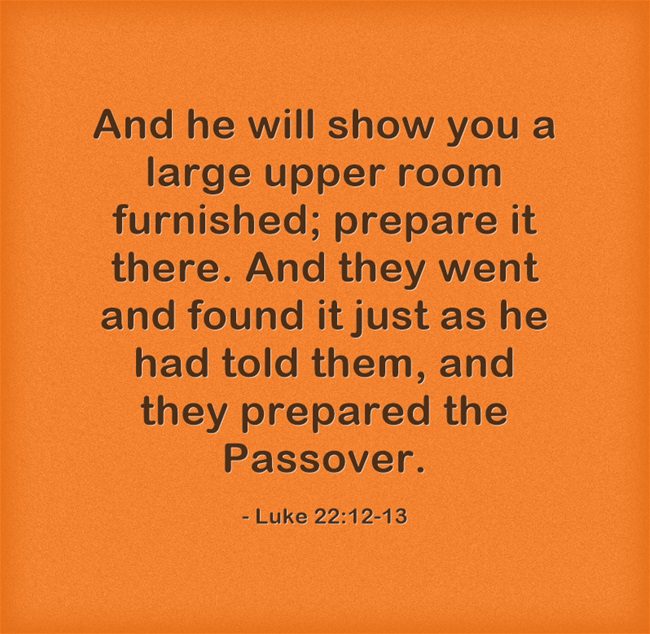
Perhaps the greatest and most important reference to the upper room occurred when the Lord’s Supper was held on the night of Jesus’ betrayal. When Jesus was preparing for this most special night He told the disciples to “say to the master of the house, ‘The Teacher says, Where is my guest room, where I may eat the Passover with my disciples?’ And he will show you a large upper room furnished and ready; there prepare for us.” And the disciples set out and went to the city and found it just as he had told them, and they prepared the Passover” (Mark 14:14-16). In this upper room Jesus “reclined at table, and the apostles with him. And he said to them, “I have earnestly desired to eat this Passover with you before I suffer. For I tell you I will not eat it until it is fulfilled in the kingdom of God” (Luke 22:14-16).
Conclusion
I find it interesting that in the temple, the upper rooms were where the mercy seat was located which represented the very presence of God and in the New Testament, during the Passover, which was also held in an upper room, there was more than just the presence of God but the very real, physical presence of God in Jesus Christ Who initiated the New Covenant which portrayed His broken body (in the bread) and His shed blood (in the wine) which was to be done in remembrance of Jesus’ supreme sacrifice (Luke 22:19). Where Jesus sat that night was the true “Mercy Seat” where He spoke of His dying for the sins of those who would repent and believe in Him (John 3:16) so that those who believed in Him would be taken into the most uppermost room that there is; that is, in the kingdom of heaven, where also there would be the very presence of God.
Article by Jack Wellman
Jack Wellman is Pastor of the Mulvane Brethren church in Mulvane Kansas. Jack is also the Senior Writer at What Christians Want To Know whose mission is to equip, encourage, and energize Christians and to address questions about the believer’s daily walk with God and the Bible. You can follow Jack on Google Plus or check out his book Blind Chance or Intelligent Design available on Amazon.
Previous Post

July 14, 2015
What Does The Term Rock Mean or Represent When Used In The Bible?
Next Post
July 15, 2015 What Does The Lamb Mean Or Represent In The Bible?
Browse Our Archives
Select a Category Bible Answers Bible Definitions Bible Story Bible Study Bible Verses Christian Books Christian Entertainment Christian Fathers Christian Mothers Christian Quotes Devotional Famous Christians Music News Parables Prayers Quotes Sunday School Lesson Uncategorized Youth Sermons
Select a Month October 2019 September 2019 August 2019 July 2019 June 2019 May 2019 April 2019 March 2019 February 2019 January 2019 December 2018 November 2018 October 2018 September 2018 August 2018 July 2018 June 2018 May 2018 April 2018 March 2018 February 2018 January 2018 December 2017 November 2017 October 2017 September 2017 August 2017 July 2017 June 2017 May 2017 April 2017 March 2017 February 2017 January 2017 December 2016 November 2016 October 2016 September 2016 August 2016 July 2016 June 2016 May 2016 March 2016 February 2016 January 2016 December 2015 November 2015 October 2015 September 2015 August 2015 July 2015 June 2015 May 2015 April 2015 March 2015 February 2015 January 2015 December 2014 November 2014 October 2014 September 2014 August 2014 July 2014 June 2014 May 2014 April 2014 March 2014 February 2014 January 2014 December 2013 November 2013 October 2013 September 2013 August 2013 July 2013 June 2013 May 2013 April 2013 March 2013
Follow Us!
TAKE THE
Religious Wisdom Quiz
How did Saul die?
Select your answer to see how you score.
Killed by Philistines Fell on his own sword Stoned by Israelites Died of old age
Related posts from Christian Crier

What Does The Bible Say About Our Thoughts?

Top 13 Bible Verses About Virtue

Do Colors Have Special Meaning In The Bible?

The Greatest Father In History
TRENDING AT PATHEOS Evangelical

The REST of Your Life: A Creative Wrestles...
This week I had a conversation with a good friend from church....

How the author of the world's best hymn...
I've been working with John Newton for a while now. This makes...

Long before this Lectio Divina, Psalm 130 - the song - started...

What About the Trees? Another Living Parable
After I finished writing the last article about falling leaves as a...

Why Classical Education Is a Conversation, Not a...
Come and Read: Joy in Classical Education When I was a little...

Cornell University has received a great deal of negative publicity and intense...
view all Evangelical blogs
Ad-Free & Subscriber Log-In Subscription Support
- About Us
- 2026 Calendar
- Videos
- Podcasts
- Library of World Religions
- Faith In Media Tracker
- Advertise With Us
- Write for Us
- Privacy Policy
- Terms of Service
- Do Not Sell My Data
- Contact Us
- Radiant Digital
- Manage Newsletter Subscriptions
- Unsubscribe From Notifications
- Sitemap
Copyright 2008-2026, Patheos. All rights reserved.
Subscription Support Ad-Free & Subscriber Log-In
Follow Patheos