
BuddhistCatholicContemplativeEvangelicalGeneral ChristianHinduJewishLatter-day SaintMuslimNew VisionsProgressive Christian
Beliefs
- Buddhist
- Catholic
- Contemplative
- Evangelical
- General Christian
- Hindu
- Jewish
- Latter-day Saint
- More Voices
- Muslim
- New Visions
- Pagan
- Progressive Christian
Topics
- Religion News
- Food and Religion
- Sports and Religion
- Religious Art
- Religious Music and Entertainment
- Religious Events
- History and Religion
- Style and Religion
- Politics and Religion
- Women in Religion
- Recreation Outdoors and Religion
- Business Finance and Religion
- Careers Workplace and Religion
- Education and Religion
- Family Parenting and Religion
- Health Fitness and Religion
- Home and Religion
- Relationships and Religion
- Technology and Religion
- Travel and Religion
Columnists
- Buddhist Columnists
- Business Finance and Religion Columnists
- Careers Workplace and Religion Columnists
- Catholic Columnists
- Contemplative Columnists
- Education and Religion Columnists
- Evangelists Columnists
- Family Parenting and Religion Columnists
- General Christian Columnists
- Health Fitness and Religion Columnists
- Hindu Columnists
- History and Religion Columnists
- Home and Religion Columnists
- Jewish Columnists
- More Voices Columnists
- Latter Day Columnists
- Muslim Columnists
- New Visions Columnists
- Nonreligious Columnists
- Pagan Columnists
- Politics and Religion Columnists
- Progressive Columnists
- Recreation Outdoors and Religion Columnists
- Relationships and Religion Columnists
- Religion News Columnists
- Religious Art Columnists
- Religious Events Columnists
- Religious Music and Entertainment Columnists
- Sports and Religion Columnists
- Style and Religion Columnists
- Technology and Religion Columnists
- Travel and Religion Columnists
- Women in Religion Columnists
Resource Library
- 2026 Calendar
- Library of World Religions
- The 100 Most Holy Places on Earth
- Patheos Answers
- Podcasts
- Videos
- Faith Leaders Database
- Anglican Episcopalian
- Bahai
- Baptist
- Buddhism
- Christianity
- Confucianism
- Eastern Orthodoxy
- Hinduism
- Holiness and Pentecostal
- ISKCON
- Islam
- Judaism
- Lutheran
- Methodist
- The Church of Jesus Christ of Latter-day Saints
- New Age
- Paganism
- Presbytarian and Reformed
- Protestantism
- Religion Behind the Scenes
- Roman Catholic
- Scientology
- Shia Islam
- Sikhism
- Sufism
- Sunni Islam
- Taoism
- Zen
- See all religions
Research Tools
 Ad-Free & Subscriber Log-In Subscription Support
Ad-Free & Subscriber Log-In Subscription Support
Follow Patheos 

- Trending:
- Forgiveness
- |
- Marriage
- |
- Consciousness
- |
- Death Penalty
- |
- Election
- |
- Halloween
 Christian Crier
- Home
- Evangelical
- What Does The Lamb Mean Or Represent In The Bible?
What Does The Lamb Mean Or Represent In The Bible?
Last updated on: July 15, 2015 at 10:49 am by Jack Wellman
What Does The Lamb Mean Or Represent In The Bible? 2015-07-15T10:49:08-05:00 Jack Wellman
Patheos Explore the world's faith through different perspectives on religion and spirituality! Patheos has the views of the prevalent religions and spiritualities of the world.
What does the lamb mean or represent in the Bible? What does it mean to the believer today?
The First Passover
Just before Israel’s exodus from Egypt, God told Moses to “Tell all the congregation of Israel that on the tenth day of this month every man shall take a lamb according to their fathers’ houses, a lamb for a household” but “if the household is too small for a lamb, then he and his nearest neighbor shall take according to the number of persons; according to what each can eat you shall make your count for the lamb” (Ex 12:3-4). The “lamb shall be without blemish, a male a year old” (Ex 12:5). This was the initiation of the first Passover where the Israelites where told that “they shall take some of the blood and put it on the two doorposts and the lintel of the houses in which they eat it” (Ex 12:7). The blood of the lamb was to be placed upon the doorposts and the lintel of the houses so that the death angel of the Lord would pass over those in that home and spare the firstborn of all who lived there.
The Passing Over of God’s Judgment
God Himself commanded this as “the Lord’s Passover. For I will pass through the land of Egypt that night, and I will strike all the firstborn in the land of Egypt, both man and beast; and on all the gods of Egypt I will execute judgments: I am the Lord. The blood shall be a sign for you, on the houses where you are. And when I see the blood, I will pass over you, and no plague will befall you to destroy you, when I strike the land of Egypt” (Ex 12:11c-13) saying “This day shall be for you a memorial day, and you shall keep it as a feast to the Lord; throughout your generations, as a statute forever, you shall keep it as a feast” (Ex 12:14). God’s judgment on Egypt was because of their bondage of the children of Israel who had made the slaves and had endured many years of hard labor for that nation which has so many false gods that it was hard to count them all. God was revealing to them the One, True God. This finally forced Egypt to let the nation of Israel go free as “The Egyptians were urgent with the people to send them out of the land in haste. For they said, “We shall all be dead” (Ex 12:33).
The Guilt Offering
The beginning of the sacrificial laws of the priesthood began in earnest after Israel’s exodus as it was commanded that “the priest shall take one of the male lambs and offer it for a guilt offering, along with the log of oil, and wave them for a wave offering before the Lord” (Lev 14:12). The lambs had to be without blemish (Lev 14:10) and they were to “kill the lamb in the place where they kill the sin offering and the burnt offering, in the place of the sanctuary. For the guilt offering, like the sin offering, belongs to the priest; it is most holy” (Lev 14:13). The lamb had to be spotless or without blemish or defect. The lamb was to be slain as an offering for the sins of the people. This was to be waved “before the Lord” so that it would be accepted by God in order for the sins of the people to be “passed over” so that they could be forgiven. The Bible teaches in both the Old Testament and the New Testament that “without the shedding of blood there is no forgiveness of sins” (Heb 9:22). In other words, sin is costly and it cannot go unpunished or be overlooked because God is holy. This is because, as God says, “the life of a creature is in the blood, and I have given it to you to make atonement for yourselves on the altar; it is the blood that makes atonement for one’s life” (Lev 17:11). Sin has to be atoned for in some way and blood has to be spilled in order to cover sins. In the Old Testament, sins were covered, but in the New Testament, by the blood of Christ, the Perfect Lamb of God, sins would actually be more than covered; they would be taken away permanently. This imagery was pictured in the Garden of Eden after Adam and Eve sinned and it became necessary for God to kill animals (shed blood) so that there would be “animal skins for Adam and his wife” (Gen 3:21). This also explains why ancient Israel was commanded to consume all of the lamb because it pictured the total, consummate sacrifice of Jesus giving His life for the forgiveness of sins.
The New High Priest
After Jesus lived a perfect, sinless life, He gave His life as a ransom for many (Mark 10:45) and became our High Priest forever (Heb 4:14). Jesus had to be born in the flesh (John 1) and be “fully human in every way, in order that he might become a merciful and faithful high priest in service to God, and that he might make atonement for the sins of the people” (Heb 2:17) as “he entered once for all into the holy places, not by means of the blood of goats and calves but by means of his own blood, thus securing an eternal redemption” (Heb 9:12) and by this “he became the source of eternal salvation for all who obey him” (Heb 5:8). “Unlike the other high priests, he does not need to offer sacrifices day after day, first for his own sins, and then for the sins of the people. He sacrificed for their sins once for all when he offered himself” (Heb 7:27) because the Levitical priests had to offer sacrifices over and over again but Jesus offered Himself up once and for all and for all time. That’s why Jesus, as the Lamb of God, Who takes away (not just covers) the sins of the world, is the perfect representation of the sacrificial lamb system that the Old Testament prefigured. These sacrifices looked ahead to that sacrifice of Jesus that abolished the need for the continuous sacrifices that were necessary in the Old Testament.
Conclusion
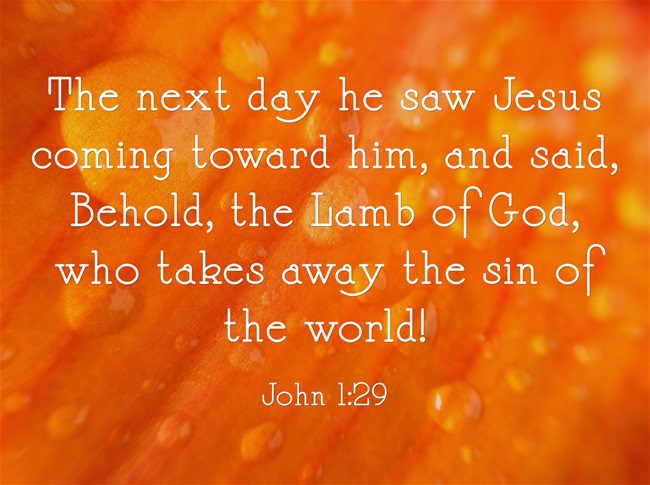
John the Baptist recognized this Perfect Lamb of God and His true purpose for coming to this earth when he declared “Behold, the Lamb of God, who takes away the sin of the world” (John 1:29)! For this purpose He came so that men would not have to die in their sins and God’s wrath would be placed upon Him and not us; at least those of us who have repented and trusted in Him.
Article by Jack Wellman
Jack Wellman is Pastor of the Mulvane Brethren church in Mulvane Kansas. Jack is also the Senior Writer at What Christians Want To Know whose mission is to equip, encourage, and energize Christians and to address questions about the believer’s daily walk with God and the Bible. You can follow Jack on Google Plus or check out his book Blind Chance or Intelligent Design available on Amazon.
Previous Post

July 15, 2015
What Happened In The Upper Room? A Bible Study
Browse Our Archives
Select a Category Bible Answers Bible Definitions Bible Story Bible Study Bible Verses Christian Books Christian Entertainment Christian Fathers Christian Mothers Christian Quotes Devotional Famous Christians Music News Parables Prayers Quotes Sunday School Lesson Uncategorized Youth Sermons
Select a Month October 2019 September 2019 August 2019 July 2019 June 2019 May 2019 April 2019 March 2019 February 2019 January 2019 December 2018 November 2018 October 2018 September 2018 August 2018 July 2018 June 2018 May 2018 April 2018 March 2018 February 2018 January 2018 December 2017 November 2017 October 2017 September 2017 August 2017 July 2017 June 2017 May 2017 April 2017 March 2017 February 2017 January 2017 December 2016 November 2016 October 2016 September 2016 August 2016 July 2016 June 2016 May 2016 March 2016 February 2016 January 2016 December 2015 November 2015 October 2015 September 2015 August 2015 July 2015 June 2015 May 2015 April 2015 March 2015 February 2015 January 2015 December 2014 November 2014 October 2014 September 2014 August 2014 July 2014 June 2014 May 2014 April 2014 March 2014 February 2014 January 2014 December 2013 November 2013 October 2013 September 2013 August 2013 July 2013 June 2013 May 2013 April 2013 March 2013
Follow Us!
TAKE THE
Religious Wisdom Quiz
Which sea did Moses cross in the Exodus story?
Select your answer to see how you score.
Sea of Galilee Caspian Sea Red Sea Dead Sea
Related posts from Christian Crier

What Does The Bible Say About Our Thoughts?

Top 13 Bible Verses About Virtue

Do Colors Have Special Meaning In The Bible?

The Greatest Father In History
TRENDING AT PATHEOS Evangelical

The REST of Your Life: A Creative Wrestles...
This week I had a conversation with a good friend from church....

How the author of the world's best hymn...
I've been working with John Newton for a while now. This makes...

Long before this Lectio Divina, Psalm 130 - the song - started...

What About the Trees? Another Living Parable
After I finished writing the last article about falling leaves as a...

Why Classical Education Is a Conversation, Not a...
Come and Read: Joy in Classical Education When I was a little...

Cornell University has received a great deal of negative publicity and intense...
view all Evangelical blogs
Ad-Free & Subscriber Log-In Subscription Support
- About Us
- 2026 Calendar
- Videos
- Podcasts
- Library of World Religions
- Faith In Media Tracker
- Advertise With Us
- Write for Us
- Privacy Policy
- Terms of Service
- Do Not Sell My Data
- Contact Us
- Radiant Digital
- Manage Newsletter Subscriptions
- Unsubscribe From Notifications
- Sitemap
Copyright 2008-2026, Patheos. All rights reserved.
Subscription Support Ad-Free & Subscriber Log-In
Follow Patheos