
BuddhistCatholicContemplativeEvangelicalGeneral ChristianHinduJewishLatter-day SaintMuslimNew VisionsProgressive Christian
Beliefs
- Buddhist
- Catholic
- Contemplative
- Evangelical
- General Christian
- Hindu
- Jewish
- Latter-day Saint
- More Voices
- Muslim
- New Visions
- Pagan
- Progressive Christian
Topics
- Religion News
- Food and Religion
- Sports and Religion
- Religious Art
- Religious Music and Entertainment
- Religious Events
- History and Religion
- Style and Religion
- Politics and Religion
- Women in Religion
- Recreation Outdoors and Religion
- Business Finance and Religion
- Careers Workplace and Religion
- Education and Religion
- Family Parenting and Religion
- Health Fitness and Religion
- Home and Religion
- Relationships and Religion
- Technology and Religion
- Travel and Religion
Columnists
- Buddhist Columnists
- Business Finance and Religion Columnists
- Careers Workplace and Religion Columnists
- Catholic Columnists
- Contemplative Columnists
- Education and Religion Columnists
- Evangelists Columnists
- Family Parenting and Religion Columnists
- General Christian Columnists
- Health Fitness and Religion Columnists
- Hindu Columnists
- History and Religion Columnists
- Home and Religion Columnists
- Jewish Columnists
- More Voices Columnists
- Latter Day Columnists
- Muslim Columnists
- New Visions Columnists
- Nonreligious Columnists
- Pagan Columnists
- Politics and Religion Columnists
- Progressive Columnists
- Recreation Outdoors and Religion Columnists
- Relationships and Religion Columnists
- Religion News Columnists
- Religious Art Columnists
- Religious Events Columnists
- Religious Music and Entertainment Columnists
- Sports and Religion Columnists
- Style and Religion Columnists
- Technology and Religion Columnists
- Travel and Religion Columnists
- Women in Religion Columnists
Resource Library
- 2026 Calendar
- Library of World Religions
- The 100 Most Holy Places on Earth
- Patheos Answers
- Podcasts
- Videos
- Faith Leaders Database
- Anglican Episcopalian
- Bahai
- Baptist
- Buddhism
- Christianity
- Confucianism
- Eastern Orthodoxy
- Hinduism
- Holiness and Pentecostal
- ISKCON
- Islam
- Judaism
- Lutheran
- Methodist
- The Church of Jesus Christ of Latter-day Saints
- New Age
- Paganism
- Presbytarian and Reformed
- Protestantism
- Religion Behind the Scenes
- Roman Catholic
- Scientology
- Shia Islam
- Sikhism
- Sufism
- Sunni Islam
- Taoism
- Zen
- See all religions
Research Tools
 Ad-Free & Subscriber Log-In Subscription Support
Ad-Free & Subscriber Log-In Subscription Support
Follow Patheos 

- Trending:
- Forgiveness
- |
- Marriage
- |
- Consciousness
- |
- Death Penalty
- |
- Election
- |
- Halloween
 Christian Crier
- Home
- Evangelical
- What Does The Term Rock Mean or Represent When Used In The Bible?
What Does The Term Rock Mean or Represent When Used In The Bible?
Last updated on: July 14, 2015 at 4:39 pm by Jack Wellman
What Does The Term Rock Mean or Represent When Used In The Bible? 2015-07-14T16:39:32-05:00 Jack Wellman
Patheos Explore the world's faith through different perspectives on religion and spirituality! Patheos has the views of the prevalent religions and spiritualities of the world.
What does the word or term “Rock” mean in the Bible? Who or what does it refer too?
Why a “Rock?”
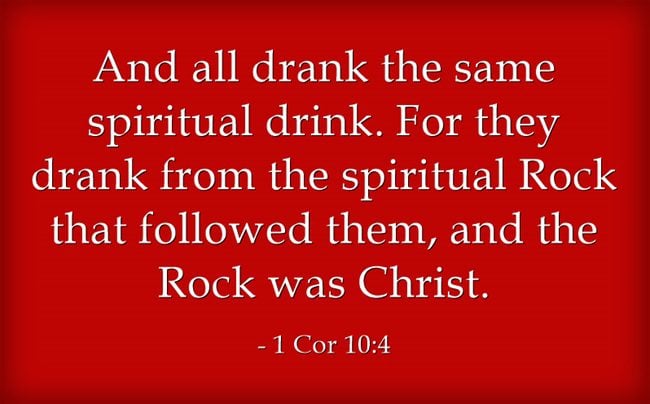
The term or phrase “the rock’ is more than just a word that describes an earthly element. It is typically about a Person and more often than not, it describes Jesus Christ and you see this symbolism in the Old Testament as well as in the New Testament when referring to either Jesus Christ or God in general. The word “rock” is used 142 times in the Bible but it is more often a reference to God than any other instance. For example in 1st Corinthians 10:1-4 Paul writes about the rock in relation to Jesus Christ in referring to an Old Testament experience where he writes “For I do not want you to be unaware, brothers, that our fathers were all under the cloud, and all passed through the sea, and all were baptized into Moses in the cloud and in the sea and all ate the same spiritual food, and all drank the same spiritual drink. For they drank from the spiritual Rock that followed them, and the Rock was Christ.” This refers to the occasion when Israel was grumbling about a lack of water and God told Moses to “Take the staff, and assemble the congregation, you and Aaron your brother, and tell the rock before their eyes to yield its water. So you shall bring water out of the rock for them and give drink to the congregation and their cattle. And Moses took the staff from before the Lord, as he commanded him” (Num 20:8-9).
Moses Strikes the Rock
After God told Moses to tell the rock so that it would yield water for Israel and all their livestock, Moses, who was angry at all of the complaining of the Israelites, “Hear now, you rebels: shall we bring water for you out of this rock?” And Moses lifted up his hand and struck the rock with his staff twice, and water came out abundantly, and the congregation drank, and their livestock” (Num 20:10b-11). Instead of speaking to the rock, Moses struck the rock and then God said “Because you did not believe in me, to uphold me as holy in the eyes of the people of Israel, therefore you shall not bring this assembly into the land that I have given them.” These are the waters of Meribah, where the people of Israel quarreled with the Lord, and through them he showed himself holy” (Num 20:12b-13). The Hebrew word of where the waters came from, Meribah, means quarrelling, since that is what Israel did but Moses did as well, but his quarrel was not against God but against the constantly complaining nation of Israel. Paul refers to this as the “spiritual drink” that they drank from as the “Rock that followed them, and that Rock was Christ” which is Paul’s way of saying that it was Jesus Christ Who was the God of the Old Testament since in Israel’s wanderings in the wilderness, God followed and led them. Paul used this to remind them that “these things took place as examples for us, that we might not desire evil as they did” (1st Cor 10:6). In other words, he was warning the church at Corinth to not grumble or complain as Israel did.
A Rock of Offense
Paul knew that many would be offended by Christ and the Old Testament refers to this also but here Paul seems to have in mind the Old Testament reference to the “Rock of Offense” when he wrote “Behold, I am laying in Zion a stone of stumbling, and a rock of offense; and whoever believes in him will not be put to shame” (Rom 9:33). Paul is quoting Isaiah 28:16 which says nearly the same thing “therefore thus says the Lord GOD, “Behold, I am the one who has laid as a foundation in Zion, a stone, a tested stone, a precious cornerstone, of a sure foundation: ‘Whoever believes will not be in haste” (Isaiah 28:16). The psalmist speaks of Jesus as “The stone that the builders rejected has become the cornerstone” (Psalm 118:22) which Jesus also quotes about Himself in Matthew 21:42. Peter testified before the rulers, elders, and scribes that “This Jesus is the stone that was rejected by you, the builders, which has become the cornerstone” (Acts 4:11) and these men knew the Scriptures well enough to know that this was in reference to Isaiah’s writing (28:16). For those of us who believe in the Rock we see Jesus as the Rock upon which we stand as “a sure foundation” (Isaiah 28:16) of our faith but of this same Rock “Many of them will stumble; they will fall and be broken, they will be snared and captured” (Isaiah 8:15).
The Rock, our Refuge
The Book of Psalms have so many references to God as the Rock that there is no way to include them all in one article but the main points the psalmist is making is that “The Lord is my rock and my fortress and my deliverer, my God, my rock, in whom I take refuge, my shield, and the horn of my salvation, my stronghold” (Psalm 18:2) “For who is God, but the Lord? And who is a rock, except our God” (Psalm 18:31)? For the believer, just as for the psalmist, He is “my rock, and exalted be the God of my salvation” (Psalm 18:46) and this symbolism is found throughout the psalms like where he writes “He alone is my rock and my salvation, my fortress; I shall not be greatly shaken” (Psalm 62:2).
Conclusion
God is our Rock and our salvation and Jesus Christ is that Rock and like a Rock He will never be moved and neither shall all who stand on Him. There is no surer foundation or footing to have than on Jesus Christ for in Him alone can we be saved (Acts 4:12). If you reject this Rock, Jesus’ own words give a foreboding warning “Everyone who falls on that stone will be broken to pieces, and when it falls on anyone, it will crush him” (Luke 20:18).
Article by Jack Wellman
Jack Wellman is Pastor of the Mulvane Brethren church in Mulvane Kansas. Jack is also the Senior Writer at What Christians Want To Know whose mission is to equip, encourage, and energize Christians and to address questions about the believer’s daily walk with God and the Bible. You can follow Jack on Google Plus or check out his book Blind Chance or Intelligent Design available on Amazon.
Previous Post

July 14, 2015
What Does The Great Commission Mean?
Next Post
July 15, 2015 What Happened In The Upper Room? A Bible Study
Browse Our Archives
Select a Category Bible Answers Bible Definitions Bible Story Bible Study Bible Verses Christian Books Christian Entertainment Christian Fathers Christian Mothers Christian Quotes Devotional Famous Christians Music News Parables Prayers Quotes Sunday School Lesson Uncategorized Youth Sermons
Select a Month October 2019 September 2019 August 2019 July 2019 June 2019 May 2019 April 2019 March 2019 February 2019 January 2019 December 2018 November 2018 October 2018 September 2018 August 2018 July 2018 June 2018 May 2018 April 2018 March 2018 February 2018 January 2018 December 2017 November 2017 October 2017 September 2017 August 2017 July 2017 June 2017 May 2017 April 2017 March 2017 February 2017 January 2017 December 2016 November 2016 October 2016 September 2016 August 2016 July 2016 June 2016 May 2016 March 2016 February 2016 January 2016 December 2015 November 2015 October 2015 September 2015 August 2015 July 2015 June 2015 May 2015 April 2015 March 2015 February 2015 January 2015 December 2014 November 2014 October 2014 September 2014 August 2014 July 2014 June 2014 May 2014 April 2014 March 2014 February 2014 January 2014 December 2013 November 2013 October 2013 September 2013 August 2013 July 2013 June 2013 May 2013 April 2013 March 2013
Follow Us!
TAKE THE
Religious Wisdom Quiz
Who cried at the tomb of Lazarus?
Select your answer to see how you score.
Jesus John Peter David
Related posts from Christian Crier

What Does The Bible Say About Our Thoughts?

Top 13 Bible Verses About Virtue

Do Colors Have Special Meaning In The Bible?

The Greatest Father In History
TRENDING AT PATHEOS Evangelical

How the author of the world's best hymn...
I've been working with John Newton for a while now. This makes...

Long before this Lectio Divina, Psalm 130 - the song - started...

What About the Trees? Another Living Parable
After I finished writing the last article about falling leaves as a...

Why Classical Education Is a Conversation, Not a...
Come and Read: Joy in Classical Education When I was a little...

Falling Leaves: A Living Parable on Letting Go
I’ve spent the vast majority of my life in the southeast corner...

Cornell University has received a great deal of negative publicity and intense...
view all Evangelical blogs
Ad-Free & Subscriber Log-In Subscription Support
- About Us
- 2026 Calendar
- Videos
- Podcasts
- Library of World Religions
- Faith In Media Tracker
- Advertise With Us
- Write for Us
- Privacy Policy
- Terms of Service
- Do Not Sell My Data
- Contact Us
- Radiant Digital
- Manage Newsletter Subscriptions
- Unsubscribe From Notifications
- Sitemap
Copyright 2008-2026, Patheos. All rights reserved.
Subscription Support Ad-Free & Subscriber Log-In
Follow Patheos