
BuddhistCatholicContemplativeEvangelicalGeneral ChristianHinduJewishLatter-day SaintMuslimNew VisionsProgressive Christian
Beliefs
- Buddhist
- Catholic
- Contemplative
- Evangelical
- General Christian
- Hindu
- Jewish
- Latter-day Saint
- More Voices
- Muslim
- New Visions
- Pagan
- Progressive Christian
Topics
- Religion News
- Food and Religion
- Sports and Religion
- Religious Art
- Religious Music and Entertainment
- Religious Events
- History and Religion
- Style and Religion
- Politics and Religion
- Women in Religion
- Recreation Outdoors and Religion
- Business Finance and Religion
- Careers Workplace and Religion
- Education and Religion
- Family Parenting and Religion
- Health Fitness and Religion
- Home and Religion
- Relationships and Religion
- Technology and Religion
- Travel and Religion
Columnists
- Buddhist Columnists
- Business Finance and Religion Columnists
- Careers Workplace and Religion Columnists
- Catholic Columnists
- Contemplative Columnists
- Education and Religion Columnists
- Evangelists Columnists
- Family Parenting and Religion Columnists
- General Christian Columnists
- Health Fitness and Religion Columnists
- Hindu Columnists
- History and Religion Columnists
- Home and Religion Columnists
- Jewish Columnists
- More Voices Columnists
- Latter Day Columnists
- Muslim Columnists
- New Visions Columnists
- Nonreligious Columnists
- Pagan Columnists
- Politics and Religion Columnists
- Progressive Columnists
- Recreation Outdoors and Religion Columnists
- Relationships and Religion Columnists
- Religion News Columnists
- Religious Art Columnists
- Religious Events Columnists
- Religious Music and Entertainment Columnists
- Sports and Religion Columnists
- Style and Religion Columnists
- Technology and Religion Columnists
- Travel and Religion Columnists
- Women in Religion Columnists
Resource Library
- 2026 Calendar
- Library of World Religions
- The 100 Most Holy Places on Earth
- Patheos Answers
- Podcasts
- Videos
- Faith Leaders Database
- Anglican Episcopalian
- Bahai
- Baptist
- Buddhism
- Christianity
- Confucianism
- Eastern Orthodoxy
- Hinduism
- Holiness and Pentecostal
- ISKCON
- Islam
- Judaism
- Lutheran
- Methodist
- The Church of Jesus Christ of Latter-day Saints
- New Age
- Paganism
- Presbytarian and Reformed
- Protestantism
- Religion Behind the Scenes
- Roman Catholic
- Scientology
- Shia Islam
- Sikhism
- Sufism
- Sunni Islam
- Taoism
- Zen
- See all religions
Research Tools
 Ad-Free & Subscriber Log-In Subscription Support
Ad-Free & Subscriber Log-In Subscription Support
Follow Patheos 

- Trending:
- Forgiveness
- |
- Marriage
- |
- Consciousness
- |
- Death Penalty
- |
- Election
- |
- Halloween
 Christian Crier
- Home
- Evangelical
- Top 7 Bible Verses About Widows
Top 7 Bible Verses About Widows
Last updated on: June 26, 2015 at 12:58 pm by Jack Wellman
Top 7 Bible Verses About Widows 2015-06-26T12:58:12-05:00 Jack Wellman
Patheos Explore the world's faith through different perspectives on religion and spirituality! Patheos has the views of the prevalent religions and spiritualities of the world.
Here are my top 7 Bible verses that I could find that have special meaning about widows and how God has great concern for them.
James 1:27 “Religion that is pure and undefiled before God, the Father, is this: to visit orphans and widows in their affliction, and to keep oneself unstained from the world.”
Is there any better definition of what pure religion is in the Bible? I’m not sure there is. The idea of the word “pure” means without hidden motives and motivated only by the desire to extend the love of God through our ministry to these who are in such dire need. The key word here might be “to visit” the orphans and the widows. Its one thing to show concern and pray for them but pure religion is actually visiting them during their affliction and most of the widows and orphans I know are under at least some form of affliction and visiting them can lessen their afflictions of loneliness and physical needs.
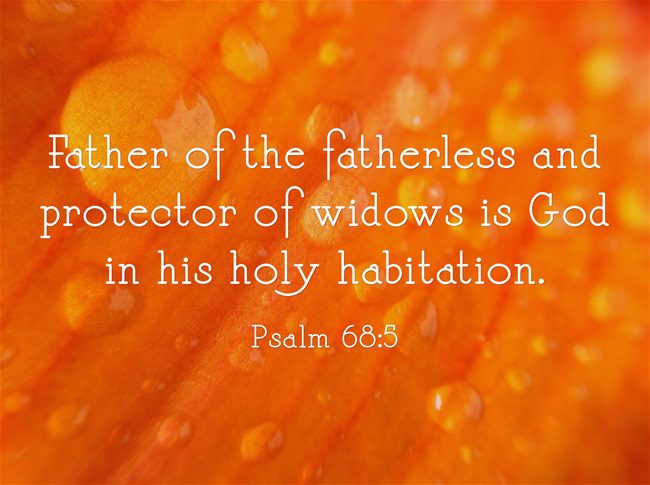
Psalm 68:5 “Father of the fatherless and protector of widows is God in his holy habitation.”
If no one else will protect the widows and orphans, God certainly will. From His holy habitation (the throne of heaven) He will surely protect them and He is grieved when we don’t, even those widows among our own families. Sometimes God directs people to visit those in their afflictions. Our church offers a Sunday church service. Since many cannot come to church we bring church to them and God uses people in His promise to protect them. The latest statistics showed that six in ten nursing home residents never have any of their family members visit them and that word “visit” as I mentioned in the reference to James 1:27 above, is part of this “protection;” protection from neglect and loneliness.
Deuteronomy 27:19 “Cursed be anyone who perverts the justice due to the sojourner, the fatherless, and the widow. And all the people shall say, ‘Amen.’”
God places a curse on those who pervert the justice that is due to the fatherless, the sojourner (stranger), and the widow. To pervert justice indicates that it is a perversion of the law to care for the widows and orphans and the law was often neglected in ancient Israel and an unwritten law of caring for the widows and orphans is being customarily broken today in many societies around the world.
First Timothy 5:5 “She who is truly a widow, left all alone, has set her hope on God and continues in supplications and prayers night and day.”
Paul seems to be writing this because some widows apparently were not “true widows” so he is singling out those who are true widows and those who are not. This is such a tender verse because the widows are often left alone and all they have is their hope in God but what better Person to have your hope set on? A widow might feel that she cannot do much for the church anymore but this is absolutely not true. The least she can do is also the most powerful thing she can do; and that is to pray for others, both day and night, and I must tell you, I covet the prayers of the widows that I have visited.
Psalm 146:9 “The Lord watches over the sojourners; he upholds the widow and the fatherless, but the way of the wicked he brings to ruin.”
God has His eye on the sparrow (Matt 10:29) but more importantly, He watches over the sojourners, the orphans, and not least of all, the widows. God doesn’t miss anything, even when we do.
Jeremiah 49:11 “Leave your fatherless children; I will keep them alive; and let your widows trust in me.”
Here Jeremiah warned Edom about their coming captivity because of the way that they treated Judah but it would be mostly the men who would suffer which explains why he wanted them to know that He will not hold the orphans and widows responsible and “will keep them alive” and so He instructs the Edomite’s to have their widows trust in Him, showing that God cares for all widows, not just those of Israel or Judah.
Luke20:46-47 “Beware of the scribes, who like to walk around in long robes, and love greetings in the marketplaces and the best seats in the synagogues and the places of honor at feasts, who devour widows’ houses and for a pretense make long prayers. They will receive the greater condemnation.”
Jesus is warning His disciples to beware of the scribes because of their hypocrisy and self-righteousness. They loved to be seen by men and thought of as holy and above others, but the truth be told, they were not only neglecting the widows but were actually devouring their homes. What did Jesus mean by this statement? This likely meant that their financial needs were being neglected even though the law commanded the Jews to take care of the widows (Ex 22:22-24; Duet 27:19) and in fact, there was a special tithe that was designated just for them but it doesn’t appear that this law was being enforced.
Conclusion
The church may be the best social institution, outside of the government, that helps the widows in our society. In the early days of the church, they saw fit to establish an office (deacons) for the purpose of ensuring that the needs of the widows were met. This need arose because of the rapid growth of the early church. We read about this in Acts 6:1 “Now in these days when the disciples were increasing in number, a complaint by the Hellenists arose against the Hebrews because their widows were being neglected in the daily distribution.” The result was that certain men were appointed and given charge to ensure that the widows would be taken care of so the office of deacon was established for this purpose. The word “deacon” comes from of the Greek word “diaconos” and literally means “a runner” or “a servant.” Since we know that God cares deeply about the widows, the church created an office for the express purpose for caring for them. Today, deacons, elders, pastors, and church members are still doing this, fulfilling God’s great desire in this respect because they know that He is a “Father of the fatherless and protector of widows is God in his holy habitation” (Psalm 68:5).
Article by Jack Wellman
Jack Wellman is Pastor of the Mulvane Brethren church in Mulvane Kansas. Jack is also the Senior Writer at What Christians Want To Know whose mission is to equip, encourage, and energize Christians and to address questions about the believer’s daily walk with God and the Bible. You can follow Jack on Google Plus or check out his book Blind Chance or Intelligent Design available on Amazon.
Previous Post

June 26, 2015
Top 7 Bible Verses About Orphans
Next Post
June 26, 2015 Top 7 Bible Verses About God’s Compassion
Browse Our Archives
Select a Category Bible Answers Bible Definitions Bible Story Bible Study Bible Verses Christian Books Christian Entertainment Christian Fathers Christian Mothers Christian Quotes Devotional Famous Christians Music News Parables Prayers Quotes Sunday School Lesson Uncategorized Youth Sermons
Select a Month October 2019 September 2019 August 2019 July 2019 June 2019 May 2019 April 2019 March 2019 February 2019 January 2019 December 2018 November 2018 October 2018 September 2018 August 2018 July 2018 June 2018 May 2018 April 2018 March 2018 February 2018 January 2018 December 2017 November 2017 October 2017 September 2017 August 2017 July 2017 June 2017 May 2017 April 2017 March 2017 February 2017 January 2017 December 2016 November 2016 October 2016 September 2016 August 2016 July 2016 June 2016 May 2016 March 2016 February 2016 January 2016 December 2015 November 2015 October 2015 September 2015 August 2015 July 2015 June 2015 May 2015 April 2015 March 2015 February 2015 January 2015 December 2014 November 2014 October 2014 September 2014 August 2014 July 2014 June 2014 May 2014 April 2014 March 2014 February 2014 January 2014 December 2013 November 2013 October 2013 September 2013 August 2013 July 2013 June 2013 May 2013 April 2013 March 2013
Follow Us!
TAKE THE
Religious Wisdom Quiz
Which empire conquered the Northern Kingdom of Israel?
Select your answer to see how you score.
Babylonian Persian Egyptian Assyrian
Related posts from Christian Crier

Top 13 Bible Verses About Virtue

The Living, Active, Word Of God
The Exclusivity Of Salvation Through Christ Alone
Bible Verses To Help You Spot Apostasy Or...
TRENDING AT PATHEOS Evangelical

How the author of the world's best hymn...
I've been working with John Newton for a while now. This makes...

Long before this Lectio Divina, Psalm 130 - the song - started...

What About the Trees? Another Living Parable
After I finished writing the last article about falling leaves as a...

Why Classical Education Is a Conversation, Not a...
Come and Read: Joy in Classical Education When I was a little...

Falling Leaves: A Living Parable on Letting Go
I’ve spent the vast majority of my life in the southeast corner...

Cornell University has received a great deal of negative publicity and intense...
view all Evangelical blogs
Ad-Free & Subscriber Log-In Subscription Support
- About Us
- 2026 Calendar
- Videos
- Podcasts
- Library of World Religions
- Faith In Media Tracker
- Advertise With Us
- Write for Us
- Privacy Policy
- Terms of Service
- Do Not Sell My Data
- Contact Us
- Radiant Digital
- Manage Newsletter Subscriptions
- Unsubscribe From Notifications
- Sitemap
Copyright 2008-2026, Patheos. All rights reserved.
Subscription Support Ad-Free & Subscriber Log-In
Follow Patheos