
BuddhistCatholicContemplativeEvangelicalGeneral ChristianHinduJewishLatter-day SaintMuslimNew VisionsProgressive Christian
Beliefs
- Buddhist
- Catholic
- Contemplative
- Evangelical
- General Christian
- Hindu
- Jewish
- Latter-day Saint
- More Voices
- Muslim
- New Visions
- Pagan
- Progressive Christian
Topics
- Religion News
- Food and Religion
- Sports and Religion
- Religious Art
- Religious Music and Entertainment
- Religious Events
- History and Religion
- Style and Religion
- Politics and Religion
- Women in Religion
- Recreation Outdoors and Religion
- Business Finance and Religion
- Careers Workplace and Religion
- Education and Religion
- Family Parenting and Religion
- Health Fitness and Religion
- Home and Religion
- Relationships and Religion
- Technology and Religion
- Travel and Religion
Columnists
- Buddhist Columnists
- Business Finance and Religion Columnists
- Careers Workplace and Religion Columnists
- Catholic Columnists
- Contemplative Columnists
- Education and Religion Columnists
- Evangelists Columnists
- Family Parenting and Religion Columnists
- General Christian Columnists
- Health Fitness and Religion Columnists
- Hindu Columnists
- History and Religion Columnists
- Home and Religion Columnists
- Jewish Columnists
- More Voices Columnists
- Latter Day Columnists
- Muslim Columnists
- New Visions Columnists
- Nonreligious Columnists
- Pagan Columnists
- Politics and Religion Columnists
- Progressive Columnists
- Recreation Outdoors and Religion Columnists
- Relationships and Religion Columnists
- Religion News Columnists
- Religious Art Columnists
- Religious Events Columnists
- Religious Music and Entertainment Columnists
- Sports and Religion Columnists
- Style and Religion Columnists
- Technology and Religion Columnists
- Travel and Religion Columnists
- Women in Religion Columnists
Resource Library
- 2026 Calendar
- Library of World Religions
- The 100 Most Holy Places on Earth
- Patheos Answers
- Podcasts
- Videos
- Faith Leaders Database
- Anglican Episcopalian
- Bahai
- Baptist
- Buddhism
- Christianity
- Confucianism
- Eastern Orthodoxy
- Hinduism
- Holiness and Pentecostal
- ISKCON
- Islam
- Judaism
- Lutheran
- Methodist
- The Church of Jesus Christ of Latter-day Saints
- New Age
- Paganism
- Presbytarian and Reformed
- Protestantism
- Religion Behind the Scenes
- Roman Catholic
- Scientology
- Shia Islam
- Sikhism
- Sufism
- Sunni Islam
- Taoism
- Zen
- See all religions
Research Tools
 Ad-Free & Subscriber Log-In Subscription Support
Ad-Free & Subscriber Log-In Subscription Support
Follow Patheos 

- Trending:
- Forgiveness
- |
- Marriage
- |
- Consciousness
- |
- Death Penalty
- |
- Election
- |
- Halloween
 Christian Crier
- Home
- Evangelical
- Who Was Nebuchadnezzar In The Bible?
Who Was Nebuchadnezzar In The Bible?
Last updated on: June 18, 2015 at 8:22 pm by Jack Wellman
Who Was Nebuchadnezzar In The Bible? 2015-06-18T20:22:32-05:00 Jack Wellman
Patheos Explore the world's faith through different perspectives on religion and spirituality! Patheos has the views of the prevalent religions and spiritualities of the world.
Who was Nebuchadnezzar in the Bible? What role did he play in the Old Testament?
The Name Nebuchadnezzar’s Meaning
Akkadian name Nabu-kudurri-usur meaning “Nabu preserve my firstborn son” and Nabu could be from the Semitic root meaning “to announce” and was the name of an Assyrian and Babylonian god of wisdom, letters and writing for which the nation of Babylon was well known for. Interestingly the name Babylon or “babilu” means (gate of god). Nebuchadnezzar ruled over the kingdom that was founded in the 12th-century BC and was known as the Babylonian Empire. He was in power when this empire captured Jerusalem, and ultimately destroyed the city’s temple and deported many of its citizens, as told in the Old Testament which you can read about in 2nd Kings 25. Psalm 137:1-6 is a lament psalm about the captives being in captivity.
Who Was Nebuchadnezzar?
As was previously noted, Nebuchadnezzar was the king of Babylon who ensured the captivity of the nation of Judah and held them captive for seventy years. Israel, identified as the Northern Kingdom or the 10 Tribes of Israel, which had broken away from the nation of Israel as a whole many years before, had been earlier taken captive before by the Assyrians of whom the Babylonians had later conquered. The Babylonian Empire was at the very height of its glory and was the most important city of the whole Mesopotamia region, and really, in the civilized or known world at the time. Nebuchadnezzar’s powerful empire were the ones who built the hanging gardens of Babylon which were considered one of the ancient wonders of the world but they also built magnificent palaces, temples, mighty walls and beautiful gateways and had no natural rival in all the world.
Babylon in Peter’s Day?
Even in Peter’s day, this name was still used but as a system of government that was hostile to Christians which explains Peter’s writing “She who is at Babylon, who is likewise chosen, sends you greetings, and so does Mark, my son” (1st Pet 5:13). Babylon was long gone by this time so why did Peter use this name? It may have been because the name was representative or symbolic of a one-ruler system of government that was still holding captive God’s chosen people but these people were members of the church and not the nation of Israel or Judah as was the case in the Old Testament period (as in 2nd Kings). Such was the type of rule that dominated the Roman Empire.
Future Babylon?
Next to the Book of Jeremiah, which mentions Babylon one hundred and fifty one times and the 2nd Book of Kings which mentions this empire twenty eight times, the Book of Revelation has the 3rd most references to Babylon but it is about a future reference to this system of government. Many scholars today believe that much of Revelation was fulfilled during the fall of Jerusalem in 70 A.D. and afterwards. The Book of Revelation mentions a second angel bringing the second of three message’s and says “Fallen, fallen is Babylon the great, she who made all nations drink the wine of the passion of her sexual immorality” (Rev 14:8). The reason that Babylon is said to have “fallen, fallen” may be due to Babylon’s first fall and the coming, greater fall which occurred in the 1st century or is yet to come.
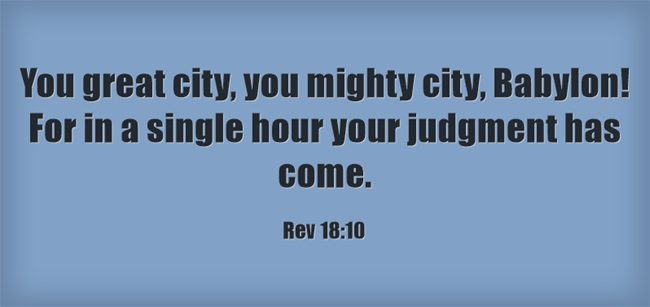
Once again in Revelation 18:2a we read the phrase “Fallen, fallen is Babylon the great!” and God apparently judges this harlot because “She has become a dwelling place for demons, a haunt for every unclean spirit, a haunt for every unclean bird, a haunt for every unclean and detestable beast” (Rev 18:2b). Later it mentions that “The great city was split into three parts, and the cities of the nation’s fell, and God remembered Babylon the great, to make her drain the cup of the wine of the fury of his wrath” (Rev 16:19). Obviously Babylon represents everything wrong with this world today as she is called “Babylon the great, mother of prostitutes and of earth’s abominations” (Rev 17:5). Again we can see why she falls and great is her fall as Revelation 18:10 says “You great city, you mighty city, Babylon! For in a single hour your judgment has come.” The point here is that with another great empire, this time perhaps a worldwide empire, another inferior, as in more wicked than Nebuchadnezzar, will rule and like the previous empire, this empire and her great king will utterly come crashing down, never to be seen or heard from again.
Conclusion
Nebuchadnezzar was an actual historical figure that ruled over one of the greatest empires in the world and archeological evidence has shown that what was recorded in 2nd Kings was played out in real time and history. Any nation that forsakes God and fails to follow Him will also be said of someday to have “fallen, fallen.”
Article by Jack Wellman
Jack Wellman is Pastor of the Mulvane Brethren church in Mulvane Kansas. Jack is also the Senior Writer at What Christians Want To Know whose mission is to equip, encourage, and energize Christians and to address questions about the believer’s daily walk with God and the Bible. You can follow Jack on Google Plus or check out his book Blind Chance or Intelligent Design available on Amazon.
Previous Post

June 18, 2015
What Does Begotten Mean When Used In The Bible?
Next Post
June 19, 2015 Top 7 Bible Verses About Youth
Browse Our Archives
Select a Category Bible Answers Bible Definitions Bible Story Bible Study Bible Verses Christian Books Christian Entertainment Christian Fathers Christian Mothers Christian Quotes Devotional Famous Christians Music News Parables Prayers Quotes Sunday School Lesson Uncategorized Youth Sermons
Select a Month October 2019 September 2019 August 2019 July 2019 June 2019 May 2019 April 2019 March 2019 February 2019 January 2019 December 2018 November 2018 October 2018 September 2018 August 2018 July 2018 June 2018 May 2018 April 2018 March 2018 February 2018 January 2018 December 2017 November 2017 October 2017 September 2017 August 2017 July 2017 June 2017 May 2017 April 2017 March 2017 February 2017 January 2017 December 2016 November 2016 October 2016 September 2016 August 2016 July 2016 June 2016 May 2016 March 2016 February 2016 January 2016 December 2015 November 2015 October 2015 September 2015 August 2015 July 2015 June 2015 May 2015 April 2015 March 2015 February 2015 January 2015 December 2014 November 2014 October 2014 September 2014 August 2014 July 2014 June 2014 May 2014 April 2014 March 2014 February 2014 January 2014 December 2013 November 2013 October 2013 September 2013 August 2013 July 2013 June 2013 May 2013 April 2013 March 2013
Follow Us!
TAKE THE
Religious Wisdom Quiz
Which book of the Bible has a talking tree?
Select your answer to see how you score.
Ezekiel Proverbs Genesis Judges
Related posts from Christian Crier

What Does The Bible Say About Our Thoughts?

Do Colors Have Special Meaning In The Bible?

The Glass – Half Empty Or Half Full?

TRENDING AT PATHEOS Evangelical

How the author of the world's best hymn...
I've been working with John Newton for a while now. This makes...

Long before this Lectio Divina, Psalm 130 - the song - started...

What About the Trees? Another Living Parable
After I finished writing the last article about falling leaves as a...

Why Classical Education Is a Conversation, Not a...
Come and Read: Joy in Classical Education When I was a little...

Falling Leaves: A Living Parable on Letting Go
I’ve spent the vast majority of my life in the southeast corner...

Cornell University has received a great deal of negative publicity and intense...
view all Evangelical blogs
Ad-Free & Subscriber Log-In Subscription Support
- About Us
- 2026 Calendar
- Videos
- Podcasts
- Library of World Religions
- Faith In Media Tracker
- Advertise With Us
- Write for Us
- Privacy Policy
- Terms of Service
- Do Not Sell My Data
- Contact Us
- Radiant Digital
- Manage Newsletter Subscriptions
- Unsubscribe From Notifications
- Sitemap
Copyright 2008-2026, Patheos. All rights reserved.
Subscription Support Ad-Free & Subscriber Log-In
Follow Patheos