
BuddhistCatholicContemplativeEvangelicalGeneral ChristianHinduJewishLatter-day SaintMuslimNew VisionsProgressive Christian
Beliefs
- Buddhist
- Catholic
- Contemplative
- Evangelical
- General Christian
- Hindu
- Jewish
- Latter-day Saint
- More Voices
- Muslim
- New Visions
- Pagan
- Progressive Christian
Topics
- Religion News
- Food and Religion
- Sports and Religion
- Religious Art
- Religious Music and Entertainment
- Religious Events
- History and Religion
- Style and Religion
- Politics and Religion
- Women in Religion
- Recreation Outdoors and Religion
- Business Finance and Religion
- Careers Workplace and Religion
- Education and Religion
- Family Parenting and Religion
- Health Fitness and Religion
- Home and Religion
- Relationships and Religion
- Technology and Religion
- Travel and Religion
Columnists
- Buddhist Columnists
- Business Finance and Religion Columnists
- Careers Workplace and Religion Columnists
- Catholic Columnists
- Contemplative Columnists
- Education and Religion Columnists
- Evangelists Columnists
- Family Parenting and Religion Columnists
- General Christian Columnists
- Health Fitness and Religion Columnists
- Hindu Columnists
- History and Religion Columnists
- Home and Religion Columnists
- Jewish Columnists
- More Voices Columnists
- Latter Day Columnists
- Muslim Columnists
- New Visions Columnists
- Nonreligious Columnists
- Pagan Columnists
- Politics and Religion Columnists
- Progressive Columnists
- Recreation Outdoors and Religion Columnists
- Relationships and Religion Columnists
- Religion News Columnists
- Religious Art Columnists
- Religious Events Columnists
- Religious Music and Entertainment Columnists
- Sports and Religion Columnists
- Style and Religion Columnists
- Technology and Religion Columnists
- Travel and Religion Columnists
- Women in Religion Columnists
Resource Library
- 2026 Calendar
- Library of World Religions
- The 100 Most Holy Places on Earth
- Patheos Answers
- Podcasts
- Videos
- Faith Leaders Database
- Anglican Episcopalian
- Bahai
- Baptist
- Buddhism
- Christianity
- Confucianism
- Eastern Orthodoxy
- Hinduism
- Holiness and Pentecostal
- ISKCON
- Islam
- Judaism
- Lutheran
- Methodist
- The Church of Jesus Christ of Latter-day Saints
- New Age
- Paganism
- Presbytarian and Reformed
- Protestantism
- Religion Behind the Scenes
- Roman Catholic
- Scientology
- Shia Islam
- Sikhism
- Sufism
- Sunni Islam
- Taoism
- Zen
- See all religions
Research Tools
 Ad-Free & Subscriber Log-In Subscription Support
Ad-Free & Subscriber Log-In Subscription Support
Follow Patheos 

- Trending:
- Forgiveness
- |
- Marriage
- |
- Consciousness
- |
- Death Penalty
- |
- Election
- |
- Halloween
 Christian Crier
- Home
- Evangelical
- What Does Yoke Mean In The Bible?
What Does Yoke Mean In The Bible?
Last updated on: June 18, 2015 at 12:02 pm by Jack Wellman
What Does Yoke Mean In The Bible? 2015-06-18T12:02:06-05:00 Jack Wellman
Patheos Explore the world's faith through different perspectives on religion and spirituality! Patheos has the views of the prevalent religions and spiritualities of the world.
If you’ve read the Bible you’ve probably heard the use of the word “yoke.” What does the Bible mean in reference to a yoke?
What is a Yoke?
A yoke is a fitting for a so-called beast of burden that would be placed around the neck of one or more animals like an ox for example. This fitting was placed around the neck in order to allow the animal or animals for the purpose of pulling loads and typically consisted of a curved piece of wood with leather straps as a binding which would allow them to draw a plough or a cart or any other type of weight. Sometimes a yoke would be symbolic of being in captivity or under slavery or bondage like in Leviticus 26:13 when God said “I am the LORD your God, who brought you out of Egypt so that you would no longer be slaves to the Egyptians; I broke the bars of your yoke and enabled you to walk with heads held high.”
Take My Yoke Upon You
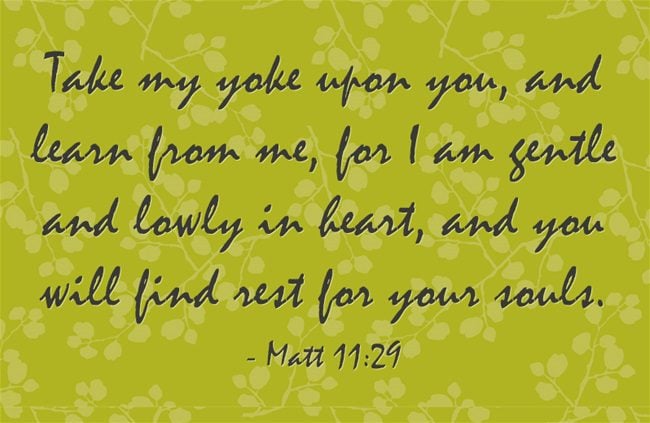
Jesus once used the word yoke in a very special way saying “Take my yoke upon you, and learn from me, for I am gentle and lowly in heart, and you will find rest for your souls” (Matt 11:29) but what did He mean by this? In the context of this Jesus had preceded this statement by saying “Come to me, all you who are weary and burdened, and I will give you rest” (Matt 11:28) so He was talking about the fact that only He can give us rest from the heavy burdens and sorrows that this world can sometimes bring. We can rest in the fact that as a yoke does with animals, our load is shared and becomes less burdensome with Him. That’s why He concluded by saying “For my yoke is easy and my burden is light” (Matt 11:30). Maybe you’ve heard the phrase that a joy shared is doubled but a burden shared is halved. This is the idea of taking upon us the yoke that Jesus provides and we can learn from Him and that should give us “rest for [our] souls.”
Unequally Yoked
Paul also wrote about a yoke but in this case it was an unequal yoke having to do with relationships writing in 2nd Corinthians 6:14-16a “Do not be yoked together with unbelievers. For what do righteousness and wickedness have in common? Or what fellowship can light have with darkness? What harmony is there between Christ and Belial? Or what does a believer have in common with an unbeliever? What agreement is there between the temple of God and idols?” Next Paul clarifies what he is saying by quoting the Old Testament verse of Isaiah 52:11 but which is also repeated in Revelation 18:5 “Come out from them and be separate, says the Lord. Touch no unclean thing, and I will receive you” (2nd Cor 6:17). For one thing this means that we should “not to associate with sexually immoral people” (1 Cor 5:9) because “If we claim to have fellowship with him and yet walk in the darkness, we lie and do not live out the truth” (1 John 1:6).
The Law of the Yoke
God commanded a law of mercy in the Old Testament about not yoking animals together that was not the same. God forbid this because it was inhumane to make different animals pull the same load because one would have to carry most of the weight. This is mentioned in several places in the Old Testament such as in Deuteronomy 22:10 which said “Not to work with beasts of different species, yoked together.” For example, if you had a donkey on one side and an ox on the other, the ox would carry most of the weight and the fact that a donkey is more stubborn, they might try to veer to the right or to the left, or stop altogether and the ox might end up carrying the entire load plus drag the donkey along.
Conclusion
Jesus gives us rest but apart from Him there is only toil and trouble. We should take Jesus’ yoke because our burdens are too heavy to bear by ourselves. We should also not be yoked with an unbeliever which means we also must not marry unbelievers because we are going to be going in two different directions. Amos asks the rhetorical question “Do two walk together, unless they have agreed to meet” and the obvious answer is no (3:3).
Article by Jack Wellman
Jack Wellman is Pastor of the Mulvane Brethren church in Mulvane Kansas. Jack is also the Senior Writer at What Christians Want To Know whose mission is to equip, encourage, and energize Christians and to address questions about the believer’s daily walk with God and the Bible. You can follow Jack on Google Plus or check out his book Blind Chance or Intelligent Design available on Amazon.
Previous Post

June 18, 2015
Top 7 Bible Verses About Self Worth
Next Post
June 18, 2015 How To Find Peace With God
Browse Our Archives
Select a Category Bible Answers Bible Definitions Bible Story Bible Study Bible Verses Christian Books Christian Entertainment Christian Fathers Christian Mothers Christian Quotes Devotional Famous Christians Music News Parables Prayers Quotes Sunday School Lesson Uncategorized Youth Sermons
Select a Month October 2019 September 2019 August 2019 July 2019 June 2019 May 2019 April 2019 March 2019 February 2019 January 2019 December 2018 November 2018 October 2018 September 2018 August 2018 July 2018 June 2018 May 2018 April 2018 March 2018 February 2018 January 2018 December 2017 November 2017 October 2017 September 2017 August 2017 July 2017 June 2017 May 2017 April 2017 March 2017 February 2017 January 2017 December 2016 November 2016 October 2016 September 2016 August 2016 July 2016 June 2016 May 2016 March 2016 February 2016 January 2016 December 2015 November 2015 October 2015 September 2015 August 2015 July 2015 June 2015 May 2015 April 2015 March 2015 February 2015 January 2015 December 2014 November 2014 October 2014 September 2014 August 2014 July 2014 June 2014 May 2014 April 2014 March 2014 February 2014 January 2014 December 2013 November 2013 October 2013 September 2013 August 2013 July 2013 June 2013 May 2013 April 2013 March 2013
Follow Us!
TAKE THE
Religious Wisdom Quiz
What does Hebrews say is living and active?
Select your answer to see how you score.
The word of God Prayer Faith The church
Related posts from Christian Crier

What Does The Bible Say About Our Thoughts?

Do Colors Have Special Meaning In The Bible?

The Glass – Half Empty Or Half Full?

TRENDING AT PATHEOS Evangelical

The REST of Your Life: A Creative Wrestles...
This week I had a conversation with a good friend from church....

How the author of the world's best hymn...
I've been working with John Newton for a while now. This makes...

Long before this Lectio Divina, Psalm 130 - the song - started...

What About the Trees? Another Living Parable
After I finished writing the last article about falling leaves as a...

Why Classical Education Is a Conversation, Not a...
Come and Read: Joy in Classical Education When I was a little...

Cornell University has received a great deal of negative publicity and intense...
view all Evangelical blogs
Ad-Free & Subscriber Log-In Subscription Support
- About Us
- 2026 Calendar
- Videos
- Podcasts
- Library of World Religions
- Faith In Media Tracker
- Advertise With Us
- Write for Us
- Privacy Policy
- Terms of Service
- Do Not Sell My Data
- Contact Us
- Radiant Digital
- Manage Newsletter Subscriptions
- Unsubscribe From Notifications
- Sitemap
Copyright 2008-2026, Patheos. All rights reserved.
Subscription Support Ad-Free & Subscriber Log-In
Follow Patheos