
BuddhistCatholicContemplativeEvangelicalGeneral ChristianHinduJewishLatter-day SaintMuslimNew VisionsProgressive Christian
Beliefs
- Buddhist
- Catholic
- Contemplative
- Evangelical
- General Christian
- Hindu
- Jewish
- Latter-day Saint
- More Voices
- Muslim
- New Visions
- Pagan
- Progressive Christian
Topics
- Religion News
- Food and Religion
- Sports and Religion
- Religious Art
- Religious Music and Entertainment
- Religious Events
- History and Religion
- Style and Religion
- Politics and Religion
- Women in Religion
- Recreation Outdoors and Religion
- Business Finance and Religion
- Careers Workplace and Religion
- Education and Religion
- Family Parenting and Religion
- Health Fitness and Religion
- Home and Religion
- Relationships and Religion
- Technology and Religion
- Travel and Religion
Columnists
- Buddhist Columnists
- Business Finance and Religion Columnists
- Careers Workplace and Religion Columnists
- Catholic Columnists
- Contemplative Columnists
- Education and Religion Columnists
- Evangelists Columnists
- Family Parenting and Religion Columnists
- General Christian Columnists
- Health Fitness and Religion Columnists
- Hindu Columnists
- History and Religion Columnists
- Home and Religion Columnists
- Jewish Columnists
- More Voices Columnists
- Latter Day Columnists
- Muslim Columnists
- New Visions Columnists
- Nonreligious Columnists
- Pagan Columnists
- Politics and Religion Columnists
- Progressive Columnists
- Recreation Outdoors and Religion Columnists
- Relationships and Religion Columnists
- Religion News Columnists
- Religious Art Columnists
- Religious Events Columnists
- Religious Music and Entertainment Columnists
- Sports and Religion Columnists
- Style and Religion Columnists
- Technology and Religion Columnists
- Travel and Religion Columnists
- Women in Religion Columnists
Resource Library
- 2026 Calendar
- Library of World Religions
- The 100 Most Holy Places on Earth
- Patheos Answers
- Podcasts
- Videos
- Faith Leaders Database
- Anglican Episcopalian
- Bahai
- Baptist
- Buddhism
- Christianity
- Confucianism
- Eastern Orthodoxy
- Hinduism
- Holiness and Pentecostal
- ISKCON
- Islam
- Judaism
- Lutheran
- Methodist
- The Church of Jesus Christ of Latter-day Saints
- New Age
- Paganism
- Presbytarian and Reformed
- Protestantism
- Religion Behind the Scenes
- Roman Catholic
- Scientology
- Shia Islam
- Sikhism
- Sufism
- Sunni Islam
- Taoism
- Zen
- See all religions
Research Tools
 Ad-Free & Subscriber Log-In Subscription Support
Ad-Free & Subscriber Log-In Subscription Support
Follow Patheos 

- Trending:
- Forgiveness
- |
- Marriage
- |
- Consciousness
- |
- Death Penalty
- |
- Election
- |
- Halloween
 Christian Crier
- Home
- Evangelical
- What Does The Bible Say About Tattoos and Piercings?
What Does The Bible Say About Tattoos and Piercings?
Last updated on: June 23, 2015 at 11:28 am by Jack Wellman
What Does The Bible Say About Tattoos and Piercings? 2015-06-23T11:28:54-05:00 Jack Wellman
Patheos Explore the world's faith through different perspectives on religion and spirituality! Patheos has the views of the prevalent religions and spiritualities of the world.
Is the Bible silent on tattoos and body piercings? Are there commands against this practice or does the Christian have freedom in this?
Does God Forbid Body Piercings and Tattoos?
Some Christians quote Old Testament Scriptures to say that body piercings and tattoos are forbidden and use such verses as Leviticus 19:28 “You shall not make any cuts on your body for the dead or tattoo yourselves: I am the Lord” but this law was written to ensure that the nation of Israel didn’t follow the pagan practices of the nations around them which did things like this but for abominable reasons. This law was not written to Christians but to the nation of Israel and that is the context of this entire chapter (Lev 19) and it is directed specifically to Israel as it says in 19:2 “Speak to all the congregation of the people of Israel and say to them.” Nowhere does this specify that it is a law that is separate from the Mosaic Law like the Ten Commandments which are still and always will be in effect. If we are to take this verse and try to shoehorn it or make it fit into the Christian’s life then we must also never “round off the hair on [our] temples or mar the edges of [our] beard” (Lev 19:27). You cannot make one part of these laws a requirement on Christians today and not make all of them a requirement. That is proof texting and taking text out of the context for which and to whom it was written makes it a pretext and a false one at that and we cannot apply the Mosaic Law to Christians today.
The Temple of the Holy Spirit
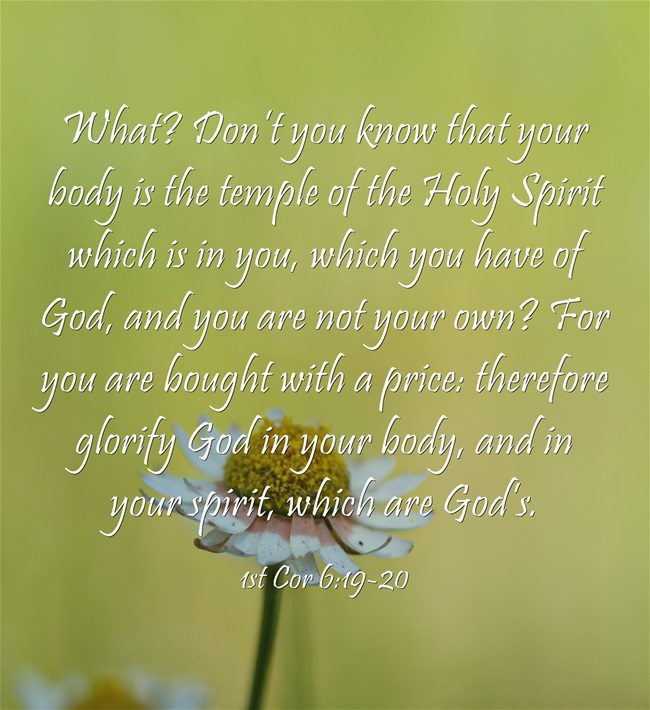
Christians who try and judge people who have body piercings and tattoos will often quote 1st Corinthians 6:19-20 which says “What? Don’t you know that your body is the temple of the Holy Spirit which is in you, which you have of God, and you are not your own? For you are bought with a price: therefore glorify God in your body, and in your spirit, which are God’s” but what is the context of this verse? Are they, once again, proof texting Scriptures to try and apply it to God’s forbidding of tattoos and body piercings? It would seem so because this chapter and this paragraph in particular are speaking about sexual immorality and not markings like tattoos or cuttings on the body. This is clear because Paul was saying “The body is not meant for sexual immorality, but for the Lord, and the Lord for the body” (1st Cor 6:13b). When Paul declared that the body is the temple of the Holy Spirit, just prior to this we can see the context as he wrote “Shall I then take the members of Christ and make them members of a prostitute? Never! Or do you not know that he who is joined to a prostitute becomes one body with her? For, as it is written, “The two will become one flesh.” But he who is joined to the Lord becomes one spirit with him. Flee from sexual immorality. Every other sin a person commits is outside the body, but the sexually immoral person sins against his own body” (1st Cor 6:15-18) so clearly and obviously he was not even talking about markings, tattoos or body piercings. The context was sexual immorality and sins that were committed “outside of the body” not on the body and whoever is involved in sexual immorality is sinning “against his own body.” How some can misapply this to tattoos and body piercings is beyond me. Could we not then say we should never color our hair because it’s the temple of the Holy Spirit? You can see just how far some could take this.
Personal Witnessing
Years ago I hesitated in witnessing to a co-worker because he had tattoos all over his body and I assumed (wrongly) that he was not saved but indeed he was. I asked the Lord and my co-worker to forgive me for that false assumption. God looks at the heart and not at what is outside (1 Sam 16:7) but I was wrongly looking at the outside and I judged the man as one; unfit to be saved and two; probably not saved. I was totally wrong about both and admitted it to him and to God and repented of this immediately and today I don’t look at the outside and trust God for He can look at the heart; I cannot. I have no business judging people from the outside at all and have since then learned not to do that.
Nothing New Under the Sun
We think that today’s trend of body piercing and jewelry is new but it’s not as there isn’t really anything new under the sun (Eccl 1:4-11) because Isaiah wrote long ago that “In that day the Lord will take away the bravery of their tinkling ornaments about their feet, and their cauls, and their round tires like the moon, the chains, and the bracelets, and the mufflers, the bonnets, and the ornaments of the legs, and the headbands, and the tablets, and the earrings, the rings, and nose jewels, the changeable suits of apparel, and the mantles, and the wimples, and the crisping pins, the glasses, and the fine linen, and the hoods, and the veils” (Isaiah 3:18-23). Why would God take these away? Because these things were sinful? No, it was because they had been in a long state of disobedience to God and were into idolatry and God was going to send them into captivity (Isaiah 3:24-26) and their wealth, including their jewelry and clothing would be stripped away by their captives with the hopes that they would repent and turn back again to God.
Conclusion
We cannot set up our own standards to judge people by. We must rely on God to judge the hearts of people because He sees the heart and knows for sure; we can’t and we don’t know. We sometimes make false assumptions and judgments on people. The Bible does not strictly forbid tattoos and body piercings but even these can go too far. If you are a Christian, then you are a witness to the lost and the way you talk, dress, and act either glorifies God and draws people to the Savior or makes them see you’re no different from them and they see that as hypocrisy. May it never be so.
Article by Jack Wellman
Jack Wellman is Pastor of the Mulvane Brethren church in Mulvane Kansas. Jack is also the Senior Writer at What Christians Want To Know whose mission is to equip, encourage, and energize Christians and to address questions about the believer’s daily walk with God and the Bible. You can follow Jack on Google Plus or check out his book Blind Chance or Intelligent Design available on Amazon.
Previous Post

June 17, 2015
4 Prayers For The Sick
Next Post
June 17, 2015 What Is Zion and The Biblical Meaning? What Is Mount Zion In The Bible?
Browse Our Archives
Select a Category Bible Answers Bible Definitions Bible Story Bible Study Bible Verses Christian Books Christian Entertainment Christian Fathers Christian Mothers Christian Quotes Devotional Famous Christians Music News Parables Prayers Quotes Sunday School Lesson Uncategorized Youth Sermons
Select a Month October 2019 September 2019 August 2019 July 2019 June 2019 May 2019 April 2019 March 2019 February 2019 January 2019 December 2018 November 2018 October 2018 September 2018 August 2018 July 2018 June 2018 May 2018 April 2018 March 2018 February 2018 January 2018 December 2017 November 2017 October 2017 September 2017 August 2017 July 2017 June 2017 May 2017 April 2017 March 2017 February 2017 January 2017 December 2016 November 2016 October 2016 September 2016 August 2016 July 2016 June 2016 May 2016 March 2016 February 2016 January 2016 December 2015 November 2015 October 2015 September 2015 August 2015 July 2015 June 2015 May 2015 April 2015 March 2015 February 2015 January 2015 December 2014 November 2014 October 2014 September 2014 August 2014 July 2014 June 2014 May 2014 April 2014 March 2014 February 2014 January 2014 December 2013 November 2013 October 2013 September 2013 August 2013 July 2013 June 2013 May 2013 April 2013 March 2013
Follow Us!
TAKE THE
Religious Wisdom Quiz
True or False: Cain killed his brother Abel because God rejected Cain's offering.
Select your answer to see how you score.
TRUE FALSE
Related posts from Christian Crier

What Does The Bible Say About Our Thoughts?

Do Colors Have Special Meaning In The Bible?

The Glass – Half Empty Or Half Full?

TRENDING AT PATHEOS Evangelical

The REST of Your Life: A Creative Wrestles...
This week I had a conversation with a good friend from church....

How the author of the world's best hymn...
I've been working with John Newton for a while now. This makes...

Long before this Lectio Divina, Psalm 130 - the song - started...

What About the Trees? Another Living Parable
After I finished writing the last article about falling leaves as a...

Why Classical Education Is a Conversation, Not a...
Come and Read: Joy in Classical Education When I was a little...

Cornell University has received a great deal of negative publicity and intense...
view all Evangelical blogs
Ad-Free & Subscriber Log-In Subscription Support
- About Us
- 2026 Calendar
- Videos
- Podcasts
- Library of World Religions
- Faith In Media Tracker
- Advertise With Us
- Write for Us
- Privacy Policy
- Terms of Service
- Do Not Sell My Data
- Contact Us
- Radiant Digital
- Manage Newsletter Subscriptions
- Unsubscribe From Notifications
- Sitemap
Copyright 2008-2026, Patheos. All rights reserved.
Subscription Support Ad-Free & Subscriber Log-In
Follow Patheos