
BuddhistCatholicContemplativeEvangelicalGeneral ChristianHinduJewishLatter-day SaintMuslimNew VisionsProgressive Christian
Beliefs
- Buddhist
- Catholic
- Contemplative
- Evangelical
- General Christian
- Hindu
- Jewish
- Latter-day Saint
- More Voices
- Muslim
- New Visions
- Pagan
- Progressive Christian
Topics
- Religion News
- Food and Religion
- Sports and Religion
- Religious Art
- Religious Music and Entertainment
- Religious Events
- History and Religion
- Style and Religion
- Politics and Religion
- Women in Religion
- Recreation Outdoors and Religion
- Business Finance and Religion
- Careers Workplace and Religion
- Education and Religion
- Family Parenting and Religion
- Health Fitness and Religion
- Home and Religion
- Relationships and Religion
- Technology and Religion
- Travel and Religion
Columnists
- Buddhist Columnists
- Business Finance and Religion Columnists
- Careers Workplace and Religion Columnists
- Catholic Columnists
- Contemplative Columnists
- Education and Religion Columnists
- Evangelists Columnists
- Family Parenting and Religion Columnists
- General Christian Columnists
- Health Fitness and Religion Columnists
- Hindu Columnists
- History and Religion Columnists
- Home and Religion Columnists
- Jewish Columnists
- More Voices Columnists
- Latter Day Columnists
- Muslim Columnists
- New Visions Columnists
- Nonreligious Columnists
- Pagan Columnists
- Politics and Religion Columnists
- Progressive Columnists
- Recreation Outdoors and Religion Columnists
- Relationships and Religion Columnists
- Religion News Columnists
- Religious Art Columnists
- Religious Events Columnists
- Religious Music and Entertainment Columnists
- Sports and Religion Columnists
- Style and Religion Columnists
- Technology and Religion Columnists
- Travel and Religion Columnists
- Women in Religion Columnists
Resource Library
- 2026 Calendar
- Library of World Religions
- The 100 Most Holy Places on Earth
- Patheos Answers
- Podcasts
- Videos
- Faith Leaders Database
- Anglican Episcopalian
- Bahai
- Baptist
- Buddhism
- Christianity
- Confucianism
- Eastern Orthodoxy
- Hinduism
- Holiness and Pentecostal
- ISKCON
- Islam
- Judaism
- Lutheran
- Methodist
- The Church of Jesus Christ of Latter-day Saints
- New Age
- Paganism
- Presbytarian and Reformed
- Protestantism
- Religion Behind the Scenes
- Roman Catholic
- Scientology
- Shia Islam
- Sikhism
- Sufism
- Sunni Islam
- Taoism
- Zen
- See all religions
Research Tools
 Ad-Free & Subscriber Log-In Subscription Support
Ad-Free & Subscriber Log-In Subscription Support
Follow Patheos 

- Trending:
- Forgiveness
- |
- Marriage
- |
- Consciousness
- |
- Death Penalty
- |
- Election
- |
- Halloween
 Christian Crier
- Home
- Evangelical
- What Does The Color Red Mean or Symbolize in The Bible
What Does The Color Red Mean or Symbolize in The Bible
Last updated on: November 3, 2014 at 4:55 pm by Michael Krauszer
What Does The Color Red Mean or Symbolize in The Bible 2014-11-03T16:55:45-06:00 Michael Krauszer
Patheos Explore the world's faith through different perspectives on religion and spirituality! Patheos has the views of the prevalent religions and spiritualities of the world.
Perhaps one of the most passionate, meaningful, and sometimes even deadly colors of all is the color red. For many, it is a passionate and fiery color—one that can stir up seduction, which is why a common phrase is “fiery passion.” Yet, the color takes on a much more powerful meaning in the context of the Holy Scriptures. It can be argued, with much support, that the most meaningful and symbolic color in the entirety of Scripture is none other than red. It goes by another name at times, though—scarlet. So, what does the color red mean or symbolize in the Bible? To find out, let’s examine some notable Bible passages.
Isaiah 1:18 “’Come now, and let us reason together,’ says the Lord, ‘though your sins are like scarlet, they shall be as white as snow; though they are red like crimson, they shall be as wool.’”
Don’t be confused at the use of “red” and “scarlet” in this verse. This is a case of the Bible emphasizing something by repeating it in a different way. This passage is saying that God has the ability to take sins and purify them. Notice that the color red (or scarlet) is used to describe sin. This repeats a number of times throughout the Bible, pointing to the fact that “red” is often synonymous with sin—and it must be cleansed.
Joshua 2:18 “unless, when we come into the land, you bind this line of scarlet cord in the window through which you let us down, and unless you bring your father, your mother, your brothers, and all your father’s household to your own home.”
This story is a part of the narrative with Rahab the harlot. Because she helped the Israelite spies, they told her she and her family could be spared, so long as they put a scarlet cord out of the window to signify that they are not to be hurt. Oddly enough, even though the Bible can use scarlet, red, or crimson as colors that symbolize sin, it is often the symbol that saves.
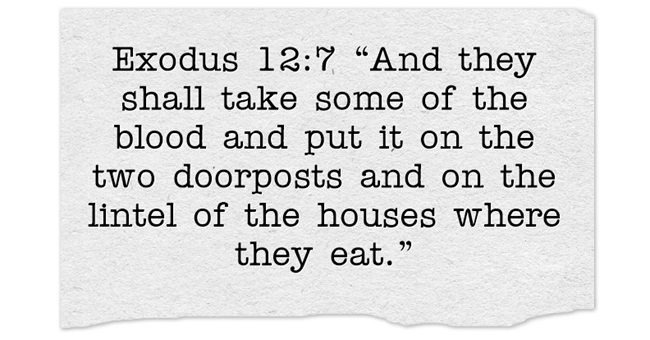
Exodus 12:7 “And they shall take some of the blood and put it on the two doorposts and on the lintel of the houses where they eat.”
At the end of the plagues in the book of Exodus, the Israelites were told to kill an unblemished lamb and put the blood of it on their doorposts, so that the spirit of God would literally pass over (where they get Passover from) the houses and spare them from death. Once again, the color (blood is red…just a reminder!) has two meanings: death, because the lamb shed its blood, but also redemption because it spared those who had it on their doorposts.
Jesus’ blood
All of this culminates within the blood of Jesus. Passover, ultimately, was a foreshadow of a greater one to come. Instead of a lamb, Jesus shed His blood for the world. And, “whosever believes in Him should not perish but have everlasting life” (John 3:16). It is our sin that Jesus had to die for and He willingly paid the price so that all can have access to the Father through Him, so long as they accept it. Even Jesus, when talking to His disciples about communion, said “for this is My blood of the new covenant, which is shed for many for the remissions of sins” (Matthew 26:28). The price for sin can only be paid through the shedding of blood; the Old Testament made that very clear. Once again, as a foreshadowing of Jesus to come, the sacrificial system made the Israelites slaughter lambs in order to atone for their sins. Jesus is our sacrificial lamb, the one without blemish. Because He died, we can live.
Conclusion
Red is a very powerful color in the Bible. It speaks of the sin that all mankind holds, but also of the redemption that everyone has access to because of Jesus shedding His blood on the cross. Had it not been for His sacrifice, people would have no longstanding way of atoning for their sins. Although in the Old Testament people slaughtered goats and other animals to do so, it was a temporary fix. Jesus, however, through His blood made the final price once and for all. So, the color red in the Bible (also scarlet and crimson) can symbolize both sin and redemption, but either way they point to some type of blood sacrifice and needful redemption.
Article By Michael Krauzer
Michael Krauszer is the founder of ChristianLitReview.com, a website dedicated to providing a Christian perspective on all forms of literature. Additionally, Michael has been a full-time staff member at Calvary Chapel Old Bridge for the last four years, working as a Ministry Assistant and Pastoral Intern. He received his Bachelor of Arts in English from The College of New Jersey and is currently in pursuit of his MA in Theological Studies from Veritas Evangelical Seminary. Michael is also a Christian freelance writer and you can find some of his writing at FaithAndEntertainment. Visit Michael’s Facebook page here: Christian Literature Review
Previous Post

November 3, 2014
What Does The Color Gold Mean Or Symbolize In The Bible
Next Post
November 4, 2014 What Does the Number Four (4) Mean or Represent in the Bible?
Browse Our Archives
Select a Category Bible Answers Bible Definitions Bible Story Bible Study Bible Verses Christian Books Christian Entertainment Christian Fathers Christian Mothers Christian Quotes Devotional Famous Christians Music News Parables Prayers Quotes Sunday School Lesson Uncategorized Youth Sermons
Select a Month October 2019 September 2019 August 2019 July 2019 June 2019 May 2019 April 2019 March 2019 February 2019 January 2019 December 2018 November 2018 October 2018 September 2018 August 2018 July 2018 June 2018 May 2018 April 2018 March 2018 February 2018 January 2018 December 2017 November 2017 October 2017 September 2017 August 2017 July 2017 June 2017 May 2017 April 2017 March 2017 February 2017 January 2017 December 2016 November 2016 October 2016 September 2016 August 2016 July 2016 June 2016 May 2016 March 2016 February 2016 January 2016 December 2015 November 2015 October 2015 September 2015 August 2015 July 2015 June 2015 May 2015 April 2015 March 2015 February 2015 January 2015 December 2014 November 2014 October 2014 September 2014 August 2014 July 2014 June 2014 May 2014 April 2014 March 2014 February 2014 January 2014 December 2013 November 2013 October 2013 September 2013 August 2013 July 2013 June 2013 May 2013 April 2013 March 2013
Follow Us!
TAKE THE
Religious Wisdom Quiz
Who said, "May your God, whom you serve continually, rescue you"?
Select your answer to see how you score.
Daniel The chief guard King Darius An angel
Related posts from Christian Crier

What Does The Bible Say About Our Thoughts?

Top 13 Bible Verses About Virtue

Do Colors Have Special Meaning In The Bible?

The Greatest Father In History
TRENDING AT PATHEOS Evangelical

The REST of Your Life: A Creative Wrestles...
This week I had a conversation with a good friend from church....

How the author of the world's best hymn...
I've been working with John Newton for a while now. This makes...

Long before this Lectio Divina, Psalm 130 - the song - started...

What About the Trees? Another Living Parable
After I finished writing the last article about falling leaves as a...

Why Classical Education Is a Conversation, Not a...
Come and Read: Joy in Classical Education When I was a little...

Cornell University has received a great deal of negative publicity and intense...
view all Evangelical blogs
Ad-Free & Subscriber Log-In Subscription Support
- About Us
- 2026 Calendar
- Videos
- Podcasts
- Library of World Religions
- Faith In Media Tracker
- Advertise With Us
- Write for Us
- Privacy Policy
- Terms of Service
- Do Not Sell My Data
- Contact Us
- Radiant Digital
- Manage Newsletter Subscriptions
- Unsubscribe From Notifications
- Sitemap
Copyright 2008-2026, Patheos. All rights reserved.
Subscription Support Ad-Free & Subscriber Log-In
Follow Patheos