
BuddhistCatholicContemplativeEvangelicalGeneral ChristianHinduJewishLatter-day SaintMuslimNew VisionsProgressive Christian
Beliefs
- Buddhist
- Catholic
- Contemplative
- Evangelical
- General Christian
- Hindu
- Jewish
- Latter-day Saint
- More Voices
- Muslim
- New Visions
- Pagan
- Progressive Christian
Topics
- Religion News
- Food and Religion
- Sports and Religion
- Religious Art
- Religious Music and Entertainment
- Religious Events
- History and Religion
- Style and Religion
- Politics and Religion
- Women in Religion
- Recreation Outdoors and Religion
- Business Finance and Religion
- Careers Workplace and Religion
- Education and Religion
- Family Parenting and Religion
- Health Fitness and Religion
- Home and Religion
- Relationships and Religion
- Technology and Religion
- Travel and Religion
Columnists
- Buddhist Columnists
- Business Finance and Religion Columnists
- Careers Workplace and Religion Columnists
- Catholic Columnists
- Contemplative Columnists
- Education and Religion Columnists
- Evangelists Columnists
- Family Parenting and Religion Columnists
- General Christian Columnists
- Health Fitness and Religion Columnists
- Hindu Columnists
- History and Religion Columnists
- Home and Religion Columnists
- Jewish Columnists
- More Voices Columnists
- Latter Day Columnists
- Muslim Columnists
- New Visions Columnists
- Nonreligious Columnists
- Pagan Columnists
- Politics and Religion Columnists
- Progressive Columnists
- Recreation Outdoors and Religion Columnists
- Relationships and Religion Columnists
- Religion News Columnists
- Religious Art Columnists
- Religious Events Columnists
- Religious Music and Entertainment Columnists
- Sports and Religion Columnists
- Style and Religion Columnists
- Technology and Religion Columnists
- Travel and Religion Columnists
- Women in Religion Columnists
Resource Library
- 2026 Calendar
- Library of World Religions
- The 100 Most Holy Places on Earth
- Patheos Answers
- Podcasts
- Videos
- Faith Leaders Database
- Anglican Episcopalian
- Bahai
- Baptist
- Buddhism
- Christianity
- Confucianism
- Eastern Orthodoxy
- Hinduism
- Holiness and Pentecostal
- ISKCON
- Islam
- Judaism
- Lutheran
- Methodist
- The Church of Jesus Christ of Latter-day Saints
- New Age
- Paganism
- Presbytarian and Reformed
- Protestantism
- Religion Behind the Scenes
- Roman Catholic
- Scientology
- Shia Islam
- Sikhism
- Sufism
- Sunni Islam
- Taoism
- Zen
- See all religions
Research Tools
 Ad-Free & Subscriber Log-In Subscription Support
Ad-Free & Subscriber Log-In Subscription Support
Follow Patheos 

- Trending:
- Forgiveness
- |
- Marriage
- |
- Consciousness
- |
- Death Penalty
- |
- Election
- |
- Halloween
 Christian Crier
- Home
- Evangelical
- 3 Bible Stories About Courage
3 Bible Stories About Courage
Last updated on: October 23, 2014 at 8:06 pm by Dr. Michael L. Williams
3 Bible Stories About Courage 2014-10-23T20:06:04-05:00 Dr. Michael L. Williams
Patheos Explore the world's faith through different perspectives on religion and spirituality! Patheos has the views of the prevalent religions and spiritualities of the world.
Courage is a word that is used in variety of ways. For many Christians, courage is a word that brings to mind standing on Biblical principles in the face of great opposition. Others think courage is demonstrated by taking a stance against Biblical principles. Either way, the Bible has plenty to say about what defines courage, which we will see by looking at three Bible stories about courage.
What is the definition of courage?
The word courage is commonly defined as (1): (Noun)”The ability to do something that frightens one.” It originates from Middle English (denoting the heart, as the seat of feelings): from Old French corage, from Latin cor “heart.” Simply stated, this common definition refers to the ability to do something brave out of a motivation from the heart.
What does the Bible teach about courage?
The Bible makes references to courage in several ways:
-
God approves of good courage: Deuteronomy 31:6-8, 23; Joshua 1:1-18; Joshua 10:25; 1 Chronicles 28:20; 2 Chronicles 19:11; Psalms 27:14; Psalms 31:24
-
God destroys evil courage: Amos 2:16
-
God uses believers to instill courage or encourage one another: Deuteronomy 1:38; Deuteronomy 3:28; Acts 28:15; Ephesians 4; Hebrews 10:24
-
Sometimes believers and non-believers encourage or provoke others to do bad things: Deuteronomy 13:6-8; 2 Samuel 1:14-17; Psalms 64:5’ Proverbs 1:10; Ephesians 6:4
-
God strengthens the hearts of believers who show good courage: Psalms 27:14; Psalms 31:24
Biblical courage, is the ability to do something brave out of a motivation of the heart. However, Biblical courage that is good always relies upon the supernatural power of God to strengthen and motivate the believer to be courageous (Romans 5:3-5). The following three stories demonstrate Biblical good courage.
Joshua and Caleb
In Numbers 13-14, God told Moses to send a spy from every tribe into the Canaan, also known as the Promised Land, and report back what they found. They were told to report back about the land, the people living there, the cities, and what natural resources are available (Number 13:17-20). After spying out the land they returned and gave their report.
The first group of spies told how the land was bountiful and proved their report by bringing back a large amount of grapes, pomegranates, and figs. However, they then reported that the people were too numerous and powerful and how the walls of their cities were too great to overcome.
Upon hearing this, Caleb from the tribe of Judah, calmed the people and said that they should immediately go up and take the land because they could do it. However, the men who had gone up with him countered by saying they could not do it because the land was so large and the inhabitants were bigger, stronger, and more numerous.
When the people heard this report they responded with crying, complaining, and murmuring all night long against Moses and Aaron for bringing them out of Egypt to die in the wilderness. Upon hearing this, Moses and Aaron fell upon their faces, rent their clothes, and challenged the people, telling them that the land was good and the LORD would give it to them. They continued saying they should not rebel against the LORD. The people responded by saying they were going to stone Moses and Aaron.
At this time the glory of the Lord intervened. He rebuked the people and told them of how He had provided for them, but they had continually rebelled against Him. He then said everyone who was 20 years old and older would die in the wilderness at the hands of their enemies and those under 20 years old would go into the Promised Land with Caleb and Joshua who had trusted the LORD (Deuteronomy 1:35-36).
David and Goliath
The most famous story in the Bible, especially amongst children, is the story of David and Goliath. David is first told of as a shepherd and the youngest of eight boys in 1 Samuel 16 when he was anointed the new King of Israel by Samuel. David’s encounter with Goliath, a giant, is found in 1 Samuel 17. Goliath was a Philistine warrior who was fighting against the Israelites and stood about 18 feet, 6 inches tall. He challenged the Israelites to send a man to fight him saying that if he was defeated, the Philistines would be servants to the Israelites.
One day David’s father sent him to take food to his three oldest brothers who were serving in Saul’s army fighting against the Philistines. David saw how afraid the men were of Goliath and asked who this heathen Philistine was that shamed Israel and defied the armies of the living God. David’s brothers heard this and became mad at him and told him to go home to tend the sheep. David responded by asking what he had done and if there was not a cause, referring to the importance of the matter that someone do something.
Soon, King Saul heard of David’s words and sent for him. David told Saul he would fight against Goliath, but was told that he was nothing more than a boy. David responded by telling of the wild animals he had killed while tending to the sheep and how he would do the same to the giant. King Saul then agreed to send David to fight. David refused to wear the king’s armor and instead chose to go with nothing but his staff and a sling. David chose five smooth stones from a brook and went up to confront Goliath.
Goliath belittled David and was insulted that the Israelites had sent a small boy to fight. Goliath threatened to kill David and feed him to the birds and animals, but David replied that although Goliath threatened him with a sword and a spear, he was going to fight Goliath in the name of the LORD and the God of the armies of Israel, whom Goliath defiled. David then took a stone and slang it at the giant using his sling and hit the giant in the forehead. The stone killed the giant and David took the giant’s sword and cut off his head. Upon seeing this, the Philistines fled.
Peter and John
In Acts 3-4 Peter and John went to the temple to pray when they encountered a man at the temple gate who was lame from birth. The man asked them for money, but Peter replied that they had none and added that by the name of Jesus Christ of Nazareth to rise up and walk. The man was immediately healed and began walking and leaping and praising God.
His healing drew a large crowd and Peter began to preach to them about Jesus Christ of Nazareth. He told of how Jesus was crucified, buried, and rose from the dead and challenged them to repent and receive the forgiveness of sins and salvation. Upon hearing this preaching, the religious leaders were upset and put them in jail.
The next day the religious leaders brought Peter and John before them and demanded they explain by what power and in whose name did they do what they did. Peter, being filled with the Holy Ghost, challenged them about why they were upset about the healing. They gave the credit to Jesus Christ for the healing and how salvation was through Him.
After hearing this the religious leaders decided to tell Peter and John not to speak or teach in the name of Jesus. Peter replied by saying, “Whether it be right in the sight of God to harken unto you more than unto God, judge ye, but we cannot but speak of the things we have heard and seen.” (Acts 4:19-20) After Peter said this, the religious leaders threatened them and let them go. Peter and John returned to their group of friends and rejoiced together and glorified God.
Later, the apostles were again healing and preaching in the name of Jesus when they were taken into custody by the same religious leaders. They were upset that they had told Peter and John not to speak or teach in the name of Jesus and now the whole city was talking about Jesus and His doctrine. Peter once again stood up and said that they would obey God rather than man and continued by accusing them of killing Jesus, who was the Savior.
Upon hearing this, the religious leaders discussed killing them, but instead, decided to beat them and release them. The apostles, once again, rejoiced and praised God because they were counted worthy to suffer for His name.
Conclusion: What can we learn from these three stories about courage?
- Caleb and Joshua: No matter how things may look or if we do not know what to do in a situation, we can always have courage because we can trust the LORD’s promises. Those who trust the LORD are blessed, starting with salvation and continuing with overcoming the world (1 John 5:4-5)
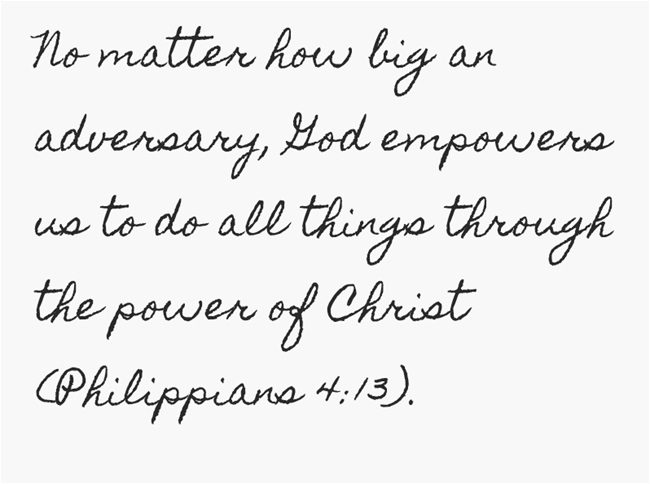
- David and Goliath: No matter how big an adversary, God empowers us to do all things through the power of Christ (Philippians 4:13). This gives us courage even when it seems like the whole world, including our family, tries to discourage us. By standing for what is right and just in the name of the LORD, God will enable us to do great things (John 14:12-14).
- Peter and John: When we do the work of the Lord and share His Word, people get upset. Some people will get so upset that they will think they are doing God’s will by persecuting or even killing us (John 16:1-3; 2 Timothy 3:10-12). However, God says that if we have the courage to suffer for Him by doing right with Christ as our example, it is worthy of God’s praise and glorifies Him (1 Peter 18-25).
Another Patheos Reading: How Does The Bible Define True Beauty?
 Article By Dr. Michael Williams
Dr. Michael L. Williams is a pastor, author, Christian educator and Biblical counselor who has served in ministry since March of 2000. Dr. Mike holds under-graduate through post graduate degrees in Christian Education and formerly worked as a nurse. Dr. Mike is the Senior Pastor of Selah Mountain Ministries, which he founded in March of 2010 in Albuquerque, New Mexico, USA (selahmountain.org). In addition to counseling, he teaches how to overcome life issues Biblically on topics such as anger management, marriage, addictions, and other subjects typically referred to as mental illnesses. Dr. Mike is also a writer at What Christians Want To Know. Dr. Mike lives with his wife Pamela Rose and adult daughter Hollie Rose. He and Pamela have other adult children and several grandchildren as well. Learn more about Dr. Mike at his personal ministry web site Wisdom4Today
Resources – Scripture quotations are from The Holy Bible, King James Version. (1) Google. (2014). “Courage”. Retrieved from https://www.google.com/?gws_rd=ssl#q=courage
Previous Post

October 21, 2014
Top 7 Bible Verses About Your Heart
Next Post
October 25, 2014 Top 7 Verses About Following God
Browse Our Archives
Select a Category Bible Answers Bible Definitions Bible Story Bible Study Bible Verses Christian Books Christian Entertainment Christian Fathers Christian Mothers Christian Quotes Devotional Famous Christians Music News Parables Prayers Quotes Sunday School Lesson Uncategorized Youth Sermons
Select a Month October 2019 September 2019 August 2019 July 2019 June 2019 May 2019 April 2019 March 2019 February 2019 January 2019 December 2018 November 2018 October 2018 September 2018 August 2018 July 2018 June 2018 May 2018 April 2018 March 2018 February 2018 January 2018 December 2017 November 2017 October 2017 September 2017 August 2017 July 2017 June 2017 May 2017 April 2017 March 2017 February 2017 January 2017 December 2016 November 2016 October 2016 September 2016 August 2016 July 2016 June 2016 May 2016 March 2016 February 2016 January 2016 December 2015 November 2015 October 2015 September 2015 August 2015 July 2015 June 2015 May 2015 April 2015 March 2015 February 2015 January 2015 December 2014 November 2014 October 2014 September 2014 August 2014 July 2014 June 2014 May 2014 April 2014 March 2014 February 2014 January 2014 December 2013 November 2013 October 2013 September 2013 August 2013 July 2013 June 2013 May 2013 April 2013 March 2013
Follow Us!
TAKE THE
Religious Wisdom Quiz
Who suggested throwing Moses into the Nile as a baby?
Select your answer to see how you score.
Pharaoh A Hebrew midwife Miriam Pharaoh's daughter
Related posts from Christian Crier

The Uniqueness Of The Brethren Church

The Living, Active, Word Of God

Blind Bartimaeus And The Salvation Of The Sinner

TRENDING AT PATHEOS Evangelical

The REST of Your Life: A Creative Wrestles...
This week I had a conversation with a good friend from church....

How the author of the world's best hymn...
I've been working with John Newton for a while now. This makes...

Long before this Lectio Divina, Psalm 130 - the song - started...

What About the Trees? Another Living Parable
After I finished writing the last article about falling leaves as a...

Why Classical Education Is a Conversation, Not a...
Come and Read: Joy in Classical Education When I was a little...

Cornell University has received a great deal of negative publicity and intense...
view all Evangelical blogs
Ad-Free & Subscriber Log-In Subscription Support
- About Us
- 2026 Calendar
- Videos
- Podcasts
- Library of World Religions
- Faith In Media Tracker
- Advertise With Us
- Write for Us
- Privacy Policy
- Terms of Service
- Do Not Sell My Data
- Contact Us
- Radiant Digital
- Manage Newsletter Subscriptions
- Unsubscribe From Notifications
- Sitemap
Copyright 2008-2026, Patheos. All rights reserved.
Subscription Support Ad-Free & Subscriber Log-In
Follow Patheos