
BuddhistCatholicContemplativeEvangelicalGeneral ChristianHinduJewishLatter-day SaintMuslimNew VisionsProgressive Christian
Beliefs
- Buddhist
- Catholic
- Contemplative
- Evangelical
- General Christian
- Hindu
- Jewish
- Latter-day Saint
- More Voices
- Muslim
- New Visions
- Pagan
- Progressive Christian
Topics
- Religion News
- Food and Religion
- Sports and Religion
- Religious Art
- Religious Music and Entertainment
- Religious Events
- History and Religion
- Style and Religion
- Politics and Religion
- Women in Religion
- Recreation Outdoors and Religion
- Business Finance and Religion
- Careers Workplace and Religion
- Education and Religion
- Family Parenting and Religion
- Health Fitness and Religion
- Home and Religion
- Relationships and Religion
- Technology and Religion
- Travel and Religion
Columnists
- Buddhist Columnists
- Business Finance and Religion Columnists
- Careers Workplace and Religion Columnists
- Catholic Columnists
- Contemplative Columnists
- Education and Religion Columnists
- Evangelists Columnists
- Family Parenting and Religion Columnists
- General Christian Columnists
- Health Fitness and Religion Columnists
- Hindu Columnists
- History and Religion Columnists
- Home and Religion Columnists
- Jewish Columnists
- More Voices Columnists
- Latter Day Columnists
- Muslim Columnists
- New Visions Columnists
- Nonreligious Columnists
- Pagan Columnists
- Politics and Religion Columnists
- Progressive Columnists
- Recreation Outdoors and Religion Columnists
- Relationships and Religion Columnists
- Religion News Columnists
- Religious Art Columnists
- Religious Events Columnists
- Religious Music and Entertainment Columnists
- Sports and Religion Columnists
- Style and Religion Columnists
- Technology and Religion Columnists
- Travel and Religion Columnists
- Women in Religion Columnists
Resource Library
- 2026 Calendar
- Library of World Religions
- The 100 Most Holy Places on Earth
- Patheos Answers
- Podcasts
- Videos
- Faith Leaders Database
- Anglican Episcopalian
- Bahai
- Baptist
- Buddhism
- Christianity
- Confucianism
- Eastern Orthodoxy
- Hinduism
- Holiness and Pentecostal
- ISKCON
- Islam
- Judaism
- Lutheran
- Methodist
- The Church of Jesus Christ of Latter-day Saints
- New Age
- Paganism
- Presbytarian and Reformed
- Protestantism
- Religion Behind the Scenes
- Roman Catholic
- Scientology
- Shia Islam
- Sikhism
- Sufism
- Sunni Islam
- Taoism
- Zen
- See all religions
Research Tools
 Ad-Free & Subscriber Log-In Subscription Support
Ad-Free & Subscriber Log-In Subscription Support
Follow Patheos 

- Trending:
- Forgiveness
- |
- Marriage
- |
- Consciousness
- |
- Death Penalty
- |
- Election
- |
- Halloween
 Christian Crier
- Home
- Evangelical
- Did Jesus Visit Hell? What Does The Bible Teach?
Did Jesus Visit Hell? What Does The Bible Teach?
Last updated on: March 25, 2015 at 7:46 am by Jack Wellman
Did Jesus Visit Hell? What Does The Bible Teach? 2015-03-25T07:46:54-05:00 Jack Wellman
Patheos Explore the world's faith through different perspectives on religion and spirituality! Patheos has the views of the prevalent religions and spiritualities of the world.
Many interpret 1 Peter 3:19 where Jesus “preached to the spirits in prison” as Jesus going to hell to preach to these spirits? Who were these spirits? The lost or the saved or even the demons?
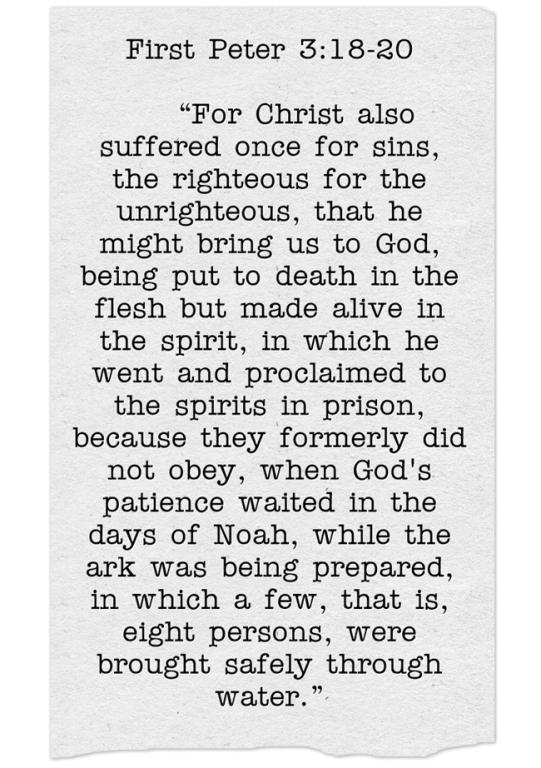
First Peter 3:18-20
“For Christ also suffered once for sins, the righteous for the unrighteous, that he might bring us to God, being put to death in the flesh but made alive in the spirit, in which he went and proclaimed to the spirits in prison, because they formerly did not obey, when God’s patience waited in the days of Noah, while the ark was being prepared, in which a few, that is, eight persons, were brought safely through water.”
The Athanasian and the Apostle’s Creed
The Apostle’s Creed says that is was Jesus “Who was conceived by the Holy Ghost, born of the Virgin Mary, suffered under Pontius Pilate, was crucified, died, and buried; He descended into hell, the third day He rose again from the dead.” The Athanasian Creed states: “He suffered death for our salvation. He descended into hell and rose again from the dead.” There is even the apocryphal Gospel of Nicodemus, which dates from the fifth century A.D. which claims that Jesus descended into hell and retrieved all the Old Testament saints, including Adam, David, Habakkuk, and Isaiah however any books that are not part of the canonized books of the Bible are apocryphal and are not accepted as God-breathed so this “gospel” from Nicodemus is not a reliable source at all (see James, 1924, pp. 125ff.).
Even so, did Jesus preach to these Old Testament saints? There is no evidence to support this from the 66 books of the Bible plus 1 Peter 3:18 talks about those who “formerly did not obey, when God’s patience waited in the days of Noah, while the ark was being prepared” so it is not likely that David, Habakkuk, and Isaiah could be considered as those who “formerly did not obey” although Adam certainly did. However if you look at the context, verse 18 leads into the fact that only “a few, that is, eight persons, were brought safely through water” were saved so in my opinion, these “spirits in prison” were those who rejected 120 years of the righteous preaching of Noah.
These ancient church creeds state it more boldly than does 1 Peter 3:19 which only says that Jesus went and “proclaimed to the spirits in prison.” The creeds state that Jesus “descended into hell” but does that mean the place where those who are condemned are at? Does this mean that Jesus had to suffer and die on the cross and then suffer for a time in hell? No, that is not what this verse or these creeds are saying at all. Others Bible scholars see the time after Jesus’ death and before His resurrection where He descended into hell and was when He preached His victory to the spirits of Noah’s wicked contemporaries who are not confined to the realm of the dead. 1 Yet others believe that Christ proclaimed His triumph on the cross to the fallen angels or demons. There are even some reputable scholars that say only Jesus’ living spirit traveled to the imprisoned demon spirits currently held in the abyss and proclaimed that He had triumphed over the Devil and death.
Who Were the Spirit’s in Prison?
As I wrote before, the “spirits in prison” to which “he went and proclaimed” His victory on the cross seems to fit the context of those who were drowned in the Noachian flood because it was “they [who] formerly did not obey, when God’s patience waited in the days of Noah…in which…eight persons were brought safely through.” These to whom Christ proclaimed His triumph were “they who formerly did not obey” and these “they” were those who heard Noah preached (God’s patience in the 120 years) in the days of Noah” and these “eight persons” were Noah, his wife and their sons and their wives. Now whether Christ in His Spirit went to proclaim victory to these who died in the flood (and the flood is symbolic of God’s judgment) or to those fallen angels who caused the rebellion we cannot say for certain from this text. These “spirits in prison” could be the demons who were so heinous in their wickedness that they had to be restrained or whether these were the spirits of the deceased or maybe even both, the point Peter is making is that Christ had victory over death, over the rulers of darkness, the demons, and even Satan himself. 2
Did Jesus Suffer in Hell?
1 Peter 3:18 says “For Christ also suffered once for sins, the righteous for the unrighteous, that he might bring us to God, being put to death in the flesh but made alive in the spirit” but notice that is says Christ also suffered once for sins.” If Christ had to suffer and die and then descended into hell to suffer again, then He wouldn’t have suffered “once for sins” but twice and wouldn’t that be double jeopardy? The idea that Jesus had to suffer and die and then after that, go to hell to suffer for three days between His death and His resurrection contradicts the many Scriptures that say we are saved by the blood of the Lamb, He died on the cross for sinners, and God’s promise that “he was not abandoned to Hades, nor did his flesh see corruption” (Acts 2:27, 31) where the David the Psalmist is quoted. Jesus would not have to go to Hades because by His death He paid for the sins of the world (John 3:16) and besides Jesus said “you, Capernaum, will you be exalted to heaven? You shall be brought down to Hades” (Luke 10:15) and the rich man was sent to “Hades, being in torment, he lifted up his eyes and saw Abraham far off and Lazarus at his side” (Luke 16:23) so Jesus could not be assigned to go to a place and suffer where He said was prepared for the damned.
Conclusion
The “hell” that Jesus descended in was a grave for there are three words that are used for hell but the one Jesus was said to have been placed was the word used for a grave and not the word used for the hell of judgment that we generally think of when we think of the word hell. This is clear because both of the early church creeds say that “He descended into hell (the grave) and rose again from the dead” because the hell as we understand it as being the place where the condemned go too is the place where one cannot return from, just like the rich man in the parable that Jesus told of the Rich Man and Lazarus.
Whatever you believe, you must believe on the Lord Jesus Christ to be saved (Acts 4:12; 16:30-31) to avoid being condemned by your disbelief (John 3:18). You must repent and confess your sins and place your trust in the Savior or you too will go to the place where those who rejected Noah’s preaching, the place where the rich man is in torment right now, and where everyone who chooses to not believe, will all go. I pray that is not you because there will be no escape from that hell (Rev 20:11-15) and so if you won’t harden your heart, make today your day of salvation (2 Cor 6:2) and you too will be saved.
A good book to check out: 7 Biblical Signs Of The End Times
Another Reading on Patheos to Check Out: What Did Jesus Really Look Like: A Look at the Bible Facts
 Article by Jack Wellman
Jack Wellman is Pastor of the Mulvane Brethren church in Mulvane Kansas. Jack is also the Senior Writer at What Christians Want To Know whose mission is to equip, encourage, and energize Christians and to address questions about the believer’s daily walk with God and the Bible. You can follow Jack on Google Plus or check out his book Blind Chance or Intelligent Design available on Amazon
1. R. C. Sproul, Gen Ed., The Reformation Study Bible. (Lake Mary, FL: Ligonier Ministries, 2005), 1815.
2. John MacArthur, Gen. Ed., The MacArthur Study Bible. (Wheaton, ILL: Crossway Publishers,2010). 1894.
James, M.R., trans. (1924), The Apocryphal New Testament (Oxford: Clarendon Press).
Previous Post

June 21, 2014
How Many Brothers and Sisters Did Jesus Have?
Next Post
June 22, 2014 Top 7 Bible Verses About Forgiveness
Browse Our Archives
Select a Category Bible Answers Bible Definitions Bible Story Bible Study Bible Verses Christian Books Christian Entertainment Christian Fathers Christian Mothers Christian Quotes Devotional Famous Christians Music News Parables Prayers Quotes Sunday School Lesson Uncategorized Youth Sermons
Select a Month October 2019 September 2019 August 2019 July 2019 June 2019 May 2019 April 2019 March 2019 February 2019 January 2019 December 2018 November 2018 October 2018 September 2018 August 2018 July 2018 June 2018 May 2018 April 2018 March 2018 February 2018 January 2018 December 2017 November 2017 October 2017 September 2017 August 2017 July 2017 June 2017 May 2017 April 2017 March 2017 February 2017 January 2017 December 2016 November 2016 October 2016 September 2016 August 2016 July 2016 June 2016 May 2016 March 2016 February 2016 January 2016 December 2015 November 2015 October 2015 September 2015 August 2015 July 2015 June 2015 May 2015 April 2015 March 2015 February 2015 January 2015 December 2014 November 2014 October 2014 September 2014 August 2014 July 2014 June 2014 May 2014 April 2014 March 2014 February 2014 January 2014 December 2013 November 2013 October 2013 September 2013 August 2013 July 2013 June 2013 May 2013 April 2013 March 2013
Follow Us!
TAKE THE
Religious Wisdom Quiz
Who was called by God to leave his home and go to a land God would show him?
Select your answer to see how you score.
Abram Jacob Moses Noah
Related posts from Christian Crier

What Does The Bible Say About Our Thoughts?

Do Colors Have Special Meaning In The Bible?

The Glass – Half Empty Or Half Full?

TRENDING AT PATHEOS Evangelical

How the author of the world's best hymn...
I've been working with John Newton for a while now. This makes...

Long before this Lectio Divina, Psalm 130 - the song - started...

What About the Trees? Another Living Parable
After I finished writing the last article about falling leaves as a...

Why Classical Education Is a Conversation, Not a...
Come and Read: Joy in Classical Education When I was a little...

Falling Leaves: A Living Parable on Letting Go
I’ve spent the vast majority of my life in the southeast corner...

Cornell University has received a great deal of negative publicity and intense...
view all Evangelical blogs
Ad-Free & Subscriber Log-In Subscription Support
- About Us
- 2026 Calendar
- Videos
- Podcasts
- Library of World Religions
- Faith In Media Tracker
- Advertise With Us
- Write for Us
- Privacy Policy
- Terms of Service
- Do Not Sell My Data
- Contact Us
- Radiant Digital
- Manage Newsletter Subscriptions
- Unsubscribe From Notifications
- Sitemap
Copyright 2008-2026, Patheos. All rights reserved.
Subscription Support Ad-Free & Subscriber Log-In
Follow Patheos