
BuddhistCatholicContemplativeEvangelicalGeneral ChristianHinduJewishLatter-day SaintMuslimNew VisionsProgressive Christian
Beliefs
- Buddhist
- Catholic
- Contemplative
- Evangelical
- General Christian
- Hindu
- Jewish
- Latter-day Saint
- More Voices
- Muslim
- New Visions
- Pagan
- Progressive Christian
Topics
- Religion News
- Food and Religion
- Sports and Religion
- Religious Art
- Religious Music and Entertainment
- Religious Events
- History and Religion
- Style and Religion
- Politics and Religion
- Women in Religion
- Recreation Outdoors and Religion
- Business Finance and Religion
- Careers Workplace and Religion
- Education and Religion
- Family Parenting and Religion
- Health Fitness and Religion
- Home and Religion
- Relationships and Religion
- Technology and Religion
- Travel and Religion
Columnists
- Buddhist Columnists
- Business Finance and Religion Columnists
- Careers Workplace and Religion Columnists
- Catholic Columnists
- Contemplative Columnists
- Education and Religion Columnists
- Evangelists Columnists
- Family Parenting and Religion Columnists
- General Christian Columnists
- Health Fitness and Religion Columnists
- Hindu Columnists
- History and Religion Columnists
- Home and Religion Columnists
- Jewish Columnists
- More Voices Columnists
- Latter Day Columnists
- Muslim Columnists
- New Visions Columnists
- Nonreligious Columnists
- Pagan Columnists
- Politics and Religion Columnists
- Progressive Columnists
- Recreation Outdoors and Religion Columnists
- Relationships and Religion Columnists
- Religion News Columnists
- Religious Art Columnists
- Religious Events Columnists
- Religious Music and Entertainment Columnists
- Sports and Religion Columnists
- Style and Religion Columnists
- Technology and Religion Columnists
- Travel and Religion Columnists
- Women in Religion Columnists
Resource Library
- 2026 Calendar
- Library of World Religions
- The 100 Most Holy Places on Earth
- Patheos Answers
- Podcasts
- Videos
- Faith Leaders Database
- Anglican Episcopalian
- Bahai
- Baptist
- Buddhism
- Christianity
- Confucianism
- Eastern Orthodoxy
- Hinduism
- Holiness and Pentecostal
- ISKCON
- Islam
- Judaism
- Lutheran
- Methodist
- The Church of Jesus Christ of Latter-day Saints
- New Age
- Paganism
- Presbytarian and Reformed
- Protestantism
- Religion Behind the Scenes
- Roman Catholic
- Scientology
- Shia Islam
- Sikhism
- Sufism
- Sunni Islam
- Taoism
- Zen
- See all religions
Research Tools
 Ad-Free & Subscriber Log-In Subscription Support
Ad-Free & Subscriber Log-In Subscription Support
Follow Patheos 

- Trending:
- Forgiveness
- |
- Marriage
- |
- Consciousness
- |
- Death Penalty
- |
- Election
- |
- Halloween
 Christian Crier
- Home
- Evangelical
- What Does Praying Without Ceasing Mean in the Bible?
What Does Praying Without Ceasing Mean in the Bible?
Last updated on: May 22, 2014 at 8:00 am by Jack Wellman
What Does Praying Without Ceasing Mean in the Bible? 2014-05-21T17:11:49-05:00 Jack Wellman
Patheos Explore the world's faith through different perspectives on religion and spirituality! Patheos has the views of the prevalent religions and spiritualities of the world.
Paul speaks about praying without ceasing or stopping? How is this possible in the life of the Christian? Let’s examine from the Bible what it means to pray without ceasing.
What is Prayer?
I know this sounds like a question that is obvious, but permit me to go a bit deeper on what the word prayer means. Prayer is not repeating a bunch of words using language that goes over certain words to make them sound grand. Prayer is really just talking to God. It is speaking with God, reverently of course, but it is simply pouring out your heart to God Who loves you. Just tell Him what you feel and what burdens you carry. He wants to hear your genuine, sincere, heartfelt concerns. As a father and grandfather, I want my children and grandchildren to communicate to me just what they are feeling and what weighs heavily on their minds. It’s about abandoning all pride, admitting our weaknesses, displaying our needs to Him verbally (if possible), and doing so with the full realization that He is there and He is listening. There is one problem; our prayers can be blocked or hindered when we have unconfessed sin or when we have something against someone and have refused to forgive them. We must first be able to clear our conscience of anything that we have done wrong and anyone that we have wronged.
If you are a child of God and have been born again (John 3:3) which means that at one point in your life you have repented and trusted in Christ, then you know He will hear your prayers and He will answer them. Sometimes the prayers are answered like this; “No, not yet, or I have something better for you” but He does answer them. Even Jesus, when He prayed three times in the Garden was told no in His desire to “have this cup pass from” Him because Jesus knew that the will of the Father supersedes what we want or think we need (Luke 22:39-46). Paul also prayed three times, pleading (or begging) Him to have this thorn in the flesh removed but God told him “my grace is sufficient” (2 Cor 12:7-10) because in Paul’s weaknesses, the strength of God could be revealed and when we are weak, we are really strong (2 Cor 12:10).
Praying at all Times
Ephesians 6:18-20 “praying at all times in the Spirit, with all prayer and supplication. To that end keep alert with all perseverance, making supplication for all the saints, and also for me, that words may be given to me in opening my mouth boldly to proclaim the mystery of the gospel, for which I am an ambassador in chains, that I may declare it boldly, as I ought to speak.”
Paul commands the church at Ephesus to be “praying at all times” and to do this in the Spirit or in the power of the Holy Spirit for the “the Spirit helps us in our weakness. For we do not know what to pray for as we ought, but the Spirit himself intercedes for us with groanings too deep for words. And he who searches hearts knows what is the mind of the Spirit, because the Spirit intercedes for the saints according to the will of God” (Rom 8:26-27). Paul requested the prayers of the saints and especially for his boldness in what he “ought to speak” because he was called to proclaim the gospel to the Gentiles, even thou he frequently did to the Jews as well.
Praying Without Ceasing
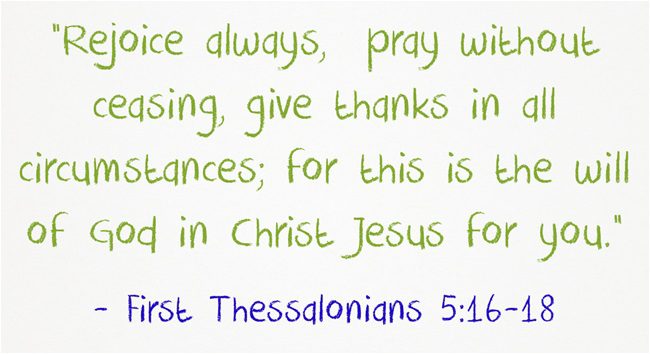
First Thessalonians 5:16-18 “Rejoice always, pray without ceasing, give thanks in all circumstances; for this is the will of God in Christ Jesus for you.”
It is God’s will that we give thanks. It is God’s will that we give thanks no matter what our circumstances are. It is God’s will for us to rejoice in Christ. And it is also God’s will that we “pray without ceasing.” This doesn’t mean that we quit our jobs and ignore our family and friends so that we can pray continuously. What this means is that we are to pray as often as we can. We can pray during times where we are driving, when we are waiting for something, when we are in between jobs, when we are at lunch but it also clearly means that we should be praying first thing in the morning and just before bedtime. If a person prays before they begin their day and praying for God’ will to be done and that He is glorified in what we do, say, or think, we know God will hear and answer this prayer. Yes, we can pray for our own needs but we need to be on our face before God to pray for the church, the pastor, our friends who don’t know Christ, and for anyone that we might come into contact with that we would have the opportunity to proclaim the gospel of Jesus Christ.
Prayer Changes Things, and You, Not God
Prayer never changes God but it does change us and it changes things. It teaches us to align our will with the Father’s for we must always pray for God’s will to be done (Rom 8:27; Col 1:9; Luke 22:39-46). We know the obvious will of God, like in Romans 12:1-3 you (and me) are commanded to “to present your bodies as a living sacrifice, holy and acceptable to God, which is your spiritual worship. Do not be conformed to this world, but be transformed by the renewal of your mind, that by testing you may discern what is the will of God, what is good and acceptable and perfect.” To have our minds renewed we need to be in prayer as often as possible, we need to transform our minds by staying in the Word of God daily, and by this we can test and “discern what is the will of God [and] what is good and acceptable and perfect” to the Father.
Conclusion
If you are not a child of God, He will not answer your prayers (John 9:31) but if you are a child of God, all we have to do is “Ask, and it will be given to you; seek, and you will find; knock, and it will be opened to you. For everyone who asks receives, and the one who seeks finds, and to the one who knocks it will be opened [because]which one of you, if his son asks him for bread, will give him a stone? Or if he asks for a fish, will give him a serpent? If you then, who are evil, know how to give good gifts to your children, how much more will your Father who is in heaven give good things to those who ask him” (Matt 7:7-11). God will hear and answer your prayers but sometimes we don’t get what we need or desire because we simply don’t ask or we don’t ask the right thing, which must be in accord with God’s will. James wrote that “You do not have, because you do not ask. You ask and do not receive, because you ask wrongly, to spend it on your passions” (James 4:2b-3). Pray big time prayers too that we know are God’s will because if your earthly father gave you things that you asked for, “how much more will your Father who is in heaven give good things to those who ask him” (Matt 7:11b)!
Another Reading on Patheos to Check Out: What Did Jesus Really Look Like: A Look at the Bible Facts
 Article by Jack Wellman
Jack Wellman is Pastor of the Mulvane Brethren church in Mulvane Kansas. Jack is also the Senior Writer at What Christians Want To Know whose mission is to equip, encourage, and energize Christians and to address questions about the believer’s daily walk with God and the Bible. You can follow Jack on Google Plus or check out his book Blind Chance or Intelligent Design available on Amazon
Previous Post

May 22, 2014
What is a Covenant? A Bible Definition of Covenant
Next Post
May 22, 2014 What Is A Parable? A Bible Definition
Browse Our Archives
Select a Category Bible Answers Bible Definitions Bible Story Bible Study Bible Verses Christian Books Christian Entertainment Christian Fathers Christian Mothers Christian Quotes Devotional Famous Christians Music News Parables Prayers Quotes Sunday School Lesson Uncategorized Youth Sermons
Select a Month October 2019 September 2019 August 2019 July 2019 June 2019 May 2019 April 2019 March 2019 February 2019 January 2019 December 2018 November 2018 October 2018 September 2018 August 2018 July 2018 June 2018 May 2018 April 2018 March 2018 February 2018 January 2018 December 2017 November 2017 October 2017 September 2017 August 2017 July 2017 June 2017 May 2017 April 2017 March 2017 February 2017 January 2017 December 2016 November 2016 October 2016 September 2016 August 2016 July 2016 June 2016 May 2016 March 2016 February 2016 January 2016 December 2015 November 2015 October 2015 September 2015 August 2015 July 2015 June 2015 May 2015 April 2015 March 2015 February 2015 January 2015 December 2014 November 2014 October 2014 September 2014 August 2014 July 2014 June 2014 May 2014 April 2014 March 2014 February 2014 January 2014 December 2013 November 2013 October 2013 September 2013 August 2013 July 2013 June 2013 May 2013 April 2013 March 2013
Follow Us!
TAKE THE
Religious Wisdom Quiz
Who is the most common author of the Psalms?
Select your answer to see how you score.
Asaph David Solomon Moses
Related posts from Christian Crier

What Does The Bible Say About Our Thoughts?

Do Colors Have Special Meaning In The Bible?

The Glass – Half Empty Or Half Full?

TRENDING AT PATHEOS Evangelical

The REST of Your Life: A Creative Wrestles...
This week I had a conversation with a good friend from church....

How the author of the world's best hymn...
I've been working with John Newton for a while now. This makes...

Long before this Lectio Divina, Psalm 130 - the song - started...

What About the Trees? Another Living Parable
After I finished writing the last article about falling leaves as a...

Why Classical Education Is a Conversation, Not a...
Come and Read: Joy in Classical Education When I was a little...

Cornell University has received a great deal of negative publicity and intense...
view all Evangelical blogs
Ad-Free & Subscriber Log-In Subscription Support
- About Us
- 2026 Calendar
- Videos
- Podcasts
- Library of World Religions
- Faith In Media Tracker
- Advertise With Us
- Write for Us
- Privacy Policy
- Terms of Service
- Do Not Sell My Data
- Contact Us
- Radiant Digital
- Manage Newsletter Subscriptions
- Unsubscribe From Notifications
- Sitemap
Copyright 2008-2026, Patheos. All rights reserved.
Subscription Support Ad-Free & Subscriber Log-In
Follow Patheos