
BuddhistCatholicContemplativeEvangelicalGeneral ChristianHinduJewishLatter-day SaintMuslimNew VisionsProgressive Christian
Beliefs
- Buddhist
- Catholic
- Contemplative
- Evangelical
- General Christian
- Hindu
- Jewish
- Latter-day Saint
- More Voices
- Muslim
- New Visions
- Pagan
- Progressive Christian
Topics
- Religion News
- Food and Religion
- Sports and Religion
- Religious Art
- Religious Music and Entertainment
- Religious Events
- History and Religion
- Style and Religion
- Politics and Religion
- Women in Religion
- Recreation Outdoors and Religion
- Business Finance and Religion
- Careers Workplace and Religion
- Education and Religion
- Family Parenting and Religion
- Health Fitness and Religion
- Home and Religion
- Relationships and Religion
- Technology and Religion
- Travel and Religion
Columnists
- Buddhist Columnists
- Business Finance and Religion Columnists
- Careers Workplace and Religion Columnists
- Catholic Columnists
- Contemplative Columnists
- Education and Religion Columnists
- Evangelists Columnists
- Family Parenting and Religion Columnists
- General Christian Columnists
- Health Fitness and Religion Columnists
- Hindu Columnists
- History and Religion Columnists
- Home and Religion Columnists
- Jewish Columnists
- More Voices Columnists
- Latter Day Columnists
- Muslim Columnists
- New Visions Columnists
- Nonreligious Columnists
- Pagan Columnists
- Politics and Religion Columnists
- Progressive Columnists
- Recreation Outdoors and Religion Columnists
- Relationships and Religion Columnists
- Religion News Columnists
- Religious Art Columnists
- Religious Events Columnists
- Religious Music and Entertainment Columnists
- Sports and Religion Columnists
- Style and Religion Columnists
- Technology and Religion Columnists
- Travel and Religion Columnists
- Women in Religion Columnists
Resource Library
- 2026 Calendar
- Library of World Religions
- The 100 Most Holy Places on Earth
- Patheos Answers
- Podcasts
- Videos
- Faith Leaders Database
- Anglican Episcopalian
- Bahai
- Baptist
- Buddhism
- Christianity
- Confucianism
- Eastern Orthodoxy
- Hinduism
- Holiness and Pentecostal
- ISKCON
- Islam
- Judaism
- Lutheran
- Methodist
- The Church of Jesus Christ of Latter-day Saints
- New Age
- Paganism
- Presbytarian and Reformed
- Protestantism
- Religion Behind the Scenes
- Roman Catholic
- Scientology
- Shia Islam
- Sikhism
- Sufism
- Sunni Islam
- Taoism
- Zen
- See all religions
Research Tools
 Ad-Free & Subscriber Log-In Subscription Support
Ad-Free & Subscriber Log-In Subscription Support
Follow Patheos 

- Trending:
- Forgiveness
- |
- Marriage
- |
- Consciousness
- |
- Death Penalty
- |
- Election
- |
- Halloween
 Christian Crier
- Home
- Evangelical
- Jonah and the Whale Bible Story: Lesson, Summary and Study
Jonah and the Whale Bible Story: Lesson, Summary and Study
Last updated on: April 20, 2014 at 11:06 am by Jack Wellman
Jonah and the Whale Bible Story: Lesson, Summary and Study 2014-04-20T11:06:15-05:00 Jack Wellman
Patheos Explore the world's faith through different perspectives on religion and spirituality! Patheos has the views of the prevalent religions and spiritualities of the world.
What can we learn from Jonah and the account of the fish? Was it a whale that swallowed Jonah? Is there something that we can use from Jonah and apply it to today?
Who was Jonah?
Second Kings 14:25 refers to him as a “servant Jonah the son of Amittai, the prophet, who was of Gath-hepher” which was an ancient border town of Israel. Jonah’s name is Hebrew and means “dove” or “peace.” Jonah was to be a reluctant messenger of God who at first ran from God’s will only to discover that there is no place that God isn’t also present. He was clearly a prophet of the Northern Kingdom or the 10 Tribes of Israel which had divided from Judea (the Southern Kingdom) and were slowly becoming more and more like the pagan nations around them.
The Reluctant Prophet
Jonah was unlike most prophets in Israel. First of all, he was sent to a pagan nation and he also fiercely resisted God’s calling him to preach to Nineveh so this would date the Book of Jonah to around 760 B.C. Some scholars believe that Jonah represents Israel in that the nation resisted witnessing to and allowing other nations to become part of Israel even though the Scriptures indicate that aliens or strangers to Israel are always welcome to join themselves to the nation given that they reject their old pagan gods and worship the Lord and Him alone. Although some Jews did associate with Nineveh, it was for monetary reasons only as they had commercial interests. We begin Jonah’s story in chapter one:
1:2-3 “Arise, go to Nineveh, that great city, and call out against it, for their evil has come up before me.” But Jonah rose to flee to Tarshish from the presence of the Lord. He went down to Joppa and found a ship going to Tarshish.”
Immediately Jonah says no to God’s calling him to Nineveh and so he boards a ship bound for Tarshish but he will soon discover that you cannot run and you cannot hide from God and His will for your life.
1:4-6 “the Lord hurled a great wind upon the sea, and there was a mighty tempest on the sea, so that the ship threatened to break up. Then the mariners were afraid, and each cried out to his god. And they hurled the cargo that was in the ship into the sea to lighten it for them. But Jonah had gone down into the inner part of the ship and had lain down and was fast asleep. So the captain came and said to him, “What do you mean, you sleeper? Arise, call out to your god! Perhaps the god will give a thought to us, that we may not perish.”
Note that God literally “hurled a great wind upon the sea” or literally God threw a strong storm at the ship threatening to break it to pieces. This must have been some storm since even these seasoned sailors were terrified and cried out to their gods and of course, since they are not gods at all, the storm continued. At risk of losing the ship, they started to toss the cargo off the ship to lighten its load, which may be God’s way of saying that when believers are disobedient to God or resist His call, even non-believers can be negatively affected. Proving that even believers can have peace in their resistance of God, Jonah was sound asleep in the inner part of the ship. The sailors where desperate so they went down to get Jonah and were shocked to fine him fast asleep and ask him to call out to his god.
1:7-10 To find out who on the ship was responsible for the storm, they said “let us cast lots, that we may know on whose account this evil has come upon us.” So they cast lots, and the lot fell on Jonah. Then they said to him, “Tell us on whose account this evil has come upon us. What is your occupation? And where do you come from? What is your country? And of what people are you?” And he said to them, “I am a Hebrew, and I fear the Lord, the God of heaven, who made the sea and the dry land.” Then the men were exceedingly afraid and said to him, “What is this that you have done!” For the men knew that he was fleeing from the presence of the Lord, because he had told them.”
The men were terrified even more when they discovered that Jonah was running away from “the presence of the Lord” indicating that He is ever present in all places on the earth and there is nowhere to go where He is not. They saw that their lives were at risk on account of Jonah’s disobedience (1:10) showing once again that rebellious believers can even hurt those around them when they resist God’s will. Consequently Jonah asked the men to throw him into the sea and the storm would cease so ever so reluctantly, they tossed him into sea and immediately the storm ceased (1:11-16). Jonah was not really interested in saving the men’s lives…he may have been wanting to commit suicide by being tossed into the sea because he surely must have known that there would be no way he would live. When Jonah was sent into the tempest that God had already prepared ahead of time (literally “had appointed”), a great fish swallowed (and saved) Jonah (1:17). Most translations do not say it was a whale but a “great fish” and the original Hebrew says as much.
In chapter two, Jonah is now at the mercy of God and so he cries out to God (2:1-2) and after three days and three nights God delivers him to “dry land” (2:10). Now God calls “the second time” to Jonah to go to Nineveh for Nineveh to repent lest God sends His judgment upon that great city-state. Nineveh was not just a city but a “great city” (3:3) meaning great in size (a three-day journey; 3:3), economic power, and military might. Judging by the size of the infant population in the city being numbered at 120,000 (4:11) we would additionally expected thousands of younger children and by estimating the number of parents you might expect to be associated with these children, there many have been well over half a million or more inhabitants. In that time period, it was one of the largest cities on earth. Surprisingly, Nineveh did repent and God held back His judgment (3:10) showing that anyone that repents and believes in God, no matter their background or history, can be shown mercy by God.
When Nineveh repented and was spared, Jonah was so angry that he just wanted to end die…again (4:3) so God appointed a plant to grow up for Jonah’s comfort to shade him from the scorching sun (4:6). This is three times that God had appointed something to happen, ahead of time, which shows that God is planning things for the believer, sometimes even despite our resistance to His will. When the morning came, God once again (appointed) a worm to devour the plant which wilted and died and then again Jonah was angry and once again he wanted to end his life (4:9). God said something very interesting. He said that “You pity the plant, for which you did not labor, nor did you make it grow, which came into being in a night and perished in a night. And should not I pity Nineveh, that great city, in which there are more than 120,000 persons who do not know their right hand from their left, and also much cattle” (4:10-11)? What is interesting is that Jonah apparently cared for the plant more than the people. This also shows that God cares for the animal’s welfare too (4:11). How many of us today care more about our pets than we do people who are perishing without Christ? How about me!?
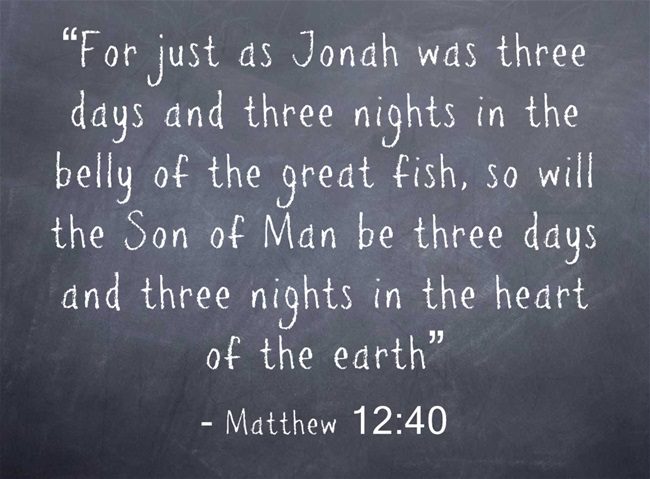
Conclusion: A Lesson from Jonah
The story of Jonah is mentioned by Jesus by example as He would be in the grave for three days. Obviously Jesus believed the account of Jonah as being true and be extension, the Old Testament (of which He quoted profusely). Jonah was pointed out as an example of His soon coming death and resurrection saying “For just as Jonah was three days and three nights in the belly of the great fish, so will the Son of Man be three days and three nights in the heart of the earth” (Matt 12:40). More importantly, Jonah did not want Nineveh saved because they were Assyrians and they were the archenemies of Israel who had frequently been more than a thorn in their side. Nineveh had a sordid history of cruelty, particularly against Israel, and had been their historical nemesis for centuries. It’d be like a Christian trying to witness to Saul who had been murdering and severely persecuting Christians before his conversion (who later became the Apostle Paul). The lesson for us is that even though we suffer persecution from non-believers, God loves them and wants to save them and we should not resist what God is calling us to do…to rescue the perishing (Jude 1:23) and to go into all the world (Matt 28:18-20; Acts 1:8). Who is someone you know that is hostile to the gospel? Who are you reluctant to witness to because they may have often ridiculed you and scorned you? Who is the least likely person that you think would ever be saved? That may be the very person God is calling you to save through the gospel of Christ. I say to you with 100% certainty that there is not one person on the face of the earth that God does not want to save (2 Pet 3:9). Is that your desire? I pray it would be.
Another Reading on Patheos to Check Out: What Did Jesus Really Look Like: A Look at the Bible Facts
 Article by Jack Wellman
Jack Wellman is Pastor of the Mulvane Brethren church in Mulvane Kansas. Jack is also the Senior Writer at What Christians Want To Know whose mission is to equip, encourage, and energize Christians and to address questions about the believer’s daily walk with God and the Bible. You can follow Jack on Google Plus or check out his book Blind Chance or Intelligent Design available on Amazon
Jonah and the whale bible story
Previous Post

April 20, 2014
Cain and Abel Bible Story: Lesson, Summary and Study
Next Post
April 20, 2014 Esther Bible Story: Lesson, Summary and Study
Browse Our Archives
Select a Category Bible Answers Bible Definitions Bible Story Bible Study Bible Verses Christian Books Christian Entertainment Christian Fathers Christian Mothers Christian Quotes Devotional Famous Christians Music News Parables Prayers Quotes Sunday School Lesson Uncategorized Youth Sermons
Select a Month October 2019 September 2019 August 2019 July 2019 June 2019 May 2019 April 2019 March 2019 February 2019 January 2019 December 2018 November 2018 October 2018 September 2018 August 2018 July 2018 June 2018 May 2018 April 2018 March 2018 February 2018 January 2018 December 2017 November 2017 October 2017 September 2017 August 2017 July 2017 June 2017 May 2017 April 2017 March 2017 February 2017 January 2017 December 2016 November 2016 October 2016 September 2016 August 2016 July 2016 June 2016 May 2016 March 2016 February 2016 January 2016 December 2015 November 2015 October 2015 September 2015 August 2015 July 2015 June 2015 May 2015 April 2015 March 2015 February 2015 January 2015 December 2014 November 2014 October 2014 September 2014 August 2014 July 2014 June 2014 May 2014 April 2014 March 2014 February 2014 January 2014 December 2013 November 2013 October 2013 September 2013 August 2013 July 2013 June 2013 May 2013 April 2013 March 2013
Follow Us!
TAKE THE
Religious Wisdom Quiz
What vision did Daniel have of four beasts representing empires?
Select your answer to see how you score.
Four dragons Horse, eagle, serpent, leopard Ox, ram, goat, lion Lion, bear, leopard, terrifying beast
Related posts from Christian Crier

Blind Bartimaeus And The Salvation Of The Sinner

The Exodus And Christian Conversion
The Book Of Esther And God’s Providence
TRENDING AT PATHEOS Evangelical

How the author of the world's best hymn...
I've been working with John Newton for a while now. This makes...

Long before this Lectio Divina, Psalm 130 - the song - started...

What About the Trees? Another Living Parable
After I finished writing the last article about falling leaves as a...

Why Classical Education Is a Conversation, Not a...
Come and Read: Joy in Classical Education When I was a little...

Falling Leaves: A Living Parable on Letting Go
I’ve spent the vast majority of my life in the southeast corner...

Cornell University has received a great deal of negative publicity and intense...
view all Evangelical blogs
Ad-Free & Subscriber Log-In Subscription Support
- About Us
- 2026 Calendar
- Videos
- Podcasts
- Library of World Religions
- Faith In Media Tracker
- Advertise With Us
- Write for Us
- Privacy Policy
- Terms of Service
- Do Not Sell My Data
- Contact Us
- Radiant Digital
- Manage Newsletter Subscriptions
- Unsubscribe From Notifications
- Sitemap
Copyright 2008-2026, Patheos. All rights reserved.
Subscription Support Ad-Free & Subscriber Log-In
Follow Patheos