
BuddhistCatholicContemplativeEvangelicalGeneral ChristianHinduJewishLatter-day SaintMuslimNew VisionsProgressive Christian
Beliefs
- Buddhist
- Catholic
- Contemplative
- Evangelical
- General Christian
- Hindu
- Jewish
- Latter-day Saint
- More Voices
- Muslim
- New Visions
- Pagan
- Progressive Christian
Topics
- Religion News
- Food and Religion
- Sports and Religion
- Religious Art
- Religious Music and Entertainment
- Religious Events
- History and Religion
- Style and Religion
- Politics and Religion
- Women in Religion
- Recreation Outdoors and Religion
- Business Finance and Religion
- Careers Workplace and Religion
- Education and Religion
- Family Parenting and Religion
- Health Fitness and Religion
- Home and Religion
- Relationships and Religion
- Technology and Religion
- Travel and Religion
Columnists
- Buddhist Columnists
- Business Finance and Religion Columnists
- Careers Workplace and Religion Columnists
- Catholic Columnists
- Contemplative Columnists
- Education and Religion Columnists
- Evangelists Columnists
- Family Parenting and Religion Columnists
- General Christian Columnists
- Health Fitness and Religion Columnists
- Hindu Columnists
- History and Religion Columnists
- Home and Religion Columnists
- Jewish Columnists
- More Voices Columnists
- Latter Day Columnists
- Muslim Columnists
- New Visions Columnists
- Nonreligious Columnists
- Pagan Columnists
- Politics and Religion Columnists
- Progressive Columnists
- Recreation Outdoors and Religion Columnists
- Relationships and Religion Columnists
- Religion News Columnists
- Religious Art Columnists
- Religious Events Columnists
- Religious Music and Entertainment Columnists
- Sports and Religion Columnists
- Style and Religion Columnists
- Technology and Religion Columnists
- Travel and Religion Columnists
- Women in Religion Columnists
Resource Library
- 2026 Calendar
- Library of World Religions
- The 100 Most Holy Places on Earth
- Patheos Answers
- Podcasts
- Videos
- Faith Leaders Database
- Anglican Episcopalian
- Bahai
- Baptist
- Buddhism
- Christianity
- Confucianism
- Eastern Orthodoxy
- Hinduism
- Holiness and Pentecostal
- ISKCON
- Islam
- Judaism
- Lutheran
- Methodist
- The Church of Jesus Christ of Latter-day Saints
- New Age
- Paganism
- Presbytarian and Reformed
- Protestantism
- Religion Behind the Scenes
- Roman Catholic
- Scientology
- Shia Islam
- Sikhism
- Sufism
- Sunni Islam
- Taoism
- Zen
- See all religions
Research Tools
 Ad-Free & Subscriber Log-In Subscription Support
Ad-Free & Subscriber Log-In Subscription Support
Follow Patheos 

- Trending:
- Forgiveness
- |
- Marriage
- |
- Consciousness
- |
- Death Penalty
- |
- Election
- |
- Halloween
 Christian Crier
- Home
- Evangelical
- Cain and Abel Bible Story: Lesson, Summary and Study
Cain and Abel Bible Story: Lesson, Summary and Study
Last updated on: April 20, 2014 at 10:54 am by Jack Wellman
Cain and Abel Bible Story: Lesson, Summary and Study 2014-04-20T10:54:57-05:00 Jack Wellman
Patheos Explore the world's faith through different perspectives on religion and spirituality! Patheos has the views of the prevalent religions and spiritualities of the world.
What is the lesson behind Cain and Able? Why did Cain murder his brother? What can we learn from this account in Genesis?
Cain and Abel’s Names
After God told Eve that she would conceive of a son that would crush the head of the serpent (Satan) mentioned in Genesis 3:15 which has been called the protoevangelium, the promise of a redeemer for fallen mankind, Eve called her son Cain. Eve may well have believed that her son might be that redeemer and that is why she called him Cain and said “I have gotten a man with the help of the Lord” (Gen 4:1). This seems likely because Cain’s name in Hebrew means “acquired” and she may have thought that she had acquired this redeemer and especially since he was the first born which is important as we will later read. After Cain was born, “she bore his brother Abel. Now Abel was a keeper of sheep, and Cain a worker of the ground” (Gen 4:2). Abel’s Hebrew name means “breath” but may be a derivative of the Assyrian name for “meadow” and this seems perfectly fitting as Abel was a keeper of sheep or a shepherd.
After the fall in the Garden (Gen 3) there was the need for blood sacrifices which God had first done in killing the animals to provide for Adam and Eve their clothing (Gen 3:21) for if you remember, they were naked; this was one way of saying it…they were naked, exposed, and their sin was clearly seen. Sin required blood to be shed so God killed the first animals providing the first sacrifice. Before the fall, no death had been experienced; even among the animal kingdom and so these animals that were killed were technically the first born (even though it was from God). God again would later provide a first born sacrifice but not an animal sacrifice, which could only cover sins but not take them away (Heb 10:4). And it would not just be another sacrifice, but the Son of God Himself who would give His own life voluntarily and by whose blood would be shed for the forgiveness of sins (Luke 22:20) and so “Cain brought to the Lord an offering of the fruit of the ground, and Abel also brought of the firstborn of his flock and of their fat portions. And the Lord had regard for Abel and his offering, but for Cain and his offering he had no regard. So Cain was very angry, and his face fell” (Gen 4:3-5). Why did God not accept Cain’s offering? Because there was no blood shed which is an appropriate sacrifice sins. Cain only brought produce of the ground, indicating that he had to work for his forgiveness and if you remember, God told Adam that after the fall he would have to work the ground with intensive labor now (Gen 3:17-19) and it would take the “sweat of your brow” from this point forward. The point is that Cain tried to work for his forgiveness or salvation from his sins and God never accepts works, and works cannot ever be accepted for sin offerings because we are always saved by grace and never by works (Eph 2:8-9).
As for Abel, he raised sheep. The interesting thing is that meat was not at that time eaten and was only done so until after Noah’s flood, so why would Abel be raising sheep if they didn’t raise them to eat? One reason is that they used them for clothing and for coverings for their tents and perhaps even to carry water in for their working of the ground, however there is an even more important reason that Able raised sheep. Since “Abel…brought of the firstborn of his flock and of their fat portions. And the Lord had regard for Abel and his offering” (Gen 4:4) it appears that Abel raised sheep to have a consistent supply of lambs to sacrifice. First of all, he brought the first born of the flock and this would be what the later sacrifices would require. Also, God has stated in both the Old Testament and the New that without the shedding of blood, there is no remission of sins (Heb 9:22). That is why God accepted Abel’s offering and did not accept Cain’s. One offering was insufficient and consisted of works but Abel’s was a blood sacrifice and that was pleasing or satisfying to God. Able had forgiveness but Cain did not because God did not accept his offering…one of works (Gen 4:5).
The First Murder
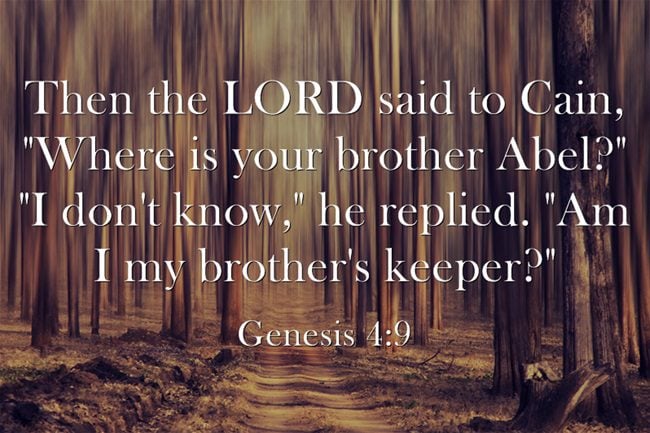
Cain was angered by this and perhaps in a jealous rage he killed his brother Able (Gen 4:8). God then asked Cain “Where is Abel your brother” (Gen 4:9a)? Why did God ask Cain this? He surely knew what had happened, being omniscient? I believe the reason was that God had asked Cain this question is that He had hoped for Cain to repent and then ask for forgiveness for what he had done, but what does Cain do? He retorts, “Am I my brother’s keeper?” as a sarcastic way of answering God (Gen 4:9b). Cain was driven from his family and home and remained a vagabond the rest of his life. As for Adam and Eve, God gave them another son which was named Seth which means “appointed” and this might mean that God appointed Seth to replace Abel or it might again have been another expectation of the Promised One who would “crush the head of the serpent” someday (Gen 3:15).
Conclusion
Every human that is alive today or has ever lived has needed a redeemer and this redeemer lives today to make intercession for the saints (Heb 7:25). He is more than a redeemer but He is THE Redeemer and He is also the High Priest of God who entered into the heavenly sanctuary with His own blood (Heb 9:25). If you have never repented and confessed your sins, and seen your need for the Savior, then you have no redeemer to rescue you from the pit (Rev 20:11-15). Without the Redeemer, Jesus Christ, no man or no woman will see God but instead will forever be separated from Him with no chance to escape. That is why Jesus gave the account of Lazarus and the Rich Man to show that there would be “a great chasm [that] has been fixed, in order that those who would pass from here to you may not be able, and none may cross from there to us” (Luke 16:26). That means if a person dies without faith in Christ they end up in the place where no one can pass and go from there to heaven…ever again. I pray you think about that today while it is still called “today” (2 Cor 6:2) for no one knows what tomorrow will bring (Prov 27:1)
Another Reading on Patheos to Check Out: What Did Jesus Really Look Like: A Look at the Bible Facts
 Article by Jack Wellman
Jack Wellman is Pastor of the Mulvane Brethren church in Mulvane Kansas. Jack is also the Senior Writer at What Christians Want To Know whose mission is to equip, encourage, and energize Christians and to address questions about the believer’s daily walk with God and the Bible. You can follow Jack on Google Plus or check out his book Blind Chance or Intelligent Design available on Amazon
Previous Post

April 20, 2014
Joshua and the Walls of Jericho Bible Story: Lesson, Summary and Study
Next Post
April 20, 2014 Jonah and the Whale Bible Story: Lesson, Summary and Study
Browse Our Archives
Select a Category Bible Answers Bible Definitions Bible Story Bible Study Bible Verses Christian Books Christian Entertainment Christian Fathers Christian Mothers Christian Quotes Devotional Famous Christians Music News Parables Prayers Quotes Sunday School Lesson Uncategorized Youth Sermons
Select a Month October 2019 September 2019 August 2019 July 2019 June 2019 May 2019 April 2019 March 2019 February 2019 January 2019 December 2018 November 2018 October 2018 September 2018 August 2018 July 2018 June 2018 May 2018 April 2018 March 2018 February 2018 January 2018 December 2017 November 2017 October 2017 September 2017 August 2017 July 2017 June 2017 May 2017 April 2017 March 2017 February 2017 January 2017 December 2016 November 2016 October 2016 September 2016 August 2016 July 2016 June 2016 May 2016 March 2016 February 2016 January 2016 December 2015 November 2015 October 2015 September 2015 August 2015 July 2015 June 2015 May 2015 April 2015 March 2015 February 2015 January 2015 December 2014 November 2014 October 2014 September 2014 August 2014 July 2014 June 2014 May 2014 April 2014 March 2014 February 2014 January 2014 December 2013 November 2013 October 2013 September 2013 August 2013 July 2013 June 2013 May 2013 April 2013 March 2013
Follow Us!
TAKE THE
Religious Wisdom Quiz
Who did Paul call "my true child in the faith"?
Select your answer to see how you score.
Barnabas Silas James Timothy
Related posts from Christian Crier
Blind Bartimaeus And The Salvation Of The Sinner

The Exodus And Christian Conversion
The Book Of Esther And God’s Providence
TRENDING AT PATHEOS Evangelical

How the author of the world's best hymn...
I've been working with John Newton for a while now. This makes...

Long before this Lectio Divina, Psalm 130 - the song - started...

What About the Trees? Another Living Parable
After I finished writing the last article about falling leaves as a...

Why Classical Education Is a Conversation, Not a...
Come and Read: Joy in Classical Education When I was a little...

Falling Leaves: A Living Parable on Letting Go
I’ve spent the vast majority of my life in the southeast corner...

Cornell University has received a great deal of negative publicity and intense...
view all Evangelical blogs
Ad-Free & Subscriber Log-In Subscription Support
- About Us
- 2026 Calendar
- Videos
- Podcasts
- Library of World Religions
- Faith In Media Tracker
- Advertise With Us
- Write for Us
- Privacy Policy
- Terms of Service
- Do Not Sell My Data
- Contact Us
- Radiant Digital
- Manage Newsletter Subscriptions
- Unsubscribe From Notifications
- Sitemap
Copyright 2008-2026, Patheos. All rights reserved.
Subscription Support Ad-Free & Subscriber Log-In
Follow Patheos