
BuddhistCatholicContemplativeEvangelicalGeneral ChristianHinduJewishLatter-day SaintMuslimNew VisionsProgressive Christian
Beliefs
- Buddhist
- Catholic
- Contemplative
- Evangelical
- General Christian
- Hindu
- Jewish
- Latter-day Saint
- More Voices
- Muslim
- New Visions
- Pagan
- Progressive Christian
Topics
- Religion News
- Food and Religion
- Sports and Religion
- Religious Art
- Religious Music and Entertainment
- Religious Events
- History and Religion
- Style and Religion
- Politics and Religion
- Women in Religion
- Recreation Outdoors and Religion
- Business Finance and Religion
- Careers Workplace and Religion
- Education and Religion
- Family Parenting and Religion
- Health Fitness and Religion
- Home and Religion
- Relationships and Religion
- Technology and Religion
- Travel and Religion
Columnists
- Buddhist Columnists
- Business Finance and Religion Columnists
- Careers Workplace and Religion Columnists
- Catholic Columnists
- Contemplative Columnists
- Education and Religion Columnists
- Evangelists Columnists
- Family Parenting and Religion Columnists
- General Christian Columnists
- Health Fitness and Religion Columnists
- Hindu Columnists
- History and Religion Columnists
- Home and Religion Columnists
- Jewish Columnists
- More Voices Columnists
- Latter Day Columnists
- Muslim Columnists
- New Visions Columnists
- Nonreligious Columnists
- Pagan Columnists
- Politics and Religion Columnists
- Progressive Columnists
- Recreation Outdoors and Religion Columnists
- Relationships and Religion Columnists
- Religion News Columnists
- Religious Art Columnists
- Religious Events Columnists
- Religious Music and Entertainment Columnists
- Sports and Religion Columnists
- Style and Religion Columnists
- Technology and Religion Columnists
- Travel and Religion Columnists
- Women in Religion Columnists
Resource Library
- 2026 Calendar
- Library of World Religions
- The 100 Most Holy Places on Earth
- Patheos Answers
- Podcasts
- Videos
- Faith Leaders Database
- Anglican Episcopalian
- Bahai
- Baptist
- Buddhism
- Christianity
- Confucianism
- Eastern Orthodoxy
- Hinduism
- Holiness and Pentecostal
- ISKCON
- Islam
- Judaism
- Lutheran
- Methodist
- The Church of Jesus Christ of Latter-day Saints
- New Age
- Paganism
- Presbytarian and Reformed
- Protestantism
- Religion Behind the Scenes
- Roman Catholic
- Scientology
- Shia Islam
- Sikhism
- Sufism
- Sunni Islam
- Taoism
- Zen
- See all religions
Research Tools
 Ad-Free & Subscriber Log-In Subscription Support
Ad-Free & Subscriber Log-In Subscription Support
Follow Patheos 

- Trending:
- Forgiveness
- |
- Marriage
- |
- Consciousness
- |
- Death Penalty
- |
- Election
- |
- Halloween
 Christian Crier
- Home
- Evangelical
- David and Goliath Bible Story: Lesson, Summary and Study
David and Goliath Bible Story: Lesson, Summary and Study
Last updated on: April 15, 2014 at 3:59 pm by Jack Wellman
David and Goliath Bible Story: Lesson, Summary and Study 2014-04-15T15:59:28-05:00 Jack Wellman
Patheos Explore the world's faith through different perspectives on religion and spirituality! Patheos has the views of the prevalent religions and spiritualities of the world.
What lesson is there to learn from the account of David and Goliath? Why is it important to Christians today? What can we apply in our lives today from this account?
David the Shepherd
David was the least in his family. When they were choosing a king to anoint to replace Saul, they went through all of Jesse’s children…except David. Jesse didn’t bring David because he was still a very young boy, likely a teenager and he was quite small and so Jesse wouldn’t have ever expected that David was God’s choice but God doesn’t look on the outside…He looks at the heart (1 Sam 16:7). He was a shepherd and shepherd in the Far and Middle East were looked down upon by most of society in those days. To a great extent, they still are today.
Goliath the Colossal
Goliath, who came from Gath, had a size that was enormous but he was also listed as a champion. His height was six cubits (1 Sam 17:4) which as about nine feet tall and the armor and spear he carried weighed several hundred pounds and the weight of the iron alone would have been too much for most men to even pick up, not to mention wear into battle. Some ancient sources say that Goliath’s height was actually four cubits and a span which would be about six feet, nine inches. This is what the NAB and the NET give but the ESV, using sources from the Hebrew, the Septuagint, Dead Sea Scroll and Josephus all say the same thing…four cubits and a span so that’s just about seven feet tall. During the time of the Iron Age that was huge by all standards. Also the fact that Goliath was a champion of one of the fiercest and most experienced and battle tested nations there were…Philistia. Goliath of the Philistines was equal to the heavy weight champion of the world and he was about to face the bantam weight contender of Israel.
David versus Goliath Story Summary
When David came to the battle front to bring food for the troops, Goliath was hurling insults at the God of Israel and David was outraged. He said
“What shall be done for the man who kills this Philistine and takes away the reproach from Israel? For who is this uncircumcised Philistine, that he should defy the armies of the living God” (1 Sam 17:26)?
When David pleaded with King Saul to kill Goliath, Saul finally relented but surely no one except David expected him to win.
“When the Philistine looked and saw David, he disdained him, for he was but a youth, ruddy and handsome in appearance. And the Philistine said to David, “Am I a dog, that you come to me with sticks?” And the Philistine cursed David by his gods. The Philistine said to David, “Come to me, and I will give your flesh to the birds of the air and to the beasts of the field.” Then David said to the Philistine, “You come to me with a sword and with a spear and with a javelin, but I come to you in the name of the Lord of hosts, the God of the armies of Israel, whom you have defied” (1 Sam 17:42-45).
Earlier, David had “took his staff in his hand and chose five smooth stones from the brook and put them in his shepherd’s pouch. His sling was in his hand, and he approached the Philistine” (1 Sam 17:40). “When the Philistine arose and came and drew near to meet David, David ran quickly toward the battle line to meet the Philistine. And David put his hand in his bag and took out a stone and slung it and struck the Philistine on his forehead. The stone sank into his forehead, and he fell on his face to the ground. So David prevailed over the Philistine with a sling and with a stone, and struck the Philistine and killed him. There was no sword in the hand of David. Then David ran and stood over the Philistine and took his sword and drew it out of its sheath and killed him and cut off his head with it.” (1 Sam 17:48-51).
Lessons Learned From A Study Of David and Goliath
Goliath had everything going for him. He had every advantage possible. He had great ability and he was trained, equipped, experienced, battle tested and battle hardened, and he was completely fearless. He was totally confident but it could also be said that he was overconfident.
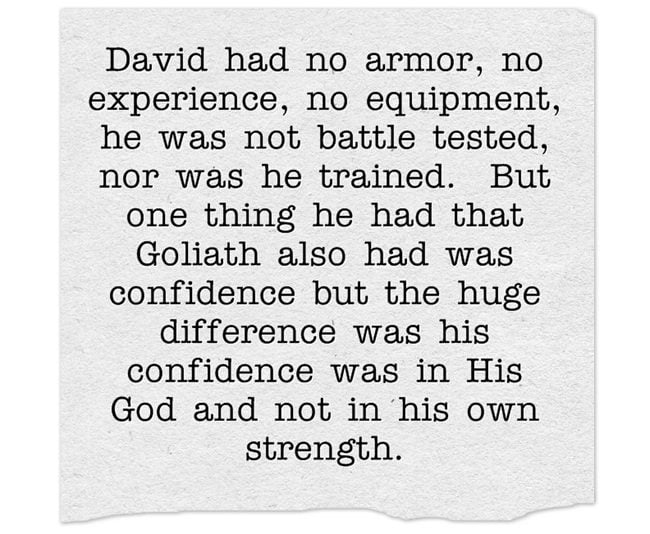
David had no armor, no experience, no equipment, he was not battle tested, nor was he trained. But one thing he had that Goliath also had was confidence but the huge difference was his confidence was in His God and not in his own strength. David looked Goliath square in the eye because He knew that God was with Him in this battle and if God is for you, who can fight against you (Rom 8:31)? The obvious answer is no one.
The question comes up about why David picked up five smooth stones? Was this in case he missed the first time? Did he want back up supplies in the event he needed to strike him twice or a third time? No, there is a good explanation for this. Goliath was not the only one of his kind. Goliath had brothers plus there were other descendants of gigantic men from Gath (1 Chron 20:5-8), from the same place that Goliath had came from (1 Sam 17:4). Apparently David was ready in the event any of Goliath’s brothers came with him or any other of the other so-called giants came from Gath. David did what we are to do. He made provisions for the future and was ready for any trouble in advance but he still relied on and trust in God to fight the battle for him. God is sovereign. The stone that killed Goliath hit him in the only vulnerable spot there was and that was right in the middle of his forehead (1 Sam 17:49). Notice that David didn’t wait for Goliath to come to him, he ran straight on into the battle (1 Sam 17:48) and it was not only that he ran but he ran quickly right into the heat of the battle. He had no fear because He trusted God completely.
Conclusion
Maybe you are facing a giant today. Perhaps you are in financial difficulties or you are having health issues. Perhaps your marriage is in trouble or your children are prodigals. What person alive doesn’t have problems but some are so huge that it’s like facing a Goliath and all you have is a pea shooter. Remember Gideon? He was the least of his family and he went up against an impossibly huge army with only 300 men yet God caused Gideon’s army to have victory. God is never impressed by the size of a problem because the Creator of the universe doesn’t see difficulties the way that we do. He sees them as a way to display His glory and that is usually done through individuals that the world often looks down upon. God is in the small things so that He can do big things through us so that He is glorified. This is because God’s power is magnified in our weakness (2 Cor 12:7-9). While others may despise the small in stature or might, God is in the small things (Zech 4:10) because God resists the proud and mighty but He gives grace only to those who are humble (James 4:6). Humble yourself and He will help you in your time of trouble and slay the giant in your life, if only you will trust Him and do it for His glory.
Another Reading on Patheos to Check Out: What Did Jesus Really Look Like: A Look at the Bible Facts
 Article by Jack Wellman
Jack Wellman is Pastor of the Mulvane Brethren church in Mulvane Kansas. Jack is also the Senior Writer at What Christians Want To Know whose mission is to equip, encourage, and energize Christians and to address questions about the believer’s daily walk with God and the Bible. You can follow Jack on Google Plus or check out his book Blind Chance or Intelligent Design available on Amazon
Previous Post

April 13, 2014
Easter Bible Verses: 7 Scriptures About The Resurrection of Jesus
Next Post
April 20, 2014 Joshua and the Walls of Jericho Bible Story: Lesson, Summary and Study
Browse Our Archives
Select a Category Bible Answers Bible Definitions Bible Story Bible Study Bible Verses Christian Books Christian Entertainment Christian Fathers Christian Mothers Christian Quotes Devotional Famous Christians Music News Parables Prayers Quotes Sunday School Lesson Uncategorized Youth Sermons
Select a Month October 2019 September 2019 August 2019 July 2019 June 2019 May 2019 April 2019 March 2019 February 2019 January 2019 December 2018 November 2018 October 2018 September 2018 August 2018 July 2018 June 2018 May 2018 April 2018 March 2018 February 2018 January 2018 December 2017 November 2017 October 2017 September 2017 August 2017 July 2017 June 2017 May 2017 April 2017 March 2017 February 2017 January 2017 December 2016 November 2016 October 2016 September 2016 August 2016 July 2016 June 2016 May 2016 March 2016 February 2016 January 2016 December 2015 November 2015 October 2015 September 2015 August 2015 July 2015 June 2015 May 2015 April 2015 March 2015 February 2015 January 2015 December 2014 November 2014 October 2014 September 2014 August 2014 July 2014 June 2014 May 2014 April 2014 March 2014 February 2014 January 2014 December 2013 November 2013 October 2013 September 2013 August 2013 July 2013 June 2013 May 2013 April 2013 March 2013
Follow Us!
TAKE THE
Religious Wisdom Quiz
Who did Paul call "my true child in the faith"?
Select your answer to see how you score.
Barnabas Silas James Timothy
Related posts from Christian Crier

What Does The Bible Say About Our Thoughts?

Do Colors Have Special Meaning In The Bible?

The Glass – Half Empty Or Half Full?

TRENDING AT PATHEOS Evangelical

How the author of the world's best hymn...
I've been working with John Newton for a while now. This makes...

Long before this Lectio Divina, Psalm 130 - the song - started...

What About the Trees? Another Living Parable
After I finished writing the last article about falling leaves as a...

Why Classical Education Is a Conversation, Not a...
Come and Read: Joy in Classical Education When I was a little...

Falling Leaves: A Living Parable on Letting Go
I’ve spent the vast majority of my life in the southeast corner...

Cornell University has received a great deal of negative publicity and intense...
view all Evangelical blogs
Ad-Free & Subscriber Log-In Subscription Support
- About Us
- 2026 Calendar
- Videos
- Podcasts
- Library of World Religions
- Faith In Media Tracker
- Advertise With Us
- Write for Us
- Privacy Policy
- Terms of Service
- Do Not Sell My Data
- Contact Us
- Radiant Digital
- Manage Newsletter Subscriptions
- Unsubscribe From Notifications
- Sitemap
Copyright 2008-2026, Patheos. All rights reserved.
Subscription Support Ad-Free & Subscriber Log-In
Follow Patheos