
BuddhistCatholicContemplativeEvangelicalGeneral ChristianHinduJewishLatter-day SaintMuslimNew VisionsProgressive Christian
Beliefs
- Buddhist
- Catholic
- Contemplative
- Evangelical
- General Christian
- Hindu
- Jewish
- Latter-day Saint
- More Voices
- Muslim
- New Visions
- Pagan
- Progressive Christian
Topics
- Religion News
- Food and Religion
- Sports and Religion
- Religious Art
- Religious Music and Entertainment
- Religious Events
- History and Religion
- Style and Religion
- Politics and Religion
- Women in Religion
- Recreation Outdoors and Religion
- Business Finance and Religion
- Careers Workplace and Religion
- Education and Religion
- Family Parenting and Religion
- Health Fitness and Religion
- Home and Religion
- Relationships and Religion
- Technology and Religion
- Travel and Religion
Columnists
- Buddhist Columnists
- Business Finance and Religion Columnists
- Careers Workplace and Religion Columnists
- Catholic Columnists
- Contemplative Columnists
- Education and Religion Columnists
- Evangelists Columnists
- Family Parenting and Religion Columnists
- General Christian Columnists
- Health Fitness and Religion Columnists
- Hindu Columnists
- History and Religion Columnists
- Home and Religion Columnists
- Jewish Columnists
- More Voices Columnists
- Latter Day Columnists
- Muslim Columnists
- New Visions Columnists
- Nonreligious Columnists
- Pagan Columnists
- Politics and Religion Columnists
- Progressive Columnists
- Recreation Outdoors and Religion Columnists
- Relationships and Religion Columnists
- Religion News Columnists
- Religious Art Columnists
- Religious Events Columnists
- Religious Music and Entertainment Columnists
- Sports and Religion Columnists
- Style and Religion Columnists
- Technology and Religion Columnists
- Travel and Religion Columnists
- Women in Religion Columnists
Resource Library
- 2026 Calendar
- Library of World Religions
- The 100 Most Holy Places on Earth
- Patheos Answers
- Podcasts
- Videos
- Faith Leaders Database
- Anglican Episcopalian
- Bahai
- Baptist
- Buddhism
- Christianity
- Confucianism
- Eastern Orthodoxy
- Hinduism
- Holiness and Pentecostal
- ISKCON
- Islam
- Judaism
- Lutheran
- Methodist
- The Church of Jesus Christ of Latter-day Saints
- New Age
- Paganism
- Presbytarian and Reformed
- Protestantism
- Religion Behind the Scenes
- Roman Catholic
- Scientology
- Shia Islam
- Sikhism
- Sufism
- Sunni Islam
- Taoism
- Zen
- See all religions
Research Tools
 Ad-Free & Subscriber Log-In Subscription Support
Ad-Free & Subscriber Log-In Subscription Support
Follow Patheos 

- Trending:
- Forgiveness
- |
- Marriage
- |
- Consciousness
- |
- Death Penalty
- |
- Election
- |
- Halloween
 Christian Crier
- Home
- Evangelical
- Does It Matter What Translation of The Bible We Read?
Does It Matter What Translation of The Bible We Read?
Last updated on: May 18, 2015 at 7:06 pm by Jack Wellman
Does It Matter What Translation of The Bible We Read? 2015-05-18T19:06:37-05:00 Jack Wellman
Patheos Explore the world's faith through different perspectives on religion and spirituality! Patheos has the views of the prevalent religions and spiritualities of the world.
So many different translations of the Bible are available. Which are the best? Does it really matter which version of the Bible we read?
The King James Version (KJV)
The best selling book of all time is the Bible. No book has ever come close to selling as many copies compared to the Holy Bible. The King James Version is the best selling version of all the Bible translations and is the most widely read in the United States. It has been time tested and much beloved by those who still prefer it, first published in 1611. In 1604 King James VI commanded that the Bible be translated into English in response to a perceived problem by the Puritans who were considered a faction at that time. The King James Version is often called the “Authorized” King James Bible because of it’s authorization by the King himself.
I use my old King James Version frequently because mine has the original Hebrew and Greek words in the margins for some words and sentences. It also has a great number of cross references for almost every verse in it. It is hard to use for some because of the “King’s English” but others prefer it as an elegantly written language that is poetic in nature. What I like about the King James Version that I have is that some words are in italics. The words in italics were added by the translators to give the verses more meaning, to help the flow of the text, or as in some cases, to put their own beliefs into the Scriptures. When I read the King James Version, I often leave out the words in italics so that I can see what the original author was intending to say since the words in italics were not in the original manuscripts and are not inspired by the Holy Spirit.
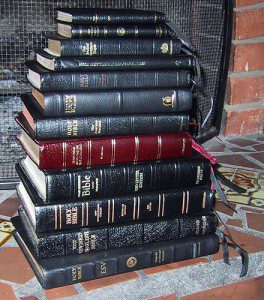 The New King James Version (NKJV)
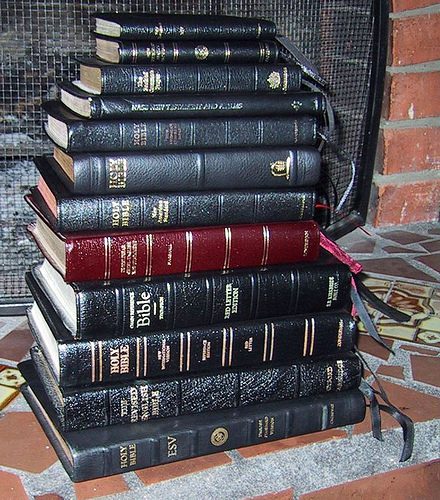
Here is another Bible version that is very popular in the world. It is much like the King James Version except that “thee and thou” are translated to the modern use of the English language like “you” (singular) and “your’s” (plural). It is essentially the same as the Authorized Version but it simply has more modern language. Another example is when the King James Version uses “verily, verily” the New King James uses “most assuredly” (John 5:24a). Besides a few minor differences, the New King James Version is still very close to the Authorized Version and is still highly popular in the States as well as in many parts of the world.
The New King James Study Bible that I have is helpful because, like most Study Bibles, they give some historical background to the verses which help me understand the context much better. It’s as important knowing what is being written as much as why it is being written and to which audience it is being written too.
The English Standard Version (ESV)
I have two English Standard Version Bibles. They are both study Bibles. One is the Reformation Study Bible from Ligonier Ministries and the other is John MacArthur’s Study Bible. The study notes are excellent supplemental materials when using them for topological subjects or for expositional preaching. There is a danger with these, as with any study Bibles. The readers should be aware that the notes are not inspired by God. They might be written by men inspired by the Holy Spirit but they are technically not “God-breathed” as the Scriptures themselves are. The reader therefore can not take study Bible notes on an equal footing with the Scriptures. They must be seen as only an addition to what the author or scholars see how the verses apply to the Christian and they come from their own unique perspective. Even the Reformation Study Bible and the MacArthur Study Bible do not agree on ever issue. One example is the rapture. Both of these authors, scholars, and theologians do not hold to the same view.
Previous Post

October 21, 2019
What Does The Bible Say About Our Thoughts?
Next Post
April 3, 2013 Can Salvation Be Earned? A Bible Study of Works vs. Grace
Browse Our Archives
Select a Category Bible Answers Bible Definitions Bible Story Bible Study Bible Verses Christian Books Christian Entertainment Christian Fathers Christian Mothers Christian Quotes Devotional Famous Christians Music News Parables Prayers Quotes Sunday School Lesson Uncategorized Youth Sermons
Select a Month October 2019 September 2019 August 2019 July 2019 June 2019 May 2019 April 2019 March 2019 February 2019 January 2019 December 2018 November 2018 October 2018 September 2018 August 2018 July 2018 June 2018 May 2018 April 2018 March 2018 February 2018 January 2018 December 2017 November 2017 October 2017 September 2017 August 2017 July 2017 June 2017 May 2017 April 2017 March 2017 February 2017 January 2017 December 2016 November 2016 October 2016 September 2016 August 2016 July 2016 June 2016 May 2016 March 2016 February 2016 January 2016 December 2015 November 2015 October 2015 September 2015 August 2015 July 2015 June 2015 May 2015 April 2015 March 2015 February 2015 January 2015 December 2014 November 2014 October 2014 September 2014 August 2014 July 2014 June 2014 May 2014 April 2014 March 2014 February 2014 January 2014 December 2013 November 2013 October 2013 September 2013 August 2013 July 2013 June 2013 May 2013 April 2013 March 2013
Follow Us!
TAKE THE
Religious Wisdom Quiz
What is "the beginning of knowledge," according to Proverbs?
Select your answer to see how you score.
Humility Riches Fear of the Lord Power
Related posts from Christian Crier

What Does The Bible Say About Our Thoughts?

Do Colors Have Special Meaning In The Bible?

The Glass – Half Empty Or Half Full?

TRENDING AT PATHEOS Evangelical

The REST of Your Life: A Creative Wrestles...
This week I had a conversation with a good friend from church....

How the author of the world's best hymn...
I've been working with John Newton for a while now. This makes...

Long before this Lectio Divina, Psalm 130 - the song - started...

What About the Trees? Another Living Parable
After I finished writing the last article about falling leaves as a...

Why Classical Education Is a Conversation, Not a...
Come and Read: Joy in Classical Education When I was a little...

Cornell University has received a great deal of negative publicity and intense...
view all Evangelical blogs
Ad-Free & Subscriber Log-In Subscription Support
- About Us
- 2026 Calendar
- Videos
- Podcasts
- Library of World Religions
- Faith In Media Tracker
- Advertise With Us
- Write for Us
- Privacy Policy
- Terms of Service
- Do Not Sell My Data
- Contact Us
- Radiant Digital
- Manage Newsletter Subscriptions
- Unsubscribe From Notifications
- Sitemap
Copyright 2008-2026, Patheos. All rights reserved.
Subscription Support Ad-Free & Subscriber Log-In
Follow Patheos