
BuddhistCatholicContemplativeEvangelicalGeneral ChristianHinduJewishLatter-day SaintMuslimNew VisionsProgressive Christian
Beliefs
- Buddhist
- Catholic
- Contemplative
- Evangelical
- General Christian
- Hindu
- Jewish
- Latter-day Saint
- More Voices
- Muslim
- New Visions
- Pagan
- Progressive Christian
Topics
- Religion News
- Food and Religion
- Sports and Religion
- Religious Art
- Religious Music and Entertainment
- Religious Events
- History and Religion
- Style and Religion
- Politics and Religion
- Women in Religion
- Recreation Outdoors and Religion
- Business Finance and Religion
- Careers Workplace and Religion
- Education and Religion
- Family Parenting and Religion
- Health Fitness and Religion
- Home and Religion
- Relationships and Religion
- Technology and Religion
- Travel and Religion
Columnists
- Buddhist Columnists
- Business Finance and Religion Columnists
- Careers Workplace and Religion Columnists
- Catholic Columnists
- Contemplative Columnists
- Education and Religion Columnists
- Evangelists Columnists
- Family Parenting and Religion Columnists
- General Christian Columnists
- Health Fitness and Religion Columnists
- Hindu Columnists
- History and Religion Columnists
- Home and Religion Columnists
- Jewish Columnists
- More Voices Columnists
- Latter Day Columnists
- Muslim Columnists
- New Visions Columnists
- Nonreligious Columnists
- Pagan Columnists
- Politics and Religion Columnists
- Progressive Columnists
- Recreation Outdoors and Religion Columnists
- Relationships and Religion Columnists
- Religion News Columnists
- Religious Art Columnists
- Religious Events Columnists
- Religious Music and Entertainment Columnists
- Sports and Religion Columnists
- Style and Religion Columnists
- Technology and Religion Columnists
- Travel and Religion Columnists
- Women in Religion Columnists
Resource Library
- 2026 Calendar
- Library of World Religions
- The 100 Most Holy Places on Earth
- Patheos Answers
- Podcasts
- Videos
- Faith Leaders Database
- Anglican Episcopalian
- Bahai
- Baptist
- Buddhism
- Christianity
- Confucianism
- Eastern Orthodoxy
- Hinduism
- Holiness and Pentecostal
- ISKCON
- Islam
- Judaism
- Lutheran
- Methodist
- The Church of Jesus Christ of Latter-day Saints
- New Age
- Paganism
- Presbytarian and Reformed
- Protestantism
- Religion Behind the Scenes
- Roman Catholic
- Scientology
- Shia Islam
- Sikhism
- Sufism
- Sunni Islam
- Taoism
- Zen
- See all religions
Research Tools
 Ad-Free & Subscriber Log-In Subscription Support
Ad-Free & Subscriber Log-In Subscription Support
Follow Patheos 

- Trending:
- Forgiveness
- |
- Marriage
- |
- Consciousness
- |
- Death Penalty
- |
- Election
- |
- Halloween
 Christian Colloquies
- Home
- Catholic
- History and Religion
- Martin Luther’s 95 Theses: A Brief Catholic Commentary (Thesis 06-10)
Martin Luther’s 95 Theses: A Brief Catholic Commentary (Thesis 06-10)
Last updated on: August 27, 2022 at 4:57 pm by Arthur Jordan
Martin Luther’s 95 Theses: A Brief Catholic Commentary (Thesis 06-10) 2022-08-27T16:57:41-03:00 Arthur Jordan
Patheos Explore the world's faith through different perspectives on religion and spirituality! Patheos has the views of the prevalent religions and spiritualities of the world.
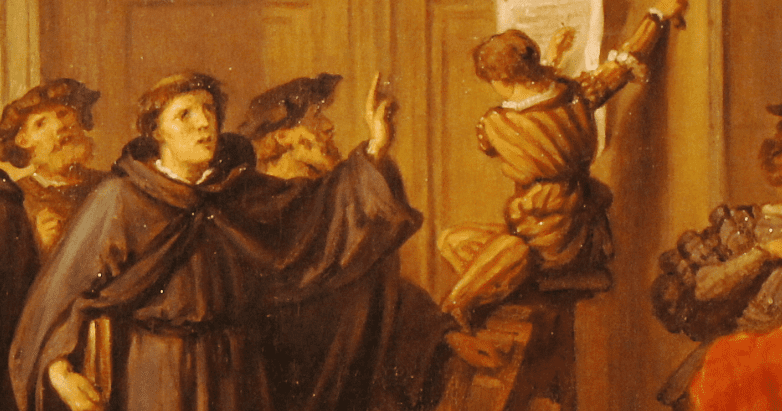
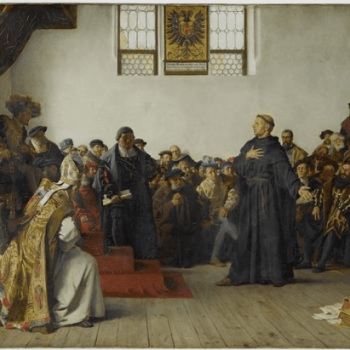
Julius Hübner/Wikimedia Commons
Martin Luther’s 95 Theses are in public domain, and you can read them at here.
Thesis 6
The Pope cannot remit any guilt, except by declaring and showing that it has been remitted by God; or, to be sure, by remitting guilt in cases reserved to his judgment. If his right to grant remission in these cases were disregarded, the guilt would certainly remain unforgiven.
The thesis is orthodox. The Catechism of the Catholic Church (CCC) says:
1441 Only God forgives sins (…) Further, by virtue of his divine authority he gives this power to men to exercise in his name.
1442 Christ has willed that in her prayer and life and action his whole Church should be the sign and instrument of the forgiveness and reconciliation that he acquired for us at the price of his blood.
Thesis 7
God remits guilt to no one unless at the same time he humbles him in all things and makes him submissive to the vicar, the priest.
The thesis is orthodox. The Scripture says:
And when he had said this, he breathed on them, and said to them,
“Receive the Holy Spirit. If you forgive the sins of any, they are forgiven; if you retain the sins of any, they are retained.” (John 20:22-23)
Thesis 8
The penitential canons are imposed only on the living, and, according to the canons themselves, nothing should be imposed on the dying.
The thesis is orthodox.
Can. 1252 The law of abstinence binds those who have completed their fourteenth year.
The law of fasting binds those who have attained their majority, until the beginning of their sixtieth year.
However, as the Portuguese Episcopal Conference explains:⠀
“The present determinations on fasting and abstinence only apply under normal health conditions, and the ill are therefore exempted from their observance.”
Thesis 9
Therefore the Holy Spirit through the Pope is kind to us insofar as the Pope in his decrees always makes exception of the article of death and of necessity.
The thesis is heterodox.
Penitential canons are dispensed to the dying faithful, indeed.
However, the Holy Spirit can benefit them through the Popes in his decrees that consider the circumstance of death and necessity.
Saint Paul VI says in Indulgentiarum Doctrina:
n.18 To the faithful in danger of death who cannot be assisted by a priest to bring them the sacraments and impart the apostolic blessing with its attendant plenary indulgence (…)
Holy Mother Church nevertheless grants a plenary indulgence to be acquired at the point of death, provided they are properly disposed and have been in the habit of reciting some prayers during their lifetime (…)
This plenary indulgence at the point of death can be acquired by the faithful even if they have already obtained another plenary indulgence on the same day.
Thesis 10
Those priests act ignorantly and wickedly who, in the case of the dying, reserve canonical penalties for purgatory.
If “canonical penalties” therefore means abstinence and fasting (related to “penitential canons” from Thesis 6), the thesis is orthodox.
The reason is that of the commentary of thesis 08:
The dying faithful are exempt from the observance of fasting and abstinence.
History and Religion
Browse Our Archives
Select a Category Comparing faiths Life and Faith Reformation Day
Select a Month August 2022 July 2022
TAKE THE
Religious Wisdom Quiz
Who is the apostle to deny Jesus?
Select your answer to see how you score.
Andrew Peter Judas Phillip
Related posts from Christian Colloquies
What did Calvin teach about the Eucharist (Holy...
Martin Luther's 95 Theses: A Brief Catholic Commentary...
What do I think about the Reformation Day?

2 Differences Between Catholics and Presbyterians on Original...
TRENDING AT PATHEOS Catholic

Creation, Preservation, and Teleology in Catholic Theology
As I write this, it is very early Monday morning. Like millions...

The Parable Of The Sower And The Word...
One of Christ’s most famous parables is that of the sower who...

Rejecting Doom: Christian Hope And Human Action
Christianity is a religion of hope. We are to have hope and...

Why I Choose the Eucharist Over the Sermon
Choose the Eucharist, Not the Sermon What are we supposed to get...

5 Design Elements Found in Spiritually Rooted Homes
Putting Spirituality Into Home Decor Our homes are more than our living...

Credo: A Story of God Told with the...
About 10 years ago, I began to imagine a personal "Credo" that...
view all Catholic blogs
Ad-Free & Subscriber Log-In Subscription Support
- About Us
- 2026 Calendar
- Videos
- Podcasts
- Library of World Religions
- Faith In Media Tracker
- Advertise With Us
- Write for Us
- Privacy Policy
- Terms of Service
- Do Not Sell My Data
- Contact Us
- Radiant Digital
- Manage Newsletter Subscriptions
- Unsubscribe From Notifications
- Sitemap
Copyright 2008-2026, Patheos. All rights reserved.
Subscription Support Ad-Free & Subscriber Log-In
Follow Patheos