
BuddhistCatholicContemplativeEvangelicalGeneral ChristianHinduJewishLatter-day SaintMuslimNew VisionsProgressive Christian
Beliefs
- Buddhist
- Catholic
- Contemplative
- Evangelical
- General Christian
- Hindu
- Jewish
- Latter-day Saint
- More Voices
- Muslim
- New Visions
- Pagan
- Progressive Christian
Topics
- Religion News
- Food and Religion
- Sports and Religion
- Religious Art
- Religious Music and Entertainment
- Religious Events
- History and Religion
- Style and Religion
- Politics and Religion
- Women in Religion
- Recreation Outdoors and Religion
- Business Finance and Religion
- Careers Workplace and Religion
- Education and Religion
- Family Parenting and Religion
- Health Fitness and Religion
- Home and Religion
- Relationships and Religion
- Technology and Religion
- Travel and Religion
Columnists
- Buddhist Columnists
- Business Finance and Religion Columnists
- Careers Workplace and Religion Columnists
- Catholic Columnists
- Contemplative Columnists
- Education and Religion Columnists
- Evangelists Columnists
- Family Parenting and Religion Columnists
- General Christian Columnists
- Health Fitness and Religion Columnists
- Hindu Columnists
- History and Religion Columnists
- Home and Religion Columnists
- Jewish Columnists
- More Voices Columnists
- Latter Day Columnists
- Muslim Columnists
- New Visions Columnists
- Nonreligious Columnists
- Pagan Columnists
- Politics and Religion Columnists
- Progressive Columnists
- Recreation Outdoors and Religion Columnists
- Relationships and Religion Columnists
- Religion News Columnists
- Religious Art Columnists
- Religious Events Columnists
- Religious Music and Entertainment Columnists
- Sports and Religion Columnists
- Style and Religion Columnists
- Technology and Religion Columnists
- Travel and Religion Columnists
- Women in Religion Columnists
Resource Library
- 2026 Calendar
- Library of World Religions
- The 100 Most Holy Places on Earth
- Patheos Answers
- Podcasts
- Videos
- Faith Leaders Database
- Anglican Episcopalian
- Bahai
- Baptist
- Buddhism
- Christianity
- Confucianism
- Eastern Orthodoxy
- Hinduism
- Holiness and Pentecostal
- ISKCON
- Islam
- Judaism
- Lutheran
- Methodist
- The Church of Jesus Christ of Latter-day Saints
- New Age
- Paganism
- Presbytarian and Reformed
- Protestantism
- Religion Behind the Scenes
- Roman Catholic
- Scientology
- Shia Islam
- Sikhism
- Sufism
- Sunni Islam
- Taoism
- Zen
- See all religions
Research Tools
 Ad-Free & Subscriber Log-In Subscription Support
Ad-Free & Subscriber Log-In Subscription Support
Follow Patheos 

- Trending:
- Forgiveness
- |
- Marriage
- |
- Consciousness
- |
- Death Penalty
- |
- Election
- |
- Halloween
 Christian Colloquies
- Home
- Catholic
- History and Religion
- Martin Luther’s 95 Theses: A Brief Catholic Commentary (Thesis 01-05).
Martin Luther’s 95 Theses: A Brief Catholic Commentary (Thesis 01-05).
Last updated on: August 27, 2022 at 4:58 pm by Arthur Jordan
Martin Luther’s 95 Theses: A Brief Catholic Commentary (Thesis 01-05). 2022-08-27T16:58:12-03:00 Arthur Jordan
Patheos Explore the world's faith through different perspectives on religion and spirituality! Patheos has the views of the prevalent religions and spiritualities of the world.
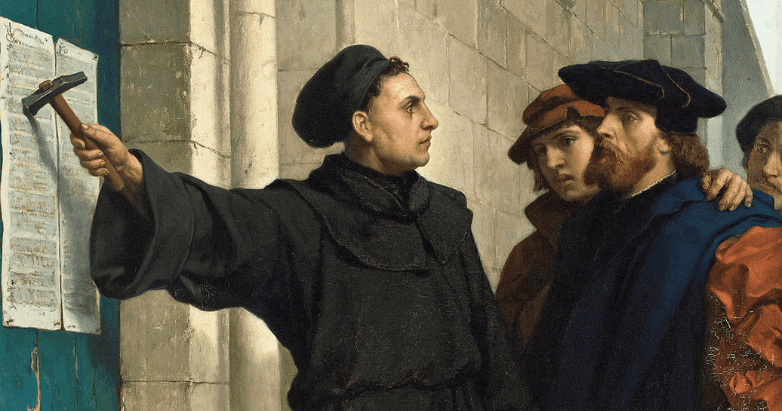
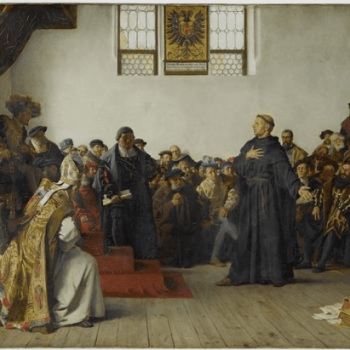
Ferdinand Pauwels/Wikimedia Commons
Martin Luther’s 95 Theses are in public domain, and you can read them at here.
Thesis 01
When our Lord and Master Jesus Christ said, “Repent’’ (Mt 4:17), he willed the entire life of believers to be one of repentance.
The thesis is orthodox. The Catechism of the Catholic Church (CCC) says:
1431 Interior repentance is a radical reorientation of our whole life, a return, a conversion to God with all our heart, an end of sin, a turning away from evil, with repugnance toward the evil actions we have committed.
Thesis 02
This word cannot be understood as referring to the sacrament of penance, that is, confession and satisfaction, as administered by the clergy.
The thesis is orthodox. I would add the word “only” in this way: “This word cannot be understood only as referring (…)”.
The CCC says:
1427 Jesus calls to conversion. This call is an essential part of the proclamation of the kingdom: “The time is fulfilled, and the kingdom of God is at hand; repent, and believe in the gospel.” In the Church’s preaching this call is addressed first to those who do not yet know Christ and his Gospel.
Thesis 03
Yet it does not mean solely inner repentance; such inner repentance is worthless unless it produces various outward mortification of the flesh.
The thesis is orthodox. The CCC says:
1430 Jesus’ call to conversion and penance, like that of the prophets before him, does not aim first at outward works, “sackcloth and ashes,” fasting and mortification, but at the conversion of the heart, interior conversion. Without this, such penances remain sterile and false; however, interior conversion urges expression in visible signs, gestures and works of penance.
Thesis 04
The penalty of sin remains as long as the hatred of self (that is, true inner repentance), namely till our entrance into the kingdom of heaven.
The thesis is orthodox because the temporal penalty can remain after death (1 Cor 3:13-15; 1 Pet 3:19), ceasing at the moment the believer enters Heaven. It is in Purgatory, in fact, that this temporal penalty is extinguished. It is also orthodox to say that inner repentance is like a hatred of self (Luke 9:23).
Thesis 05
The Pope neither desires nor is able to remit any penalties except those imposed by his own authority or that of the canons.
The thesis is heterodox.
Every sin involves a double consequence: guilt and punishment. This punishment, eternal or temporal, derives from the very nature of sin, and not from a canonical imposition.
Moreover, the penance imposed by the confessor is a way for the believers in Jesus Christ to repair the disorders caused by their sins.
The repentant sinner has the guilt erased and the eternal punishment (hell) abolished, but the temporal punishment remains.
The Church has the power to abolish the temporal punishment due to sin.
For this Thesis, some foundational principles from Scripture:
On guilt and punishment:
I will punish the world for its evil, and the wicked for their iniquity;I will put an end to the pride of the arrogant, and lay low the haughtiness of the ruthless. (Isa. 13:11)
On temporal punishments:
I will greatly multiply your pain in childbearing; in pain you shall bring forth children. (Gen. 3:16)
Therefore as sin came into the world through one man and death through sin, and so death spread to all men because all men sinned. (Rom. 5:12)
On the temporal punishment even after the forgiveness of sin:
David said to Nathan, ‘I have sinned against the Lord.’ And Nathan said to David, ‘The Lord also has put away your sin; you shall not die. Nevertheless, because by this deed you have utterly scorned the Lord, the child that is born to you shall die.’ (2 Sam. 12:13-14)
On the Church’s power to abolish the temporal punishments:
Truly, I say to you, whatever you bind on earth shall be bound in heaven, and whatever you loose on earth shall be loosed in heaven. (Matt. 18:18)
History and Religion
Previous Post
August 7, 2022
What do I think about the Reformation Day?
Browse Our Archives
Select a Category Comparing faiths Life and Faith Reformation Day
Select a Month August 2022 July 2022
TAKE THE
Religious Wisdom Quiz
What does "Barnabas" mean?
Select your answer to see how you score.
Son of Encouragement The Chosen One God is my help Servant of the Lord
Related posts from Christian Colloquies

Martin Luther’s 95 Theses: A Brief Catholic Commentary...
What did Calvin teach about the Eucharist (Holy...
What do I think about the Reformation Day?
2 Differences Between Catholics and Presbyterians on Original...
TRENDING AT PATHEOS Catholic

Rejecting Doom: Christian Hope And Human Action
Christianity is a religion of hope. We are to have hope and...

It’s What Comes From Within Which Matters
One of the most difficult things for us to understand is why...

Why I Choose the Eucharist Over the Sermon
Choose the Eucharist, Not the Sermon What are we supposed to get...

5 Design Elements Found in Spiritually Rooted Homes
Putting Spirituality Into Home Decor Our homes are more than our living...

Credo: A Story of God Told with the...
About 10 years ago, I began to imagine a personal "Credo" that...

The Anatomy of Divine Revelation in Catholic Thought
The claim that God has made Himself known to human beings is...
view all Catholic blogs
Ad-Free & Subscriber Log-In Subscription Support
- About Us
- 2026 Calendar
- Videos
- Podcasts
- Library of World Religions
- Faith In Media Tracker
- Advertise With Us
- Write for Us
- Privacy Policy
- Terms of Service
- Do Not Sell My Data
- Contact Us
- Radiant Digital
- Manage Newsletter Subscriptions
- Unsubscribe From Notifications
- Sitemap
Copyright 2008-2026, Patheos. All rights reserved.
Subscription Support Ad-Free & Subscriber Log-In
Follow Patheos