
BuddhistCatholicContemplativeEvangelicalGeneral ChristianHinduJewishLatter-day SaintMuslimNew VisionsProgressive Christian
Beliefs
- Buddhist
- Catholic
- Contemplative
- Evangelical
- General Christian
- Hindu
- Jewish
- Latter-day Saint
- More Voices
- Muslim
- New Visions
- Pagan
- Progressive Christian
Topics
- Religion News
- Food and Religion
- Sports and Religion
- Religious Art
- Religious Music and Entertainment
- Religious Events
- History and Religion
- Style and Religion
- Politics and Religion
- Women in Religion
- Recreation Outdoors and Religion
- Business Finance and Religion
- Careers Workplace and Religion
- Education and Religion
- Family Parenting and Religion
- Health Fitness and Religion
- Home and Religion
- Relationships and Religion
- Technology and Religion
- Travel and Religion
Columnists
- Buddhist Columnists
- Business Finance and Religion Columnists
- Careers Workplace and Religion Columnists
- Catholic Columnists
- Contemplative Columnists
- Education and Religion Columnists
- Evangelists Columnists
- Family Parenting and Religion Columnists
- General Christian Columnists
- Health Fitness and Religion Columnists
- Hindu Columnists
- History and Religion Columnists
- Home and Religion Columnists
- Jewish Columnists
- More Voices Columnists
- Latter Day Columnists
- Muslim Columnists
- New Visions Columnists
- Nonreligious Columnists
- Pagan Columnists
- Politics and Religion Columnists
- Progressive Columnists
- Recreation Outdoors and Religion Columnists
- Relationships and Religion Columnists
- Religion News Columnists
- Religious Art Columnists
- Religious Events Columnists
- Religious Music and Entertainment Columnists
- Sports and Religion Columnists
- Style and Religion Columnists
- Technology and Religion Columnists
- Travel and Religion Columnists
- Women in Religion Columnists
Resource Library
- 2026 Calendar
- Library of World Religions
- The 100 Most Holy Places on Earth
- Patheos Answers
- Podcasts
- Videos
- Faith Leaders Database
- Anglican Episcopalian
- Bahai
- Baptist
- Buddhism
- Christianity
- Confucianism
- Eastern Orthodoxy
- Hinduism
- Holiness and Pentecostal
- ISKCON
- Islam
- Judaism
- Lutheran
- Methodist
- The Church of Jesus Christ of Latter-day Saints
- New Age
- Paganism
- Presbytarian and Reformed
- Protestantism
- Religion Behind the Scenes
- Roman Catholic
- Scientology
- Shia Islam
- Sikhism
- Sufism
- Sunni Islam
- Taoism
- Zen
- See all religions
Research Tools
 Ad-Free & Subscriber Log-In Subscription Support
Ad-Free & Subscriber Log-In Subscription Support
Follow Patheos 

- Trending:
- Forgiveness
- |
- Marriage
- |
- Consciousness
- |
- Death Penalty
- |
- Election
- |
- Halloween
 Christian Colloquies
- Home
- Catholic
- History and Religion
- 2 Differences Between Catholics and Presbyterians on Original Sin Dogma
2 Differences Between Catholics and Presbyterians on Original Sin Dogma
Last updated on: August 3, 2022 at 7:19 pm by Arthur Jordan
2 Differences Between Catholics and Presbyterians on Original Sin Dogma 2022-08-03T19:19:57-03:00 Arthur Jordan
Patheos Explore the world's faith through different perspectives on religion and spirituality! Patheos has the views of the prevalent religions and spiritualities of the world.
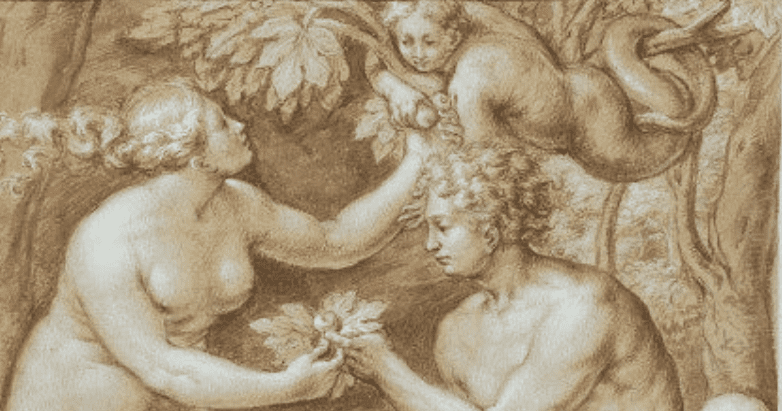
V&A Museum Collections/Wikimedia.
The Westminster Standards contain the system of doctrine taught in Scriptures from a reformed Presbyterian perspective. Among them, the Westminster Confession of Faith has a prominent role.
In chapter VI, in addressing the fall of man and original sin, it states:
I. Our first parents, being seduced by the subtilty and temptation of Satan, sinned, in eating the forbidden fruit. This their sin, God was pleased, according to his wise and holy counsel, to permit, having purposed to order it to his own glory.
Analyzing words superficially
And on this point, Catholics agree. And, I should remember it, we should start analyses like these from what we agree on. However, we disagree on what it says shortly thereafter:
II. By this sin they fell from their original righteousness and communion with God, and so became dead in sin, and wholly defiled in all the parts and faculties of soul and body.
The Confession, if one analyzes its words superficially, agrees with Catholic dogma by saying that “by this sin they fell from their original righteousness and communion with God, and so became dead in sin.”
So much so that, in similar words, the Council of Trent defines:
I. If any one does not confess that the first man, Adam, when he had transgressed the commandment of God in Paradise, immediately lost the holiness and justice wherein he had been constituted;
and that he incurred, through the offence of that prevarication, the wrath and indignation of God, and consequently death, with which God had previously threatened him, and, together with death, captivity under his power who thenceforth had the empire of death, that is to say,
the devil, and that the entire Adam, through that offence of prevarication, was changed, in body and soul, for the worse; let him be anathema.
That disobedience, the fruit of pride and a grave sin, provoked God’s righteous indignation and man’s eternal rejection. Through original sin, our parents lost what we call sanctifying grace, the supernatural gift which inserted them in the very life of God and made them his friends.
Our parents also lost the preternatural gifts: immortality, impassibility etc. They, therefore, lost that original righteousness.
In fact, they “became dead in sin”, as stated by the Confession. The Council of Trent also states:
II. If any one asserts, that the prevarication of Adam injured himself alone, and not his posterity; and that the holiness and justice, received of God, which he lost, he lost for himself alone, and not for us also;
or that he, being defiled by the sin of disobedience, has only transfused death, and pains of the body, into the whole human race, but not sin also, which is the death of the soul; let him be anathema.
Do we agree?
However, if the original sin is the death of the soul, and if the death of the soul is the absence of supernatural life (the sanctifying grace), the original sin, in Catholic doctrine, is the condition of being depraved of grace, “dead in sin”.
It is by Baptism that the grace of Our Lord, the life in God, is given to us, and we are regenerated, and sin is totally extinguished, as Trent says:
V. If any one denies, that, by the grace of our Lord Jesus Christ, which is conferred in baptism, the guilt of original sin is remitted (…).
For, in those who are born again, there is nothing that God hates;
(…) who is created according to God, are made innocent, immaculate, pure, harmless, and beloved of God, heirs indeed of God, but joint heirs with Christ; so that there is nothing whatever to retard their entrance into heaven.
Therefore, even if the words employed by the Confession, in this first passage of paragraph II, affirm the same as Trent, our definition of original sin diverges from each other: while for Catholics it is the absence of sanctifying grace, for The Westminster Confession it is the entire corruption of nature which is a sin and which, even in the regenerated, persists as a sin, as the Confession says in number V:
V. This corruption of nature, during this life, doth remain in those that are regenerated; and although it be, through Christ, pardoned, and mortified; yet both itself, and all the motions thereof, are truly and properly sin.
Another difference
The Confession also diverges from Catholic dogma by stating that, because of original sin, men are “wholly defiled in all the parts and faculties of soul and body “. Thus explains the Confession:
IV. From this original corruption, whereby we are utterly indisposed, disabled, and made opposite to all good, and wholly inclined to all evil, do proceed all actual transgressions.
Catholic dogma, in contrast, states that “the entire Adam, through that offence of prevarication, was changed, in body and soul, for the worse”.
A change for the worse
Catholics do not hold that the corruption of nature is itself sin, or that the sinner, before he is regenerated, is “utterly indisposed, disabled, and made opposite to all good, and wholly inclined to all evil”, since men can do, without the grace of God, e.g. morally good natural actions, as greeting a brother.
Thus, two points apart us in this dogma: the very definition of original sin and what is the consequence of it in human nature.
Catholic
History and Religion
Previous Post

July 30, 2022
Christian Colloquies are live!
Next Post
August 7, 2022 What do I think about the Reformation Day?
Browse Our Archives
Select a Category Comparing faiths Life and Faith Reformation Day
Select a Month August 2022 July 2022
TAKE THE
Religious Wisdom Quiz
What was the first plague in Egypt?
Select your answer to see how you score.
Darkness Hail Water turning to blood Frogs
Related posts from Christian Colloquies
Martin Luther’s 95 Theses: A Brief Catholic Commentary...
What did Calvin teach about the Eucharist (Holy...
Martin Luther's 95 Theses: A Brief Catholic Commentary...
What do I think about the Reformation Day?
TRENDING AT PATHEOS Catholic

The Parable Of The Sower And The Word...
One of Christ’s most famous parables is that of the sower who...

Rejecting Doom: Christian Hope And Human Action
Christianity is a religion of hope. We are to have hope and...

Why I Choose the Eucharist Over the Sermon
Choose the Eucharist, Not the Sermon What are we supposed to get...

5 Design Elements Found in Spiritually Rooted Homes
Putting Spirituality Into Home Decor Our homes are more than our living...

Credo: A Story of God Told with the...
About 10 years ago, I began to imagine a personal "Credo" that...

The Anatomy of Divine Revelation in Catholic Thought
The claim that God has made Himself known to human beings is...
view all Catholic blogs
Ad-Free & Subscriber Log-In Subscription Support
- About Us
- 2026 Calendar
- Videos
- Podcasts
- Library of World Religions
- Faith In Media Tracker
- Advertise With Us
- Write for Us
- Privacy Policy
- Terms of Service
- Do Not Sell My Data
- Contact Us
- Radiant Digital
- Manage Newsletter Subscriptions
- Unsubscribe From Notifications
- Sitemap
Copyright 2008-2026, Patheos. All rights reserved.
Subscription Support Ad-Free & Subscriber Log-In
Follow Patheos