
BuddhistCatholicContemplativeEvangelicalGeneral ChristianHinduJewishLatter-day SaintMuslimNew VisionsProgressive Christian
Beliefs
- Buddhist
- Catholic
- Contemplative
- Evangelical
- General Christian
- Hindu
- Jewish
- Latter-day Saint
- More Voices
- Muslim
- New Visions
- Pagan
- Progressive Christian
Topics
- Religion News
- Food and Religion
- Sports and Religion
- Religious Art
- Religious Music and Entertainment
- Religious Events
- History and Religion
- Style and Religion
- Politics and Religion
- Women in Religion
- Recreation Outdoors and Religion
- Business Finance and Religion
- Careers Workplace and Religion
- Education and Religion
- Family Parenting and Religion
- Health Fitness and Religion
- Home and Religion
- Relationships and Religion
- Technology and Religion
- Travel and Religion
Columnists
- Buddhist Columnists
- Business Finance and Religion Columnists
- Careers Workplace and Religion Columnists
- Catholic Columnists
- Contemplative Columnists
- Education and Religion Columnists
- Evangelists Columnists
- Family Parenting and Religion Columnists
- General Christian Columnists
- Health Fitness and Religion Columnists
- Hindu Columnists
- History and Religion Columnists
- Home and Religion Columnists
- Jewish Columnists
- More Voices Columnists
- Latter Day Columnists
- Muslim Columnists
- New Visions Columnists
- Nonreligious Columnists
- Pagan Columnists
- Politics and Religion Columnists
- Progressive Columnists
- Recreation Outdoors and Religion Columnists
- Relationships and Religion Columnists
- Religion News Columnists
- Religious Art Columnists
- Religious Events Columnists
- Religious Music and Entertainment Columnists
- Sports and Religion Columnists
- Style and Religion Columnists
- Technology and Religion Columnists
- Travel and Religion Columnists
- Women in Religion Columnists
Resource Library
- 2026 Calendar
- Library of World Religions
- The 100 Most Holy Places on Earth
- Patheos Answers
- Podcasts
- Videos
- Faith Leaders Database
- Anglican Episcopalian
- Bahai
- Baptist
- Buddhism
- Christianity
- Confucianism
- Eastern Orthodoxy
- Hinduism
- Holiness and Pentecostal
- ISKCON
- Islam
- Judaism
- Lutheran
- Methodist
- The Church of Jesus Christ of Latter-day Saints
- New Age
- Paganism
- Presbytarian and Reformed
- Protestantism
- Religion Behind the Scenes
- Roman Catholic
- Scientology
- Shia Islam
- Sikhism
- Sufism
- Sunni Islam
- Taoism
- Zen
- See all religions
Research Tools
 Ad-Free & Subscriber Log-In Subscription Support
Ad-Free & Subscriber Log-In Subscription Support
Follow Patheos 

- Trending:
- Forgiveness
- |
- Marriage
- |
- Consciousness
- |
- Death Penalty
- |
- Election
- |
- Halloween

-
Explore
- Home
- Evangelical
- What Happens When Arminians Are Consistent In Their Theology
What Happens When Arminians Are Consistent In Their Theology
Last updated on: September 16, 2016 at 11:15 pm by Jack Lee
What Happens When Arminians Are Consistent In Their Theology 2016-09-16T23:15:55-05:00 Jack Lee
Patheos Explore the world's faith through different perspectives on religion and spirituality! Patheos has the views of the prevalent religions and spiritualities of the world.
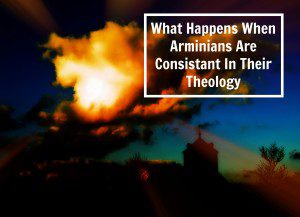
Original Photo Attribution: “big church cloud” CC 2.0
A rare but wonderful thing is when you can theologically debate with someone who truly understands the opposing side of the argument and is honest about the inconsistencies of their own views. This applies to theological discussions but also to discussions in work, family, and especially marriage settings. When we can be honest with ourselves about our views and reasoning, the truth usually comes out. I’ll admit, I fail more often than not when I’m trying to maintain this fair and honest position. Especially when it comes to theology and work of Christ the conversation can get elevated. Lord willing, I trust this is something I will get better at with age.
However, this post is not about me, directly anyway. It’s about the most consistent arminian with whom I have discussed theology. It’s also about how we must be very careful of the image we make of God versus what scripture clearly teaches.
This conversation took place a number of years ago, the fall of 2005 to be exact. A well known arminian professor was speaking at Dallas Baptist University over arminian and calvinistic theology. He was presenting both views and then comparing and contrasting. I am purposely withholding his identity. The session was billed as “Arminianism and Calvinism: Common Ground and Divergent Perspectives.”
Given that it’s been over 10 years, I will do my absolute best to recall the verbiage accurately and honestly.
Professor _____ began by presenting the general theology of both camps; very accurately I might add. In fact, he did a better job representing calvinism than many calvinists I know! He spent a fair amount of time comparing and contrasting and really trying to build some bridges between the camps by focusing on common ground issues. He was kind. He was generous and he was welcoming to difficult questions. It was during in the Q&A that things got a little more interesting.
A few questions asked were related to the problem of evil in the world. More specifically, is God sovereign when terrible things happen in our world? Professor _____ casually responded and explained potential differences in “permitting evil” and “doing evil”. He elaborated on each groups different points while clarifying where he stood in the arminian camp.
Then, he was asked (presumably by a calvinist) about the theological position of men like Jonathan Edwards and how they interpreted the place of evil in the world. The young man referenced the verse Romans 9:21-23, “21 Has the potter no right over the clay, to make out of the same lump one vessel for honorable use and another for dishonorable use? 22 What if God, desiring to show his wrath and to make known his power, has endured with much patience vessels of wrath prepared for destruction, 23 in order to make known the riches of his glory for vessels of mercy, which he has prepared beforehand for glory” (ESV).
To provide a little background, Edwards believed that all things exist and function to bring glory to God. Evil is no exception. Consider these words from Jonathan Edwards on the topic:
“…It is proper that the shining forth of God’s glory should be complete; that is, that all parts of his glory should shine forth, that every beauty should be proportionably effulgent, that the beholder may have a proper notion of God.
Thus it is necessary, that God’s awful majesty, his authority and dreadful greatness, justice, and holiness, should be manifested. But this could not be, unless sin and punishment had been decreed; so that the shining forth of God’s glory would be very imperfect, both because these parts of divine glory would not shine forth as the others do, and also the glory of his goodness, love, and holiness would be faint without them; nay, they could scarcely shine forth at all.
If it were not right that God should decree and permit and punish sin, there could be no manifestation of God’s holiness in hatred of sin, or in showing any preference, in his providence, of godliness before it. There would be no manifestation of God’s grace or true goodness, if there was no sin to be pardoned, no misery to be saved from. How much happiness soever he bestowed, his goodness would not be so much prized and admired. . .
So evil is necessary, in order to the highest happiness of the creature, and the completeness of that communication of God, for which he made the world; because the creature’s happiness consists in the knowledge of God, and the sense of his love.” (The Works of Jonathan Edwards, Vol 2)
At this point Professor _____ , paused and thought for a moment and replied, “If you read the bible with the framework and theology of Jonathan Edwards, or John Piper, then the entire bible makes perfect sense from cover to cover. However, I cannot agree with Edwards because how I view the nature of God does not allow for this kind of interpretation. For me, this is mystery that I will understand when I am in heaven”
I was floored.
In so many words, one of the leading arminian theologians in the world seemed to say that though the bible appears to hold a consistent view on an issue he refuse to believe it. It wasn’t long after that that the symposium ended. In retrospect, I wish I had stopped and talked to him about his comment. Perhaps, there was something else he would like to add or clarify. But as it is, I am left to be oddly thankful for the honesty related to his inconsistencies with scripture and appalled at his willingness to openly deny what the whole of scripture seems to teach.
As Christians, we are to mold our lives and theology to the teachings of scripture and not the other way around. While I do not think this was what Professor _____ intended to do, there is a significant danger in making God the way you want Him to be. You create an idol. You are worship God not as He is but as you want Him to be. It’s been my experience that those who try and manipulate scripture to fit their idea of God, often create a “god” that is oddly similar to themselves. God becomes passionate about the things they are passionate about. God tends to become politically sided with their party. God becomes a cause for war and violence. God becomes a tool to achieve a personal agenda.
We must all examine our lives and theology to make sure it is in line with holy scripture. If something is written that we don’t like or makes us uncomfortable then we have to deal with that. Often times we have to wrestle with scripture. That’s OK. God is not afraid of hard doctrine or hard questions, ask them.
It should be worth saying again, that I don’t think Professor _____ was intentionally misleading or manipulating the scriptures. He appeared (to me anyway) to be following his theology out to what he believed to be it’s logical conclusion, despite his inconsistencies.
Brothers and sisters in Christ, we must let scripture and sound doctrine slowly penetrate our minds and souls so that we are not trying to change God, but rather, God is changing us. This is why some say we are reformed and always reforming.
Previous Post

September 6, 2016
20 Great Films From Around The World
Next Post

September 12, 2016 Pathos, Ethos, and Logos; Regaining the Ground for Coherent Logic
Browse Our Archives
Select a Category #ShoutYourAbortion 10 Commandments 2016 Election 2017 2020 Election Abortion Accelerate Books Adultery America Andy Stanley Arminianism Ashley Madison Atonement B&H Academic Baptism Barry Horner Beauty Biblical Elders Billy Graham Blog Book Review Bruce Jenner Caitlyn Jenner Calvin Calvinism Cheating Chick-fil-A Children Christ Christian History Christian Living Christian Podcasts Christianity Christmas Church History Church Leadership Civil Disobedience Constitutional Coronavirus Culture Death Demoninations Discipleship Doctrine Doctrine of God Donald Trump Ecclesiology Entertainment Eschatology Ethics Evangelical Evangelism Evil Evolution Fear Forgive Yourself Forgiveness Francis Chan Future Israel Gay Marriage Gender Genesis George Floyd Gospel Government Gun Control Halloween hamartiology Heavenly Reward Hermeneutics History Hollywood Holy Spirit Homeschool Homosexual Homosexuality Hope Hospitality Humor Husband Infant Baptism Interview Jesus John Piper Josh Duggar Joshua Harris Judgment Justice Kathy Griffin Kim Davis Leadership Logic Love Manhood Marriage Martin Luther Messianic Prophecy Miscarriage Mocking Modesty Money Movie Reviews Music Music Review Netflix New Testament Obergefell Old Testament Parenting Pastor Pastoring Persecution Planned Parenthood Podcast Politics Pop Culture Pornography Prayer Preaching Predestination Pride Prosperity Gospel Rachel Held Evans Racism Ravi Zacharias Redemption Reformation 500 Reformation Day Reformed Theology Relationship Repentance Salvation Same Sex Marriage Satan Satire Scripture Seminary Sex Sin slavery Sola Scriptura Soteriology Sovereignty Spiritual Gifts Spurgeon Star Wars Steven Furtick Suffering Sufficiency of Scripture Sunday School Supreme Court Technology Testimony The Church The Lord of the Rings The Problem of Evil The Shack Theology Theonomy Tithing Transgenderism Tullian Tchividjian Uncategorized Universalism Vanity Fair Video Games Virgin Birth Voting Wife Women Worldview Worship
Select a Month June 2025 April 2025 March 2025 March 2024 February 2024 January 2024 December 2023 June 2023 April 2023 March 2023 January 2023 December 2022 November 2022 October 2022 September 2022 August 2022 July 2022 June 2022 May 2022 April 2022 March 2022 February 2022 January 2022 December 2021 November 2021 October 2021 August 2021 July 2021 June 2021 May 2021 April 2021 March 2021 February 2021 January 2021 December 2020 November 2020 October 2020 September 2020 August 2020 July 2020 June 2020 May 2020 April 2020 March 2020 February 2020 January 2020 December 2019 November 2019 October 2019 September 2019 August 2019 July 2019 June 2019 May 2019 April 2019 March 2019 February 2019 January 2019 December 2018 November 2018 October 2018 September 2018 August 2018 July 2018 June 2018 May 2018 April 2018 March 2018 February 2018 January 2018 December 2017 November 2017 October 2017 September 2017 August 2017 July 2017 June 2017 May 2017 April 2017 March 2017 February 2017 January 2017 December 2016 November 2016 October 2016 September 2016 August 2016 July 2016 June 2016 May 2016 April 2016 March 2016 February 2016 January 2016 December 2015 November 2015 October 2015 September 2015 August 2015 July 2015 June 2015 May 2015 April 2015 March 2015 February 2015 January 2015 December 2014 November 2014 October 2014 September 2014 August 2014 July 2014
Follow Us!
TAKE THE
Religious Wisdom Quiz
Which book prophesies the destruction of Nineveh?
Select your answer to see how you score.
Obadiah Nahum Jonah Zephaniah
Related posts from The Chorus In The Chaos

Unconditional Election: A Study in What it Means...
Total Depravity: A Critical Lesson in Seeing the...
6 Common Misconceptions About Calvinism

'I Don't Need Theology, I Just Need Jesus'...
TRENDING AT PATHEOS Evangelical

How the author of the world's best hymn...
I've been working with John Newton for a while now. This makes...

Long before this Lectio Divina, Psalm 130 - the song - started...

What About the Trees? Another Living Parable
After I finished writing the last article about falling leaves as a...

Why Classical Education Is a Conversation, Not a...
Come and Read: Joy in Classical Education When I was a little...

Falling Leaves: A Living Parable on Letting Go
I’ve spent the vast majority of my life in the southeast corner...

Cornell University has received a great deal of negative publicity and intense...
view all Evangelical blogs
Ad-Free & Subscriber Log-In Subscription Support
- About Us
- 2026 Calendar
- Videos
- Podcasts
- Library of World Religions
- Faith In Media Tracker
- Advertise With Us
- Write for Us
- Privacy Policy
- Terms of Service
- Do Not Sell My Data
- Contact Us
- Radiant Digital
- Manage Newsletter Subscriptions
- Unsubscribe From Notifications
- Sitemap
Copyright 2008-2026, Patheos. All rights reserved.
Subscription Support Ad-Free & Subscriber Log-In
Follow Patheos