
BuddhistCatholicContemplativeEvangelicalGeneral ChristianHinduJewishLatter-day SaintMuslimNew VisionsProgressive Christian
Beliefs
- Buddhist
- Catholic
- Contemplative
- Evangelical
- General Christian
- Hindu
- Jewish
- Latter-day Saint
- More Voices
- Muslim
- New Visions
- Pagan
- Progressive Christian
Topics
- Religion News
- Food and Religion
- Sports and Religion
- Religious Art
- Religious Music and Entertainment
- Religious Events
- History and Religion
- Style and Religion
- Politics and Religion
- Women in Religion
- Recreation Outdoors and Religion
- Business Finance and Religion
- Careers Workplace and Religion
- Education and Religion
- Family Parenting and Religion
- Health Fitness and Religion
- Home and Religion
- Relationships and Religion
- Technology and Religion
- Travel and Religion
Columnists
- Buddhist Columnists
- Business Finance and Religion Columnists
- Careers Workplace and Religion Columnists
- Catholic Columnists
- Contemplative Columnists
- Education and Religion Columnists
- Evangelists Columnists
- Family Parenting and Religion Columnists
- General Christian Columnists
- Health Fitness and Religion Columnists
- Hindu Columnists
- History and Religion Columnists
- Home and Religion Columnists
- Jewish Columnists
- More Voices Columnists
- Latter Day Columnists
- Muslim Columnists
- New Visions Columnists
- Nonreligious Columnists
- Pagan Columnists
- Politics and Religion Columnists
- Progressive Columnists
- Recreation Outdoors and Religion Columnists
- Relationships and Religion Columnists
- Religion News Columnists
- Religious Art Columnists
- Religious Events Columnists
- Religious Music and Entertainment Columnists
- Sports and Religion Columnists
- Style and Religion Columnists
- Technology and Religion Columnists
- Travel and Religion Columnists
- Women in Religion Columnists
Resource Library
- 2026 Calendar
- Library of World Religions
- The 100 Most Holy Places on Earth
- Patheos Answers
- Podcasts
- Videos
- Faith Leaders Database
- Anglican Episcopalian
- Bahai
- Baptist
- Buddhism
- Christianity
- Confucianism
- Eastern Orthodoxy
- Hinduism
- Holiness and Pentecostal
- ISKCON
- Islam
- Judaism
- Lutheran
- Methodist
- The Church of Jesus Christ of Latter-day Saints
- New Age
- Paganism
- Presbytarian and Reformed
- Protestantism
- Religion Behind the Scenes
- Roman Catholic
- Scientology
- Shia Islam
- Sikhism
- Sufism
- Sunni Islam
- Taoism
- Zen
- See all religions
Research Tools
 Ad-Free & Subscriber Log-In Subscription Support
Ad-Free & Subscriber Log-In Subscription Support
Follow Patheos 

- Trending:
- Forgiveness
- |
- Marriage
- |
- Consciousness
- |
- Death Penalty
- |
- Election
- |
- Halloween

-
Explore
- Home
- Evangelical
- Three Billboards: The Violent Grace of Martin McDonagh
Three Billboards: The Violent Grace of Martin McDonagh
Last updated on: December 5, 2017 at 9:13 am by Jonathan Dorst
Three Billboards: The Violent Grace of Martin McDonagh 2017-12-05T09:13:26-05:00 Jonathan Dorst
Patheos Explore the world's faith through different perspectives on religion and spirituality! Patheos has the views of the prevalent religions and spiritualities of the world.
Early on in the film Three Billboards Outside Ebbing, Missouri there is a brief shot of a character reading a book. The book, acting like a literary product placement, is Flannery O’Connor’s “A Good Man Is Hard To Find.” O’Connor was a Southern Catholic writer who was known for stories with shocking acts of violence followed by moments of real grace. It was part of O’Connor’s philosophy that to fully understand grace, we must see and feel human depravity.
Martin McDonagh, the writer and director of Three Billboards is clearly a fan of Flannery O’Connor (though I’ve not read an interview where he admits that, at least one other film director, Scott Derrickson, openly admits his own huge admiration for O’Connor). McDonagh’s first feature film, In Bruges, is a gorgeous piece of filmmaking that also has shocking O’Connor-like moments of violence mixed with compelling moments of grace.
“A Good Man Is Hard To Find” is both a fitting subtitle to Three Billboards as well as a key to understanding its story. One of O’Connor’s best-known short stories, “A Good Man” tells the story of 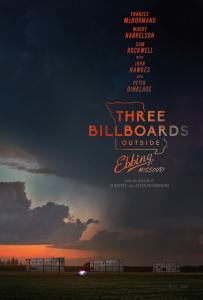 a family traveling on vacation that runs into a group of killers on the loose. The story’s center is the grandmother of the family who is concerned about looking like a “good,” proper lady, but who eventually has a moment of choosing to actually do good in a moment of grace surrounded by brutal violence. One of the killers remarks that she would have been a good woman if “it had been somebody there to shoot her every minute of her life.” This idea of a constant infliction of violence clarifying, and even shaping, a person’s character is echoed in McDonagh’s latest film.
In Three Billboards Outside Ebbing, Missouri, there are no pure heroes or villains. The basic story is of a woman, Mildred Hayes (Frances McDormand), who is trying to find the man who raped and murdered her daughter. She believes that the local police, including Chief Willoughby (Woody Harrelson) and Officer Dixon (Sam Rockwell), are not doing enough to solve the case, which prompts her to put up the billboards referred to in the title in order to exhort the police to keep working the case. As the story progresses, we see that every character has virtues and vices and that the person you think is going to be the protagonist might be one of its villains.
There is some religious symbolism (a steeple in the frame, a sacrificial act of love and justice) but, apart from a confrontation between Mildred and a priest and a conversation Mildred has with a deer, there is little obvious spiritual language apart from characters taking the Lord’s name in vain. Rather, the moments of grace are shown rather than spoken. In fact, talking through the film’s connections in the car afterwards, my wife and I marveled at how almost everyone who was hurt forgave their assailant. There is hard won empathy and kindness shown here.
McDonagh grew up Catholic, and one of Catholicism’s most visually compelling doctrines, so often depicted in Catholic art, is the idea of purgatory, the state in between heaven and hell. Both In Bruges and Three Billboards use purgatory imagery to underline the dramatic weight of their characters’ situations and choices. In the former film, the city of Bruges acts as a geographic purgatory for Ray, Collin Farrell’s morally conflicted hitman (who hates Bruges and just wants to get back to Dublin). Bruges is the place where he will hide out until his boss determines where to send him next or until Ray decides to administer justice to himself. In one of the latter film’s most memorable scenes, Sam Rockwell’s Dixon is caught up reading a letter from his mentor encouraging him to stop hating and to be a better person, which would lead to his achieving his dream of becoming a detective. As he is reading, he is also listening to music in his earbuds and so does not recognize the flames that are growing outside his office, the result of a series of Molotov cocktails Mildred has thrown at the police station. The message is clear, Dixon has to decide whether to be engulfed (damned) by his anger and fear or whether to follow his mentor’s encouragement and example and choose a life of love and self-sacrifice.
Of course, the Bible doesn’t provide for a purgatory-like temporary destination in the afterlife. Still, it does exhort us to “Choose this day whom you will serve” and “Seek the Lord while he may be found.” Our choices in this life do matter for eternity. Good men and women are hard to find, in fact all have sinned and fall short of God’s glory, but God’s grace can intervene in our lives, save us from ourselves, and turn us towards goodness. This is explicit in most of the Bible, although in the book of Esther it is implicit, with God not even being mentioned once in its 10 chapters. Like Esther, McDonagh’s movies offer an implicit understanding of divine grace giving hope to hopelessly angry, violent people.
Previous Post
November 29, 2017
Two Hermeneutical Errors of the Prosperity Gospel
Next Post
December 6, 2017 Believing in White Privilege Is Not a Prerequisite for Righteousness
Browse Our Archives
Select a Category #ShoutYourAbortion 10 Commandments 2016 Election 2017 2020 Election Abortion Accelerate Books Adultery America Andy Stanley Arminianism Ashley Madison Atonement B&H Academic Baptism Barry Horner Beauty Biblical Elders Billy Graham Blog Book Review Bruce Jenner Caitlyn Jenner Calvin Calvinism Cheating Chick-fil-A Children Christ Christian History Christian Living Christian Podcasts Christianity Christmas Church History Church Leadership Civil Disobedience Constitutional Coronavirus Culture Death Demoninations Discipleship Doctrine Doctrine of God Donald Trump Ecclesiology Entertainment Eschatology Ethics Evangelical Evangelism Evil Evolution Fear Forgive Yourself Forgiveness Francis Chan Future Israel Gay Marriage Gender Genesis George Floyd Gospel Government Gun Control Halloween hamartiology Heavenly Reward Hermeneutics History Hollywood Holy Spirit Homeschool Homosexual Homosexuality Hope Hospitality Humor Husband Infant Baptism Interview Jesus John Piper Josh Duggar Joshua Harris Judgment Justice Kathy Griffin Kim Davis Leadership Logic Love Manhood Marriage Martin Luther Messianic Prophecy Miscarriage Mocking Modesty Money Movie Reviews Music Music Review Netflix New Testament Obergefell Old Testament Parenting Pastor Pastoring Persecution Planned Parenthood Podcast Politics Pop Culture Pornography Prayer Preaching Predestination Pride Prosperity Gospel Rachel Held Evans Racism Ravi Zacharias Redemption Reformation 500 Reformation Day Reformed Theology Relationship Repentance Salvation Same Sex Marriage Satan Satire Scripture Seminary Sex Sin slavery Sola Scriptura Soteriology Sovereignty Spiritual Gifts Spurgeon Star Wars Steven Furtick Suffering Sufficiency of Scripture Sunday School Supreme Court Technology Testimony The Church The Lord of the Rings The Problem of Evil The Shack Theology Theonomy Tithing Transgenderism Tullian Tchividjian Uncategorized Universalism Vanity Fair Video Games Virgin Birth Voting Wife Women Worldview Worship
Select a Month June 2025 April 2025 March 2025 March 2024 February 2024 January 2024 December 2023 June 2023 April 2023 March 2023 January 2023 December 2022 November 2022 October 2022 September 2022 August 2022 July 2022 June 2022 May 2022 April 2022 March 2022 February 2022 January 2022 December 2021 November 2021 October 2021 August 2021 July 2021 June 2021 May 2021 April 2021 March 2021 February 2021 January 2021 December 2020 November 2020 October 2020 September 2020 August 2020 July 2020 June 2020 May 2020 April 2020 March 2020 February 2020 January 2020 December 2019 November 2019 October 2019 September 2019 August 2019 July 2019 June 2019 May 2019 April 2019 March 2019 February 2019 January 2019 December 2018 November 2018 October 2018 September 2018 August 2018 July 2018 June 2018 May 2018 April 2018 March 2018 February 2018 January 2018 December 2017 November 2017 October 2017 September 2017 August 2017 July 2017 June 2017 May 2017 April 2017 March 2017 February 2017 January 2017 December 2016 November 2016 October 2016 September 2016 August 2016 July 2016 June 2016 May 2016 April 2016 March 2016 February 2016 January 2016 December 2015 November 2015 October 2015 September 2015 August 2015 July 2015 June 2015 May 2015 April 2015 March 2015 February 2015 January 2015 December 2014 November 2014 October 2014 September 2014 August 2014 July 2014
Follow Us!
TAKE THE
Religious Wisdom Quiz
Which mountain is traditionally believed to be where Noah's Ark came to rest?
Select your answer to see how you score.
Mount Ararat Mount Hermon Mount Carmel Mount Sinai
Related posts from The Chorus In The Chaos
The Serious Comedy of 'Instant Family'
'A Quiet Place': A Story of Sacrifice in...
What is a Heretic? Netflix's 'Christian Film' Come...
How Was Samson Righteous? A Review of Pure...
TRENDING AT PATHEOS Evangelical

The REST of Your Life: A Creative Wrestles...
This week I had a conversation with a good friend from church....

How the author of the world's best hymn...
I've been working with John Newton for a while now. This makes...

Long before this Lectio Divina, Psalm 130 - the song - started...

What About the Trees? Another Living Parable
After I finished writing the last article about falling leaves as a...

Why Classical Education Is a Conversation, Not a...
Come and Read: Joy in Classical Education When I was a little...

Cornell University has received a great deal of negative publicity and intense...
view all Evangelical blogs
Ad-Free & Subscriber Log-In Subscription Support
- About Us
- 2026 Calendar
- Videos
- Podcasts
- Library of World Religions
- Faith In Media Tracker
- Advertise With Us
- Write for Us
- Privacy Policy
- Terms of Service
- Do Not Sell My Data
- Contact Us
- Radiant Digital
- Manage Newsletter Subscriptions
- Unsubscribe From Notifications
- Sitemap
Copyright 2008-2026, Patheos. All rights reserved.
Subscription Support Ad-Free & Subscriber Log-In
Follow Patheos