
BuddhistCatholicContemplativeEvangelicalGeneral ChristianHinduJewishLatter-day SaintMuslimNew VisionsProgressive Christian
Beliefs
- Buddhist
- Catholic
- Contemplative
- Evangelical
- General Christian
- Hindu
- Jewish
- Latter-day Saint
- More Voices
- Muslim
- New Visions
- Pagan
- Progressive Christian
Topics
- Religion News
- Food and Religion
- Sports and Religion
- Religious Art
- Religious Music and Entertainment
- Religious Events
- History and Religion
- Style and Religion
- Politics and Religion
- Women in Religion
- Recreation Outdoors and Religion
- Business Finance and Religion
- Careers Workplace and Religion
- Education and Religion
- Family Parenting and Religion
- Health Fitness and Religion
- Home and Religion
- Relationships and Religion
- Technology and Religion
- Travel and Religion
Columnists
- Buddhist Columnists
- Business Finance and Religion Columnists
- Careers Workplace and Religion Columnists
- Catholic Columnists
- Contemplative Columnists
- Education and Religion Columnists
- Evangelists Columnists
- Family Parenting and Religion Columnists
- General Christian Columnists
- Health Fitness and Religion Columnists
- Hindu Columnists
- History and Religion Columnists
- Home and Religion Columnists
- Jewish Columnists
- More Voices Columnists
- Latter Day Columnists
- Muslim Columnists
- New Visions Columnists
- Nonreligious Columnists
- Pagan Columnists
- Politics and Religion Columnists
- Progressive Columnists
- Recreation Outdoors and Religion Columnists
- Relationships and Religion Columnists
- Religion News Columnists
- Religious Art Columnists
- Religious Events Columnists
- Religious Music and Entertainment Columnists
- Sports and Religion Columnists
- Style and Religion Columnists
- Technology and Religion Columnists
- Travel and Religion Columnists
- Women in Religion Columnists
Resource Library
- 2026 Calendar
- Library of World Religions
- The 100 Most Holy Places on Earth
- Patheos Answers
- Podcasts
- Videos
- Faith Leaders Database
- Anglican Episcopalian
- Bahai
- Baptist
- Buddhism
- Christianity
- Confucianism
- Eastern Orthodoxy
- Hinduism
- Holiness and Pentecostal
- ISKCON
- Islam
- Judaism
- Lutheran
- Methodist
- The Church of Jesus Christ of Latter-day Saints
- New Age
- Paganism
- Presbytarian and Reformed
- Protestantism
- Religion Behind the Scenes
- Roman Catholic
- Scientology
- Shia Islam
- Sikhism
- Sufism
- Sunni Islam
- Taoism
- Zen
- See all religions
Research Tools
 Ad-Free & Subscriber Log-In Subscription Support
Ad-Free & Subscriber Log-In Subscription Support
Follow Patheos 

- Trending:
- Forgiveness
- |
- Marriage
- |
- Consciousness
- |
- Death Penalty
- |
- Election
- |
- Halloween

-
Explore
- Home
- Evangelical
- Book Review – The Pastor as Public Theologian: Reclaiming a Lost Vision
Book Review – The Pastor as Public Theologian: Reclaiming a Lost Vision
Last updated on: April 11, 2016 at 10:43 pm by Grayson Gilbert
Book Review – The Pastor as Public Theologian: Reclaiming a Lost Vision 2016-04-11T22:43:29-05:00 Grayson Gilbert
Patheos Explore the world's faith through different perspectives on religion and spirituality! Patheos has the views of the prevalent religions and spiritualities of the world.
The Pastor as Public Theologian has hit some fairly good feedback from many Christian circles, and for good reason. Not only is the structure of this book laid out cleanly, but it is easy to interact with the writing as you are reading it. The style of the book is largely pastoral, rather than exegetical in nature, but for obvious reasons (hence, the title). While I don’t feel as if this book has set an earth-shattering precedent, it is indeed a timely book for the evangelical church, who is in desperate need of filling the pulpit with men who are not only equipped to do the service of a pastor – but focus foremost upon the proclamation and exposition of the Word from the pulpit.
One thing I greatly appreciated about this book was that is lacked the tendency to run away with polemics and chastisement of the church. We know the American church and the pastorate are weak currently (as a collective whole) – what is needed is the solution: a return to expository preaching and for the pastorate to be seen as one of a rich historical foundation. This foundation is precisely what Vanhoozer and Strachan argue for, using the historical-theological narrative to build their case.
Beyond this, the layout of the book is easy to follow. Starting with a brief biblical theology of the pastorate, they deal within the nature of prophet, priest, and king, drawing from OT texts and offices to inform in part what the pastorate looks like – under the auspices of the true Prophet, Priest, and King. In the next section of the book, they dive deeply into the historical roots of the pastorate, drawing from the Early Church Fathers, Medieval Period, Reformation, the Puritans, and a few modern examples of pastors who stood against the tides of theological liberalism (Ockenga) and tumultuous times (M.L.J.).
In the second section of the book, Vanhoozer and Strachan turn the focus toward a systematic and practical theology of the pastoral office. In this, they further build the case for both the nature of theological depth and practical orthopraxy. Thus, not only is the pastor-theologian fulfilling the deep need for an in depth knowledge of the God who saves, but also an in depth treatment on how that theology informs their lives in the wake of living under God’s commands, trials and burdens this life gives us, having an abiding faith and trust through knowing Christ crucified and the power of His resurrection. Yet also, here they offer a brief treatment regarding the imperative (command) in light of the indicative (fact) mood within scripture. More clearly, they seek to draw the line in why the pastor obeys the scriptures, and leads others to do so as well.
The final chapter of the book focuses specifically on how the Great Commission informs the role of the pastor-theologian. Thus, it is not the conventional growth-by-numbers treatment that is so common in the broader Evangelical church, but the “building of God’s house” through disciple-making. In breaking down this commission, the tasks are fairly straight forward:
- Evangelism: Proclaiming What Is in Christ
- Catechism: Teaching What Is in Christ
- Liturgist: Celebrating What Is in Christ
- Apologist: Demonstrating What Is in Christ
In between each of these chapters are brief sections called Pastoral Perspectives, and they offer exactly what it sounds like. Some of these are incredibly helpful, others are less so. That’s always the nature of the beast with multiple contributions within a larger work, but these are at most 2-3 pages each.
I set off to read this book because I was excited to read it. I have long lamented over the state of the American church, having recognized the systemic issue of unqualified men in the pulpits. Often, the pulpit is the last place the broader evangelical church sees as a bastion of theologically rich, biblically sound doctrine. Rather, the pastor is oft seen as the man who dons the drape of public service, performs the weddings, funerals, and dedications. Those who regularly study the scriptures will note the disparity between how the majority populous views pastoral ministry and what it is actually intended to be, per scriptural qualifications outlined in the Pastoral Epistles.
Though I would heartily give a recommendation for this book, there were a few weak spots within the content, which I
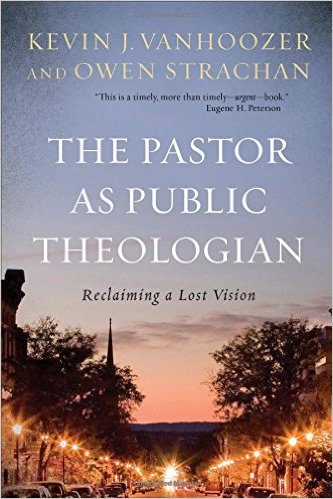
http://www.amazon.com/The-Pastor-Public-Theologian-Reclaiming/dp/0801097711
disagree with equally as heartily:
“God does not directly will suffering” (pg. 154).
There are a host of responses to this, but suffice it to say, I would think by now we should have developed a more rich theology of suffering. 1 Peter directly contradicts this quote.
“The Pastor-theologian works largely in the indicative mood, proclaiming the gospel, and whenever possible, using words to do so: Jesus’ own words about Jesus” (152).
I would like to give deference where it is due, but at the same time, this is the same re-hashed (falsely) attributed quoted of St. Francis de Assisi. The gospel must be proclaimed using words, something Vanhoozer and Strachan undoubtedly understand, as they expound on this in numerous point in the book and even slightly here. Yet that little phrase, “whenever possible, using words to do so” seems to reinforce a problematic inference of one’s actions giving credence to the testimony of the scriptures. While it is true that “God’s name is blasphemed among the Gentile because of you…” there are better ways to phrase what I believe the author is seeking to say.
The only other issue I had within this text, and by far, this left me unsettled in the midst of reading the book, was one of the pastoral perspectives. In the midst of reflecting upon the need for the pastor-theologian to have a breadth of knowledge in general fields, this pastor slips in his presupposition of theistic evolution (or OEC; it wasn’t entirely clear which, yet nonetheless it was clear he held to one of the two). Interestingly, he seemed to highlight the need for gentle disagreement on these matters – yet neglected to mention the untenable hermeneutical principle this methodology embraces, and the exegetical problems this creates later on. I suspect many reading this review will disagree with me on this, but perhaps he has moved too broadly in his perspective, and it seemed like an intentional act of hegemony. Throw it out there enough times and in enough popular works, and the next generation of Christians is much less likely to challenge the exegetical grounds on which it stands.
Disclosure: I received this book free from Baker Academic through the media reviewer program. The opinions I have expressed are my own, and I was not required to write a positive review. I am disclosing this in accordance with the Federal Trade Commission’s 16 CFR, Part 255.
Previous Post

November 12, 2015
The Bible Verse Most Christians Completely Ignore
Next Post
December 3, 2015 The God of Calvinism is Greater than the God of Arminianism
Browse Our Archives
Select a Category #ShoutYourAbortion 10 Commandments 2016 Election 2017 2020 Election Abortion Accelerate Books Adultery America Andy Stanley Arminianism Ashley Madison Atonement B&H Academic Baptism Barry Horner Beauty Biblical Elders Billy Graham Blog Book Review Bruce Jenner Caitlyn Jenner Calvin Calvinism Cheating Chick-fil-A Children Christ Christian History Christian Living Christian Podcasts Christianity Christmas Church History Church Leadership Civil Disobedience Constitutional Coronavirus Culture Death Demoninations Discipleship Doctrine Doctrine of God Donald Trump Ecclesiology Entertainment Eschatology Ethics Evangelical Evangelism Evil Evolution Fear Forgive Yourself Forgiveness Francis Chan Future Israel Gay Marriage Gender Genesis George Floyd Gospel Government Gun Control Halloween hamartiology Heavenly Reward Hermeneutics History Hollywood Holy Spirit Homeschool Homosexual Homosexuality Hope Hospitality Humor Husband Infant Baptism Interview Jesus John Piper Josh Duggar Joshua Harris Judgment Justice Kathy Griffin Kim Davis Leadership Logic Love Manhood Marriage Martin Luther Messianic Prophecy Miscarriage Mocking Modesty Money Movie Reviews Music Music Review Netflix New Testament Obergefell Old Testament Parenting Pastor Pastoring Persecution Planned Parenthood Podcast Politics Pop Culture Pornography Prayer Preaching Predestination Pride Prosperity Gospel Rachel Held Evans Racism Ravi Zacharias Redemption Reformation 500 Reformation Day Reformed Theology Relationship Repentance Salvation Same Sex Marriage Satan Satire Scripture Seminary Sex Sin slavery Sola Scriptura Soteriology Sovereignty Spiritual Gifts Spurgeon Star Wars Steven Furtick Suffering Sufficiency of Scripture Sunday School Supreme Court Technology Testimony The Church The Lord of the Rings The Problem of Evil The Shack Theology Theonomy Tithing Transgenderism Tullian Tchividjian Uncategorized Universalism Vanity Fair Video Games Virgin Birth Voting Wife Women Worldview Worship
Select a Month June 2025 April 2025 March 2025 March 2024 February 2024 January 2024 December 2023 June 2023 April 2023 March 2023 January 2023 December 2022 November 2022 October 2022 September 2022 August 2022 July 2022 June 2022 May 2022 April 2022 March 2022 February 2022 January 2022 December 2021 November 2021 October 2021 August 2021 July 2021 June 2021 May 2021 April 2021 March 2021 February 2021 January 2021 December 2020 November 2020 October 2020 September 2020 August 2020 July 2020 June 2020 May 2020 April 2020 March 2020 February 2020 January 2020 December 2019 November 2019 October 2019 September 2019 August 2019 July 2019 June 2019 May 2019 April 2019 March 2019 February 2019 January 2019 December 2018 November 2018 October 2018 September 2018 August 2018 July 2018 June 2018 May 2018 April 2018 March 2018 February 2018 January 2018 December 2017 November 2017 October 2017 September 2017 August 2017 July 2017 June 2017 May 2017 April 2017 March 2017 February 2017 January 2017 December 2016 November 2016 October 2016 September 2016 August 2016 July 2016 June 2016 May 2016 April 2016 March 2016 February 2016 January 2016 December 2015 November 2015 October 2015 September 2015 August 2015 July 2015 June 2015 May 2015 April 2015 March 2015 February 2015 January 2015 December 2014 November 2014 October 2014 September 2014 August 2014 July 2014
Follow Us!
TAKE THE
Religious Wisdom Quiz
In the Parable of the Pearl of Great Price, what does the merchant do?
Select your answer to see how you score.
Builds a bigger barn Finds a lost coin Buys many pearls Sells all to buy the pearl
Related posts from The Chorus In The Chaos

‘Two Cities,Two Loves’, a Look at Christians and...
Inerrancy and the Gospels: How to Handle Narrative...
God's Glory Revealed in Christ

'I Don't Need Theology, I Just Need Jesus'...
TRENDING AT PATHEOS Evangelical

How the author of the world's best hymn...
I've been working with John Newton for a while now. This makes...

Long before this Lectio Divina, Psalm 130 - the song - started...

What About the Trees? Another Living Parable
After I finished writing the last article about falling leaves as a...

Why Classical Education Is a Conversation, Not a...
Come and Read: Joy in Classical Education When I was a little...

Falling Leaves: A Living Parable on Letting Go
I’ve spent the vast majority of my life in the southeast corner...

Cornell University has received a great deal of negative publicity and intense...
view all Evangelical blogs
Ad-Free & Subscriber Log-In Subscription Support
- About Us
- 2026 Calendar
- Videos
- Podcasts
- Library of World Religions
- Faith In Media Tracker
- Advertise With Us
- Write for Us
- Privacy Policy
- Terms of Service
- Do Not Sell My Data
- Contact Us
- Radiant Digital
- Manage Newsletter Subscriptions
- Unsubscribe From Notifications
- Sitemap
Copyright 2008-2026, Patheos. All rights reserved.
Subscription Support Ad-Free & Subscriber Log-In
Follow Patheos