
BuddhistCatholicContemplativeEvangelicalGeneral ChristianHinduJewishLatter-day SaintMuslimNew VisionsProgressive Christian
Beliefs
- Buddhist
- Catholic
- Contemplative
- Evangelical
- General Christian
- Hindu
- Jewish
- Latter-day Saint
- More Voices
- Muslim
- New Visions
- Pagan
- Progressive Christian
Topics
- Religion News
- Food and Religion
- Sports and Religion
- Religious Art
- Religious Music and Entertainment
- Religious Events
- History and Religion
- Style and Religion
- Politics and Religion
- Women in Religion
- Recreation Outdoors and Religion
- Business Finance and Religion
- Careers Workplace and Religion
- Education and Religion
- Family Parenting and Religion
- Health Fitness and Religion
- Home and Religion
- Relationships and Religion
- Technology and Religion
- Travel and Religion
Columnists
- Buddhist Columnists
- Business Finance and Religion Columnists
- Careers Workplace and Religion Columnists
- Catholic Columnists
- Contemplative Columnists
- Education and Religion Columnists
- Evangelists Columnists
- Family Parenting and Religion Columnists
- General Christian Columnists
- Health Fitness and Religion Columnists
- Hindu Columnists
- History and Religion Columnists
- Home and Religion Columnists
- Jewish Columnists
- More Voices Columnists
- Latter Day Columnists
- Muslim Columnists
- New Visions Columnists
- Nonreligious Columnists
- Pagan Columnists
- Politics and Religion Columnists
- Progressive Columnists
- Recreation Outdoors and Religion Columnists
- Relationships and Religion Columnists
- Religion News Columnists
- Religious Art Columnists
- Religious Events Columnists
- Religious Music and Entertainment Columnists
- Sports and Religion Columnists
- Style and Religion Columnists
- Technology and Religion Columnists
- Travel and Religion Columnists
- Women in Religion Columnists
Resource Library
- 2026 Calendar
- Library of World Religions
- The 100 Most Holy Places on Earth
- Patheos Answers
- Podcasts
- Videos
- Faith Leaders Database
- Anglican Episcopalian
- Bahai
- Baptist
- Buddhism
- Christianity
- Confucianism
- Eastern Orthodoxy
- Hinduism
- Holiness and Pentecostal
- ISKCON
- Islam
- Judaism
- Lutheran
- Methodist
- The Church of Jesus Christ of Latter-day Saints
- New Age
- Paganism
- Presbytarian and Reformed
- Protestantism
- Religion Behind the Scenes
- Roman Catholic
- Scientology
- Shia Islam
- Sikhism
- Sufism
- Sunni Islam
- Taoism
- Zen
- See all religions
Research Tools
 Ad-Free & Subscriber Log-In Subscription Support
Ad-Free & Subscriber Log-In Subscription Support
Follow Patheos 

- Trending:
- Forgiveness
- |
- Marriage
- |
- Consciousness
- |
- Death Penalty
- |
- Election
- |
- Halloween

-
Explore
- Home
- Evangelical
- Memento and The Lord’s Supper
Memento and The Lord’s Supper
Last updated on: May 19, 2017 at 8:17 am by Jonathan Dorst
Memento and The Lord’s Supper 2017-05-19T08:17:57-05:00 Jonathan Dorst
Patheos Explore the world's faith through different perspectives on religion and spirituality! Patheos has the views of the prevalent religions and spiritualities of the world.
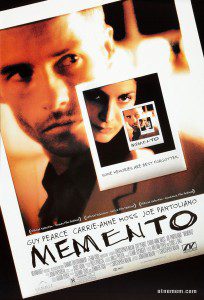 I once watched Memento (2000) with a group and afterwards one of the group members said that he didn’t like the film because the medical condition of the main character is so rare that he couldn’t identify with it, and so he had little sympathy for the protagonist. But, it seems to me that the film is an examination, not so much of a medical condition, but of Leonard’s real condition, the condition of being human and trying to make your way in the world. And that is a something with which we can all identify. Memento seems, on first viewing, to merely be a puzzle that must be put together to make sense of the plot. However, the more you interact with the film, the more you realize that the plot is secondary, and the questions that the film raises are at the center of what the film is really about.
Christopher Nolan’s second film is about Leonard Shelby (Guy Pearce) and his condition, anterograde amnesia, which prevents him from making new memories. He can plan ahead and remember things before the accident that caused his condition, but he cannot recall what he has just done, essentially living life ten minutes at a time. In order to be able to get his bearings every morning (and multiple times throughout the day), Leonard places informational tattoos all over his body and takes Polaroid pictures of people in his life everywhere he goes. The most prominent of his tattoos are two across his chest that say ‘John G raped and murdered my wife’ and ‘Find him and kill him’.
The plot is ostensibly about Leonard’s quest to find and kill his wife’s rapist/killer. However, since Leonard and his ‘friend’ Teddy (Joe Pantoliano) present different accounts of events (and since Nolan has refused in interviews to say what actually did happen), the viewer is left to decide which narrator is more reliable.
Leonard’s condition is an ingenious device to comment on the world. Because Leonard is not able to make new memories, he can only go on old, unreliable memories and on facts that he has accumulated to guide his daily life. What the viewer is presented with is a parable of postmodern Western life: we live in the present, cut off from history, listening to a baffling array of voices, not knowing who to trust. His condition also necessitates that he have ‘a system’ to give his life meaning and to make it bearable. Postmodernism says that, to some degree, we all invent reality, living within our own narratives, failing to fully fit into any meta-narrative.
Memory is a peculiar thing and many films have explored the dynamics surrounding it. Movies like 50 First Dates and Finding Nemo use memory loss for laughs, while films like The Bourne Identity, The Girl on the Train, Anastasia, and Spellbound use amnesia as a dramatic plot device. It’s a rare film, like Away From Her or The Vow, that explores how devastating the loss of memory can be. One of the most interesting movies about memory, and in some ways most like Memento, is Charlie Kaufman’s Eternal Sunshine of the Spotless Mind, where two people (played by Kate Winslet and Jim Carrey) choose to have their memories erased so they don’t have to deal with their feelings about each other, only to meet later and, in the midst of getting to know each other (again), find out about their choice to erase the others’ memory.
The Bible has a lot to say about memory. Interestingly, throughout the book of Genesis, it’s God who is said to remember things- in Genesis 8:1, God ‘remembers’ Noah and in Genesis 30:22, God remembers Rachel. This would seem to contradict our belief in God’s omniscience until you recognize that the biblical writer is using the word ‘remember’ as a way that humans can relate to God beginning to act in someone’s situation.
It’s not until Exodus 13 that the call to remember is given as a command. God commands Israel to remember how He brought them out of Israel by celebrating the Passover. The call to remember then becomes a regular exhortation throughout Scripture.
Every Sunday, we quote Jesus calling us to remember His person and work when we come to the Lord’s Table. The minister says, “This is my body, which is given for you. Do this in remembrance of me.” I used to wonder, why is Jesus so concerned about our memory? I mean, of course, I can remember that Jesus died on the cross for me.
This is where I think biblical language is stronger than our everyday use of that same language. For instance, when the Bible says we need to listen to God’s word, it doesn’t just mean that we need to pay attention, it means that we need to obey, that we need to let God’s word get into our hearts and change us. Similarly, when Jesus says that we are to remember Him, He doesn’t just mean that we recall facts of His existence, rather that we ground our reality in Him. In other words, remembering the work of Christ is less about being able to recall an historical event and more about having it shape how we live and act consistently.
This is where we are like Leonard Shelby. Because we are, as the hymn says, ‘Prone to wander… prone to leave the God I love.’ On the one hand, we know God loves us and that Jesus died to pay the penalty for our sin, but ten minutes after being told that mom is in the hospital or that we didn’t get the promotion, we don’t believe that God loves us or that Jesus is our righteousness. The gospel of free grace is so counter-intuitive that unless we’re constantly reminded that it’s true, our hearts revert to works righteousness, not believing that God loves us unless we earn His love.
Michael Horton puts it so well, “We can never take the gospel for granted. It is always the surprising announcement that fills our sails with faith for an active life of good works… The gospel is so odd, even to us Christians, that we have to get it again and again. That is why God has graciously created different avenues for getting it to us: he proclaims it by the mouth of another in Christ’s name, bathes me in it with water, and puts it in my hand through bread and wine.”
The Lord’s Supper is our tattoo, our Polaroid pictures, reminding us who we are, what our mission is, and who we can trust. It says, ‘Remember that you’re loved more than you can imagine, and more than you deserve.’ It reminds us that we have a family and that we’re not alone.
Interestingly, the movie Memento is based on a short story called Memento Mori, which means “Remember your death” or “Remember that you have to die.” In the film, Leonard has to create meaningful tasks to give order to his life and to keep from losing purpose in life, which is essentially death. So too, the elements of Communion are reminders of death- of a body broken and of a dying man’s shed blood. But, rather than reminding us that life is short and we need to make the most of the little time we have before we die, the elements remind us that death is not the end. Because of Christ’s eternal sacrifice, we have eternal life in Him.
Everyone is prone to spiritual amnesia. That’s why we need spiritual disciplines, and it’s why we need to meet with the Lord at His table regularly, so that we can remember His death and be equipped for our death, and our life in eternity. Memento mori, but also memento amorem– remember the love.
Previous Post

May 16, 2017
You're Wrong; Limited Atonement is Beautiful
Next Post

May 24, 2017 Forgiveness Does NOT Mean No Consequences
Browse Our Archives
Select a Category #ShoutYourAbortion 10 Commandments 2016 Election 2017 2020 Election Abortion Accelerate Books Adultery America Andy Stanley Arminianism Ashley Madison Atonement B&H Academic Baptism Barry Horner Beauty Biblical Elders Billy Graham Blog Book Review Bruce Jenner Caitlyn Jenner Calvin Calvinism Cheating Chick-fil-A Children Christ Christian History Christian Living Christian Podcasts Christianity Christmas Church History Church Leadership Civil Disobedience Constitutional Coronavirus Culture Death Demoninations Discipleship Doctrine Doctrine of God Donald Trump Ecclesiology Entertainment Eschatology Ethics Evangelical Evangelism Evil Evolution Fear Forgive Yourself Forgiveness Francis Chan Future Israel Gay Marriage Gender Genesis George Floyd Gospel Government Gun Control Halloween hamartiology Heavenly Reward Hermeneutics History Hollywood Holy Spirit Homeschool Homosexual Homosexuality Hope Hospitality Humor Husband Infant Baptism Interview Jesus John Piper Josh Duggar Joshua Harris Judgment Justice Kathy Griffin Kim Davis Leadership Logic Love Manhood Marriage Martin Luther Messianic Prophecy Miscarriage Mocking Modesty Money Movie Reviews Music Music Review Netflix New Testament Obergefell Old Testament Parenting Pastor Pastoring Persecution Planned Parenthood Podcast Politics Pop Culture Pornography Prayer Preaching Predestination Pride Prosperity Gospel Rachel Held Evans Racism Ravi Zacharias Redemption Reformation 500 Reformation Day Reformed Theology Relationship Repentance Salvation Same Sex Marriage Satan Satire Scripture Seminary Sex Sin slavery Sola Scriptura Soteriology Sovereignty Spiritual Gifts Spurgeon Star Wars Steven Furtick Suffering Sufficiency of Scripture Sunday School Supreme Court Technology Testimony The Church The Lord of the Rings The Problem of Evil The Shack Theology Theonomy Tithing Transgenderism Tullian Tchividjian Uncategorized Universalism Vanity Fair Video Games Virgin Birth Voting Wife Women Worldview Worship
Select a Month June 2025 April 2025 March 2025 March 2024 February 2024 January 2024 December 2023 June 2023 April 2023 March 2023 January 2023 December 2022 November 2022 October 2022 September 2022 August 2022 July 2022 June 2022 May 2022 April 2022 March 2022 February 2022 January 2022 December 2021 November 2021 October 2021 August 2021 July 2021 June 2021 May 2021 April 2021 March 2021 February 2021 January 2021 December 2020 November 2020 October 2020 September 2020 August 2020 July 2020 June 2020 May 2020 April 2020 March 2020 February 2020 January 2020 December 2019 November 2019 October 2019 September 2019 August 2019 July 2019 June 2019 May 2019 April 2019 March 2019 February 2019 January 2019 December 2018 November 2018 October 2018 September 2018 August 2018 July 2018 June 2018 May 2018 April 2018 March 2018 February 2018 January 2018 December 2017 November 2017 October 2017 September 2017 August 2017 July 2017 June 2017 May 2017 April 2017 March 2017 February 2017 January 2017 December 2016 November 2016 October 2016 September 2016 August 2016 July 2016 June 2016 May 2016 April 2016 March 2016 February 2016 January 2016 December 2015 November 2015 October 2015 September 2015 August 2015 July 2015 June 2015 May 2015 April 2015 March 2015 February 2015 January 2015 December 2014 November 2014 October 2014 September 2014 August 2014 July 2014
Follow Us!
TAKE THE
Religious Wisdom Quiz
Who prayed in a den of lions?
Select your answer to see how you score.
Noah Daniel Elijah David
Related posts from The Chorus In The Chaos
The Serious Comedy of 'Instant Family'

'A Quiet Place': A Story of Sacrifice in...
What is a Heretic? Netflix's 'Christian Film' Come...
How Was Samson Righteous? A Review of Pure...
TRENDING AT PATHEOS Evangelical

The REST of Your Life: A Creative Wrestles...
This week I had a conversation with a good friend from church....

How the author of the world's best hymn...
I've been working with John Newton for a while now. This makes...

Long before this Lectio Divina, Psalm 130 - the song - started...

What About the Trees? Another Living Parable
After I finished writing the last article about falling leaves as a...

Why Classical Education Is a Conversation, Not a...
Come and Read: Joy in Classical Education When I was a little...

Cornell University has received a great deal of negative publicity and intense...
view all Evangelical blogs
Ad-Free & Subscriber Log-In Subscription Support
- About Us
- 2026 Calendar
- Videos
- Podcasts
- Library of World Religions
- Faith In Media Tracker
- Advertise With Us
- Write for Us
- Privacy Policy
- Terms of Service
- Do Not Sell My Data
- Contact Us
- Radiant Digital
- Manage Newsletter Subscriptions
- Unsubscribe From Notifications
- Sitemap
Copyright 2008-2026, Patheos. All rights reserved.
Subscription Support Ad-Free & Subscriber Log-In
Follow Patheos