
BuddhistCatholicContemplativeEvangelicalGeneral ChristianHinduJewishLatter-day SaintMuslimNew VisionsProgressive Christian
Beliefs
- Buddhist
- Catholic
- Contemplative
- Evangelical
- General Christian
- Hindu
- Jewish
- Latter-day Saint
- More Voices
- Muslim
- New Visions
- Pagan
- Progressive Christian
Topics
- Religion News
- Food and Religion
- Sports and Religion
- Religious Art
- Religious Music and Entertainment
- Religious Events
- History and Religion
- Style and Religion
- Politics and Religion
- Women in Religion
- Recreation Outdoors and Religion
- Business Finance and Religion
- Careers Workplace and Religion
- Education and Religion
- Family Parenting and Religion
- Health Fitness and Religion
- Home and Religion
- Relationships and Religion
- Technology and Religion
- Travel and Religion
Columnists
- Buddhist Columnists
- Business Finance and Religion Columnists
- Careers Workplace and Religion Columnists
- Catholic Columnists
- Contemplative Columnists
- Education and Religion Columnists
- Evangelists Columnists
- Family Parenting and Religion Columnists
- General Christian Columnists
- Health Fitness and Religion Columnists
- Hindu Columnists
- History and Religion Columnists
- Home and Religion Columnists
- Jewish Columnists
- More Voices Columnists
- Latter Day Columnists
- Muslim Columnists
- New Visions Columnists
- Nonreligious Columnists
- Pagan Columnists
- Politics and Religion Columnists
- Progressive Columnists
- Recreation Outdoors and Religion Columnists
- Relationships and Religion Columnists
- Religion News Columnists
- Religious Art Columnists
- Religious Events Columnists
- Religious Music and Entertainment Columnists
- Sports and Religion Columnists
- Style and Religion Columnists
- Technology and Religion Columnists
- Travel and Religion Columnists
- Women in Religion Columnists
Resource Library
- 2026 Calendar
- Library of World Religions
- The 100 Most Holy Places on Earth
- Patheos Answers
- Podcasts
- Videos
- Faith Leaders Database
- Anglican Episcopalian
- Bahai
- Baptist
- Buddhism
- Christianity
- Confucianism
- Eastern Orthodoxy
- Hinduism
- Holiness and Pentecostal
- ISKCON
- Islam
- Judaism
- Lutheran
- Methodist
- The Church of Jesus Christ of Latter-day Saints
- New Age
- Paganism
- Presbytarian and Reformed
- Protestantism
- Religion Behind the Scenes
- Roman Catholic
- Scientology
- Shia Islam
- Sikhism
- Sufism
- Sunni Islam
- Taoism
- Zen
- See all religions
Research Tools
 Ad-Free & Subscriber Log-In Subscription Support
Ad-Free & Subscriber Log-In Subscription Support
Follow Patheos 

- Trending:
- Forgiveness
- |
- Marriage
- |
- Consciousness
- |
- Death Penalty
- |
- Election
- |
- Halloween

-
Explore
- Home
- Evangelical
- Five Festal Garments – Book Review
Five Festal Garments – Book Review
Last updated on: April 11, 2016 at 5:00 pm by Jonathan Dorst
Five Festal Garments – Book Review 2016-04-11T17:00:49-05:00 Jonathan Dorst
Patheos Explore the world's faith through different perspectives on religion and spirituality! Patheos has the views of the prevalent religions and spiritualities of the world.
As a preacher and occasional writer, I am naturally drawn to the Old Testament. I suppose one of the reasons for that is because I was raised so much on the New Testament, and when I did hear about the Old Testament, it was often just character studies that ended with encouragements to be like Joseph or don’t be like Samson. When I really started learning covenant theology and began reading the whole Bible as Jesus’ story, I was naturally drawn to the see the hidden nuggets of Christological gold in the Hebrew Bible, and to share them with people who had grown up as ‘New Testament Christians,’ encouraging them to become ‘Biblical Christians.’
The series New Studies in Biblical Theology is a fine series overseen by pastor-scholar D.A. Carson, attempting to understand individual books in the Bible on their own terms and in context with
Day 158: Diffusion of Knowledge by Quinn Dombrowski; CC 2.0
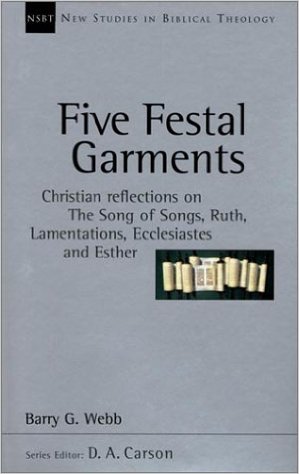
the rest of the biblical canon. Barry Webb’s contribution, Five Festal Garments, is an excellent volume in the series. The book digs deeply into 5 somewhat unrelated books, Songs of Songs, Ruth, Lamentations, Ecclesiastes, and Esther, the only unifying threads being that the books rarely mention God, that they are all related to Jewish festivals, and that most Christians don’t really know what to do with these books, in terms of thoughtful application to their own lives, and how they fit into the bigger story of Scripture.
The title of the book is a bit odd, but intriguing. It’s a reference to the episode in Genesis 45, where Joseph gives gifts to his reconciled brothers, including clothes, and gives 5 ‘festal garments’ to the youngest, Benjamin. As Webb writes, “There could be no question of the brothers refusing these garments, but they would always wear them rather awkwardly. Much the same could be said of the five Scrolls [biblical books]. They are all problem books in one way or another.”
In the first section, on The Song of Songs, Webb deals with various attempts to interpret the book, all hinging on the person of Solomon, and ultimately sides with those who would read a single love poem approach over a love poetry collection approach. Webb sees the book as a conversation between two lovers that has both an earthy side and a wisdom application to it. “”[W]hat is being suggested is that the love depicted here… has its ultimate source in Yahweh, and indeed partakes of his very nature. In keeping with the allusive character of the Song, however, this powerful point is made with exquisite indirectness rather than being crudely forced upon us. The Song is not as secular as it at first appears.” Those interpreters who see The Song of Songs as a collection of ancient love poems may find Webb’s attempts to harmonize the story by seeing much of it as dream and fantasy a little too neat, but his explanation of Solomon as an emblem of romance that the lovers evoke is fairly convincing. Certainly his explanation of how the book fits into the story and themes of the Bible should be acceptable and encouraging to any interpreter who believes in the divine character of Scripture.
The book of Ruth is probably the easiest of the 5 books to read Christologically, with its ties to David and Jesus’ genealogy and its presentation of redemption in Bethlehem. Dr. Webb describes the book as a romantic comedy that is on the surface gentle, but on deeper layers quite controversial. The author does fine work in showing how the characters in Ruth relate to each other. I especially appreciated his discussion on how the book interacts with the law of Moses, particularly the ban on Hebrew-Moabite marriage, as well as his discussion of how the theme of kindness is picked up in Paul’s descriptions of salvation in Christ.
In the chapter on the book of Lamentations, there is a fascinating discussion of how a literary work on the radical disorientation that suffering brings us should be so well-ordered and logical. Lamentations is one of the most obscure books in the Bible, requiring background knowledge of the destruction of the temple in 587 BC and the exile of God’s people, and it has always seemed a difficult book to preach through. Webb is immensely helpful here, as he presents themes that could be preached in ways that could speak powerfully to modern people, and shows the connection of apparently meaningless suffering to Christ.
In analyzing Ecclesiastes, Webb takes the fairly standard two-voice view, and breaks the structure of the book into mostly alternating observation and instruction passages. Having read quite a few books on Ecclesiastes, the best part of the chapter for me was the author’s discussion of how Ecclesiastes is understood and echoed by the New Testament.
Esther is the only book in the Bible that never mentions God. And yet, the argument is made in Five Festal Garments that all clues in the book lead obviously to Yahweh. Mordecai is hinted at as a type of Christ, but I wish the author had gone further in looking at Mordecai’s figurative death, resurrection, exaltation, vanquishing of his enemies, and restoration of shalom to his people. There is a fascinating discussion on the morality of the exiles in Babylon and whether the narrator approves or disapproves of much of the characters’ actions in Esther, and an encouragement for us link this story with Christians who live in exile. Maybe Webb’s most inspiring prose is saved for the end of this chapter: “The book of Esther is indeed a festive garment, a garment to put on when we are astonished, once again, at some unexpected way God has rescued us, and when we are ready to celebrate. But it is also a garment to put on when the forces arrayed against us seem all-powerful, when to laugh may be the only way to stay sane. To put this garment on, however, is not to whistle in the dark, or to pretend that things are other than they are. It is to clothe ourselves with the truth that God is sovereign, and to be reminded that nothing can ultimately thwart his purposes. To put on Esther is to affirm that God is our deliverer, and to share in the laughter of heaven.”
By the end of my reading, I couldn’t believe that the book was only 136 pages. Dr. Webb shows a great gift here (that many Christian writers could learn from) of packing a lot of meat into a small container. If you want to learn more about some biblical books that are not often preached in modern churches, I would highly recommend this very readable book. I have preached series on Ruth and Esther, and am inspired in the future to preach on the other 3 books chronicled in this volume.
Previous Post

February 2, 2016
Christians, Let Your Vote be Mastered by Scriptural Convictions
Next Post

February 19, 2016 The Pope, The Donald, and The Church: Why Christians SHOULD Judge Others
Browse Our Archives
Select a Category #ShoutYourAbortion 10 Commandments 2016 Election 2017 2020 Election Abortion Accelerate Books Adultery America Andy Stanley Arminianism Ashley Madison Atonement B&H Academic Baptism Barry Horner Beauty Biblical Elders Billy Graham Blog Book Review Bruce Jenner Caitlyn Jenner Calvin Calvinism Cheating Chick-fil-A Children Christ Christian History Christian Living Christian Podcasts Christianity Christmas Church History Church Leadership Civil Disobedience Constitutional Coronavirus Culture Death Demoninations Discipleship Doctrine Doctrine of God Donald Trump Ecclesiology Entertainment Eschatology Ethics Evangelical Evangelism Evil Evolution Fear Forgive Yourself Forgiveness Francis Chan Future Israel Gay Marriage Gender Genesis George Floyd Gospel Government Gun Control Halloween hamartiology Heavenly Reward Hermeneutics History Hollywood Holy Spirit Homeschool Homosexual Homosexuality Hope Hospitality Humor Husband Infant Baptism Interview Jesus John Piper Josh Duggar Joshua Harris Judgment Justice Kathy Griffin Kim Davis Leadership Logic Love Manhood Marriage Martin Luther Messianic Prophecy Miscarriage Mocking Modesty Money Movie Reviews Music Music Review Netflix New Testament Obergefell Old Testament Parenting Pastor Pastoring Persecution Planned Parenthood Podcast Politics Pop Culture Pornography Prayer Preaching Predestination Pride Prosperity Gospel Rachel Held Evans Racism Ravi Zacharias Redemption Reformation 500 Reformation Day Reformed Theology Relationship Repentance Salvation Same Sex Marriage Satan Satire Scripture Seminary Sex Sin slavery Sola Scriptura Soteriology Sovereignty Spiritual Gifts Spurgeon Star Wars Steven Furtick Suffering Sufficiency of Scripture Sunday School Supreme Court Technology Testimony The Church The Lord of the Rings The Problem of Evil The Shack Theology Theonomy Tithing Transgenderism Tullian Tchividjian Uncategorized Universalism Vanity Fair Video Games Virgin Birth Voting Wife Women Worldview Worship
Select a Month June 2025 April 2025 March 2025 March 2024 February 2024 January 2024 December 2023 June 2023 April 2023 March 2023 January 2023 December 2022 November 2022 October 2022 September 2022 August 2022 July 2022 June 2022 May 2022 April 2022 March 2022 February 2022 January 2022 December 2021 November 2021 October 2021 August 2021 July 2021 June 2021 May 2021 April 2021 March 2021 February 2021 January 2021 December 2020 November 2020 October 2020 September 2020 August 2020 July 2020 June 2020 May 2020 April 2020 March 2020 February 2020 January 2020 December 2019 November 2019 October 2019 September 2019 August 2019 July 2019 June 2019 May 2019 April 2019 March 2019 February 2019 January 2019 December 2018 November 2018 October 2018 September 2018 August 2018 July 2018 June 2018 May 2018 April 2018 March 2018 February 2018 January 2018 December 2017 November 2017 October 2017 September 2017 August 2017 July 2017 June 2017 May 2017 April 2017 March 2017 February 2017 January 2017 December 2016 November 2016 October 2016 September 2016 August 2016 July 2016 June 2016 May 2016 April 2016 March 2016 February 2016 January 2016 December 2015 November 2015 October 2015 September 2015 August 2015 July 2015 June 2015 May 2015 April 2015 March 2015 February 2015 January 2015 December 2014 November 2014 October 2014 September 2014 August 2014 July 2014
Follow Us!
TAKE THE
Religious Wisdom Quiz
What does "Bethel" (where Jacob dreamed) mean?
Select your answer to see how you score.
God's Blessing House of God Field of Vision Mountain of Light
Related posts from The Chorus In The Chaos

‘Two Cities,Two Loves’, a Look at Christians and...

Inerrancy and the Gospels: How to Handle Narrative...

A Lesson on Prayer from a Depressed Charles...
TRENDING AT PATHEOS Evangelical

The REST of Your Life: A Creative Wrestles...
This week I had a conversation with a good friend from church....

How the author of the world's best hymn...
I've been working with John Newton for a while now. This makes...

Long before this Lectio Divina, Psalm 130 - the song - started...

What About the Trees? Another Living Parable
After I finished writing the last article about falling leaves as a...

Why Classical Education Is a Conversation, Not a...
Come and Read: Joy in Classical Education When I was a little...

Cornell University has received a great deal of negative publicity and intense...
view all Evangelical blogs
Ad-Free & Subscriber Log-In Subscription Support
- About Us
- 2026 Calendar
- Videos
- Podcasts
- Library of World Religions
- Faith In Media Tracker
- Advertise With Us
- Write for Us
- Privacy Policy
- Terms of Service
- Do Not Sell My Data
- Contact Us
- Radiant Digital
- Manage Newsletter Subscriptions
- Unsubscribe From Notifications
- Sitemap
Copyright 2008-2026, Patheos. All rights reserved.
Subscription Support Ad-Free & Subscriber Log-In
Follow Patheos