
BuddhistCatholicContemplativeEvangelicalGeneral ChristianHinduJewishLatter-day SaintMuslimNew VisionsProgressive Christian
Beliefs
- Buddhist
- Catholic
- Contemplative
- Evangelical
- General Christian
- Hindu
- Jewish
- Latter-day Saint
- More Voices
- Muslim
- New Visions
- Pagan
- Progressive Christian
Topics
- Religion News
- Food and Religion
- Sports and Religion
- Religious Art
- Religious Music and Entertainment
- Religious Events
- History and Religion
- Style and Religion
- Politics and Religion
- Women in Religion
- Recreation Outdoors and Religion
- Business Finance and Religion
- Careers Workplace and Religion
- Education and Religion
- Family Parenting and Religion
- Health Fitness and Religion
- Home and Religion
- Relationships and Religion
- Technology and Religion
- Travel and Religion
Columnists
- Buddhist Columnists
- Business Finance and Religion Columnists
- Careers Workplace and Religion Columnists
- Catholic Columnists
- Contemplative Columnists
- Education and Religion Columnists
- Evangelists Columnists
- Family Parenting and Religion Columnists
- General Christian Columnists
- Health Fitness and Religion Columnists
- Hindu Columnists
- History and Religion Columnists
- Home and Religion Columnists
- Jewish Columnists
- More Voices Columnists
- Latter Day Columnists
- Muslim Columnists
- New Visions Columnists
- Nonreligious Columnists
- Pagan Columnists
- Politics and Religion Columnists
- Progressive Columnists
- Recreation Outdoors and Religion Columnists
- Relationships and Religion Columnists
- Religion News Columnists
- Religious Art Columnists
- Religious Events Columnists
- Religious Music and Entertainment Columnists
- Sports and Religion Columnists
- Style and Religion Columnists
- Technology and Religion Columnists
- Travel and Religion Columnists
- Women in Religion Columnists
Resource Library
- 2026 Calendar
- Library of World Religions
- The 100 Most Holy Places on Earth
- Patheos Answers
- Podcasts
- Videos
- Faith Leaders Database
- Anglican Episcopalian
- Bahai
- Baptist
- Buddhism
- Christianity
- Confucianism
- Eastern Orthodoxy
- Hinduism
- Holiness and Pentecostal
- ISKCON
- Islam
- Judaism
- Lutheran
- Methodist
- The Church of Jesus Christ of Latter-day Saints
- New Age
- Paganism
- Presbytarian and Reformed
- Protestantism
- Religion Behind the Scenes
- Roman Catholic
- Scientology
- Shia Islam
- Sikhism
- Sufism
- Sunni Islam
- Taoism
- Zen
- See all religions
Research Tools
 Ad-Free & Subscriber Log-In Subscription Support
Follow Patheos 

- Trending:
- Advent
- |
- Forgiveness
- |
- Thanksgiving
- |
- Election
- |
- Seasonal Holidays
- |
- Marriage

-
Explore
- Home
- Evangelical
- Calvinism & Arminianism – A Concise Summary
Calvinism & Arminianism – A Concise Summary
Last updated on: February 7, 2017 at 5:28 pm by Guest Contributor
Calvinism & Arminianism – A Concise Summary 2017-02-07T17:28:46-05:00 Guest Contributor
Patheos Explore the world's faith through different perspectives on religion and spirituality! Patheos has the views of the prevalent religions and spiritualities of the world.
Introduction
Many theologians and pastors in our time claim that John Calvin would not be a Calvinist himself if he were alive today. I think in some aspects this assertion is true. Calvin’s own writings don’t read quite as clear on a couple of points that Calvinists of today are staunch about. It does appear, at least on the surface, that on some issues he’ll state one thing and in another he’ll say something that seems to contradict it. However, this is not necessarily a bad thing, especially when you take into account the incredible volume of writings and preaching he accomplished. Not to mention we all grow, learn, and change our ideas on things (including theology).
The main reason many claim that John Calvin wasn’t a Calvinist, as defined in our day, is because he himself is not responsible for developing the codified system of theology which is known by his name. He wasn’t even alive when the famous acronym defining the Doctrines of Grace was formulated.
I don’t completely agree with the above paragraphs, as I find it to be true all of the elements of the acronym (T.U.L.I.P.) can be found in the resources Calvin has left behind. However, I don’t completely disagree with everything stated above either.
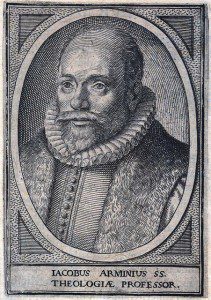
Iacobus Arminius by Skara Kommun; CC BY 2.0
Jacobus Arminius
Several years after Calvin died in 1564, Jacobus Arminius went to Geneva in order to study under Theodore Beza, the man who took over as Calvin’s successor.
Arminius finished his studies in 1587 and then moved to Amsterdam where he served as the pastor of a church. During a preaching series through the book of Romans, he started to disagree on several theological issues that were held by Calvin. Interestingly, it was while attempting to defend the teachings of Calvin against critics that brought Arminius to the point of doubting some of the conclusions Calvin had taught. In a similar, but far less dramatic way, just as Luther and Calvin had boldly attempted to bring reform to the Roman Catholic Church, Arminius tried to bring some type of reform to Lutheranism and Calvinism.
The Remonstrance
After Arminius died in 1609, some of his followers put together a document which was titled, “The Five Articles of Remonstrance.” Martin Luther originally posted his 95 Theses on the church door in Wittenberg on October 31 of 1517, in order to make his objections known to the Roman Catholic Church so the leaders could get together and discuss his objections. In a like manner, the intent of the Five Articles of Remonstrance was an invitation by those who followed the teachings of Arminius to those who followed the teachings of Calvin so they could get together in order to discuss their differences.
The Five Articles
The result of all this was condemnation of Arminius and the Remonstrants, but the controversy did not stop and it had a liberalizing effect on theology in Europe and England, as well as the American colonies. Somewhere around the mid-1700s the basic positions of Arminius were cleaned up a bit and expanded in England by the renowned brothers, John and Charles Wesley. In both England and the early United States, Methodism and a stream of other churches followed what came to be known as Arminian-Wesleyan theology. Even in our time, the five points of the Remonstrants still provide an accurate summary of the differences between Calvinistic/Reformed traditions and Arminian Wesleyan traditions.
The Big Five
- Conditional Election – That God, by an eternal and unchangeable purpose in Jesus Christ his Son before the foundation of the world, has determined that out of the fallen, sinful race of men, to save in Christ, for Christ’s sake, and through Christ, those who through the grace of the Holy Spirit shall believe on this his son Jesus, and shall persevere in this faith and obedience of faith, through this grace, even to the end…
- Unlimited Atonement – That, accordingly, Jesus Christ the Savior of the world, died for all men and for every man, so that he has obtained for them all, by his death on the cross, redemption and the forgiveness of sins; yet that no one actually enjoys this forgiveness of sins except the believer, according to the word of the Gospel of John 3:16 and 1 John 3:2…
- Deprivation – That man does not possess saving grace of himself, nor of the energy of his free will, inasmuch as in his state of apostasy and sin he can of and by himself neither think, will, nor do anything that is truly good (such as saving Faith eminently is); but that it is necessary that he be born again of God in Christ, through his Holy Spirit, and renewed in understanding, inclination, and will, and all his faculties, in order that he may rightly understand, think, will, and effect what is truly good, according to the Word of Christ…
- Resistible Grace – That this grace of God is the beginning, continuance, and accomplishment of all good, even to the extent that the regenerate man himself, without prevenient or assisting, awakening, following and cooperative grace, can neither think, will, nor do good, nor withstand any temptations to evil; so that all good deeds or movements that can be conceived must be ascribed to the grace of God in Christ. But with respect to the mode of the operation of this grace, it is not irresistible, since it is written concerning many, that they have resisted the Holy Spirit (Acts 7, and elsewhere in many places).
- Assurance and Security – That those who are incorporated into Christ by true faith, and have thereby become partakers of his life-giving Spirit, as a result have full power to strive against Satan, sin, the world, and their own flesh, and to win the victory; it being well understood that it is ever through the assisting grace of the Holy Spirit; and that Jesus Christ assists them through his Spirit in all temptations, extends to them his hand, and if only they are ready for the conflict, desire his help, and are not inactive, keeps them from falling, so that they, by no deceit or power of Satan, can be misled nor plucked out of Christ’s hands, according to the Word of Christ, John 10:28: “Neither shall any man pluck them out of my hand.” But whether they are capable, through negligence, of forsaking again the first beginning of their life in Christ, of again returning to this present evil world, of turning away from the holy doctrine which was delivered them, of losing a good conscience, of neglecting grace, that must be more particularly determined out of the Holy Scripture, before we ourselves can teach it with the full confidence of our mind.*
Doctrines of Grace (TULIP – Calvinism)
Those who followed the teachings of John Calvin met in Dordrecht, Netherlands sometime during 1618 to 1619 and developed a statement of their own which has become known as the Canons of Dort. This consisted of a point-by-point refutation and condemnation of the Five Articles of Remonstrance. Accordingly, there were five main points to this countering document. These five main points found in the Canons of Dort are what has come to be known as “Calvinism” and/or “The Doctrines of Grace.”
These five doctrinal statements are most commonly referred to and summarized today by the simple acrostic, TULIP:
- Total Depravity – Mankind is completely sinful and cannot do a single thing to contribute to his salvation. Until one’s heart is regenerated by God they cannot “choose” Christ.
- Unconditional Election – Because of the above, we are completely dependent on God to initiate salvation for us, which He did in eternity past by choosing (or electing) to save some, without any condition, work, or effort on their part.
- Limited Atonement – In order to accomplish the salvation of those God has previously chosen, God sent Jesus, His Son, to die specifically for the sins of those whom He has elected so that they can receive eternal life.
- Irresistible Grace – Those whom God has predestined for salvation, for whom Christ died, will be irresistibly drawn by God’s grace into the family of God as His children.
- Perseverance of the Saints – Since God’s will cannot be changed or influenced, not a single one whom God has chosen, for whom Christ died, and whom were drawn and transformed by God’s irresistible pull of grace, can ultimately be lost (lose their salvation). All of them will be glorified. Due to this direct gift of grace from God in their life, all those who are delivered by God’s grace in this way will show evidence to it by living a life of perseverance in faith and obedience to the Word.
The Sovereignty of God
Another aspect of Calvinism that must be mentioned is God’s Sovereignty. Clearly it’s not listed as one of the specific points of Calvinism’s TULIP, but it is the foundation of which they all stand. The belief of God’s complete and absolute control over all things can be seen behind every single one of the five points from first to last, if humans are to have any hope of salvation, and if God is to be certain of defeating sin, death, and the devil in the ultimate end.
Conclusion
Well, that about sums it up as briefly as possible while still mentioning all that needs to be said. Of course there are different levels and nuances to each position. Some even claim to believe three or four points of one and one or two points of the other. I’m not sure if one follows the logic of each system, particularly Calvinism, if that’s possible. But, as the old cliché states, we need to be careful that we are not putting God in a box.
* “The Articles of the Remonstrants” are adapted from Phillip Schaff, The Creeds of Christendom, Volume 3, Baker Books, Grand Rapids, 1996, pp 545ff.
Featured Image Credit: “Juan Calvino” by Fondo Antiguo de la Universidad de Sevilla; CC BY 2.0
This was a guest post from Dr. Jeff Hagan.
Jeff is an ordained Christian minister with over 23 years of ministry experience. He has attended Gordon-Conwell Theological Seminary, Luther Rice Seminary, Tyndale Seminary and a handful of other institutes as well. He has earned several degrees including the Doctor of Christian Education and the Doctor of Theology.

Next Post

April 26, 2016 The Rare Jewel of Christian Contentment
Browse Our Archives
Select a Category #ShoutYourAbortion 10 Commandments 2016 Election 2017 2020 Election Abortion Accelerate Books Adultery America Andy Stanley Arminianism Ashley Madison Atonement B&H Academic Baptism Barry Horner Beauty Biblical Elders Billy Graham Blog Book Review Bruce Jenner Caitlyn Jenner Calvin Calvinism Cheating Chick-fil-A Children Christ Christian History Christian Living Christian Podcasts Christianity Christmas Church History Church Leadership Civil Disobedience Constitutional Coronavirus Culture Death Demoninations Discipleship Doctrine Doctrine of God Donald Trump Ecclesiology Entertainment Eschatology Ethics Evangelical Evangelism Evil Evolution Fear Forgive Yourself Forgiveness Francis Chan Future Israel Gay Marriage Gender Genesis George Floyd Gospel Government Gun Control Halloween hamartiology Heavenly Reward Hermeneutics History Hollywood Holy Spirit Homeschool Homosexual Homosexuality Hope Hospitality Humor Husband Infant Baptism Interview Jesus John Piper Josh Duggar Joshua Harris Judgment Justice Kathy Griffin Kim Davis Leadership Logic Love Manhood Marriage Martin Luther Messianic Prophecy Miscarriage Mocking Modesty Money Movie Reviews Music Music Review Netflix New Testament Obergefell Old Testament Parenting Pastor Pastoring Persecution Planned Parenthood Podcast Politics Pop Culture Pornography Prayer Preaching Predestination Pride Prosperity Gospel Rachel Held Evans Racism Ravi Zacharias Redemption Reformation 500 Reformation Day Reformed Theology Relationship Repentance Salvation Same Sex Marriage Satan Satire Scripture Seminary Sex Sin slavery Sola Scriptura Soteriology Sovereignty Spiritual Gifts Spurgeon Star Wars Steven Furtick Suffering Sufficiency of Scripture Sunday School Supreme Court Technology Testimony The Church The Lord of the Rings The Problem of Evil The Shack Theology Theonomy Tithing Transgenderism Tullian Tchividjian Uncategorized Universalism Vanity Fair Video Games Virgin Birth Voting Wife Women Worldview Worship
Select a Month June 2025 April 2025 March 2025 March 2024 February 2024 January 2024 December 2023 June 2023 April 2023 March 2023 January 2023 December 2022 November 2022 October 2022 September 2022 August 2022 July 2022 June 2022 May 2022 April 2022 March 2022 February 2022 January 2022 December 2021 November 2021 October 2021 August 2021 July 2021 June 2021 May 2021 April 2021 March 2021 February 2021 January 2021 December 2020 November 2020 October 2020 September 2020 August 2020 July 2020 June 2020 May 2020 April 2020 March 2020 February 2020 January 2020 December 2019 November 2019 October 2019 September 2019 August 2019 July 2019 June 2019 May 2019 April 2019 March 2019 February 2019 January 2019 December 2018 November 2018 October 2018 September 2018 August 2018 July 2018 June 2018 May 2018 April 2018 March 2018 February 2018 January 2018 December 2017 November 2017 October 2017 September 2017 August 2017 July 2017 June 2017 May 2017 April 2017 March 2017 February 2017 January 2017 December 2016 November 2016 October 2016 September 2016 August 2016 July 2016 June 2016 May 2016 April 2016 March 2016 February 2016 January 2016 December 2015 November 2015 October 2015 September 2015 August 2015 July 2015 June 2015 May 2015 April 2015 March 2015 February 2015 January 2015 December 2014 November 2014 October 2014 September 2014 August 2014 July 2014
Follow Us!
TAKE THE
Religious Wisdom Quiz
Where was Paul when he had a vision of a man from Macedonia pleading for help?
Select your answer to see how you score.
Troas Athens Corinth Philippi
Related posts from The Chorus In The Chaos

Unconditional Election: A Study in What it Means...
Total Depravity: A Critical Lesson in Seeing the...
6 Common Misconceptions About Calvinism
How I Became a Calvinist: By Reading the...
TRENDING AT PATHEOS Evangelical

Don’t Miss the Parents: A Creative Christmas Meditation
As we enter the Advent Season, I see a lot of people...

Making Stones Into Bread: Choosing the “Right” Work
I was on my online arts ministry Zoom meeting with the International...

Ukraine’s exhausted Christians face fifth winter of war
By Julian Lukins The full-scale war in Ukraine is taking “a serious...

Russell Brand's Conviction is not anti-Christian Persecution
How do we shed the reputation that the Church is OK with...

Have you ever caught yourself saying, “I’ll do it tomorrow,” or “Now...

Throughout history, people have pursued pleasure, possessions, relationships, and success in an...
view all Evangelical blogs
Ad-Free & Subscriber Log-In Subscription Support
- About Us
- 2026 Calendar
- Videos
- Podcasts
- Library of World Religions
- Faith In Media Tracker
- Advertise With Us
- Write for Us
- Privacy Policy
- Terms of Service
- Do Not Sell My Data
- Contact Us
- Radiant Digital
- Manage Newsletter Subscriptions
- Unsubscribe From Notifications
- Sitemap
Copyright 2008-2026, Patheos, part of the Radiant Digital network of media brands. All rights reserved.
Subscription Support Ad-Free & Subscriber Log-In
Follow Patheos