
BuddhistCatholicContemplativeEvangelicalGeneral ChristianHinduJewishLatter-day SaintMuslimNew VisionsProgressive Christian
Beliefs
- Buddhist
- Catholic
- Contemplative
- Evangelical
- General Christian
- Hindu
- Jewish
- Latter-day Saint
- More Voices
- Muslim
- New Visions
- Pagan
- Progressive Christian
Topics
- Religion News
- Food and Religion
- Sports and Religion
- Religious Art
- Religious Music and Entertainment
- Religious Events
- History and Religion
- Style and Religion
- Politics and Religion
- Women in Religion
- Recreation Outdoors and Religion
- Business Finance and Religion
- Careers Workplace and Religion
- Education and Religion
- Family Parenting and Religion
- Health Fitness and Religion
- Home and Religion
- Relationships and Religion
- Technology and Religion
- Travel and Religion
Columnists
- Buddhist Columnists
- Business Finance and Religion Columnists
- Careers Workplace and Religion Columnists
- Catholic Columnists
- Contemplative Columnists
- Education and Religion Columnists
- Evangelists Columnists
- Family Parenting and Religion Columnists
- General Christian Columnists
- Health Fitness and Religion Columnists
- Hindu Columnists
- History and Religion Columnists
- Home and Religion Columnists
- Jewish Columnists
- More Voices Columnists
- Latter Day Columnists
- Muslim Columnists
- New Visions Columnists
- Nonreligious Columnists
- Pagan Columnists
- Politics and Religion Columnists
- Progressive Columnists
- Recreation Outdoors and Religion Columnists
- Relationships and Religion Columnists
- Religion News Columnists
- Religious Art Columnists
- Religious Events Columnists
- Religious Music and Entertainment Columnists
- Sports and Religion Columnists
- Style and Religion Columnists
- Technology and Religion Columnists
- Travel and Religion Columnists
- Women in Religion Columnists
Resource Library
- 2026 Calendar
- Library of World Religions
- The 100 Most Holy Places on Earth
- Patheos Answers
- Podcasts
- Videos
- Faith Leaders Database
- Anglican Episcopalian
- Bahai
- Baptist
- Buddhism
- Christianity
- Confucianism
- Eastern Orthodoxy
- Hinduism
- Holiness and Pentecostal
- ISKCON
- Islam
- Judaism
- Lutheran
- Methodist
- The Church of Jesus Christ of Latter-day Saints
- New Age
- Paganism
- Presbytarian and Reformed
- Protestantism
- Religion Behind the Scenes
- Roman Catholic
- Scientology
- Shia Islam
- Sikhism
- Sufism
- Sunni Islam
- Taoism
- Zen
- See all religions
Research Tools
 Ad-Free & Subscriber Log-In Subscription Support
Ad-Free & Subscriber Log-In Subscription Support
Follow Patheos 

- Trending:
- Forgiveness
- |
- Marriage
- |
- Consciousness
- |
- Death Penalty
- |
- Election
- |
- Halloween

-
Explore
- Home
- Evangelical
- “Birdman” Movie Review (The Unexpected Virtue Of Long Takes)
“Birdman” Movie Review (The Unexpected Virtue Of Long Takes)
Last updated on: April 13, 2016 at 7:36 am by Jonathan Dorst
“Birdman” Movie Review (The Unexpected Virtue Of Long Takes) 2016-04-13T07:36:31-05:00 Jonathan Dorst
Patheos Explore the world's faith through different perspectives on religion and spirituality! Patheos has the views of the prevalent religions and spiritualities of the world.
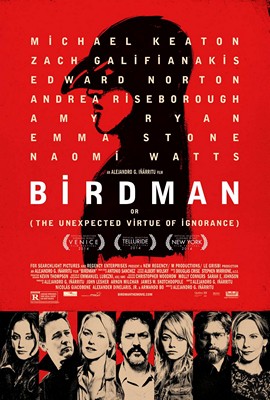 The very first films consisted of one long, unedited shot, with filmmakers simply pointing their cameras at a scene until the film stock ran out. The story goes that the first instance of editing occurred by accident, when a camera stopped working in the middle of a shoot and the filmmakers decided to piece two shots together rather than re-shoot the whole thing. Whether you believe that story or not, the practice of editing is what sets film apart from every other art form**.**
D.W. Griffith, in his epic spectacles The Birth of a Nation (1915) and Intolerance (1916), is credited with pioneering the classical editing techniques that have been used ever since. Francois Truffaut, the great French director, has commented on this classical style by saying, “As a rule, a film sequence is divided into shots that last between five to fifteen seconds. A film that runs an hour and a half will average six hundred shots.” Sergei Eisenstein deepened the well of editing techniques by his creation of the montage style, where many quick cuts combine to underline the action and chaos of a set piece. The classic example of montage is the staircase sequence in his film, Battleship Potempkin (1925).
Alfred Hitchcock was a master director who used montage principles in the famous shower scene in Psycho (1960) as well as in The Birds (1963), which has around 1,360 shots in it. Hitch pursued the opposite path from the montage style, however, in seeing how few cuts (edits) he could make in the film Rope (1948). The maximum length that a shot could be in those days, due to the amount of film able to be loaded in the camera, was 10 minutes; Hitchcock shot only 10 takes for the 80 minute film. Paul Thomas Anderson is also known for his long takes in films such as Magnolia (1999), Punch-Drunk Love (2002), and Boogie Nights (1997). Neither of these filmmakers, however, have been as ambitious as Aleksandr Sokurov, whose film, Russian Ark (2002), was shot in the Hermitage Museum in Russia in a single day, in a single, uncut 96 minute sequence.
Enter director Alejandro Iñárritu and cinematographer Emmanuel Lubezki, the creative team behind this year’s Oscar Best Picture winner, Birdman: Or (The Unexpected Virtue of Ignorance). Lubezki is one of the best cinematographers in the business and is well-known for his long takes. In Children of Men (2006), there are two unbroken shots that seem to run incredibly long for the amount of action that is happening in them. In Gravity (2013), the opening scene in space runs seemingly without a cut for over 13 minutes. Lubezki, however, does not necessarily want to be identified as a one trick pony. He recently said in an interview, “I was disappointed that with Children of Men, people noticed that the car scene was one shot with no cuts. If people notice that, it’s like they’re noticing my trick, you know what I mean? I’m doing it so people will get immersed in the movie, not to show off.”
In Birdman, there are only sixteen visible cuts in the entire film. The effect of so few cuts is to create the sensation of a continuously rolling camera and therefore unbroken action. Of course, there are many more edits than what is obvious to the naked eye, but there are still long, uninterrupted scenes. What is interesting is that although Lubezki won his second straight Academy Award for Best Cinematography (following his win for Gravity), the film was not nominated for Best Editing. Possibly the reason for the lack of a nomination for Editing was either 1) because the film plays as one continuous scene, the editing did not stand out to Academy voters, or 2) because the movie was shot in sequence (ie, unlike most films, it was filmed from start to finish in sequential order), the editing process was much shorter than usual.
Of course, for actors and technicians, it is very difficult to film long scenes, because everything has to be perfect. The actors in Birdman have talked in interviews about how some scenes require them to speak up to 15 pages of dialogue at a time. Hitchcock relates to Francois Truffaut in the book Hitchcock Truffaut how hard it was to film Rope. “I was so scared that something would go wrong that I couldn’t even look during the first take. For eight minutes of consecutive shooting everything went very smoothly. Then the camera panned around as the two killers walked back toward the chest, and there, right in camera focus, was an electrician standing by the window! So the first take was ruined.”
The question we ask of a film like Birdman is, why shoot it this way? Is there a reason for such a technical challenge, or is the style winning out over the substance? Are the creative minds showing off, or are they harnessing every weapon in their arsenal to tell the very best story that they can? Simply put, do the long takes serve the story?
Birdman has many cinematic allusions, from Fight Club (1999) to Mulholland Drive (2001) to Batman (1989). But it is also full of theatrical allusions, most notably Macbeth, some even seeing the film as a riff on the Scottish play. And herein lies part of the justification for Birdman’s technique. Since the film is all about Riggan Thomson’s (Michael Keaton) desire to gain respect by going from movies to theater, Hollywood to Broadway, one of the main differences between the two art forms is found in the ability to edit. The only ‘edits’ that are possible in a play are when the lights go dark or when the curtain closes. Otherwise, the effect of a play is of continuous action. This is one reason some actors and critics have more respect for the theater, because there is so little margin for error, and an actor (and director for that matter) does not have the luxury of re-shooting a scene twenty times. Hitchcock may have had similar thoughts when he filmed Rope, as the material was originally a play. In Birdman, not only does the style point us towards the wonder and challenge of theater, we might also wonder if the actors themselves relished the challenge of acting without cutting.
A second reason for indulging in such difficult technique is that the long takes underscore the nature of celebrity, a key theme of the film. Classic editing allows the mind to “rest” when the scene shifts and the camera cuts the emotion of a scene. By not cutting, and thus not allowing us to rest, we get some sympathy for celebrities, like Riggan Thomson, who are under constant public scrutiny everywhere they go.
The third, and most compelling reason I think the style of Birdman works, is because it helps us to feel Riggan’s existential struggle. His life is moving too quickly through middle age, his career is moving too fast to extinction, and his play’s opening night is coming at him without a delay. The continuous moving camera does not let us rest, just as Riggan’s mind is unable to rest. Iñárritu admitted as much in an interview with Variety, saying, “I realized — and I am probably the last person in the world to realize this — that we live our lives with no editing. From the time we open our eyes, we live in a Steadicam form, and the only editing is when we talk about our lives or remember things. So I wanted this character to be submerged in that inescapable reality, and the audience has to live these desperate three days alongside him.”
On the whole, the style works for the content of this film. We do get immersed in the story and in Riggan’s mindset. The visual presentation is a bit showy, and like most great artists, I doubt Iñárritu will explain all the reasons why he chose to tell the story of Birdman the way he did. However, maybe this modern master of cinema, in a film about the nature of movies, wanted to give a nod to the founding of the cinema itself, when it was all one long take.
Previous Post

February 28, 2015
Theonomy: An Introduction
Next Post

March 5, 2015 Theonomy: A Critique
Browse Our Archives
Select a Category #ShoutYourAbortion 10 Commandments 2016 Election 2017 2020 Election Abortion Accelerate Books Adultery America Andy Stanley Arminianism Ashley Madison Atonement B&H Academic Baptism Barry Horner Beauty Biblical Elders Billy Graham Blog Book Review Bruce Jenner Caitlyn Jenner Calvin Calvinism Cheating Chick-fil-A Children Christ Christian History Christian Living Christian Podcasts Christianity Christmas Church History Church Leadership Civil Disobedience Constitutional Coronavirus Culture Death Demoninations Discipleship Doctrine Doctrine of God Donald Trump Ecclesiology Entertainment Eschatology Ethics Evangelical Evangelism Evil Evolution Fear Forgive Yourself Forgiveness Francis Chan Future Israel Gay Marriage Gender Genesis George Floyd Gospel Government Gun Control Halloween hamartiology Heavenly Reward Hermeneutics History Hollywood Holy Spirit Homeschool Homosexual Homosexuality Hope Hospitality Humor Husband Infant Baptism Interview Jesus John Piper Josh Duggar Joshua Harris Judgment Justice Kathy Griffin Kim Davis Leadership Logic Love Manhood Marriage Martin Luther Messianic Prophecy Miscarriage Mocking Modesty Money Movie Reviews Music Music Review Netflix New Testament Obergefell Old Testament Parenting Pastor Pastoring Persecution Planned Parenthood Podcast Politics Pop Culture Pornography Prayer Preaching Predestination Pride Prosperity Gospel Rachel Held Evans Racism Ravi Zacharias Redemption Reformation 500 Reformation Day Reformed Theology Relationship Repentance Salvation Same Sex Marriage Satan Satire Scripture Seminary Sex Sin slavery Sola Scriptura Soteriology Sovereignty Spiritual Gifts Spurgeon Star Wars Steven Furtick Suffering Sufficiency of Scripture Sunday School Supreme Court Technology Testimony The Church The Lord of the Rings The Problem of Evil The Shack Theology Theonomy Tithing Transgenderism Tullian Tchividjian Uncategorized Universalism Vanity Fair Video Games Virgin Birth Voting Wife Women Worldview Worship
Select a Month June 2025 April 2025 March 2025 March 2024 February 2024 January 2024 December 2023 June 2023 April 2023 March 2023 January 2023 December 2022 November 2022 October 2022 September 2022 August 2022 July 2022 June 2022 May 2022 April 2022 March 2022 February 2022 January 2022 December 2021 November 2021 October 2021 August 2021 July 2021 June 2021 May 2021 April 2021 March 2021 February 2021 January 2021 December 2020 November 2020 October 2020 September 2020 August 2020 July 2020 June 2020 May 2020 April 2020 March 2020 February 2020 January 2020 December 2019 November 2019 October 2019 September 2019 August 2019 July 2019 June 2019 May 2019 April 2019 March 2019 February 2019 January 2019 December 2018 November 2018 October 2018 September 2018 August 2018 July 2018 June 2018 May 2018 April 2018 March 2018 February 2018 January 2018 December 2017 November 2017 October 2017 September 2017 August 2017 July 2017 June 2017 May 2017 April 2017 March 2017 February 2017 January 2017 December 2016 November 2016 October 2016 September 2016 August 2016 July 2016 June 2016 May 2016 April 2016 March 2016 February 2016 January 2016 December 2015 November 2015 October 2015 September 2015 August 2015 July 2015 June 2015 May 2015 April 2015 March 2015 February 2015 January 2015 December 2014 November 2014 October 2014 September 2014 August 2014 July 2014
Follow Us!
TAKE THE
Religious Wisdom Quiz
What does "Jireh" mean in Hebrew?
Select your answer to see how you score.
Savior Redeemer Provider Protector
Related posts from The Chorus In The Chaos
The Serious Comedy of 'Instant Family'

'A Quiet Place': A Story of Sacrifice in...
What is a Heretic? Netflix's 'Christian Film' Come...
How Was Samson Righteous? A Review of Pure...
TRENDING AT PATHEOS Evangelical

The REST of Your Life: A Creative Wrestles...
This week I had a conversation with a good friend from church....

How the author of the world's best hymn...
I've been working with John Newton for a while now. This makes...

Long before this Lectio Divina, Psalm 130 - the song - started...

What About the Trees? Another Living Parable
After I finished writing the last article about falling leaves as a...

Why Classical Education Is a Conversation, Not a...
Come and Read: Joy in Classical Education When I was a little...

Cornell University has received a great deal of negative publicity and intense...
view all Evangelical blogs
Ad-Free & Subscriber Log-In Subscription Support
- About Us
- 2026 Calendar
- Videos
- Podcasts
- Library of World Religions
- Faith In Media Tracker
- Advertise With Us
- Write for Us
- Privacy Policy
- Terms of Service
- Do Not Sell My Data
- Contact Us
- Radiant Digital
- Manage Newsletter Subscriptions
- Unsubscribe From Notifications
- Sitemap
Copyright 2008-2026, Patheos. All rights reserved.
Subscription Support Ad-Free & Subscriber Log-In
Follow Patheos