
BuddhistCatholicContemplativeEvangelicalGeneral ChristianHinduJewishLatter-day SaintMuslimNew VisionsProgressive Christian
Beliefs
- Buddhist
- Catholic
- Contemplative
- Evangelical
- General Christian
- Hindu
- Jewish
- Latter-day Saint
- More Voices
- Muslim
- New Visions
- Pagan
- Progressive Christian
Topics
- Religion News
- Food and Religion
- Sports and Religion
- Religious Art
- Religious Music and Entertainment
- Religious Events
- History and Religion
- Style and Religion
- Politics and Religion
- Women in Religion
- Recreation Outdoors and Religion
- Business Finance and Religion
- Careers Workplace and Religion
- Education and Religion
- Family Parenting and Religion
- Health Fitness and Religion
- Home and Religion
- Relationships and Religion
- Technology and Religion
- Travel and Religion
Columnists
- Buddhist Columnists
- Business Finance and Religion Columnists
- Careers Workplace and Religion Columnists
- Catholic Columnists
- Contemplative Columnists
- Education and Religion Columnists
- Evangelists Columnists
- Family Parenting and Religion Columnists
- General Christian Columnists
- Health Fitness and Religion Columnists
- Hindu Columnists
- History and Religion Columnists
- Home and Religion Columnists
- Jewish Columnists
- More Voices Columnists
- Latter Day Columnists
- Muslim Columnists
- New Visions Columnists
- Nonreligious Columnists
- Pagan Columnists
- Politics and Religion Columnists
- Progressive Columnists
- Recreation Outdoors and Religion Columnists
- Relationships and Religion Columnists
- Religion News Columnists
- Religious Art Columnists
- Religious Events Columnists
- Religious Music and Entertainment Columnists
- Sports and Religion Columnists
- Style and Religion Columnists
- Technology and Religion Columnists
- Travel and Religion Columnists
- Women in Religion Columnists
Resource Library
- 2026 Calendar
- Library of World Religions
- The 100 Most Holy Places on Earth
- Patheos Answers
- Podcasts
- Videos
- Faith Leaders Database
- Anglican Episcopalian
- Bahai
- Baptist
- Buddhism
- Christianity
- Confucianism
- Eastern Orthodoxy
- Hinduism
- Holiness and Pentecostal
- ISKCON
- Islam
- Judaism
- Lutheran
- Methodist
- The Church of Jesus Christ of Latter-day Saints
- New Age
- Paganism
- Presbytarian and Reformed
- Protestantism
- Religion Behind the Scenes
- Roman Catholic
- Scientology
- Shia Islam
- Sikhism
- Sufism
- Sunni Islam
- Taoism
- Zen
- See all religions
Research Tools
 Ad-Free & Subscriber Log-In Subscription Support
Ad-Free & Subscriber Log-In Subscription Support
Follow Patheos 

- Trending:
- Forgiveness
- |
- Marriage
- |
- Consciousness
- |
- Death Penalty
- |
- Election
- |
- Halloween

-
Explore
- Home
- Evangelical
- A Scriptural Argument For Infant Baptism
A Scriptural Argument For Infant Baptism
Last updated on: March 3, 2017 at 9:12 am by Jack Lee
A Scriptural Argument For Infant Baptism 2017-03-03T09:12:54-05:00 Jack Lee
Patheos Explore the world's faith through different perspectives on religion and spirituality! Patheos has the views of the prevalent religions and spiritualities of the world.
Children, obey your parents in the Lord, for this is right. “Honor your father and mother” (this is the first commandment with a promise), “that it may go well with you and that you may live long in the land.” Fathers, do not provoke your children to anger, but bring them up in the discipline and instruction of the Lord. (Ephesians 6:1-4)
Introduction
Ephesians 6 is not a chapter I see people often directed to when they inquire about covenant theology or infant baptism. Yet, I find it to contain some intriguing text for the subjects. It speaks volumes about the relationship of children to their parents and God. It also gives us insightful historical references and context that we can draw compelling conclusions from, namely, substantiating that children are part of the covenant. When you study this text in detail you find that covenant theology is clearly seen and applied. Once this foundation is established, we discover a persuasive argument for infant baptism.
It is not lost on me that there are individuals reading this because they are resolved on disproving anything related to covenant theology and/or infant baptism. For those people, first, let me thank you for reading. Secondly, let me qualify something from the start, there will never be a right understanding for a case of infant baptism without an accurate understanding of covenant theology; one is dependent on the other. If you approach this text with strict dispensational glasses, there is a reasonable chance you will miss my argument.
lastly, its worth saying from the outset that what I am providing is not an exhaustive argument for covenant theology and infant baptism. There have been many fantastic books and articles written on it. I am not looking to restate what has been said, I am rather, trying to add to the argument from a text that is often overlooked.
The Critical Nature of Context
When approaching any study of a section of scripture, regardless of the amount of the text, it’s a good idea to gather the context of the letter or book. Who wrote it? Why did they write? Who was it to? Basic questions, like these, serve us in understanding what is being said. Without context, we can get quickly get led astray and draw wild conclusions.
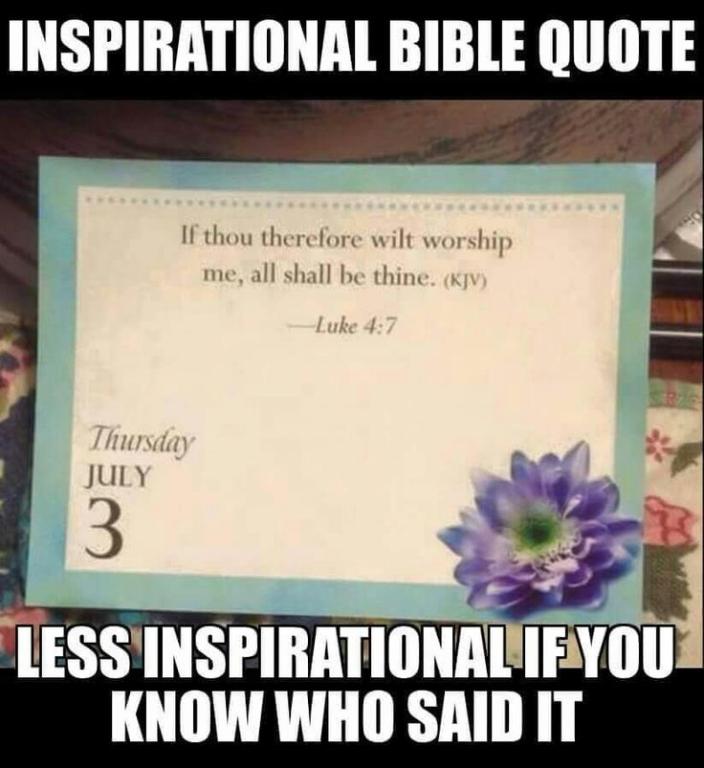 One of my favorite examples of how easily the point can be missed when the context is lost comes from a friend of mine who observed a Daily Inspirational Verse Calendar at a relative’s house (pictured). We have all seen these; each day there is new verse for you to read and meditate on. In this case the verse reads “If thou therefore wilt worship me, all shall be thine,” from Luke 4:7.
This verse, by itself and with no context, sounds quite powerful and awe inspiring indeed. Yet, if we take a moment to explore the context, we learn that it is actually Satan speak here as he is tempting Jesus in the wilderness! That GREATLY changes how you might interpret and apply this verse. Context is critical.
So, some quick context on Ephesians: almost everyone agrees it was written by the Apostle Paul (few dispute this). It was written around 62 A.D., we know this because of the mention of his imprisonment while writing it. The introduction of the letter communicates to us that Paul is writing this letter “To the saints who in Ephesus, and faithful in Christ Jesus” (Eph. 1:1). This may seem elementary or obvious, but it’s significant for our subject matter. Lastly, based on the overall theme and content, it’s generally assumed that Paul wrote the letter to encourage unity in Christ among a diverse set of believers. This too is also important.
The first point to make, which I have already hinted at, is that this letter is clearly defined as being written to those “in Christ Jesus”, or Christians. Paul did not write this to every person in the city/area. He specifies who it is for and then begins explaining (Chapter 1) that those to whom the letter is written are elected, predestined, etc. Undoubtedly, Paul does not intend for this letter to be received by the general masses. The message is unique and the audience has a unique qualification, being the body of Christ.
After the introduction, he goes on to describe what unity in Christ is and what it means to live as the body of Christ (Chapter 4). He then addresses wives and husbands and gives them a spectacular example of what the marriage relationship is to be like, modeled after Christ and the church (Chapter 5). We see no variation in the audience for who the letter is intended, as he transitions and speaks to the children in the church, in Chapter 6.
Paul addresses the children in the same way as he addressed the husbands and wives in the previous chapter, as if they are accepted members of the body of Christ. Also, note that the commands he gives them are “in the Lord”. That is a strong and weighty phrase. He doesn’t give any qualifications to indicate he is addressing a faithful segment of children; he speaks to all children in the church of Ephesus. If you connect that with the fact that the theme of the letter is unity is Christ, it begins to paint a strong picture of how Paul viewed the children in the church.
This is not the only place that Paul addresses children like they are members of the body. Consider 1 Corinthians 7:14. Here, Paul argues that children are “holy” if there just one believing parent in this house. They are set apart; they belong to a culture that seeks to honor God, in Christ. While they are certainly spiritually dead in their sin, (outside of the saving grace of Jesus Christ) they are within the visible body of Christ and, as we will see, expected to not only be familiar with covenant language but partakers of its promises.
Covenantal Theology and Language
I should explain a little more about what covenant theology is as its helpful in interpreting this set of verses. Covenant theology is a conceptual overview and interpretive framework for understanding the overall flow of the Bible. Stated differently and more plainly, it’s how we understand the way God saves His people. The Old Testament and New Testament are joined together in part of one perfect plan by which God fulfills His promise of “I will be their God and they will be my people”. This statement, and ones like it, are scattered through the whole of scripture. This He does to praise of His glorious grace.
The big overarching plan of salvation is comprised of several covenants that work and flow together to accomplish God’s purpose. You might have heard of some of these smaller covenants, such as the Adamic covenant, Noahic covenant, Davidic covenant, and the one Christians today know intimately, the new covenant.
When considering this text in Ephesians 6, we should remember that much like the people of God in the Old Testament, there were some who were part of the visible congregation, but necessarily spiritually reborn or “saved”. Yet, that didn’t make these people any less of a member of the nation or culture of Israel. They were taught the same laws, philosophy, and values as everyone else. They attended the same gatherings and events. They were treated like Jews because they were Jews; they have been given the covenant sign (circumcision) of the Jews. Consider Genesis 17:10, when circumcision was introduced as the covenant sign and deep connection it has to the covenant itself: “This is my covenant, which you shall keep, between me and you and your offspring after you: Every male among you shall be circumcised.”
A similar reality is true for us in the church today. We don’t avoid teaching our kids the bible until they profess faith in Christ. No, we are commanded to teach and instruct our children about the gospel from the beginning and hope for faith to come. We work to impress upon them God’s law, philosophy, and Christian values. We treat them as Christians because in every visible way, they are.
Furthermore, notice the text that Paul quotes in our Ephesians text, “Honor your mother and your father”. He is quoting from a well-known section of scripture called the 10 commandments. We find this narrative in in Exodus 20, when God established the Mosaic Covenant. Clearly, children were members of the covenant then or they would have not been bound by the law or held to its commandments. In the same logic, why would Paul give the same command to the children of church, if they were not also part of the covenant people of God?
It’s also interesting that Paul directly references the promise that is tied to the original commandment in Exodus. One could argue that it looks as if Paul is trying to establish a connection in the relationship of parents and children now to the relationship of parents and children in The Old Testament, or Israel. It would be very odd for Paul to apply covenant language under the “in the Lord” qualifier to those outside of the body of the Christ. To whom covenant promises are given, they are covenant members.
In this text, we also see a promise of “land” to the children who “honor their mother in father”. In the new covenant, we understand this to be eternal life and not physical land as it was for the children of Israel. But this parallel further draws the connection between how we are to understand the covenantal relationship between parents, children, and God.
The Sign of Covenant
Once we establish that children of Christians are to be recognized members of the church and covenant community, the journey to infant baptism is not difficult. Much like circumcision was physical sign given to identify someone in The Old Testament as members of the covenant, we know from the New Testament that baptism is the method by which we make this pronouncement today.
When Christians baptize our children, we do so with the understanding that this child will be taught the gospel, taught the laws of God, taught Christian customs, taught how to worship, they will go to church, they will be involved in church events, and so on. They are to be treated as if they are part of the church because they are part of the church. After all, they given a commandment with a promise.
In closing, its worth stating clearly that baptism does not save, as circumcision did not. Faith is required for salvation and that is not imparted through baptism. God alone initiates faith as He is “the author and finisher of our faith” (Hebrews 12:2). Baptism is an outward physical sign of a larger covenantal reality.
For more information and reading on covenant theology I suggest the following books:
The Christ of The Covenants by O. Palmer Robertson
Far as The Curse is Found by Michael D. Williams
Covenant, Justification, and Pastoral Ministry edited by R. Scott Clark
Christian Baptism by John Murray
What Christian Parents Should Know About Christian Baptism by John P. Sartelle
Previous Post

March 2, 2017
Jesus: The Comforting and Threatening Light
Next Post

March 8, 2017 Today Women Are Striking, and I am Going to Work
Browse Our Archives
Select a Category #ShoutYourAbortion 10 Commandments 2016 Election 2017 2020 Election Abortion Accelerate Books Adultery America Andy Stanley Arminianism Ashley Madison Atonement B&H Academic Baptism Barry Horner Beauty Biblical Elders Billy Graham Blog Book Review Bruce Jenner Caitlyn Jenner Calvin Calvinism Cheating Chick-fil-A Children Christ Christian History Christian Living Christian Podcasts Christianity Christmas Church History Church Leadership Civil Disobedience Constitutional Coronavirus Culture Death Demoninations Discipleship Doctrine Doctrine of God Donald Trump Ecclesiology Entertainment Eschatology Ethics Evangelical Evangelism Evil Evolution Fear Forgive Yourself Forgiveness Francis Chan Future Israel Gay Marriage Gender Genesis George Floyd Gospel Government Gun Control Halloween hamartiology Heavenly Reward Hermeneutics History Hollywood Holy Spirit Homeschool Homosexual Homosexuality Hope Hospitality Humor Husband Infant Baptism Interview Jesus John Piper Josh Duggar Joshua Harris Judgment Justice Kathy Griffin Kim Davis Leadership Logic Love Manhood Marriage Martin Luther Messianic Prophecy Miscarriage Mocking Modesty Money Movie Reviews Music Music Review Netflix New Testament Obergefell Old Testament Parenting Pastor Pastoring Persecution Planned Parenthood Podcast Politics Pop Culture Pornography Prayer Preaching Predestination Pride Prosperity Gospel Rachel Held Evans Racism Ravi Zacharias Redemption Reformation 500 Reformation Day Reformed Theology Relationship Repentance Salvation Same Sex Marriage Satan Satire Scripture Seminary Sex Sin slavery Sola Scriptura Soteriology Sovereignty Spiritual Gifts Spurgeon Star Wars Steven Furtick Suffering Sufficiency of Scripture Sunday School Supreme Court Technology Testimony The Church The Lord of the Rings The Problem of Evil The Shack Theology Theonomy Tithing Transgenderism Tullian Tchividjian Uncategorized Universalism Vanity Fair Video Games Virgin Birth Voting Wife Women Worldview Worship
Select a Month June 2025 April 2025 March 2025 March 2024 February 2024 January 2024 December 2023 June 2023 April 2023 March 2023 January 2023 December 2022 November 2022 October 2022 September 2022 August 2022 July 2022 June 2022 May 2022 April 2022 March 2022 February 2022 January 2022 December 2021 November 2021 October 2021 August 2021 July 2021 June 2021 May 2021 April 2021 March 2021 February 2021 January 2021 December 2020 November 2020 October 2020 September 2020 August 2020 July 2020 June 2020 May 2020 April 2020 March 2020 February 2020 January 2020 December 2019 November 2019 October 2019 September 2019 August 2019 July 2019 June 2019 May 2019 April 2019 March 2019 February 2019 January 2019 December 2018 November 2018 October 2018 September 2018 August 2018 July 2018 June 2018 May 2018 April 2018 March 2018 February 2018 January 2018 December 2017 November 2017 October 2017 September 2017 August 2017 July 2017 June 2017 May 2017 April 2017 March 2017 February 2017 January 2017 December 2016 November 2016 October 2016 September 2016 August 2016 July 2016 June 2016 May 2016 April 2016 March 2016 February 2016 January 2016 December 2015 November 2015 October 2015 September 2015 August 2015 July 2015 June 2015 May 2015 April 2015 March 2015 February 2015 January 2015 December 2014 November 2014 October 2014 September 2014 August 2014 July 2014
Follow Us!
TAKE THE
Religious Wisdom Quiz
What does "Barnabas" mean?
Select your answer to see how you score.
God is my help The Chosen One Son of Encouragement Servant of the Lord
Related posts from The Chorus In The Chaos

God's Expectation of Orthodoxy: Tell the Children

Covetousness: Theft of the Heart
The Most Influential Children’s Catechism

The Glories of Christ As Our Great High...
TRENDING AT PATHEOS Evangelical

How the author of the world's best hymn...
I've been working with John Newton for a while now. This makes...

Long before this Lectio Divina, Psalm 130 - the song - started...

What About the Trees? Another Living Parable
After I finished writing the last article about falling leaves as a...

Why Classical Education Is a Conversation, Not a...
Come and Read: Joy in Classical Education When I was a little...

Falling Leaves: A Living Parable on Letting Go
I’ve spent the vast majority of my life in the southeast corner...

Cornell University has received a great deal of negative publicity and intense...
view all Evangelical blogs
Ad-Free & Subscriber Log-In Subscription Support
- About Us
- 2026 Calendar
- Videos
- Podcasts
- Library of World Religions
- Faith In Media Tracker
- Advertise With Us
- Write for Us
- Privacy Policy
- Terms of Service
- Do Not Sell My Data
- Contact Us
- Radiant Digital
- Manage Newsletter Subscriptions
- Unsubscribe From Notifications
- Sitemap
Copyright 2008-2026, Patheos. All rights reserved.
Subscription Support Ad-Free & Subscriber Log-In
Follow Patheos