
BuddhistCatholicContemplativeEvangelicalGeneral ChristianHinduJewishLatter-day SaintMuslimNew VisionsProgressive Christian
Beliefs
- Buddhist
- Catholic
- Contemplative
- Evangelical
- General Christian
- Hindu
- Jewish
- Latter-day Saint
- More Voices
- Muslim
- New Visions
- Pagan
- Progressive Christian
Topics
- Religion News
- Food and Religion
- Sports and Religion
- Religious Art
- Religious Music and Entertainment
- Religious Events
- History and Religion
- Style and Religion
- Politics and Religion
- Women in Religion
- Recreation Outdoors and Religion
- Business Finance and Religion
- Careers Workplace and Religion
- Education and Religion
- Family Parenting and Religion
- Health Fitness and Religion
- Home and Religion
- Relationships and Religion
- Technology and Religion
- Travel and Religion
Columnists
- Buddhist Columnists
- Business Finance and Religion Columnists
- Careers Workplace and Religion Columnists
- Catholic Columnists
- Contemplative Columnists
- Education and Religion Columnists
- Evangelists Columnists
- Family Parenting and Religion Columnists
- General Christian Columnists
- Health Fitness and Religion Columnists
- Hindu Columnists
- History and Religion Columnists
- Home and Religion Columnists
- Jewish Columnists
- More Voices Columnists
- Latter Day Columnists
- Muslim Columnists
- New Visions Columnists
- Nonreligious Columnists
- Pagan Columnists
- Politics and Religion Columnists
- Progressive Columnists
- Recreation Outdoors and Religion Columnists
- Relationships and Religion Columnists
- Religion News Columnists
- Religious Art Columnists
- Religious Events Columnists
- Religious Music and Entertainment Columnists
- Sports and Religion Columnists
- Style and Religion Columnists
- Technology and Religion Columnists
- Travel and Religion Columnists
- Women in Religion Columnists
Resource Library
- 2026 Calendar
- Library of World Religions
- The 100 Most Holy Places on Earth
- Patheos Answers
- Podcasts
- Videos
- Faith Leaders Database
- Anglican Episcopalian
- Bahai
- Baptist
- Buddhism
- Christianity
- Confucianism
- Eastern Orthodoxy
- Hinduism
- Holiness and Pentecostal
- ISKCON
- Islam
- Judaism
- Lutheran
- Methodist
- The Church of Jesus Christ of Latter-day Saints
- New Age
- Paganism
- Presbytarian and Reformed
- Protestantism
- Religion Behind the Scenes
- Roman Catholic
- Scientology
- Shia Islam
- Sikhism
- Sufism
- Sunni Islam
- Taoism
- Zen
- See all religions
Research Tools
 Ad-Free & Subscriber Log-In Subscription Support
Ad-Free & Subscriber Log-In Subscription Support
Follow Patheos 

- Trending:
- Forgiveness
- |
- Marriage
- |
- Consciousness
- |
- Death Penalty
- |
- Election
- |
- Halloween
 Chaos and Old Night
- Home
- Catholic
- A beautiful film
A beautiful film
Last updated on: May 22, 2019 at 6:20 am by Sean P. Dailey
A beautiful film 2019-05-22T06:20:39-05:00 Sean P. Dailey
Patheos Explore the world's faith through different perspectives on religion and spirituality! Patheos has the views of the prevalent religions and spiritualities of the world.
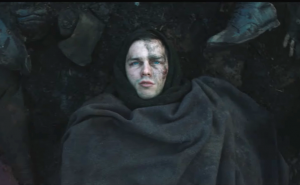
Still from film ‘Tolkien’ (Fox Searchlight)
Tolkien (2019)
Directed by Dome Karukoski
Written by David Gleeson and Stephen Beresford
Rated PG-13 (for some sequences of war violence)
Tolkien is a beautiful film. I wrote back in February that I had some misgivings, based on its trailer. But I said I would keep an open mind until I saw it. I have now seen it, and while it’s flawed in some ways, it succeeds wonderfully in telling the story of the young J.R.R. Tolkien (Nicholas Hoult) and the influences that made him one of the most beloved writers of the 20th century.
The movie actually tells two stories. The first is a story about what Professor Tolkien endured in the trenches in World War I, specifically the Battle of the Somme.
The second story, told in flashbacks, is about Professor Tolkien’s life up to the point when he shipped to France: an idyllic boyhood with his younger brother Hilary in rural Sarehole Mill outside Birmingham, England; the death of his mother; the Catholic priest, Fr. Francis Morgan, who was appointed the boys’ legal guardian; King Edward’s school and young Ronald (as he was called) meeting his boyhood friends; and meeting Edith Bratt (played by Lily Collins); and Oxford.
Memories from the trenches
Tolkien is structured so that it appears Ronald is recalling all this as he huddles in a trench, soaked to the skin, cold, and terrified. He remembers his mother, Mabel, who awakened in Ronald his love of languages and his love of nature and instilled in him a love for the Catholic faith. That love was further nurtured by Fr. Morgan after Mabel’s death (their father had died some years earlier in South Africa).
In the trenches, delirious, wracked with fever, he suddenly is desperate to find news of his boyhood friend, Geoffrey Smith. He stumbles into a pit filled with corpses and collapses in the mix of blood and water at the bottom. He remembers meeting Smith and the others, Robert Gilson and Christopher Wiseman, his first day at King Edward’s.
Ronald has already annoyed the master, who mispronounced his last name (“It’s ‘TolkEEN,’ sir, not ‘Tolkine.’”). The boys are to take turns reading Chaucer out loud from a book and as a prank one of them steals Ronald’s book off his desk. After a couple of boys stumble through the seemingly unpronounceable Middle English from their own texts, it’s Ronald’s turn. He picks up from memory where the last boy left off, pronouncing all the words perfectly.
This leads to a fight and, then, friendship, as Ronald, Robert, Christopher, and Geoffrey discover a common love for literature, poetry, classics, and art. They form the Tea Club & Barrovian Society, the first of many literary societies Professor Tolkien would co-found throughout his life.
It was about this time that he started inventing his own languages. Also, he meets Edith, who would become the love of his life and would inspire one of his most important characters, Lúthien Tinúviel, an elf princess in The Silmarillion. But Edith was not Catholic and was a few years older than Ronald. In a decision that was probably as hard for Fr. Morgan as it was for Ronald, Fr. Morgan forbade Ronald to have any contact with Edith until Ronald turned twenty-one.
Professor Joseph Wright
At the Somme, the situation grows more dire. Ronald’s batman, Sam, finds him in the pit and gets him to move before the Germans attack. The blur between real events and Ronald’s delirium becomes more pronounced: he sees fearsome knights warring on horses, the silhouette of a massive, crowned being outlined in the smoke, and in the fire of an exploding shell, a face with eyes of flame.
Suddenly, the English line is attacked by a dragon—Germans with flamethrowers.
Punctuating all this is creeping, silent mustard gas, choking the men to death who haven’t donned their gas masks in time.
Then he drifts back to Oxford and how, brooding on Edith and ignoring his studies, he is scheduled to be “sent down” (expelled). At this point he meets the man who would truly ignite his mind: Professor Joseph Wright. Professor Wright (Derek Jacobi) took the young, undisciplined Ronald under his wing and inspired him to switch his field of studies from classics to English language and literature.
The first time Ronald and Professor Wright speak is for me one of the most moving events of the film. With the two walking in a wood, Professor Wright begins to talk about trees, all the things we use them for, how they shelter us and shade us. “We march past them on our way into battle,” he says, and we limp back past them when we return. And all that we think and feel about trees, Professor Wright says, “is summed up in one short word: oak.”
It recalled for me the opening of John’s Gospel: “In the beginning was the Word.”
Words and language, myths and legends, stories and pictures and poems, and Edith: this is what filled in Ronald’s mind in the midst of the chaos and slaughter of the trenches. And it was that “story-germ,” as Ronald wrote years later in the Forward to the Second Edition of The Lord of the Rings, that brought forth Middle Earth; Elves and Dwarves and Men; Arda Marred and the Two Trees; and the Shire and the Blessed Realm and the Dead Marshes.
The humanities
This is Tolkien’s triumph: showing how all these influences meshed in Professor Tolkien’s mind, and formed him as a writer and as a man.
Where the movie stumbles is sometimes in its pacing. For instance, Mabel Tolkien’s death was rushed. It was a couple of minutes before I realized she was dead and not just sick. The film of course invents things for dramatic purposes. The real-life Ronald and Edith married about two months before he shipped to France (he having won her back once he turned twenty-one). But the filmmakers couldn’t resist the clichéd meeting of Ronald and Edith on the docks just before he boards the ship, she pleading with him to stay alive so they could marry later.
Tolkien has been criticized in some circles for ignoring Ronald’s Catholic faith. This is false. Throughout, from scenes with Ronald’s mother to crucifixes he sees on the battlefield, it is unmistakable how important Tolkien’s faith was to him. Colm Meaney gives a particularly good performance as Fr. Morgan, especially toward the end of the film where he tells Ronald that Ronald made the right choice about Edith. (I have no idea if that conversation ever actually happened, but it works in the film).
I would also note that the influence of any person’s religion on his or her life is complex. Attempting to portray it in film is fraught with peril. It is easy to get it wrong. Better that it be kept to a minimum than risk flubbing it.
This loving care extends to minor details as well. For instance, Ronald’s bedroom walls are covered with his drawings, including one of a giant spider.
If there is one thing that Professor Tolkien’s life was about—and that Tolkien is about—it is the importance of words, and the importance of language and stories and books and pictures and poems, in times of war and the seeming end of the world.
How important this is for a modern audience to hear, what with a science and technology curriculum that has been pushed on young people for years, at the expense of the humanities. Thanks to technology, we have industrialized warfare. But with the humanities, we might know better than to elect leaders who send young men and women to fight those wars.
Previous Post

April 30, 2019
Repeal the Second Amendment
Next Post
July 13, 2019 Archbishop Chaput, I see you
Browse Our Archives
Select a Category Advent/Christmas alarms and discursions American history appreciations and criticisms Arts and entertainment Catholic Church G.K. Chesterton Illinois J.R.R Tolkien Lent Nazi watch politics religion Uncategorized
Select a Month July 2021 June 2021 January 2021 November 2020 October 2020 August 2020 July 2020 February 2020 January 2020 December 2019 August 2019 July 2019 May 2019 April 2019 March 2019 February 2019 January 2019 December 2018 November 2018 October 2018 September 2018 July 2018 June 2018 May 2018
Follow Us!
TAKE THE
Religious Wisdom Quiz
Which disciple brought his brother to Jesus, saying, 'We have found the Messiah'?
Select your answer to see how you score.
John Andrew Peter James
Related posts from Chaos and Old Night

A most unselfish way of giving pleasure

There is more to a police procedural than...
Dale Ahlquist is on a mission - sadly,...

Begging—and answering—the question
TRENDING AT PATHEOS Catholic

Rejecting Doom: Christian Hope And Human Action
Christianity is a religion of hope. We are to have hope and...

It’s What Comes From Within Which Matters
One of the most difficult things for us to understand is why...

Why I Choose the Eucharist Over the Sermon
Choose the Eucharist, Not the Sermon What are we supposed to get...

5 Design Elements Found in Spiritually Rooted Homes
Putting Spirituality Into Home Decor Our homes are more than our living...

Credo: A Story of God Told with the...
About 10 years ago, I began to imagine a personal "Credo" that...

The Anatomy of Divine Revelation in Catholic Thought
The claim that God has made Himself known to human beings is...
view all Catholic blogs
Ad-Free & Subscriber Log-In Subscription Support
- About Us
- 2026 Calendar
- Videos
- Podcasts
- Library of World Religions
- Faith In Media Tracker
- Advertise With Us
- Write for Us
- Privacy Policy
- Terms of Service
- Do Not Sell My Data
- Contact Us
- Radiant Digital
- Manage Newsletter Subscriptions
- Unsubscribe From Notifications
- Sitemap
Copyright 2008-2026, Patheos. All rights reserved.
Subscription Support Ad-Free & Subscriber Log-In
Follow Patheos