
BuddhistCatholicContemplativeEvangelicalGeneral ChristianHinduJewishLatter-day SaintMuslimNew VisionsProgressive Christian
Beliefs
- Buddhist
- Catholic
- Contemplative
- Evangelical
- General Christian
- Hindu
- Jewish
- Latter-day Saint
- More Voices
- Muslim
- New Visions
- Pagan
- Progressive Christian
Topics
- Religion News
- Food and Religion
- Sports and Religion
- Religious Art
- Religious Music and Entertainment
- Religious Events
- History and Religion
- Style and Religion
- Politics and Religion
- Women in Religion
- Recreation Outdoors and Religion
- Business Finance and Religion
- Careers Workplace and Religion
- Education and Religion
- Family Parenting and Religion
- Health Fitness and Religion
- Home and Religion
- Relationships and Religion
- Technology and Religion
- Travel and Religion
Columnists
- Buddhist Columnists
- Business Finance and Religion Columnists
- Careers Workplace and Religion Columnists
- Catholic Columnists
- Contemplative Columnists
- Education and Religion Columnists
- Evangelists Columnists
- Family Parenting and Religion Columnists
- General Christian Columnists
- Health Fitness and Religion Columnists
- Hindu Columnists
- History and Religion Columnists
- Home and Religion Columnists
- Jewish Columnists
- More Voices Columnists
- Latter Day Columnists
- Muslim Columnists
- New Visions Columnists
- Nonreligious Columnists
- Pagan Columnists
- Politics and Religion Columnists
- Progressive Columnists
- Recreation Outdoors and Religion Columnists
- Relationships and Religion Columnists
- Religion News Columnists
- Religious Art Columnists
- Religious Events Columnists
- Religious Music and Entertainment Columnists
- Sports and Religion Columnists
- Style and Religion Columnists
- Technology and Religion Columnists
- Travel and Religion Columnists
- Women in Religion Columnists
Resource Library
- 2026 Calendar
- Library of World Religions
- The 100 Most Holy Places on Earth
- Patheos Answers
- Podcasts
- Videos
- Faith Leaders Database
- Anglican Episcopalian
- Bahai
- Baptist
- Buddhism
- Christianity
- Confucianism
- Eastern Orthodoxy
- Hinduism
- Holiness and Pentecostal
- ISKCON
- Islam
- Judaism
- Lutheran
- Methodist
- The Church of Jesus Christ of Latter-day Saints
- New Age
- Paganism
- Presbytarian and Reformed
- Protestantism
- Religion Behind the Scenes
- Roman Catholic
- Scientology
- Shia Islam
- Sikhism
- Sufism
- Sunni Islam
- Taoism
- Zen
- See all religions
Research Tools
 Ad-Free & Subscriber Log-In Subscription Support
Ad-Free & Subscriber Log-In Subscription Support
Follow Patheos 

- Trending:
- Forgiveness
- |
- Marriage
- |
- Consciousness
- |
- Death Penalty
- |
- Election
- |
- Halloween
 Cooperative Baptist Fellowship
- Home
- Progressive Christian
- Preaching truth in a post-truth world
Preaching truth in a post-truth world
Last updated on: January 23, 2017 at 12:54 pm by Guest Contributor
Preaching truth in a post-truth world 2017-01-23T12:54:08-04:00 Guest Contributor
Patheos Explore the world's faith through different perspectives on religion and spirituality! Patheos has the views of the prevalent religions and spiritualities of the world.
By Matt Sapp

Matt Sapp is pastor of Heritage Baptist Church in Canton, Ga.
2016 wasn’t a great year for truth, and the first few weeks of 2017 don’t appear to have offered any improvement. When Stephen Colbert coined the term “truthiness” in 2005, everyone laughed. Few are laughing now.
Colbert used the word to mean understanding something to be true because it “feels” right or because our gut tells us it ought to be true. Truthiness means that facts are secondary to emotion and that wishful thinking somehow has the power to bend the truth. The idea behind truthiness is closely related to confirmation bias, the idea that we are more likely to uncritically accept ideas or opinions as true if they tend to reinforce what we already believe.
During the 2016 presidential election we discovered an electorate primed for confirmation bias and truthiness. Our presidential candidates quickly proved ready to take advantage of the new reality by intentionally seeking to obscure the truth; by muddying the waters about the basic standards of truth; and by constantly calling into question what we previously accepted as reliable sources of truth — in the media, the scientific community and the government — all in an effort to advance their own agendas and to the distinct detriment of our democracy.
Truthiness and confirmation bias are not, of course, only political phenomena. Religious leaders and constituencies fall prey to the same fallacies. In fact, there are few, if any, areas of our lives where basic standards of truth haven’t begun to erode. That’s why we find ourselves liking and re-posting things on Facebook that turn out not to be true — whether about our favorite football teams or our least favorite political candidates.
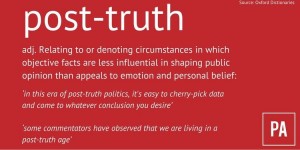 All of this leads many to conclude that we are living in a “post-truth” America. In fact, “post-truth” was named the 2016 word of the year by Oxford Dictionaries.
(As an aside, the previous sentence links to an article from The Washington Post. I hesitated to include the link because I know that some who read this article will question whether the Post—one of America’s most respected newspapers—is a trustworthy source of information. My hesitancy to confidently cite a respected news source illustrates both the post-truth world in which we live and its dangers.)
In a post-truth world we seek out and lend credence to only those sources of information that tend to confirm our biases, and we begin to reject the idea that there are any unbiased, objective sources of truth.
When information bubbles and echo chambers become so exclusionary and loud, when confirmation bias and wanting to “feel” right become more important than facts, and when we become so factioned and entrenched in our ideological ghettos, that winning an argument or an election — that power and victory — become more important than truth, then we live firmly in a post-truth society.
To the extent that what I’ve just described is happening, we are in real trouble. And a post-truth society presents a distinct challenge to Christians because we believe that Christ is the truth (John 14:6).
So how does a post-truth world present a challenge to the gospel?
Love your enemies and pray for those who persecute you (Matt 5:44) — those are basic Christian truths. But in a post-truth world people sit in the pews and wonder if those truths “feel” right. Do they line up with what I heard on the radio or TV last week? Do they tend to confirm my biases? Because, if not, in a post-truth world, we are being conditioned to hold those ideas as suspect.
So we start to interpret the truth into something more akin to truthiness. We think, “In some situations loving your enemies means killing them and praying for those who persecute you means praying for God to destroy them.” Doesn’t that “feel” more right, we think? Let’s make that the truth.
The last shall be first. You can’t serve God and money. Blessed are the peacemakers. “Nice try preacher,” we think, “but that doesn’t feel right.”
“Self-promotion feels better. My gut instinct tells me I can serve two masters. Bomb the hell out of ‘em. Sometimes peace is made at the end of a sword,” we say.
Those ideas “feel” great. And in today’s world, we’re learning that if it feels right, it’s true; and if it doesn’t feel right, it isn’t.
In this way the Sermon on the Mount isn’t outright rejected. It’s just questioned around the edges and reinterpreted until it takes on the form of truthiness, until it becomes something that “feels” right in our gut — and until it becomes something less than true.
And this isn’t something we should just look out for in other people. We are all at risk of falling prey to this tendency in a post-truth world. Truthiness is powerfully alluring.
So how do we preach truth in a post-truth world?
First, we should preach the truth calmly and persistently, prayerfully and deliberately, and intentionally, so that we guard ourselves against a drift toward truthiness.
Second, we shouldn’t preach the truth only reactively — the truth must be more than simply a response to every “post-truth” flare up.
Instead, with courage and dignity and diligence we should preach proactively that humility is a virtue and meekness a strength. That looking out for the other person and caring for the downtrodden are their own rewards. That all of God’s children are equal in the eyes of God.
In a post-truth world we should confidently proclaim that there is such a thing as truth, that it has a unique and unrivaled power, and that it wins in the end.
No amount of post-truth yelling or anger or violence or money or intimidation or religious chest-thumping or political browbeating can keep truth down. The truth will out. It will come to light.
Truth is like yeast in the dough or the faith of a mustard seed — and, like Shakespeare’s Hermia, though it be but little, it is fierce! So truth doesn’t need us to defend it. But it does need us to let it out into the world; it does need to be insistently and persistently proclaimed.
The truth doesn’t have to “feel” right. It is right. It doesn’t have to shout to win an argument. And, as hard as it may be for us to understand, it doesn’t have to win every day, every battle, every election or even every decade. Our faith teaches us that it’s already won the war.
There’s another thing truth has done. It has set us free (John 8:32) — free to be right, even if it doesn’t always “feel” right.
Matt Sapp serves as the pastor of Heritage Baptist Church in Canton, Ga.
Previous Post

January 20, 2017
Deadheading in the Church
Next Post

January 25, 2017 Being the Church in the 21st Century
Browse Our Archives
Select a Category Advent Advocacy Baptist Black Lives Matter Campbell University CCM Chaplain Children Church Starts Clergy Sexual Misconduct Coaching Culture Environment Equality Ethics Events Field Personnel Health History Human Trafficking Immigration Interfaith Interviews Lent Ministry Missions Payday Pentecost Politics Prayer Race Refugees Religious Liberty Sermon Spirituality Theology Uncategorized United Nations Women Worship Young Adults
Select a Month November 2018 October 2018 September 2018 August 2018 July 2018 June 2018 May 2018 April 2018 March 2018 February 2018 January 2018 December 2017 November 2017 October 2017 September 2017 August 2017 July 2017 June 2017 May 2017 April 2017 March 2017 February 2017 January 2017 December 2016 November 2016 October 2016 February 2016
Follow Us!
TAKE THE
Religious Wisdom Quiz
What caused the kingdom to split after Solomon's death?
Select your answer to see how you score.
Famine Idol worship Rehoboam's harsh policies Prophet's curse
Related posts from Cooperative Baptist Fellowship

Repent, and Believe the Good News: Black Lives...
Cooperative Baptist Fellowship

CBF Podcast: Live from the General Assembly Podcast...
Cooperative Baptist Fellowship
CBF Podcast: A Conversation with Michael Wear, Author...
Cooperative Baptist Fellowship

Cooperative Baptist Fellowship
TRENDING AT PATHEOS Progressive Christian

What Being a Modern-Day Apostle Means to Me
In my last column, I discussed the ins and outs of modern-day...

Did Ancient China Once Worship the God of...
Across human history, a common thread weaves through the origins of the...

Love Your Neighbor – Including Earth-Kin: Lev. 19,...
God’s command to love your neighbor means acting in an ethical and...

Lead a Church Study of “Jesus and Lao...
Guest writer Jack Thomas (The Irreverent Reverend) reflects on leading his church...

Pastoral Wisdom for Responding to Sermon Pushback
Getting sermon pushback on your social justice sermon? Learn practical, Proverbs-based strategies...

Principles for Understanding the Apostolic Ministry Today
Whenever people discover that my formal ministry title is "apostle," as in...
view all Progressive Christian blogs
Ad-Free & Subscriber Log-In Subscription Support
- About Us
- 2026 Calendar
- Videos
- Podcasts
- Library of World Religions
- Faith In Media Tracker
- Advertise With Us
- Write for Us
- Privacy Policy
- Terms of Service
- Do Not Sell My Data
- Contact Us
- Radiant Digital
- Manage Newsletter Subscriptions
- Unsubscribe From Notifications
- Sitemap
Copyright 2008-2026, Patheos. All rights reserved.
Subscription Support Ad-Free & Subscriber Log-In
Follow Patheos