
BuddhistCatholicContemplativeEvangelicalGeneral ChristianHinduJewishLatter-day SaintMuslimNew VisionsProgressive Christian
Beliefs
- Buddhist
- Catholic
- Contemplative
- Evangelical
- General Christian
- Hindu
- Jewish
- Latter-day Saint
- More Voices
- Muslim
- New Visions
- Pagan
- Progressive Christian
Topics
- Religion News
- Food and Religion
- Sports and Religion
- Religious Art
- Religious Music and Entertainment
- Religious Events
- History and Religion
- Style and Religion
- Politics and Religion
- Women in Religion
- Recreation Outdoors and Religion
- Business Finance and Religion
- Careers Workplace and Religion
- Education and Religion
- Family Parenting and Religion
- Health Fitness and Religion
- Home and Religion
- Relationships and Religion
- Technology and Religion
- Travel and Religion
Columnists
- Buddhist Columnists
- Business Finance and Religion Columnists
- Careers Workplace and Religion Columnists
- Catholic Columnists
- Contemplative Columnists
- Education and Religion Columnists
- Evangelists Columnists
- Family Parenting and Religion Columnists
- General Christian Columnists
- Health Fitness and Religion Columnists
- Hindu Columnists
- History and Religion Columnists
- Home and Religion Columnists
- Jewish Columnists
- More Voices Columnists
- Latter Day Columnists
- Muslim Columnists
- New Visions Columnists
- Nonreligious Columnists
- Pagan Columnists
- Politics and Religion Columnists
- Progressive Columnists
- Recreation Outdoors and Religion Columnists
- Relationships and Religion Columnists
- Religion News Columnists
- Religious Art Columnists
- Religious Events Columnists
- Religious Music and Entertainment Columnists
- Sports and Religion Columnists
- Style and Religion Columnists
- Technology and Religion Columnists
- Travel and Religion Columnists
- Women in Religion Columnists
Resource Library
- 2026 Calendar
- Library of World Religions
- The 100 Most Holy Places on Earth
- Patheos Answers
- Podcasts
- Videos
- Faith Leaders Database
- Anglican Episcopalian
- Bahai
- Baptist
- Buddhism
- Christianity
- Confucianism
- Eastern Orthodoxy
- Hinduism
- Holiness and Pentecostal
- ISKCON
- Islam
- Judaism
- Lutheran
- Methodist
- The Church of Jesus Christ of Latter-day Saints
- New Age
- Paganism
- Presbytarian and Reformed
- Protestantism
- Religion Behind the Scenes
- Roman Catholic
- Scientology
- Shia Islam
- Sikhism
- Sufism
- Sunni Islam
- Taoism
- Zen
- See all religions
Research Tools
 Ad-Free & Subscriber Log-In Subscription Support
Ad-Free & Subscriber Log-In Subscription Support
Follow Patheos 

- Trending:
- Forgiveness
- |
- Marriage
- |
- Consciousness
- |
- Death Penalty
- |
- Election
- |
- Halloween
 Cooperative Baptist Fellowship
- Home
- Progressive Christian
- The Baptist heritage of religious liberty for all
The Baptist heritage of religious liberty for all
Last updated on: November 9, 2016 at 10:51 pm by Guest Contributor
The Baptist heritage of religious liberty for all 2016-11-09T22:51:20-04:00 Guest Contributor
Patheos Explore the world's faith through different perspectives on religion and spirituality! Patheos has the views of the prevalent religions and spiritualities of the world.
By Holly Hollman
Recently, the term “religious liberty” has been used loosely by the media, presidential candidates and others, causing a great deal of confusion. There have been highly charged fights over laws purporting to protect religious liberty. There has been fear about how someone’s religious liberty could harm another person. News articles often put “scare quotes” around the term.

Holly Hollman, General Counsel of the Baptist Joint Committee for Religious Liberty
For more than four centuries, Baptists have been at the vanguard of the fight for religious liberty for all people, no matter their beliefs. In the midst of much confusion, it can be helpful to return to the foundational principles of religious liberty and the unique way it is protected in the United States.
The term “religious liberty” means the freedom to believe and exercise or act upon religious conscience without unnecessary interference by the government. It involves both the freedom to practice religion and not to practice religion. If you can’t say “no,” your “yes” is meaningless.
Just like any freedom, religious liberty is not without limits. As the old saying goes, “My right to swing my fist ends where your nose begins.” Some religions involve beliefs or practices that conflict with other laws; in the United States, that could include compulsory education laws, animal protection laws and anti-drug laws. When conflicts arise, legislatures and courts must step in to determine how to accommodate sincere religious beliefs while protecting other government interests, including protecting those who may not share the same beliefs. So, when government makes exceptions for religious exercise, it must look out for the rights and well-being of others who may be detrimentally affected.
As commonplace as it may seem today, this concept was not always widely understood. Baptists have always believed we are inherently free to choose whether to worship God and follow Christ without efforts by the government to advance or restrain religion. This historic commitment to religious liberty for all people can be traced back to 17th century England. Thomas Helwys, who helped establish the first Baptist congregation in England, called for individual religious freedom, declaring that the King of England had no power over the souls of his subjects. Helwys’ audacious words landed him in prison, where he languished and died.
In colonial America, Baptists faced persecution for their beliefs at the hands of the colonial theocratic governments. As the colonies began to work for their independence from England, they continued to banish Baptists and other religious minorities to jails for dissenting religious views and practices. During this time, Roger Williams fled persecution in Massachusetts and founded Rhode Island, establishing “a shelter for persons distressed for conscience” for anyone of any belief and created the first Baptist church in America. Baptist preachers in Virginia were imprisoned for preaching the Gospel without a license from the government.
When the United States began drafting its constitution, Baptists led by John Leland in Virginia pressed for explicit religious freedom protections. Baptists said the government was powerless to control conscience and incompetent to dictate spiritual matters. The ideas that the government will not do anything to establish religion or obstruct an individual’s religious practice were new and radical. In 1791, the ratification of the First Amendment embodied the Baptist vision of a nation founded on religious liberty for all and the institutional separation of church and state.
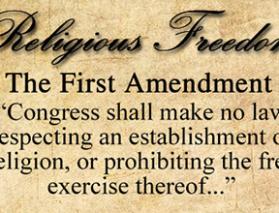
The first 16 words of the First Amendment continue to protect religious freedom. The prohibition on an establishment of religion keeps the government from advancing or privileging religion. The protection of free exercise keeps the government from unnecessarily interfering with religious practice.
The First Amendment keeps government neutral — neither helping nor hurting religion, but allowing people to practice their religion (or practice no religion). That distinct method of protection allows people with vastly different beliefs to live peaceably together, and it creates an institutional separation of church and state that is good for both. Additional protections exist in various federal, state and local laws.
The Baptist Joint Committee for Religious Liberty advocates a “golden rule” of religious liberty: Do not ask government to promote your religion if you don’t want government to promote somebody else’s religion; and do not permit government to hinder somebody else’s religion if you don’t want government to hinder your own religion.
The expression of the Baptist ideal of religious liberty began more than four centuries ago, and we all have a role and responsibility to make sure it is protected through the next 400 years and beyond.
Holly Hollman serves as General Counsel of the Baptist Joint Committee for Religious Liberty in Washington, D.C.
Previous Post

October 31, 2016
More or Less? A groaning Earth and our unsustainable impact

Browse Our Archives
Select a Category Advent Advocacy Baptist Black Lives Matter Campbell University CCM Chaplain Children Church Starts Clergy Sexual Misconduct Coaching Culture Environment Equality Ethics Events Field Personnel Health History Human Trafficking Immigration Interfaith Interviews Lent Ministry Missions Payday Pentecost Politics Prayer Race Refugees Religious Liberty Sermon Spirituality Theology Uncategorized United Nations Women Worship Young Adults
Select a Month November 2018 October 2018 September 2018 August 2018 July 2018 June 2018 May 2018 April 2018 March 2018 February 2018 January 2018 December 2017 November 2017 October 2017 September 2017 August 2017 July 2017 June 2017 May 2017 April 2017 March 2017 February 2017 January 2017 December 2016 November 2016 October 2016 February 2016
Follow Us!
TAKE THE
Religious Wisdom Quiz
What message did Jeremiah send to the exiles in Babylon to encourage them?
Select your answer to see how you score.
Pray for Judah only Return and revolt Fast and do not marry Build houses and seek the city's good
Related posts from Cooperative Baptist Fellowship

CBF Podcast: Live from the General Assembly Podcast...
Cooperative Baptist Fellowship
Cooperative Baptist Fellowship
CBF Podcast: The Guardian columnist Daniel José Camacho...
Cooperative Baptist Fellowship
When Government Spies on Religion (redux)
Cooperative Baptist Fellowship
TRENDING AT PATHEOS Progressive Christian

Why Christians Have a Sacred Duty to Vote:...
The Bible offers strong support for the sacred duty to vote. Here...

What Being a Modern-Day Apostle Means to Me
In my last column, I discussed the ins and outs of modern-day...

Did Ancient China Once Worship the God of...
Across human history, a common thread weaves through the origins of the...

Love Your Neighbor – Including Earth-Kin: Lev. 19,...
God’s command to love your neighbor means acting in an ethical and...

Lead a Church Study of “Jesus and Lao...
Guest writer Jack Thomas (The Irreverent Reverend) reflects on leading his church...

Principles for Understanding the Apostolic Ministry Today
Whenever people discover that my formal ministry title is "apostle," as in...
view all Progressive Christian blogs
Ad-Free & Subscriber Log-In Subscription Support
- About Us
- 2026 Calendar
- Videos
- Podcasts
- Library of World Religions
- Faith In Media Tracker
- Advertise With Us
- Write for Us
- Privacy Policy
- Terms of Service
- Do Not Sell My Data
- Contact Us
- Radiant Digital
- Manage Newsletter Subscriptions
- Unsubscribe From Notifications
- Sitemap
Copyright 2008-2026, Patheos. All rights reserved.
Subscription Support Ad-Free & Subscriber Log-In
Follow Patheos