
BuddhistCatholicContemplativeEvangelicalGeneral ChristianHinduJewishLatter-day SaintMuslimNew VisionsProgressive Christian
Beliefs
- Buddhist
- Catholic
- Contemplative
- Evangelical
- General Christian
- Hindu
- Jewish
- Latter-day Saint
- More Voices
- Muslim
- New Visions
- Pagan
- Progressive Christian
Topics
- Religion News
- Food and Religion
- Sports and Religion
- Religious Art
- Religious Music and Entertainment
- Religious Events
- History and Religion
- Style and Religion
- Politics and Religion
- Women in Religion
- Recreation Outdoors and Religion
- Business Finance and Religion
- Careers Workplace and Religion
- Education and Religion
- Family Parenting and Religion
- Health Fitness and Religion
- Home and Religion
- Relationships and Religion
- Technology and Religion
- Travel and Religion
Columnists
- Buddhist Columnists
- Business Finance and Religion Columnists
- Careers Workplace and Religion Columnists
- Catholic Columnists
- Contemplative Columnists
- Education and Religion Columnists
- Evangelists Columnists
- Family Parenting and Religion Columnists
- General Christian Columnists
- Health Fitness and Religion Columnists
- Hindu Columnists
- History and Religion Columnists
- Home and Religion Columnists
- Jewish Columnists
- More Voices Columnists
- Latter Day Columnists
- Muslim Columnists
- New Visions Columnists
- Nonreligious Columnists
- Pagan Columnists
- Politics and Religion Columnists
- Progressive Columnists
- Recreation Outdoors and Religion Columnists
- Relationships and Religion Columnists
- Religion News Columnists
- Religious Art Columnists
- Religious Events Columnists
- Religious Music and Entertainment Columnists
- Sports and Religion Columnists
- Style and Religion Columnists
- Technology and Religion Columnists
- Travel and Religion Columnists
- Women in Religion Columnists
Resource Library
- 2026 Calendar
- Library of World Religions
- The 100 Most Holy Places on Earth
- Patheos Answers
- Podcasts
- Videos
- Faith Leaders Database
- Anglican Episcopalian
- Bahai
- Baptist
- Buddhism
- Christianity
- Confucianism
- Eastern Orthodoxy
- Hinduism
- Holiness and Pentecostal
- ISKCON
- Islam
- Judaism
- Lutheran
- Methodist
- The Church of Jesus Christ of Latter-day Saints
- New Age
- Paganism
- Presbytarian and Reformed
- Protestantism
- Religion Behind the Scenes
- Roman Catholic
- Scientology
- Shia Islam
- Sikhism
- Sufism
- Sunni Islam
- Taoism
- Zen
- See all religions
Research Tools
 Ad-Free & Subscriber Log-In Subscription Support
Ad-Free & Subscriber Log-In Subscription Support
Follow Patheos 

- Trending:
- Forgiveness
- |
- Marriage
- |
- Consciousness
- |
- Death Penalty
- |
- Election
- |
- Halloween
 Catholic News
- Home
- Catholic
- Religion News
- What is Pope Francis’ approach to appointing new bishops?
What is Pope Francis’ approach to appointing new bishops?
Last updated on: October 17, 2017 at 8:34 pm by CNA Daily News
What is Pope Francis’ approach to appointing new bishops? 2017-10-17T20:34:00+00:00 CNA Daily News
Patheos Explore the world's faith through different perspectives on religion and spirituality! Patheos has the views of the prevalent religions and spiritualities of the world.
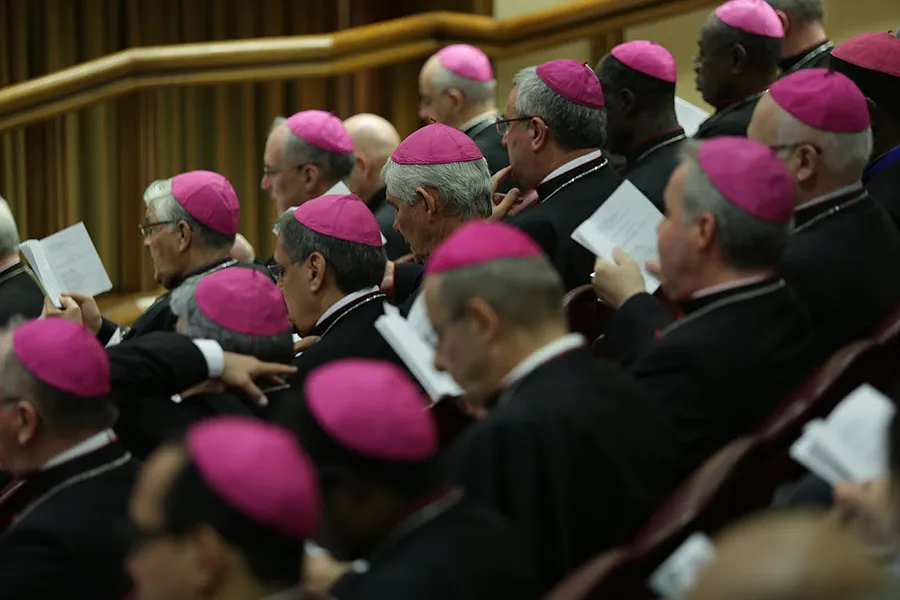
Vatican City, Oct 17, 2017 / 02:34 pm (CNA/EWTN News).- Among the most lasting aspects of a Pope’s leadership is his appointment of bishops. To understand a Pope, it’s important to understand how he makes decisions about episcopal leadership.
With that in mind, Pope Francis’ approach to the selection and appointment of bishops is worth considering.
When diocesan and auxiliary bishops turn 75 years old, they are required to submit a letter of resignation to the Pope, which he can accept immediately or at any time going forward.
At present, there are seven key posts in the world waiting for a new bishop. While it can take more than a year before a bishop’s resignation is accepted, many analysts anticipate a flurry of significant episcopal appointments over the next several months.
Bishops who recently submitted a letter of resignation to Pope Francis include Cardinal Donald Wuerl of Washington, DC; Cardinal Laurent Mosengwo of Kinshasa (Democratic Republic of Congo); Cardinal Wilfrid Fox Napier of Durban (South Africa); Cardinal Oscar Rodriguez Maradiaga of Tegucigalpa (Honduras); Cardinal Norberto Rivera Carrera of Mexico City; Cardinal André Vingt-Trois of Paris; and Archbishop Peter Okada of Tokyo.
What will Pope Francis’ criteria be in appointing new bishops to these significant dioceses?
Some recent appointments may shed light on his priorities.
Pope Francis recently appointed Mario Delpini, 66, to serve as Archbishop of Milan, succeeding Cardinal Angelo Scola. Delpini served as Milan’s auxiliary bishop for a decade before being appointed archbishop.
Archbishop Delpini had been a collaborator with the three previous archbishops of Milan, Cardinals Martini, Tettamanzi and Scola. Unlike his predecessors, however, all of his priestly life took place in the Archdiocese of Milan.
Pope Francis also recently appointed a Vicar of Rome, the title used for the functional head of the Diocese of Rome. To replace Cardinal Agostino Vallini, the Pope picked Bishop Angelo De Donatis, 63, who preached the 2014 Lenten spiritual exercises to the Roman Curia, and was appointed an auxiliary bishop of Rome in 2015.
Archbishops Delpini and De Donatis have several things in common. They both have extensive pastoral experience, both are considered ideologically moderate, and both were already connected to the dioceses they’d been appointed to lead. These are said to be key criteria in the episcopal appointments of Pope Francis.
In fact, the Pope’s apparent criteria were a factor in many of his other notable appointments.
In 2014, the Pope chose Cardinal Reinhard Woelki as Archbishop of Cologne, moving him from his post in Berlin. Cardinal Woelki’s move to Cologne was a return to his hometown. When he was appointed, he was noted for his human touch, his pastoral work and simple style of life – television news pieces featured him washing his clothes personally and cooking at his home.
The same year, the Pope picked Carlos Osoro Sierra as the Archbishop of Madrid, and later named him a cardinal. Cardinal Osoro Sierra is known as the “little Francis” in Spain, largely because of his pastoral gifts and his missionary impulse, which have been a transformational factor for the Church in Spain.
Given these four examples, what is the Pope going to do with the Church in the U.S.?
Over the past year, Pope Francis has appointed 16 U.S. bishops, most of them in smaller dioceses or as auxiliaries. The major pending question is that of the successor of Cardinal Donald Wuerl, the Archbishop of Washington, D.C. Cardinal Wuerl is already 76 years old, more than a year beyond the normal retirement age.
The post in Washington, D.C. is a key post, as it involves both pastoral care and institutional relations with the U.S. political establishment. What will Pope Francis do?
An insistent rumor says that Bishop Robert W. McElroy of San Diego might be at the top of the list of the post.
Bishop McElroy recently grabbed headlines for jumping into the discussion on LGBT issues that followed Fr. James Martin’s book, “Building a Bridge.” Bishop McElroy has defended the book, and Martin, in the face of criticisms of his work.
He also recently took part in a Boston College conference on Amoris Laetitia, hosted by Cardinal Blase Cupich and Father James Keenan, SJ. During the conference, Bishop McElroy reported on the diocesan Synod he launched on Amoris Laetitia, and said that Catholic teaching must take seriously the complexity of adult moral life.
Among observers, he is considered a figure similar to Cardinal Blase Cupich, who was personally chosen by Pope Francis in 2014 to lead the Archdiocese of Chicago. This seems to suggest that he is a fit for Pope Francis’ model of episcopal leadership.
Of course, his appointment is simply a rumor, just as another rumor in Rome says that the Pope will soon call Cardinal Cupich to lead an important Vatican office in Rome.
There are no confirmation of rumors, and sometimes gossip is just a way to test possible reactions to an appointment. Such rumors are typical in such a moment of transition.
It’s worth noting that Pope Francis might also be reconsidering the selection process for bishops.
During the June 12-14 meeting of the Council of Cardinals, a new procedure for the appointment of bishops was discussed. It was not the first time the cardinals who advise Pope Francis have addressed this issue.
In particular, the Holy See Press Office explained that the consultation before the appointment of a new bishop might involve more local priests and laity. In the end, a bishop’s appointment is always a Pope’s appointment. However, the Pope receives suggestions – usually in the form of a set of three – from the local nuncios of each country, who consult broadly, and “interview” a number of people before suggesting any name to the Pope.
The idea being suggested is to emphasize the local level, rather than the nuncio’s suggestions. One of the issues apparently of concern is the way that nuncios gather information, as the standard questionnaire they deliver is said to be too dated.
Previous Post

October 17, 2017
Benedict XVI's secretary denies rumors that he is close to death
Browse Our Archives
Select a Category Americas Asia - Pacific Europe Middle East - Africa Uncategorized US Vatican
Select a Month November 2017 October 2017 September 2017 August 2017 July 2017 June 2017 May 2017 April 2017 March 2017 February 2017 January 2017 December 2016 November 2016 October 2016 September 2016 August 2016 July 2016 June 2016 May 2016 April 2016 March 2016 February 2016 January 2016 December 2015 November 2015 October 2015 September 2015 August 2015 July 2015 June 2015 May 2015 April 2015 March 2015 February 2015 January 2015 December 2014 November 2014 October 2014 September 2014 August 2014 July 2014 June 2014 May 2014 April 2014 March 2014 February 2014 January 2014 December 2013 November 2013 October 2013 September 2013 August 2013 July 2013 June 2013 May 2013 April 2013 March 2013 February 2013 January 2013 December 2012 November 2012 October 2012 September 2012 August 2012 July 2012 June 2012 May 2012
TAKE THE
Religious Wisdom Quiz
In 2 Corinthians, Paul describes a man being caught up to the third heaven. How many years before writing did this happen?
Select your answer to see how you score.
Ten years Seven years Twelve years Fourteen years
Related posts from Catholic News

How do we help trafficking victims re-enter society?...

More than just giving – World Day of...

New book reveals details of John Paul I’s...

Despite reports, Pope Francis isn’t opening the door...
TRENDING AT PATHEOS Catholic

The Parable Of The Sower And The Word...
One of Christ’s most famous parables is that of the sower who...

Rejecting Doom: Christian Hope And Human Action
Christianity is a religion of hope. We are to have hope and...

Why I Choose the Eucharist Over the Sermon
Choose the Eucharist, Not the Sermon What are we supposed to get...

5 Design Elements Found in Spiritually Rooted Homes
Putting Spirituality Into Home Decor Our homes are more than our living...

Credo: A Story of God Told with the...
About 10 years ago, I began to imagine a personal "Credo" that...

The Anatomy of Divine Revelation in Catholic Thought
The claim that God has made Himself known to human beings is...
view all Catholic blogs
Ad-Free & Subscriber Log-In Subscription Support
- About Us
- 2026 Calendar
- Videos
- Podcasts
- Library of World Religions
- Faith In Media Tracker
- Advertise With Us
- Write for Us
- Privacy Policy
- Terms of Service
- Do Not Sell My Data
- Contact Us
- Radiant Digital
- Manage Newsletter Subscriptions
- Unsubscribe From Notifications
- Sitemap
Copyright 2008-2026, Patheos. All rights reserved.
Subscription Support Ad-Free & Subscriber Log-In
Follow Patheos