
BuddhistCatholicContemplativeEvangelicalGeneral ChristianHinduJewishLatter-day SaintMuslimNew VisionsProgressive Christian
Beliefs
- Buddhist
- Catholic
- Contemplative
- Evangelical
- General Christian
- Hindu
- Jewish
- Latter-day Saint
- More Voices
- Muslim
- New Visions
- Pagan
- Progressive Christian
Topics
- Religion News
- Food and Religion
- Sports and Religion
- Religious Art
- Religious Music and Entertainment
- Religious Events
- History and Religion
- Style and Religion
- Politics and Religion
- Women in Religion
- Recreation Outdoors and Religion
- Business Finance and Religion
- Careers Workplace and Religion
- Education and Religion
- Family Parenting and Religion
- Health Fitness and Religion
- Home and Religion
- Relationships and Religion
- Technology and Religion
- Travel and Religion
Columnists
- Buddhist Columnists
- Business Finance and Religion Columnists
- Careers Workplace and Religion Columnists
- Catholic Columnists
- Contemplative Columnists
- Education and Religion Columnists
- Evangelists Columnists
- Family Parenting and Religion Columnists
- General Christian Columnists
- Health Fitness and Religion Columnists
- Hindu Columnists
- History and Religion Columnists
- Home and Religion Columnists
- Jewish Columnists
- More Voices Columnists
- Latter Day Columnists
- Muslim Columnists
- New Visions Columnists
- Nonreligious Columnists
- Pagan Columnists
- Politics and Religion Columnists
- Progressive Columnists
- Recreation Outdoors and Religion Columnists
- Relationships and Religion Columnists
- Religion News Columnists
- Religious Art Columnists
- Religious Events Columnists
- Religious Music and Entertainment Columnists
- Sports and Religion Columnists
- Style and Religion Columnists
- Technology and Religion Columnists
- Travel and Religion Columnists
- Women in Religion Columnists
Resource Library
- 2026 Calendar
- Library of World Religions
- The 100 Most Holy Places on Earth
- Patheos Answers
- Podcasts
- Videos
- Faith Leaders Database
- Anglican Episcopalian
- Bahai
- Baptist
- Buddhism
- Christianity
- Confucianism
- Eastern Orthodoxy
- Hinduism
- Holiness and Pentecostal
- ISKCON
- Islam
- Judaism
- Lutheran
- Methodist
- The Church of Jesus Christ of Latter-day Saints
- New Age
- Paganism
- Presbytarian and Reformed
- Protestantism
- Religion Behind the Scenes
- Roman Catholic
- Scientology
- Shia Islam
- Sikhism
- Sufism
- Sunni Islam
- Taoism
- Zen
- See all religions
Research Tools
 Ad-Free & Subscriber Log-In Subscription Support
Ad-Free & Subscriber Log-In Subscription Support
Follow Patheos 

- Trending:
- Forgiveness
- |
- Marriage
- |
- Consciousness
- |
- Death Penalty
- |
- Election
- |
- Halloween
 Catholic News
- Home
- Catholic
- Religion News
- Pope talks meaning of life in call with Space Station astronauts
Pope talks meaning of life in call with Space Station astronauts
Last updated on: October 26, 2017 at 6:53 pm by CNA Daily News
Pope talks meaning of life in call with Space Station astronauts 2017-10-26T18:53:00+00:00 CNA Daily News
Patheos Explore the world's faith through different perspectives on religion and spirituality! Patheos has the views of the prevalent religions and spiritualities of the world.
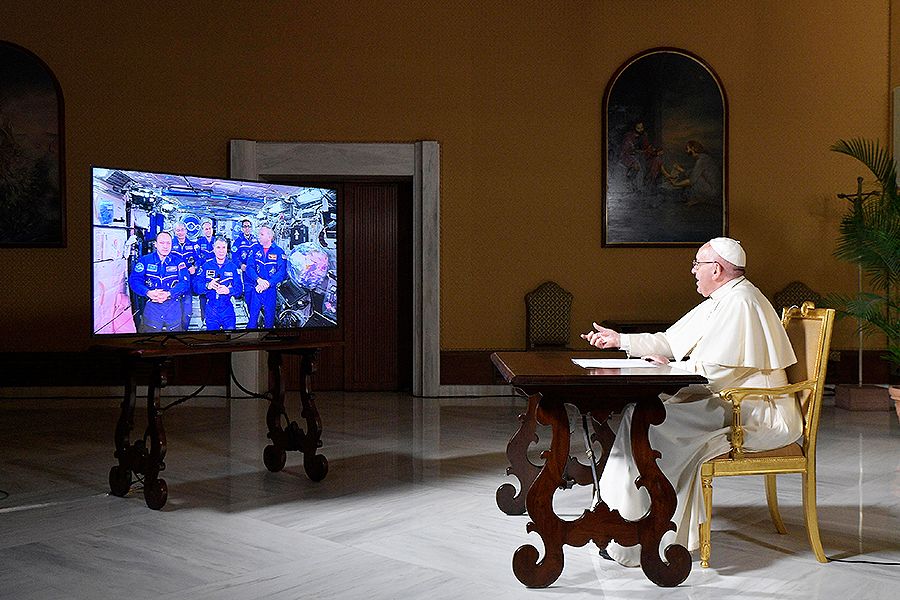
Vatican City, Oct 26, 2017 / 12:53 pm (CNA/EWTN News).- Pope Francis conversed with astronauts orbiting earth on the International Space Station on Thursday, discussing questions as diverse as man’s place in the universe, the fragility of life and the planet, and international cooperation.
“Astronomy makes us contemplate the horizons of the universe and raises questions in us: Where did we come from? Where are we going?” the Pope said.
His first question to the astronauts: “What is your thought on man’s place in the universe?”
Italian astronaut Paolo Nespoli responded, saying that man’s place in the universe is a “complex question,” especially for him since his specialties are in the technical realm.
However, he noted that being in space has helped him to realize that the more humanity learns, the more clearly we can see how much we still do not know.
“I would love for people like you, not just engineers, not just physicists, but people like you (Holy Father) – theologians, philosophers, poets, writers… – to come here in space, and this will surely happen in the future, I would love (for them) to come here to explore what it means to have a human being in space,” he said.
Pope Francis contacted NASA’s International Space Station via a satellite call from the Vatican on Oct. 26. Aboard the space station are a total of six astronauts, including three Americans, two Russians and one Italian, who have been orbiting the earth, about 220 miles away.
Three will return to earth in December of this year, and the other three in February 2018.
Josef Aschbacher, director of the earth observation programs (ESA), told journalists after the call that for the astronauts, speaking with the Pope was an “experience of a lifetime.”
He said the Pope’s questions were all “very interesting” because they have to do with “our life, as humanity.”
For example, Francis asked the team what motivated them to become astronauts, and what they enjoy about being in space.
“Traveling in space modifies so many things that are taken for granted in everyday life, for example the idea of ??up and down,” he said, also asking if there is anything about living in the space station that has surprised them.
American Randolph Bresnik said that what gives him the greatest joy in space is being able “to look outside and see God's creation maybe a little bit from his perspective. People cannot come up here and see the indescribable beauty of our earth and not be touched in their souls.”
There’s an incredible peace and serenity to our planet when you see it in orbit, he said, and there are “no borders, no conflict, it’s just peaceful.”
He also said that from space you can see “the thinness of the atmosphere, and it makes you realize how fragile our existence here is.”
Pope Francis responded by saying that he loved that answer, how Bresnik had pointed out the earth’s fragility, how it’s a “passing moment,” the earth turning at a rate of 10 km per second.
The astronauts also spoke with Francis about their own diversity and how it is an asset in their work on the International Space Station.
“As we work here on the space station and in our international partnership, we hope that the example of what we can achieve together is an example for all the world and humanity,” Bresnik said.
Francis said that although our society is very individualistic, cooperation is essential in life, asking about examples of collaboration in their work.
The International Space Station is a great example of international collaboration, American Joseph Acaba replied, because the crew members are from different countries and cultures, and they work together, also communicating on a daily basis with control centers in the U.S., Russia, Japan, Canada, and nine different countries in Europe.
“It's our diversity that makes us stronger,” Acaba said. “And I think we need to embrace who we are as individuals and respect those around us. And by working together we can do things much better than we can as individuals.”
The other astronauts on the call were American Mark T. Vande Hei, and Russians Aleksandr Misurkin and Sergey Ryazanskiy.
The encounter between the astronauts on the space station and the Pope was a fascinating intersection between religion and science, said Aschbacher, noting that science can assist in the search for God through its curiosity to better understand our world.
Science asks some of the same questions as religion, such as, “where we are from and where we are going and where do we live,” he said.
Roberto Battiston, president of the Italian Space Agency (ASI), added that “there is no doubt that science is a way of searching for the truth” and though religion and science may have different ways of searching, they still have the same goal.
Pope Francis’ call marks the second time a pope has contacted astronauts in space. In 2011, Pope Benedict XVI became the first when he called the International Space Station via satellite link, speaking with 12 astronauts for about 20 minutes.
In the call, Benedict asked the astronauts questions about what it is like to view the earth from outer space and if it gave them a new perspective on the importance of promoting peace and caring for our planet’s resources.
Previous Post

October 26, 2017
Guam archdiocese adopts more stringent child protection policies
Next Post
October 26, 2017 Trump declares opioid crisis a public health emergency
Browse Our Archives
Select a Category Americas Asia - Pacific Europe Middle East - Africa Uncategorized US Vatican
Select a Month November 2017 October 2017 September 2017 August 2017 July 2017 June 2017 May 2017 April 2017 March 2017 February 2017 January 2017 December 2016 November 2016 October 2016 September 2016 August 2016 July 2016 June 2016 May 2016 April 2016 March 2016 February 2016 January 2016 December 2015 November 2015 October 2015 September 2015 August 2015 July 2015 June 2015 May 2015 April 2015 March 2015 February 2015 January 2015 December 2014 November 2014 October 2014 September 2014 August 2014 July 2014 June 2014 May 2014 April 2014 March 2014 February 2014 January 2014 December 2013 November 2013 October 2013 September 2013 August 2013 July 2013 June 2013 May 2013 April 2013 March 2013 February 2013 January 2013 December 2012 November 2012 October 2012 September 2012 August 2012 July 2012 June 2012 May 2012
TAKE THE
Religious Wisdom Quiz
True or False: Hebrews teaches that the blood of bulls and goats can take away sins.
Select your answer to see how you score.
TRUE FALSE
Related posts from Catholic News

How do we help trafficking victims re-enter society?...

More than just giving – World Day of...

New book reveals details of John Paul I’s...

Despite reports, Pope Francis isn’t opening the door...
TRENDING AT PATHEOS Catholic

Rejecting Doom: Christian Hope And Human Action
Christianity is a religion of hope. We are to have hope and...

It’s What Comes From Within Which Matters
One of the most difficult things for us to understand is why...

Why I Choose the Eucharist Over the Sermon
Choose the Eucharist, Not the Sermon What are we supposed to get...

5 Design Elements Found in Spiritually Rooted Homes
Putting Spirituality Into Home Decor Our homes are more than our living...

Credo: A Story of God Told with the...
About 10 years ago, I began to imagine a personal "Credo" that...

The Anatomy of Divine Revelation in Catholic Thought
The claim that God has made Himself known to human beings is...
view all Catholic blogs
Ad-Free & Subscriber Log-In Subscription Support
- About Us
- 2026 Calendar
- Videos
- Podcasts
- Library of World Religions
- Faith In Media Tracker
- Advertise With Us
- Write for Us
- Privacy Policy
- Terms of Service
- Do Not Sell My Data
- Contact Us
- Radiant Digital
- Manage Newsletter Subscriptions
- Unsubscribe From Notifications
- Sitemap
Copyright 2008-2026, Patheos. All rights reserved.
Subscription Support Ad-Free & Subscriber Log-In
Follow Patheos