
BuddhistCatholicContemplativeEvangelicalGeneral ChristianHinduJewishLatter-day SaintMuslimNew VisionsProgressive Christian
Beliefs
- Buddhist
- Catholic
- Contemplative
- Evangelical
- General Christian
- Hindu
- Jewish
- Latter-day Saint
- More Voices
- Muslim
- New Visions
- Pagan
- Progressive Christian
Topics
- Religion News
- Food and Religion
- Sports and Religion
- Religious Art
- Religious Music and Entertainment
- Religious Events
- History and Religion
- Style and Religion
- Politics and Religion
- Women in Religion
- Recreation Outdoors and Religion
- Business Finance and Religion
- Careers Workplace and Religion
- Education and Religion
- Family Parenting and Religion
- Health Fitness and Religion
- Home and Religion
- Relationships and Religion
- Technology and Religion
- Travel and Religion
Columnists
- Buddhist Columnists
- Business Finance and Religion Columnists
- Careers Workplace and Religion Columnists
- Catholic Columnists
- Contemplative Columnists
- Education and Religion Columnists
- Evangelists Columnists
- Family Parenting and Religion Columnists
- General Christian Columnists
- Health Fitness and Religion Columnists
- Hindu Columnists
- History and Religion Columnists
- Home and Religion Columnists
- Jewish Columnists
- More Voices Columnists
- Latter Day Columnists
- Muslim Columnists
- New Visions Columnists
- Nonreligious Columnists
- Pagan Columnists
- Politics and Religion Columnists
- Progressive Columnists
- Recreation Outdoors and Religion Columnists
- Relationships and Religion Columnists
- Religion News Columnists
- Religious Art Columnists
- Religious Events Columnists
- Religious Music and Entertainment Columnists
- Sports and Religion Columnists
- Style and Religion Columnists
- Technology and Religion Columnists
- Travel and Religion Columnists
- Women in Religion Columnists
Resource Library
- 2026 Calendar
- Library of World Religions
- The 100 Most Holy Places on Earth
- Patheos Answers
- Podcasts
- Videos
- Faith Leaders Database
- Anglican Episcopalian
- Bahai
- Baptist
- Buddhism
- Christianity
- Confucianism
- Eastern Orthodoxy
- Hinduism
- Holiness and Pentecostal
- ISKCON
- Islam
- Judaism
- Lutheran
- Methodist
- The Church of Jesus Christ of Latter-day Saints
- New Age
- Paganism
- Presbytarian and Reformed
- Protestantism
- Religion Behind the Scenes
- Roman Catholic
- Scientology
- Shia Islam
- Sikhism
- Sufism
- Sunni Islam
- Taoism
- Zen
- See all religions
Research Tools
 Ad-Free & Subscriber Log-In Subscription Support
Ad-Free & Subscriber Log-In Subscription Support
Follow Patheos 

- Trending:
- Forgiveness
- |
- Marriage
- |
- Consciousness
- |
- Death Penalty
- |
- Election
- |
- Halloween
 Catholic News
- Home
- Catholic
- Religion News
- Pope Francis: putting God first doesn’t mean avoiding reality
Pope Francis: putting God first doesn’t mean avoiding reality
Last updated on: October 22, 2017 at 11:18 am by CNA Daily News
Pope Francis: putting God first doesn’t mean avoiding reality 2017-10-22T11:18:00+00:00 CNA Daily News
Patheos Explore the world's faith through different perspectives on religion and spirituality! Patheos has the views of the prevalent religions and spiritualities of the world.
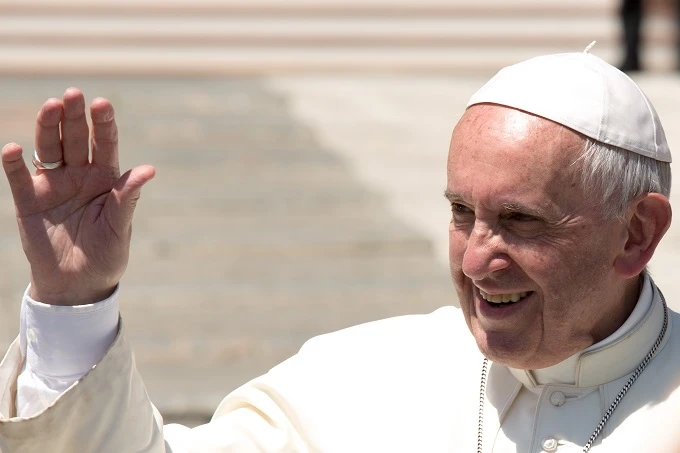
Vatican City, Oct 22, 2017 / 05:18 am (CNA/EWTN News).- On Sunday Pope Francis spoke on the importance of both fulfilling our earthly duties and making God a priority, stressing that the two are never in opposition, but are complementary, with the primacy of God giving direction to our daily activities.
“The Christian is called to commit themselves concretely in human and social realities without putting God and Cesar into opposition, but by illuminating the earthly reality with the light that comes from God,” the Pope said.
Giving priority to God and having hope in him “do not lead to an escape from reality,” he said, but rather, “they make industrious that which belongs to him.”
Pope Francis spoke to pilgrims present in St. Peter's Square for his Oct. 22 Sunday Angelus address, which coincided with both World Mission Sunday and the feast of St. John Paul II.
In his speech, the Pope centered his reflection on the day's Gospel reading from Matthew, in which the Pharisees question Jesus about whether or not is is just to pay taxes to Cesar.
This meeting constitutes yet another “face-to-face encounter” between Jesus and his opponents, the Pope said, noting that the “thorny” issue of taxes is supposed to be a trap.
However, rather than falling into it, Jesus offers a calm response and “takes advantage of the malicious question in order to give an important teaching, rising above the polemics and opposing sides.”
By looking at the image and inscription of Cesar carved onto the Roman coins and telling the Pharisees to “render to Cesar what is Cesar's, and to God what is God's,” Jesus on one hand says that paying taxes to the Roman emperor “is not an act of idolatry, but an act of duty to the earthly authority.”
On the other hand, in his reference to God, Jesus “recalls the primacy of God, asking to give him what is owed to him as the Lord of life, of man and of history.”
While the image of Cesar recalls our rights and duties as citizens of the state, the reference to God symbolically points to the image that is imprinted on every person, which is “the image of God,” the Pope said.
“He is the Lord of all, and we, who were created in his image, belong above all to him,” Francis said, asking pilgrims From the question posed by the Pharisees, Jesus derives a more vital and radical question for each one of us: “to whom do I belong?”
“To our family, our city, our friends, school, work, politics, or the state? Yes, certainly. But above all, Jesus reminds us, you belong to God,” he said, adding that the Lord is the one who has given us all that we have and are.
And therefore, in our daily lives “we can and must live them in renewed knowledge of this fundamental belonging and in the recognition of our heart to the Father, who created each one of us unique and unrepeatable, but always in the image of his beloved Son, Jesus,” he said. “It is a marvelous mystery.”
Pope Francis then led pilgrims in praying the traditional Angelus prayer. Afterward, he noted how yesterday Spanish martyrs Matteo Casals, Teofilo Casajús, Fernando Saperas and their 106 companions were beatified in Barcelona, and prayed that their “heroic example” and intercession would support Christians all over the world who today endure persecution and discrimination.
He also noted how Oct. 22 marks World Missionary Day, which was launched in 1926 by the Congregation for Divine Worship and is now promoted by the Congregation for the Evangelization of Peoples and the Pontifical Mission Societies.
Francis invited everyone to “live the joy of missionary witness to the Gospel” in their various states of life and urged faithful to support missionaries around the world either financially or through prayer.
To this end, the Pope announced that an “Extraordinary Missionary Month” will take place in October 2019 in order to “nourish the ardor of the evangelizing activity of the Church “ad gentes,” or “to the nations.”
<blockquote class="twitter-tweet" data-lang="en"><p lang="en" dir="ltr">During Angelus, <a href="https://twitter.com/hashtag/PopeFrancis?src=hash&ref_src=twsrc%5Etfw">#PopeFrancis</a> announced an Extraordinary Missionary Month for October 2019 in order to “nourish the ardor" of evangelization <a href="https://t.co/3BNXxY2aF3">pic.twitter.com/3BNXxY2aF3</a></p>— Elise Harris (@eharris_it) <a href="https://twitter.com/eharris_it/status/922044220646608897?ref_src=twsrc%5Etfw">October 22, 2017</a></blockquote>
<script async src="//platform.twitter.com/widgets.js" charset="utf-8"></script>
In an Oct. 22 letter marking the centenary anniversary of the publication of Pope Benedict XV's 1919 apostolic letter “Maximum Illud” on Catholic missions after the First World War, Pope Francis said the main aim for the missionary month is to foster “an increased awareness of the 'missio ad gentes' and taking up again with renewed fervor the missionary transformation of the Church’s life and pastoral activity.”
Addressed to Cardinal Fernando Filoni, prefect of the Congregation for the Evangelization of Peoples, the letter noted that “Maximum Illud” had called on the Church to transcend national boundaries and bear witness, “with prophetic spirit and evangelical boldness, to God’s saving will through the Church’s universal mission.”
The Pope voiced his hope that the 100th anniversary of Benedict XV's letter would be an incentive to “combat the recurring temptation lurking beneath every form of ecclesial introversion, self-referential retreat into comfort zones, pastoral pessimism and sterile nostalgia for the past.”
“Instead, may we be open to the joyful newness of the Gospel,” he said, and prayed that in “our troubled times” of war and conflict, the good news that “forgiveness triumphs over sin, life defeats death and love conquers fear,” would be proclaimed to the world “with renewed fervor, and instill trust and hope in everyone.”
He also prayed that the 2019 missionary month would “prove an intense and fruitful occasion of grace, and promote initiatives and above all prayer, the soul of all missionary activity.”
“May it likewise advance the preaching of the Gospel, biblical and theological reflection on the Church’s mission, works of Christian charity, and practical works of cooperation and solidarity between Churches, so that missionary zeal may revive and never be wanting among us.”
In his comments after the Angelus, Pope Francis also offered prayers for peace throughout the world, specifically in Kenya, where there is ongoing debate over their recent presidential elections.
General elections took place in Kenya Aug. 8, and initial results showed that President Uhuru Kenyatta was re-elected with the majority vote. However, his main rival, Raila Odinga, refused to accept the result and fought it in the country's Supreme Court.
As a result, the vote was annulled and fresh elections scheduled to take place Oct. 17. However, the date of the new election was later changed to Oct. 26.
In his remarks, Francis prayed that Kenya would “know how to face the current difficulties in a climate of constructive dialogue, having at heart the pursuit of the common good.”
Previous Post

October 21, 2017
Missionary work begins with everyone, cardinal says
Next Post
October 22, 2017 Venezuelan bishops denounce pro-government bias in elections
Browse Our Archives
Select a Category Americas Asia - Pacific Europe Middle East - Africa Uncategorized US Vatican
Select a Month November 2017 October 2017 September 2017 August 2017 July 2017 June 2017 May 2017 April 2017 March 2017 February 2017 January 2017 December 2016 November 2016 October 2016 September 2016 August 2016 July 2016 June 2016 May 2016 April 2016 March 2016 February 2016 January 2016 December 2015 November 2015 October 2015 September 2015 August 2015 July 2015 June 2015 May 2015 April 2015 March 2015 February 2015 January 2015 December 2014 November 2014 October 2014 September 2014 August 2014 July 2014 June 2014 May 2014 April 2014 March 2014 February 2014 January 2014 December 2013 November 2013 October 2013 September 2013 August 2013 July 2013 June 2013 May 2013 April 2013 March 2013 February 2013 January 2013 December 2012 November 2012 October 2012 September 2012 August 2012 July 2012 June 2012 May 2012
TAKE THE
Religious Wisdom Quiz
Which Psalm is famous as the "Shepherd's Psalm"?
Select your answer to see how you score.
Psalm 23 Psalm 1 Psalm 119 Psalm 51
Related posts from Catholic News

How do we help trafficking victims re-enter society?...

More than just giving – World Day of...

New book reveals details of John Paul I’s...

Despite reports, Pope Francis isn’t opening the door...
TRENDING AT PATHEOS Catholic

Rejecting Doom: Christian Hope And Human Action
Christianity is a religion of hope. We are to have hope and...

It’s What Comes From Within Which Matters
One of the most difficult things for us to understand is why...

Why I Choose the Eucharist Over the Sermon
Choose the Eucharist, Not the Sermon What are we supposed to get...

5 Design Elements Found in Spiritually Rooted Homes
Putting Spirituality Into Home Decor Our homes are more than our living...

Credo: A Story of God Told with the...
About 10 years ago, I began to imagine a personal "Credo" that...

The Anatomy of Divine Revelation in Catholic Thought
The claim that God has made Himself known to human beings is...
view all Catholic blogs
Ad-Free & Subscriber Log-In Subscription Support
- About Us
- 2026 Calendar
- Videos
- Podcasts
- Library of World Religions
- Faith In Media Tracker
- Advertise With Us
- Write for Us
- Privacy Policy
- Terms of Service
- Do Not Sell My Data
- Contact Us
- Radiant Digital
- Manage Newsletter Subscriptions
- Unsubscribe From Notifications
- Sitemap
Copyright 2008-2026, Patheos. All rights reserved.
Subscription Support Ad-Free & Subscriber Log-In
Follow Patheos