
BuddhistCatholicContemplativeEvangelicalGeneral ChristianHinduJewishLatter-day SaintMuslimNew VisionsProgressive Christian
Beliefs
- Buddhist
- Catholic
- Contemplative
- Evangelical
- General Christian
- Hindu
- Jewish
- Latter-day Saint
- More Voices
- Muslim
- New Visions
- Pagan
- Progressive Christian
Topics
- Religion News
- Food and Religion
- Sports and Religion
- Religious Art
- Religious Music and Entertainment
- Religious Events
- History and Religion
- Style and Religion
- Politics and Religion
- Women in Religion
- Recreation Outdoors and Religion
- Business Finance and Religion
- Careers Workplace and Religion
- Education and Religion
- Family Parenting and Religion
- Health Fitness and Religion
- Home and Religion
- Relationships and Religion
- Technology and Religion
- Travel and Religion
Columnists
- Buddhist Columnists
- Business Finance and Religion Columnists
- Careers Workplace and Religion Columnists
- Catholic Columnists
- Contemplative Columnists
- Education and Religion Columnists
- Evangelists Columnists
- Family Parenting and Religion Columnists
- General Christian Columnists
- Health Fitness and Religion Columnists
- Hindu Columnists
- History and Religion Columnists
- Home and Religion Columnists
- Jewish Columnists
- More Voices Columnists
- Latter Day Columnists
- Muslim Columnists
- New Visions Columnists
- Nonreligious Columnists
- Pagan Columnists
- Politics and Religion Columnists
- Progressive Columnists
- Recreation Outdoors and Religion Columnists
- Relationships and Religion Columnists
- Religion News Columnists
- Religious Art Columnists
- Religious Events Columnists
- Religious Music and Entertainment Columnists
- Sports and Religion Columnists
- Style and Religion Columnists
- Technology and Religion Columnists
- Travel and Religion Columnists
- Women in Religion Columnists
Resource Library
- 2026 Calendar
- Library of World Religions
- The 100 Most Holy Places on Earth
- Patheos Answers
- Podcasts
- Videos
- Faith Leaders Database
- Anglican Episcopalian
- Bahai
- Baptist
- Buddhism
- Christianity
- Confucianism
- Eastern Orthodoxy
- Hinduism
- Holiness and Pentecostal
- ISKCON
- Islam
- Judaism
- Lutheran
- Methodist
- The Church of Jesus Christ of Latter-day Saints
- New Age
- Paganism
- Presbytarian and Reformed
- Protestantism
- Religion Behind the Scenes
- Roman Catholic
- Scientology
- Shia Islam
- Sikhism
- Sufism
- Sunni Islam
- Taoism
- Zen
- See all religions
Research Tools
 Ad-Free & Subscriber Log-In Subscription Support
Ad-Free & Subscriber Log-In Subscription Support
Follow Patheos 

- Trending:
- Forgiveness
- |
- Marriage
- |
- Consciousness
- |
- Death Penalty
- |
- Election
- |
- Halloween
 Catholic News
- Home
- Catholic
- Religion News
- Catechesis must encounter the disabled with love, archbishop says
Catechesis must encounter the disabled with love, archbishop says
Last updated on: October 21, 2017 at 8:01 am by CNA Daily News
Catechesis must encounter the disabled with love, archbishop says 2017-10-21T08:01:00+00:00 CNA Daily News
Patheos Explore the world's faith through different perspectives on religion and spirituality! Patheos has the views of the prevalent religions and spiritualities of the world.
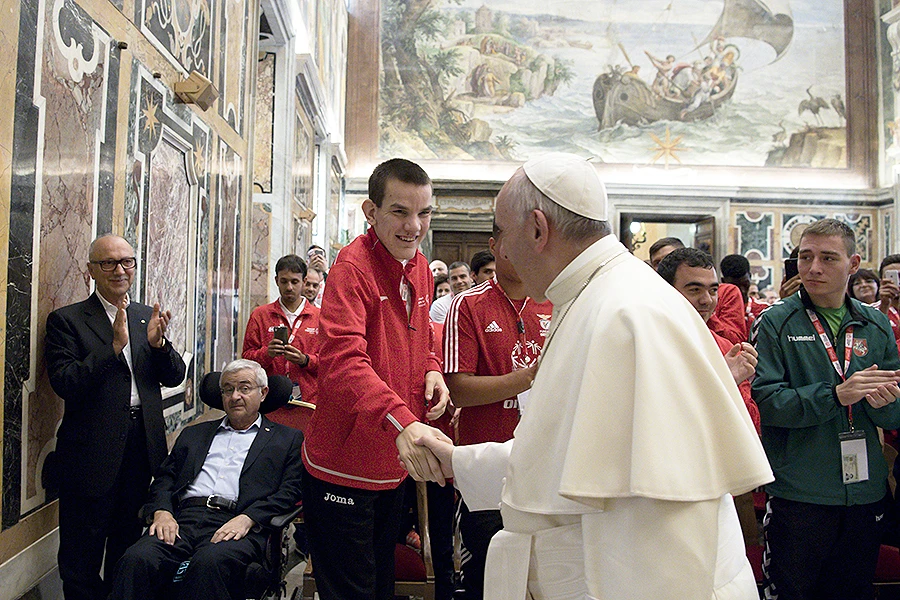
Rome, Italy, Oct 21, 2017 / 02:01 am (CNA).- The Church must learn “how to encounter disabled people today, how to allow them to have an encounter with Christ in the silence of their own interior and in the signs that indicate his presence in brothers; how to foster their commitment to witness and to be protagonists in the community as catechists, and therefore believers who transmit the faith, living it and teaching it,” Archbishop Rino Fisichella said Friday.
“God directs his word to everyone, no one excluded,” the archbishop said Oct. 20. “He finds ways in which to speak to the people who derive from the multiformity of his being,” while addressing the misperception that intellectually disabled people cannot understand the Catholic faith.
God communicates through the dynamics of “support, inclusion and integration,” he said, adding that “a person can be blind, but hear; can be deaf, but perceive; can be unable to reflect, but grasp the intimacy of the strength of presence.”
Archbishop Fisichella, President of the Pontifical Council for the Promotion of the New Evangelization, offered these remarks in a keynote speech on the opening night of a Vatican-sponsored conference dedicated to catechesis for those with intellectual disabilities.
The conference, titled “Catechesis and Persons with Disabilities: A Necessary Engagement in the Daily Pastoral Life of the Church,” is taking place Oct. 20-22 at the Pontifical Urbanianum University in Rome.
Over 420 people who work in catechesis are registered for the conference, and come from professions and countries all over the world.
In addition to Fisichella, other speakers include Baroness Sheila Hollins of the Pontifical Commission for the Protection of Minors, and representatives from dioceses around the world, who will present methods for the catechesis of disabled people. Disabled people participating will lead moments of prayer throughout the gathering.
Participants will also have an audience with Pope Francis during the event, demonstrating the Pope's keen interest in the topic.
In his speech, Fisichella said addressing the topic of disability within the Christian community is “urgent” because of the social and cultural stigmas that people with disabilities often face today.
Recounting several examples of situations when people with disabilities have been discriminated against, he noted that in 2015 an elderly parent who was beaten for taking a reserved parking spot when buying medicine for his son, who was having an epileptic emergency.
He also pointed to how in August of this year a disabled teenage girl was raped in the Italian town of Piacenza, and her attacker immediately set free. Another example was how, earlier this month in Naples, seven couples who had made adoption requests refused the offer of a child with Downs Syndrome.
“The bullying and arrogance of the stronger” can always happen to anyone, Fisichella said, but noted that it's also always true “that when this happens to a person who is disabled, and therefore weak and defenseless, then the disdain and the complaint” must be more forceful.
Fisichella reflected on the way that God relates to man, saying it is the Lord from the beginning who chose to speak and reveal himself to man. Revelation, and the response of faith, begins with “the act of love from which comes God’s decision to reveal himself and the purpose of calling one to share in his own life,” he said.
There are different stages of revelation, he said, noting that each one “is marked by the love of God.”
“It's a love that reaches the heart of every person, meeting them in their interior, where the perception of a presence that gives meaning to life is best expressed,” he said.
Faith, he said, is “a personal act which testifies to having encountered God who made himself known.”
Faith “is never far from love,” Fisichella said, explaining that love itself “generates faith and sustains it with the strength of hope.”
“Love comes from God and returns to God,” he said, and “this completely transforms man, because it renders him capable of relating to himself and others with a love he receives as a gift and which he himself cannot produce.”
Fisichella said that “one can think of catechesis as a desire to stay for a long time in order to grow in knowledge of the Lord Jesus,” adding that the heart of catechesis is “to make the life of the believer a path where through the knowledge of what is believed we enter into the mystery by celebrating it with the prayer of the entire people of God.”
To fully understand this, it's necessary that “it be made easier to understand the impact that catechesis can have on people with disabilities,” he said.
Ultimately, the goal of catechesis is “to make it so that God seizes everyone, whatever state they are in, because the primacy lies with him,” Fisichella said, stressing that God “finds the most adequate means to communicate his life of love and to make the love he invests in a person felt.”
The archbishop pointed to music, song and art, which all bespeak love, he said, allowing those who experience them to understand God in a different way, he said. So “no one is excluded from the Word that God speaks, with which he makes himself known to each one.”
He then spoke of the need to promote the “culture of encounter” that Pope Francis speaks of so often, with a special emphasis on friendship, brotherhood and solidarity.
We must learn to take the initiative on this, the archbishop said, explaining that a true culture of encounter “does not stop at a few hurried moments, and in the form of formalities.”
“Rather, it feels the duty to 'entertain' itself with people, of giving one's own time without the hurry that prevents them from entering into depth (of) the encounter with the richness of experience acquired and with the charisms which are offered to each person, no one excluded, for the growth of the entire community.”
“A culture of encounter, then, is to welcome the mystery of the brother in order to understand better the mystery of his own existence,” Fisichella said, adding that this “culture” must also be a place where “the dimension of the Church, a community that lives communion, becomes the criteria of judgement and testimony of our presence in today's world”
Our responsibility, then, “is to transmit the faith in a living way, and not to create obstacles, so that it reaches everyone, above all those who are preferred by the Lord.”
Previous Post

October 20, 2017
Defining our values: What Catholics can take from Bush's speech
Next Post
October 21, 2017 Pope slams 'eugenic' mentality that seeks to eliminate disability
Browse Our Archives
Select a Category Americas Asia - Pacific Europe Middle East - Africa Uncategorized US Vatican
Select a Month November 2017 October 2017 September 2017 August 2017 July 2017 June 2017 May 2017 April 2017 March 2017 February 2017 January 2017 December 2016 November 2016 October 2016 September 2016 August 2016 July 2016 June 2016 May 2016 April 2016 March 2016 February 2016 January 2016 December 2015 November 2015 October 2015 September 2015 August 2015 July 2015 June 2015 May 2015 April 2015 March 2015 February 2015 January 2015 December 2014 November 2014 October 2014 September 2014 August 2014 July 2014 June 2014 May 2014 April 2014 March 2014 February 2014 January 2014 December 2013 November 2013 October 2013 September 2013 August 2013 July 2013 June 2013 May 2013 April 2013 March 2013 February 2013 January 2013 December 2012 November 2012 October 2012 September 2012 August 2012 July 2012 June 2012 May 2012
TAKE THE
Religious Wisdom Quiz
What does the Bible say about greed?
Select your answer to see how you score.
It leads to ruin It helps you win It is best It is always wise
Related posts from Catholic News

Sixty Vincentians martyred during Spanish Civil War to...

Filipinos gather in Rome to promote bishop's beatification...

UK bishop calls for prayers as MPs urge...

On All Souls' Day, Pope Francis prays for...
TRENDING AT PATHEOS Catholic

Rejecting Doom: Christian Hope And Human Action
Christianity is a religion of hope. We are to have hope and...

It’s What Comes From Within Which Matters
One of the most difficult things for us to understand is why...

Why I Choose the Eucharist Over the Sermon
Choose the Eucharist, Not the Sermon What are we supposed to get...

5 Design Elements Found in Spiritually Rooted Homes
Putting Spirituality Into Home Decor Our homes are more than our living...

Credo: A Story of God Told with the...
About 10 years ago, I began to imagine a personal "Credo" that...

The Anatomy of Divine Revelation in Catholic Thought
The claim that God has made Himself known to human beings is...
view all Catholic blogs
Ad-Free & Subscriber Log-In Subscription Support
- About Us
- 2026 Calendar
- Videos
- Podcasts
- Library of World Religions
- Faith In Media Tracker
- Advertise With Us
- Write for Us
- Privacy Policy
- Terms of Service
- Do Not Sell My Data
- Contact Us
- Radiant Digital
- Manage Newsletter Subscriptions
- Unsubscribe From Notifications
- Sitemap
Copyright 2008-2026, Patheos. All rights reserved.
Subscription Support Ad-Free & Subscriber Log-In
Follow Patheos