
BuddhistCatholicContemplativeEvangelicalGeneral ChristianHinduJewishLatter-day SaintMuslimNew VisionsProgressive Christian
Beliefs
- Buddhist
- Catholic
- Contemplative
- Evangelical
- General Christian
- Hindu
- Jewish
- Latter-day Saint
- More Voices
- Muslim
- New Visions
- Pagan
- Progressive Christian
Topics
- Religion News
- Food and Religion
- Sports and Religion
- Religious Art
- Religious Music and Entertainment
- Religious Events
- History and Religion
- Style and Religion
- Politics and Religion
- Women in Religion
- Recreation Outdoors and Religion
- Business Finance and Religion
- Careers Workplace and Religion
- Education and Religion
- Family Parenting and Religion
- Health Fitness and Religion
- Home and Religion
- Relationships and Religion
- Technology and Religion
- Travel and Religion
Columnists
- Buddhist Columnists
- Business Finance and Religion Columnists
- Careers Workplace and Religion Columnists
- Catholic Columnists
- Contemplative Columnists
- Education and Religion Columnists
- Evangelists Columnists
- Family Parenting and Religion Columnists
- General Christian Columnists
- Health Fitness and Religion Columnists
- Hindu Columnists
- History and Religion Columnists
- Home and Religion Columnists
- Jewish Columnists
- More Voices Columnists
- Latter Day Columnists
- Muslim Columnists
- New Visions Columnists
- Nonreligious Columnists
- Pagan Columnists
- Politics and Religion Columnists
- Progressive Columnists
- Recreation Outdoors and Religion Columnists
- Relationships and Religion Columnists
- Religion News Columnists
- Religious Art Columnists
- Religious Events Columnists
- Religious Music and Entertainment Columnists
- Sports and Religion Columnists
- Style and Religion Columnists
- Technology and Religion Columnists
- Travel and Religion Columnists
- Women in Religion Columnists
Resource Library
- 2026 Calendar
- Library of World Religions
- The 100 Most Holy Places on Earth
- Patheos Answers
- Podcasts
- Videos
- Faith Leaders Database
- Anglican Episcopalian
- Bahai
- Baptist
- Buddhism
- Christianity
- Confucianism
- Eastern Orthodoxy
- Hinduism
- Holiness and Pentecostal
- ISKCON
- Islam
- Judaism
- Lutheran
- Methodist
- The Church of Jesus Christ of Latter-day Saints
- New Age
- Paganism
- Presbytarian and Reformed
- Protestantism
- Religion Behind the Scenes
- Roman Catholic
- Scientology
- Shia Islam
- Sikhism
- Sufism
- Sunni Islam
- Taoism
- Zen
- See all religions
Research Tools
 Ad-Free & Subscriber Log-In Subscription Support
Ad-Free & Subscriber Log-In Subscription Support
Follow Patheos 

- Trending:
- Forgiveness
- |
- Marriage
- |
- Consciousness
- |
- Death Penalty
- |
- Election
- |
- Halloween
 Catholic News
- Home
- Catholic
- Religion News
- Who was St Peter Claver, whose tomb the Pope will visit this week?
Who was St Peter Claver, whose tomb the Pope will visit this week?
Last updated on: September 7, 2017 at 12:01 pm by CNA Daily News
Who was St Peter Claver, whose tomb the Pope will visit this week? 2017-09-07T12:01:00+00:00 CNA Daily News
Patheos Explore the world's faith through different perspectives on religion and spirituality! Patheos has the views of the prevalent religions and spiritualities of the world.
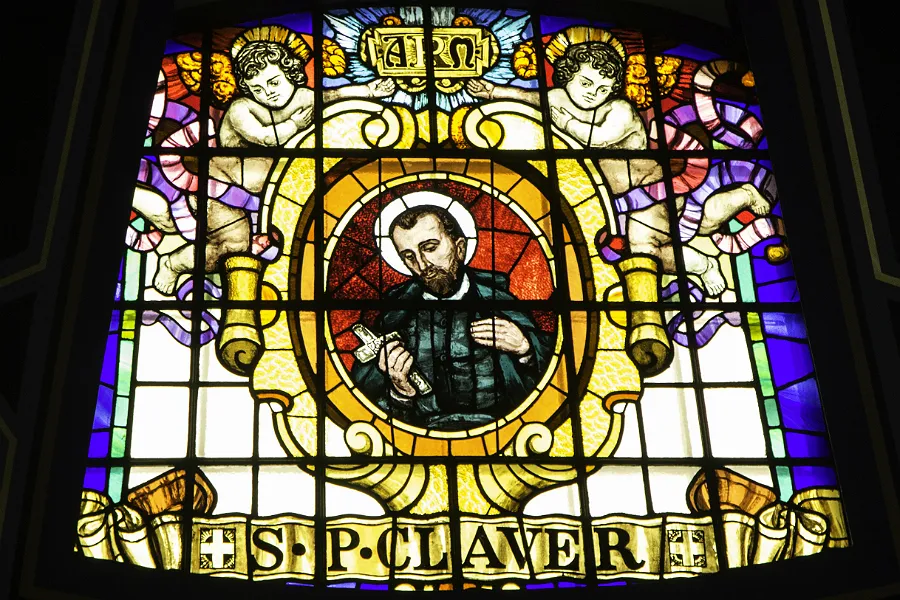
Cartagena, Colombia, Sep 7, 2017 / 06:01 am (CNA/EWTN News).- During his trip to Colombia, Pope Francis will visit Sept. 10 the home and shrine of St. Peter Claver, a Spanish missionary priest and fellow Jesuit who is the patron saint of Colombia.
While there, Pope Francis will pray the Angelus and give his typical weekly address, as well as venerate the saint’s tomb and bless a homeless shelter.
Because both men are Jesuits who have advocated for social justice and for the poor and marginalized, many suspect that this visit will be personally significant to the Pope as well as meaningful for Colombia.
Peter Claver was born in 1581 to a devout farming family in the Catalonia region of Spain.
He attended the University of Barcelona as a young man before joining the Jesuits at the age of 20.
During his studies as a novice, Peter met and developed a friendship with Alphonsus Rodriguez, an older lay Jesuit brother who performed menial work but was renowned for his holiness and insight. Eventually Rodriguez told Peter that he felt God was calling Peter to the colonies of New Spain in the Americas. Leo XIII would later canonize both men on the same day, almost two centuries later.
Taking the advice of Rodriguez, Peter volunteered for the new colonies, and arrived in Cartagena, a port city in present-day Colombia, in 1610. He continued his studies there and was ordained a priest in Cartagena in 1615.
By that time, the African slave trade had already been in place for several decades in the Americas, for which Cartagena was a major hub. While there, Peter witnessed the cruelty with which the slaves were treated firsthand.
Moved by their suffering, Peter resolved to work to bring both bodily and spiritual aid to the slaves, vowing to be “the slave of the slaves forever.” Despite his own health problems and the language barrier between himself and the constantly-arriving slaves, Peter threw himself into this vocation with great vigor.
As soon as a slave ship would enter the port, Peter would meet it in the harbor and board the ship to care for the terrified and poorly treated passengers on board, who had made the journey from Africa in diseased and cramped conditions over the course of several months. His first priority was to tend to the sick, and to baptize those in immediate danger of death.
He would also travel the countryside from plantation to plantation, visiting the slaves and tending to both their physical and spiritual needs.
“We must speak to them with our hands,” he once said, “before we try to speak to them with our lips.”
When it came to catechesis, because of the language barrier, Peter often used pictorial representations of the truths and biblical stories he was teaching.
True to his vow of being a slave for the slaves, Peter allowed himself minimal amounts of food and sleep. His holiness led to several miraculous occurrences even while he was still alive – such as instances when he healed the sick with the touch of his cloak, or appeared surrounded by a supernatural light during his hospital visits.
Some Spanish royal officials took notice and were impressed by Peter’s work, making their own contributions toward the relief and religious education of slaves. Others found his work bothersome, and many Spanish expatriates in the New World refused to enter the same church or confessional as the slaves Peter Claver was serving.
After suffering from poor health for some years, Peter was struck with a severe fever and died Sept. 8, 1654. He had baptized and taught the faith to more than 300,000 slaves during his forty years in Colombia.
St. Peter Claver was canonized in 1888 by Leo XIII, along with Alphonsus Rodriguez. He is the patron saint of Colombia, slaves, missionary work to Africans, and seafarers.
The feast day of St. Peter Claver is Sept. 9, which was also declared by Colombia as a National Day of Human Rights in his honor.
The legacy of St. Peter Claver is strong in the United States as well, where in the early 20th century the Knights of Peter Claver were founded in his honor in Mobile, Alabama.
The group was founded in 1909 as a Catholic fraternal society for men of color at a time when racism in some parts of the South prevented them from joining the Knights of Columbus, another Catholic fraternity.
The Knights of Peter Claver were founded with the goals of supporting various parish, diocesan and community objectives, including serving the poor, creating Catholic community and forming youth. They have worked alongside the National Urban League and the National Association for the Advancement of Colored People for the advancement of civil rights.
The Knights eventually opened auxiliary and junior divisions for women and for young people, and membership is open to people of all races and ethnicities. It is the largest historically African-American Catholic lay organization in the United States.
The body of St. Peter Claver is kept and venerated in the shrine of St. Peter Claver in Cartagena, which Pope Francis will visit on Sunday Sept. 10, one day after the saint’s feast day.
At the shrine, Pope Francis will pray the usual Angelus prayer followed by an address, and he will also venerate the tomb of St. Peter Claver.
While the overall theme of the Pope’s trip to Colombia is focused on peace and reconciliation, the visit to St. Peter Claver’s shrine could be an opportunity for the Pope to talk about modern-day slavery such as human trafficking, issues of race, care for the poor and reaching people on the peripheries of the Church.

Browse Our Archives
Select a Category Americas Asia - Pacific Europe Middle East - Africa Uncategorized US Vatican
Select a Month November 2017 October 2017 September 2017 August 2017 July 2017 June 2017 May 2017 April 2017 March 2017 February 2017 January 2017 December 2016 November 2016 October 2016 September 2016 August 2016 July 2016 June 2016 May 2016 April 2016 March 2016 February 2016 January 2016 December 2015 November 2015 October 2015 September 2015 August 2015 July 2015 June 2015 May 2015 April 2015 March 2015 February 2015 January 2015 December 2014 November 2014 October 2014 September 2014 August 2014 July 2014 June 2014 May 2014 April 2014 March 2014 February 2014 January 2014 December 2013 November 2013 October 2013 September 2013 August 2013 July 2013 June 2013 May 2013 April 2013 March 2013 February 2013 January 2013 December 2012 November 2012 October 2012 September 2012 August 2012 July 2012 June 2012 May 2012
TAKE THE
Religious Wisdom Quiz
Which prophet stood watch on a rampart to hear from God?
Select your answer to see how you score.
Amos Ezekiel Joel Habakkuk
Related posts from Catholic News

Venezuela's hate crime law seeks to silence political...

Canadian doctors face questions over assisted suicide, euthanasia...

Caritas Venezuela warns that 280,000 children could die...

Bishop appointed for Canada's Chaldean eparchy
TRENDING AT PATHEOS Catholic

Rejecting Doom: Christian Hope And Human Action
Christianity is a religion of hope. We are to have hope and...

It’s What Comes From Within Which Matters
One of the most difficult things for us to understand is why...

Why I Choose the Eucharist Over the Sermon
Choose the Eucharist, Not the Sermon What are we supposed to get...

5 Design Elements Found in Spiritually Rooted Homes
Putting Spirituality Into Home Decor Our homes are more than our living...

Credo: A Story of God Told with the...
About 10 years ago, I began to imagine a personal "Credo" that...

The Anatomy of Divine Revelation in Catholic Thought
The claim that God has made Himself known to human beings is...
view all Catholic blogs
Ad-Free & Subscriber Log-In Subscription Support
- About Us
- 2026 Calendar
- Videos
- Podcasts
- Library of World Religions
- Faith In Media Tracker
- Advertise With Us
- Write for Us
- Privacy Policy
- Terms of Service
- Do Not Sell My Data
- Contact Us
- Radiant Digital
- Manage Newsletter Subscriptions
- Unsubscribe From Notifications
- Sitemap
Copyright 2008-2026, Patheos. All rights reserved.
Subscription Support Ad-Free & Subscriber Log-In
Follow Patheos