
BuddhistCatholicContemplativeEvangelicalGeneral ChristianHinduJewishLatter-day SaintMuslimNew VisionsProgressive Christian
Beliefs
- Buddhist
- Catholic
- Contemplative
- Evangelical
- General Christian
- Hindu
- Jewish
- Latter-day Saint
- More Voices
- Muslim
- New Visions
- Pagan
- Progressive Christian
Topics
- Religion News
- Food and Religion
- Sports and Religion
- Religious Art
- Religious Music and Entertainment
- Religious Events
- History and Religion
- Style and Religion
- Politics and Religion
- Women in Religion
- Recreation Outdoors and Religion
- Business Finance and Religion
- Careers Workplace and Religion
- Education and Religion
- Family Parenting and Religion
- Health Fitness and Religion
- Home and Religion
- Relationships and Religion
- Technology and Religion
- Travel and Religion
Columnists
- Buddhist Columnists
- Business Finance and Religion Columnists
- Careers Workplace and Religion Columnists
- Catholic Columnists
- Contemplative Columnists
- Education and Religion Columnists
- Evangelists Columnists
- Family Parenting and Religion Columnists
- General Christian Columnists
- Health Fitness and Religion Columnists
- Hindu Columnists
- History and Religion Columnists
- Home and Religion Columnists
- Jewish Columnists
- More Voices Columnists
- Latter Day Columnists
- Muslim Columnists
- New Visions Columnists
- Nonreligious Columnists
- Pagan Columnists
- Politics and Religion Columnists
- Progressive Columnists
- Recreation Outdoors and Religion Columnists
- Relationships and Religion Columnists
- Religion News Columnists
- Religious Art Columnists
- Religious Events Columnists
- Religious Music and Entertainment Columnists
- Sports and Religion Columnists
- Style and Religion Columnists
- Technology and Religion Columnists
- Travel and Religion Columnists
- Women in Religion Columnists
Resource Library
- 2026 Calendar
- Library of World Religions
- The 100 Most Holy Places on Earth
- Patheos Answers
- Podcasts
- Videos
- Faith Leaders Database
- Anglican Episcopalian
- Bahai
- Baptist
- Buddhism
- Christianity
- Confucianism
- Eastern Orthodoxy
- Hinduism
- Holiness and Pentecostal
- ISKCON
- Islam
- Judaism
- Lutheran
- Methodist
- The Church of Jesus Christ of Latter-day Saints
- New Age
- Paganism
- Presbytarian and Reformed
- Protestantism
- Religion Behind the Scenes
- Roman Catholic
- Scientology
- Shia Islam
- Sikhism
- Sufism
- Sunni Islam
- Taoism
- Zen
- See all religions
Research Tools
 Ad-Free & Subscriber Log-In Subscription Support
Ad-Free & Subscriber Log-In Subscription Support
Follow Patheos 

- Trending:
- Forgiveness
- |
- Marriage
- |
- Consciousness
- |
- Death Penalty
- |
- Election
- |
- Halloween
 Catholic News
- Home
- Catholic
- Religion News
- What it’s like to gather relics of Fr. Stanley Rother
What it’s like to gather relics of Fr. Stanley Rother
Last updated on: September 20, 2017 at 9:23 am by CNA Daily News
What it’s like to gather relics of Fr. Stanley Rother 2017-09-20T09:23:00+00:00 CNA Daily News
Patheos Explore the world's faith through different perspectives on religion and spirituality! Patheos has the views of the prevalent religions and spiritualities of the world.
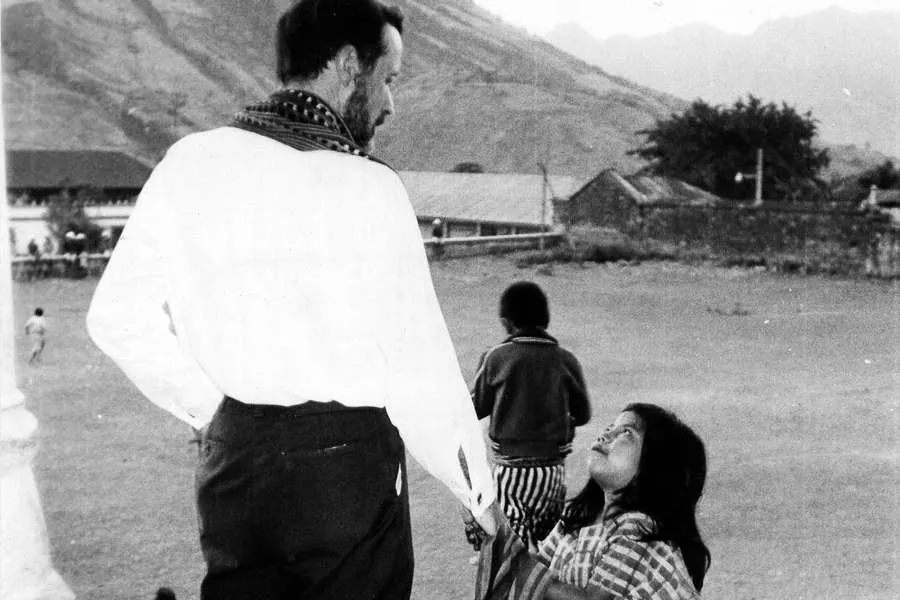
Oklahoma City, Okla., Sep 20, 2017 / 03:23 am (CNA/EWTN News).- When Fr. Stanley Rother, a missionary priest from Okarche, Oklahoma, was killed by rebels in Guatemala, his body was transferred back to the United States to be buried by his family.
But his heart remained in Guatemala.
Literally.
The native Guatemalans loved their pastor so much that they enshrined his heart at the mission parish in Santiago Atitlan.
On Sept. 23, that heart will go from being a disembodied remain to a first-class relic, a sacred artifact of someone who has been beatified by the Catholic Church.
The keeping and venerating of relics is perhaps one of the more bizarre Catholic practices, but it’s a scripturally-backed practice of the Church since its beginning.
There are three classes of relics recognized by the Church. First-class relics are bodily remains of a saint, such as bones or flesh or hair. Second-class relics are belongings of the saint, such as clothes or other personal items. Third-class relics are items that have been touched to a first- or second-class relic of that saint.
When Archbishop Paul Coakley was installed as head of the Oklahoma City Archdiocese in 2011, he inherited the task of the cause of canonization for Fr. Stanley Rother. As part of this undertaking, he also inherited the task of his gathering relics, a process that officially commenced once it was clear that the martyred priest’s beatification was imminent.
The second-class relics were easy. Over the years, the archdiocese had collected a handful of personal items of Fr. Stanley, donated by friends and family, including some of his clothes, and a pipe that he smoked. Once he is beatified, these things become second-class relics.
But when it came to exhuming the body to collect first-class relics, Archbishop Coakley admits he was a little lost.
“We had to do a lot of research,” the archbishop told CNA. “This happens so rarely, we didn’t know how to go about preparing for this.”
First, he obtained permission and rights to Fr. Stanley Rother’s remains from the priest’s two surviving siblings.
Then, according to Vatican protocol, he gathered the proscribed team of witnesses and medical experts who would help with the canonical exhumation and examination of Fr. Stanley’s body.
The medical team consisted of a pathologist and an orthopedic surgeon, both local Catholics. They helped examine and describe the remains, and compile a report sent to the Holy See. Among other things, the Church looks for signs of incorruptibility, when a body does not decompose. The condition has been found among some saints, although by itself, it is not enough to prove sanctity.
“They had expertise that would be helpful in describing what would be found when his tomb was opened, because we didn’t know what we could find,” Archbishop Coakley said.
Both the exhumation and examination are done “with great dignity and reverence, and there is a process by which we exhumed his body from the family plot at the parish cemetery in Okarche,” the archbishop added.
“And in that process we took one of his ribs, and that’s what we used for preparing first class relics,” he said.
His body was then transferred to a temporary resting place in Resurrection Cemetery, a Catholic cemetery next to the pastoral center in Oklahoma City, while his rib was sent to Rome.
“There is an Augustinian monastery of St. Lucia in Rome, and they are custodians of relics and have experience in preparing relics, so we sent our relic of Fr. Rother to them,” Archbishop Coakley said.
The sisters there will divide the rib into many tiny fragments, which will be encased in reliquaries, available to bishops who wish to obtain relics of Fr. Rother for public veneration. First-class relics are no longer distributed to lay persons, in order to protect the relics from negligence or abuse.
Meanwhile, the task of preparing the third-class relics (sometimes referred to as “touched relics”) of Fr. Stanley fell to the Carmelite Monastery of Rochester, New York, a congregation of 11 discalced, cloistered Carmelite nuns.
Mother Therese, the prioress of the convent, told CNA that while the sisters had done smaller “touched relic” projects for Carmelite saints, this was the first major relic project the convent has undertaken.
“A sister from Oklahoma City mentioned to me that the archdiocese was looking for someone to put together relic cards for Fr. Stanley’s beatification,” she said. “I said, ‘Well we’ve not done this on a huge scale but we are familiar with this process’…so that’s how it came about, a simple question from one of our Carmelite nuns.”
Often, third-class relics distributed at beatifications come in the form of a little piece of cloth embedded in a holy card.
“When the body was exhumed, the bones were wrapped in a very large and special cloth,” Mother Therese said.
This cloth was signed and dated by Archbishop Coakley during the exhumation in May and then sent to the nuns, who are punching small holes in the holy cards of Fr. Stanley and affixing the pieces of cloth – which will become relics once Fr. Stanley is beatified – to the cards.
The holy cards also have a picture of Fr. Stanley on the front, and a prayer for his canonization on the back – some in English and some in Spanish. The sisters have already made 10,000 and are expecting to make several thousand more.
“It’s a very great privilege for us,” Mother Therese said. “It has brought us very close to Fr. Stanley…we feel that he will intercede for us and that he will bless our community and the Church in the U.S. as well, because he’s the first American-born martyr.”
Archbishop Coakley said working on Father Stanley’s cause has been an honor, especially as someone who graduated from the same seminary as Fr. Stanley (though years later) and has been interested in his story for quite some time.
“I took that as a great privilege to be coming into the Oklahoma City Archdiocese at such a time,” he said.
“I…entrusted my ministry to him and prayed for his assistance and intercession as I undertook this ministry, I’ve felt a very near kinship with him since I was a seminarian and a priest and as the archbishop now.”
Previous Post

September 20, 2017
Catholic health care growth a benefit, not a threat, ethicist says
Next Post
September 20, 2017 Korea exhibit at Vatican shares history, peace through art
Browse Our Archives
Select a Category Americas Asia - Pacific Europe Middle East - Africa Uncategorized US Vatican
Select a Month November 2017 October 2017 September 2017 August 2017 July 2017 June 2017 May 2017 April 2017 March 2017 February 2017 January 2017 December 2016 November 2016 October 2016 September 2016 August 2016 July 2016 June 2016 May 2016 April 2016 March 2016 February 2016 January 2016 December 2015 November 2015 October 2015 September 2015 August 2015 July 2015 June 2015 May 2015 April 2015 March 2015 February 2015 January 2015 December 2014 November 2014 October 2014 September 2014 August 2014 July 2014 June 2014 May 2014 April 2014 March 2014 February 2014 January 2014 December 2013 November 2013 October 2013 September 2013 August 2013 July 2013 June 2013 May 2013 April 2013 March 2013 February 2013 January 2013 December 2012 November 2012 October 2012 September 2012 August 2012 July 2012 June 2012 May 2012
TAKE THE
Religious Wisdom Quiz
Which New Testament book quotes Psalm 110 to describe Jesus as the eternal High Priest?
Select your answer to see how you score.
Romans Hebrews Acts Revelation
Related posts from Catholic News

US bishops' new child protection program aims to...

Wealthy foundation aims to redefine religious freedom—and Christianity,...

Victims of Islamic State in focus at UN...

Catholic University of America offers free tuition to...
TRENDING AT PATHEOS Catholic

Creation, Preservation, and Teleology in Catholic Theology
As I write this, it is very early Monday morning. Like millions...

The Parable Of The Sower And The Word...
One of Christ’s most famous parables is that of the sower who...

Rejecting Doom: Christian Hope And Human Action
Christianity is a religion of hope. We are to have hope and...

Why I Choose the Eucharist Over the Sermon
Choose the Eucharist, Not the Sermon What are we supposed to get...

5 Design Elements Found in Spiritually Rooted Homes
Putting Spirituality Into Home Decor Our homes are more than our living...

Credo: A Story of God Told with the...
About 10 years ago, I began to imagine a personal "Credo" that...
view all Catholic blogs
Ad-Free & Subscriber Log-In Subscription Support
- About Us
- 2026 Calendar
- Videos
- Podcasts
- Library of World Religions
- Faith In Media Tracker
- Advertise With Us
- Write for Us
- Privacy Policy
- Terms of Service
- Do Not Sell My Data
- Contact Us
- Radiant Digital
- Manage Newsletter Subscriptions
- Unsubscribe From Notifications
- Sitemap
Copyright 2008-2026, Patheos. All rights reserved.
Subscription Support Ad-Free & Subscriber Log-In
Follow Patheos