
BuddhistCatholicContemplativeEvangelicalGeneral ChristianHinduJewishLatter-day SaintMuslimNew VisionsProgressive Christian
Beliefs
- Buddhist
- Catholic
- Contemplative
- Evangelical
- General Christian
- Hindu
- Jewish
- Latter-day Saint
- More Voices
- Muslim
- New Visions
- Pagan
- Progressive Christian
Topics
- Religion News
- Food and Religion
- Sports and Religion
- Religious Art
- Religious Music and Entertainment
- Religious Events
- History and Religion
- Style and Religion
- Politics and Religion
- Women in Religion
- Recreation Outdoors and Religion
- Business Finance and Religion
- Careers Workplace and Religion
- Education and Religion
- Family Parenting and Religion
- Health Fitness and Religion
- Home and Religion
- Relationships and Religion
- Technology and Religion
- Travel and Religion
Columnists
- Buddhist Columnists
- Business Finance and Religion Columnists
- Careers Workplace and Religion Columnists
- Catholic Columnists
- Contemplative Columnists
- Education and Religion Columnists
- Evangelists Columnists
- Family Parenting and Religion Columnists
- General Christian Columnists
- Health Fitness and Religion Columnists
- Hindu Columnists
- History and Religion Columnists
- Home and Religion Columnists
- Jewish Columnists
- More Voices Columnists
- Latter Day Columnists
- Muslim Columnists
- New Visions Columnists
- Nonreligious Columnists
- Pagan Columnists
- Politics and Religion Columnists
- Progressive Columnists
- Recreation Outdoors and Religion Columnists
- Relationships and Religion Columnists
- Religion News Columnists
- Religious Art Columnists
- Religious Events Columnists
- Religious Music and Entertainment Columnists
- Sports and Religion Columnists
- Style and Religion Columnists
- Technology and Religion Columnists
- Travel and Religion Columnists
- Women in Religion Columnists
Resource Library
- 2026 Calendar
- Library of World Religions
- The 100 Most Holy Places on Earth
- Patheos Answers
- Podcasts
- Videos
- Faith Leaders Database
- Anglican Episcopalian
- Bahai
- Baptist
- Buddhism
- Christianity
- Confucianism
- Eastern Orthodoxy
- Hinduism
- Holiness and Pentecostal
- ISKCON
- Islam
- Judaism
- Lutheran
- Methodist
- The Church of Jesus Christ of Latter-day Saints
- New Age
- Paganism
- Presbytarian and Reformed
- Protestantism
- Religion Behind the Scenes
- Roman Catholic
- Scientology
- Shia Islam
- Sikhism
- Sufism
- Sunni Islam
- Taoism
- Zen
- See all religions
Research Tools
 Ad-Free & Subscriber Log-In Subscription Support
Ad-Free & Subscriber Log-In Subscription Support
Follow Patheos 

- Trending:
- Forgiveness
- |
- Marriage
- |
- Consciousness
- |
- Death Penalty
- |
- Election
- |
- Halloween
 Catholic News
- Home
- Catholic
- Religion News
- Vocations that only seek to ‘climb the ladder’ are dead, Pope says
Vocations that only seek to ‘climb the ladder’ are dead, Pope says
Last updated on: September 9, 2017 at 10:05 pm by CNA Daily News
Vocations that only seek to ‘climb the ladder’ are dead, Pope says 2017-09-09T22:05:00+00:00 CNA Daily News
Patheos Explore the world's faith through different perspectives on religion and spirituality! Patheos has the views of the prevalent religions and spiritualities of the world.
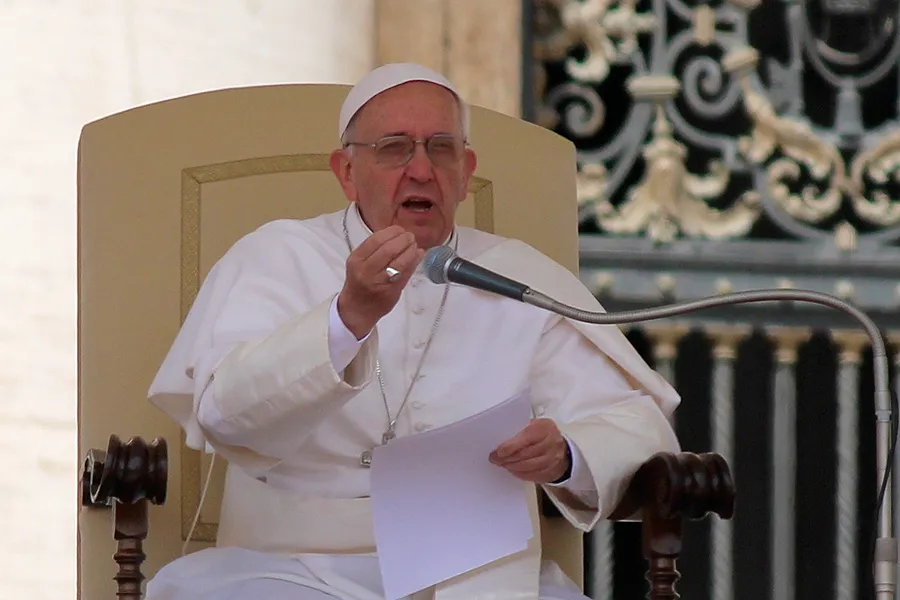
Medellin, Colombia, Sep 9, 2017 / 04:05 pm (CNA/EWTN News).- On Saturday, Pope Francis told Colombia's priests and religious that vocations come from a variety of different backgrounds and flourish with joyful service, but die as soon as they become infected by greed or selfish interests.
“We are a people chosen for the truth, and our call has to be in truth,” the Pope said Sept. 9. “There can be no place for deceit, hypocrisy or small-mindedness if we are branches of this vine, if our vocation is grafted onto Jesus.”
Every consecrated person must be careful to ensure that they bear fruit, he said, explaining that from the start, those who accompany the vocational process must “encourage a right intention, a genuine desire to be configured to Jesus.”
“When these processes are not nourished by this true sap that is the Spirit of Jesus, then we experience dryness and God learns with sadness that these branches are already dead,” he said.
Sadly, consecrated vocations “die when they love to be sustained with honors, when they are driven by a search for personal reassurance and social advancement, when the motivation is 'to climb the ladder,' to cleave to material interests and to strive shamefully for financial gain,” he said.
As he has done frequently in the past, the Pope said the devil “enters through the wallet.” And this doesn't just apply to the early stages of the vocation, but “all of us have to be careful because the corrupting of men and women in the Church begins in this way.”
Pope Francis spoke to priests, religious, seminarians and their families in the Macarena Stadium in Medellin, Colombia.
Largely undertaken as an encouragement of the country's peace process, the Sept. 6-11 visit includes stops in four cities. Francis has already traveled to Bogota, Villavicencio and Medellin, and will go to Cartagena tomorrow on his last official day in the country.
At times throughout his speech, Pope Francis departed from his prepared remarks, delving into the crisis of commitment among young people, discussing the importance of vulnerability, and emphasizing that our lives are what make the Gospel credible to our non-believing friends and neighbors.
Before speaking, the Pope listened to the testimonies of Sr. Leidy de San Jose, a contemplative Carmelite nun; Maria Isabel Arboleda Perez, whose son is a priest; and Fr. Juan Felipe Escobar, priest for the Archdiocese of Medellin.
In his speech, Francis directly addressed the young people present, saying most of them likely first discovered Jesus in communities “with a contagious apostolic zeal, which inspire and attract others.”
“Where there is life, zeal, the desire to take Christ to others, genuine vocations arise,” he said, noting that despite the current crisis of commitment in relationships, many youth “stand together against the evils of the world” through both political and volunteer work.
And when they do this for Jesus with the understanding that they are a part of the community, they become “street preachers,” and are able “to bring Jesus Christ to every street, every town square and every corner of the earth.”
Pope Francis pointed to the importance of recognizing the “complex relational realities” and varied situations out of which vocations arise.
“It would be almost unrealistic to think that all of you heard the call of God in the midst of families sustained by a strong love and full of values such as generosity, compromise, fidelity and patience,” he said.
While there are some vocations that arise from these situations, “and I pray to God that they are many,” the Pope said, keeping our feet “firmly planted on the ground” means recognizing that our vocational calling brings us closer to the “thread of suffering and bloodshed” that runs throughout the Bible, and which “Colombia knows so well.”
This thread can be seen in Cain's murder of Abel, in the violence in the family of David, the problems within Tobias' family and the lamentations of Job, Francis said, explaining that from the beginning we see how God shows his closeness when he “changes the course of events to call men and women in the frailty of their personal and shared history.”
“Let us not be afraid, in that complex land, for God always brings about the miracle of producing good clusters on the vine,” he said, and prayed that there would be vocations in every community and family of Medellín.
The vine of Christ is true, and truth is essential to the religious call, the Pope continued.
“The poison of lies, obfuscation, manipulation and the abuse of the People of God, the weak and especially the elderly and young, can have no place in our communities,” he said. “They are branches that are determined to dry us out and that God tells us to cut off.”
Francis then noted that God doesn't just cut away the dead branches, but, as the Gospel passage says, he also “purifies the vine of its imperfections.”
“The promise is that we will bear fruit, and abundantly, just like the grain of wheat, if we are able to give ourselves, to offer our lives freely,” he said, and pointed to Colombian saints such as St. Laura Montoya and Bl. Mariano de Jesus Euse Hoyos as examples.
Asking those present how it is that God purifies us of the things that “lead to death and which take hold of our lives and distort his call,” the Pope said the answer is by “inviting us to dwell in him.”
To dwell, he said, “does not only signify being, but rather also indicates maintaining a relationship that is alive, existential and absolutely necessary; it means to live and grow in an intimate and fruitful union with Jesus.”
This “dwelling” cannot be a merely passive act or simple abandonment without having any consequences in our daily lives, he continued, and offered the religious three ways to make their “dwelling in the Lord” effective.
The first is to touch Christ's humanity, Francis said, which means to look with “the gaze and attitude of Jesus, who contemplates reality not as a judge, but rather as a Good Samaritan; who recognizes the value of the people who walk with him, as well as their wounds and sins.”
It means to imitate Jesus, who looks at people and “discovers their silent suffering and who is moved by peoples’ needs, above all when they are overwhelmed by injustice, inhumane poverty, indifference or by the perverse actions of corruption and violence.”
It also entails embracing Jesus' words and gestures, “which express love for those nearby and search for those far away,” while being both tender and firm in rejecting sin and announcing the Gospel.
The second means of dwelling in the Lord is contemplating Christ's divinity, which requires “awakening and sustaining” studies that increase our knowledge of God, Pope Francis said, adding that priority ought to be given to reading Sacred Scripture.
“Whoever does not know the Scriptures, does not know Jesus. Whoever does not love the Scriptures, does not love Jesus,” he said, and prayed that studying would “help us to interpret reality with the eyes of God, that it may not be a way of avoiding what is happening to our people, nor be subject to the whim of fashions or ideologies.”
“May our study not be overcome by nostalgia or the tendency to confine the mystery, nor may it be unwilling to respond to questions that people no longer ask themselves, and may it not abandon those who find themselves in an existential void and who question us from their worlds and cultures,” he said.
Prayer is also an essential to this contemplation, he said, since it forms a “fundamental part of our lives and apostolic service.”
Time spent in prayer “frees us from the burden of worldliness, and teaches us to live joyfully, to distance ourselves from what is superficial, in an exercise of true freedom,” he said. It also frees us from self-centeredness and from “being reclusive in an empty religious experience.”
Contemplating God also requires that we are “reconciled in order to reconcile,” Francis said, explaining that to be called “does not give us a certificate of right conduct and sinlessness; we are not clothed in an aura of holiness.”
Rather, “we are all sinners and we need forgiveness and God’s mercy to rise each day. He uproots whatever is not good in us, as well as the wrong we have done, casting it out of the vineyard to be burned up. He cleanses us so that we may bear fruit.”
Finally, the Pope said we have to dwell in God in order to live fully, because “if we remain in him, his joy will be in us. We will not be sad disciples and bitter apostles.”
On the contrary, “we will reflect and be heralds of true happiness, a complete joy that no one can take away. We will spread the hope of a new life that Christ has given to us.”
God’s call, the Pope said, is not “a heavy burden that robs us of joy,” but rather, he wants us to live “a spirituality that brings joy to our lives and even to our weariness.”
“Our contagious joy must be our first testimony to the closeness and love of God,” he said, adding that Colombia itself has received the gaze of the Lord and is thus a sign of his “loving election.”
Francis closed his speech saying “it is now up to us to offer all our love and service while being united to Jesus, our vine. To be the promise of a new beginning for Colombia, that leaves behind the floods of discord and violence, a Colombia that wants to bear abundant fruits of justice and peace, of encounter and solidarity.”
Previous Post

September 9, 2017
The suffering of children wounds the heart, Pope Francis says
Next Post
September 10, 2017 Vatican: Pope Francis 'is fine' after hitting face on popemobile
Browse Our Archives
Select a Category Americas Asia - Pacific Europe Middle East - Africa Uncategorized US Vatican
Select a Month November 2017 October 2017 September 2017 August 2017 July 2017 June 2017 May 2017 April 2017 March 2017 February 2017 January 2017 December 2016 November 2016 October 2016 September 2016 August 2016 July 2016 June 2016 May 2016 April 2016 March 2016 February 2016 January 2016 December 2015 November 2015 October 2015 September 2015 August 2015 July 2015 June 2015 May 2015 April 2015 March 2015 February 2015 January 2015 December 2014 November 2014 October 2014 September 2014 August 2014 July 2014 June 2014 May 2014 April 2014 March 2014 February 2014 January 2014 December 2013 November 2013 October 2013 September 2013 August 2013 July 2013 June 2013 May 2013 April 2013 March 2013 February 2013 January 2013 December 2012 November 2012 October 2012 September 2012 August 2012 July 2012 June 2012 May 2012
TAKE THE
Religious Wisdom Quiz
Who said, "My God, my God, why have you forsaken me?"
Select your answer to see how you score.
David Jesus Isaiah Job
Related posts from Catholic News

Venezuela's hate crime law seeks to silence political...

Canadian doctors face questions over assisted suicide, euthanasia...

Caritas Venezuela warns that 280,000 children could die...

Bishop appointed for Canada's Chaldean eparchy
TRENDING AT PATHEOS Catholic

Rejecting Doom: Christian Hope And Human Action
Christianity is a religion of hope. We are to have hope and...

It’s What Comes From Within Which Matters
One of the most difficult things for us to understand is why...

Why I Choose the Eucharist Over the Sermon
Choose the Eucharist, Not the Sermon What are we supposed to get...

5 Design Elements Found in Spiritually Rooted Homes
Putting Spirituality Into Home Decor Our homes are more than our living...

Credo: A Story of God Told with the...
About 10 years ago, I began to imagine a personal "Credo" that...

The Anatomy of Divine Revelation in Catholic Thought
The claim that God has made Himself known to human beings is...
view all Catholic blogs
Ad-Free & Subscriber Log-In Subscription Support
- About Us
- 2026 Calendar
- Videos
- Podcasts
- Library of World Religions
- Faith In Media Tracker
- Advertise With Us
- Write for Us
- Privacy Policy
- Terms of Service
- Do Not Sell My Data
- Contact Us
- Radiant Digital
- Manage Newsletter Subscriptions
- Unsubscribe From Notifications
- Sitemap
Copyright 2008-2026, Patheos. All rights reserved.
Subscription Support Ad-Free & Subscriber Log-In
Follow Patheos