
BuddhistCatholicContemplativeEvangelicalGeneral ChristianHinduJewishLatter-day SaintMuslimNew VisionsProgressive Christian
Beliefs
- Buddhist
- Catholic
- Contemplative
- Evangelical
- General Christian
- Hindu
- Jewish
- Latter-day Saint
- More Voices
- Muslim
- New Visions
- Pagan
- Progressive Christian
Topics
- Religion News
- Food and Religion
- Sports and Religion
- Religious Art
- Religious Music and Entertainment
- Religious Events
- History and Religion
- Style and Religion
- Politics and Religion
- Women in Religion
- Recreation Outdoors and Religion
- Business Finance and Religion
- Careers Workplace and Religion
- Education and Religion
- Family Parenting and Religion
- Health Fitness and Religion
- Home and Religion
- Relationships and Religion
- Technology and Religion
- Travel and Religion
Columnists
- Buddhist Columnists
- Business Finance and Religion Columnists
- Careers Workplace and Religion Columnists
- Catholic Columnists
- Contemplative Columnists
- Education and Religion Columnists
- Evangelists Columnists
- Family Parenting and Religion Columnists
- General Christian Columnists
- Health Fitness and Religion Columnists
- Hindu Columnists
- History and Religion Columnists
- Home and Religion Columnists
- Jewish Columnists
- More Voices Columnists
- Latter Day Columnists
- Muslim Columnists
- New Visions Columnists
- Nonreligious Columnists
- Pagan Columnists
- Politics and Religion Columnists
- Progressive Columnists
- Recreation Outdoors and Religion Columnists
- Relationships and Religion Columnists
- Religion News Columnists
- Religious Art Columnists
- Religious Events Columnists
- Religious Music and Entertainment Columnists
- Sports and Religion Columnists
- Style and Religion Columnists
- Technology and Religion Columnists
- Travel and Religion Columnists
- Women in Religion Columnists
Resource Library
- 2026 Calendar
- Library of World Religions
- The 100 Most Holy Places on Earth
- Patheos Answers
- Podcasts
- Videos
- Faith Leaders Database
- Anglican Episcopalian
- Bahai
- Baptist
- Buddhism
- Christianity
- Confucianism
- Eastern Orthodoxy
- Hinduism
- Holiness and Pentecostal
- ISKCON
- Islam
- Judaism
- Lutheran
- Methodist
- The Church of Jesus Christ of Latter-day Saints
- New Age
- Paganism
- Presbytarian and Reformed
- Protestantism
- Religion Behind the Scenes
- Roman Catholic
- Scientology
- Shia Islam
- Sikhism
- Sufism
- Sunni Islam
- Taoism
- Zen
- See all religions
Research Tools
 Ad-Free & Subscriber Log-In Subscription Support
Ad-Free & Subscriber Log-In Subscription Support
Follow Patheos 

- Trending:
- Forgiveness
- |
- Marriage
- |
- Consciousness
- |
- Death Penalty
- |
- Election
- |
- Halloween
 Catholic News
- Home
- Catholic
- Religion News
- True peace hinges on the people, not bureaucracy, Pope says
True peace hinges on the people, not bureaucracy, Pope says
Last updated on: September 11, 2017 at 12:00 am by CNA Daily News
True peace hinges on the people, not bureaucracy, Pope says 2017-09-11T00:00:00+00:00 CNA Daily News
Patheos Explore the world's faith through different perspectives on religion and spirituality! Patheos has the views of the prevalent religions and spiritualities of the world.
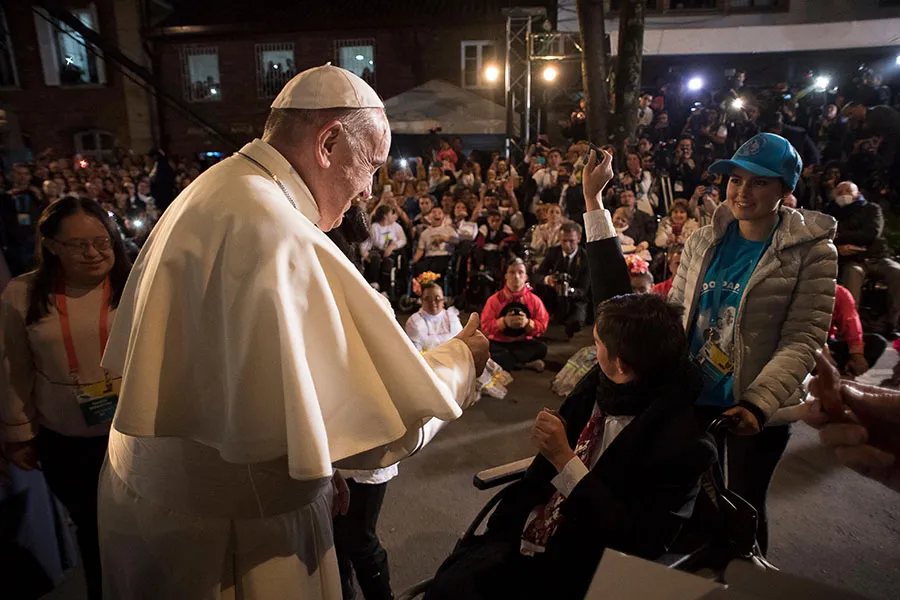
Cartagena, Colombia, Sep 10, 2017 / 06:00 pm (CNA/EWTN News).- On his last day in Colombia, Pope Francis said the peace process shouldn't be reduced to bureaucratic talks between two parties, but must above all focus on and involve the people, who themselves must take steps toward reconciliation, rather than revenge.
“We have learned that these ways of making peace, of placing reason above revenge, of the delicate harmony between politics and law, cannot ignore the involvement of the people,” the Pope said Sept. 10.
“Peace is not achieved by normative frameworks and institutional arrangements between well-intentioned political or economic groups,” he said. Rather, “Jesus finds the solution to the harm inflicted through a personal encounter between the parties.”
It's also necessary that any peace processes draw on the experience “of those sectors that have often been overlooked, so that communities themselves can influence the development of collective memory.”
“The principal author, the historic subject of this process, is the people as a whole and their culture, and not a single class, minority, group or elite,” he said. While Colombia has sought peace for decades, two sides meeting for dialogue “is not enough; it has also been necessary to involve many more actors in this dialogue aimed at healing sins.”
“We do not need plans drawn up by a few for the few, or an enlightened or outspoken minority which claims to speak for everyone. It is about agreeing to live together, a social and cultural pact.”
Pope Francis offered his reflections during Mass at the port of Contecar in Cartagena on the last day of his Sept. 6-11 visit to Colombia. Prior to celebrating the liturgy, he blessed and laid the cornerstones for a homeless shelter and prayed the Angelus at the Shrine of Jesuit priest St. Peter Claver y Corberó.
In his homily, the Pope began by noting that Cartagena has for the past 32 years been known as a champion of human rights, and was called “heroic” for it's role in fighting to maintain independence in the early 1800s.
On the human rights front, Francis quoted the 1985 Congress of Colombia praising the role of Jesuit priests Peter Claver, Alonso de Sandoval and Br. Nicolás González, who in the 7th century sought to “alleviate the situation of the oppressed of that time, especially of slaves, of those who implored fair treatment and freedom.”
With this backdrop, the day's Gospel reading from Matthew, which recounts the parable of the Good Shepherd who leaves the 99 to find the one lost sheep, offers timely and relevant insights into forgiveness, correction, community and prayer, he said.
“This fact pervades the entire text: there is no one too lost to deserve our care, our closeness and our forgiveness,” the Pope said, adding that from this perspective, “we can see that a fault or a sin committed by one person challenges us all, but involves, primarily, the victim of someone’s sin.”
“He or she is called to take the initiative so that whoever has caused the harm is not lost,” he said, recalling the many testimonies he heard throughout the visit from people who suffered “irreparable losses,”but who, despite their own suffering, were able to reach out and “take the first step” on a path other than violence or revenge.
Francis said peace above all begins with the people, and the path to reintegration into the community “begins with a dialogue of two persons.”
“Nothing can replace that healing encounter; no collective process excuses us from the challenge of meeting, clarifying, forgiving,” he said, explaining that the deep, historic wounds the country has suffered “necessarily require moments where justice is done.”
This means giving victims the opportunity to know the truth, ensuring that damages are adequately repaired and making clear and firm commitments to not repeat the same crimes in the future.
However, the Pope said this is “only the beginning” of the Christian response. Followers of Christ, he said, must generate a change in culture “from below,” so that we “respond to the culture of death and violence, with the culture of life and encounter.”
Francis then questioned those present on both how hard they have worked for peace, and, on the contrary, how much they have neglected in the process, “allowing barbarity to become enfleshed in the life of our people.”
“How many times have we 'normalized' the logic of violence and social exclusion, without prophetically raising our hands or voices!” he said, noting that there were thousands of Christians around during the time of St. Peter Claver, including many who were consecrated, “but only a handful started a counter-cultural movement of encounter.”
St. Peter Claver didn't have “prestigious academic qualifications, and he even said of himself that he was mediocre in terms of intelligence,” the Pope observed. “But he had the genius to live the Gospel to the full, to meet those whom others considered merely as waste material.”
In the process of encountering others, we discover our rights and rebuild our lives so they can reemerge as “authentically human,” he said, and urged all men and women to defend the sacredness “of every human life, of every man and every woman, the poor, the elderly, children, the infirm, the unborn, the unemployed, the abandoned, those considered disposable because they are only considered as part of a statistic.”
However, when looking to the Gospel, Jesus shows us that some choose to stay closed, continuing to do evil.
“We cannot deny that there are people who persist in sins that damage the fabric of our coexistence and community,” he said, and pointed to the “heartbreaking drama” of drugs, the destruction of nature due to pollution, the exploitation of labor and money laundering and human trafficking.
The Pope went off-the-cuff briefly to emphasize the evil of trafficking.
"This evil is a direct attack against the dignity of the human person and progressively breaks the image that the creator infused in us," he said. "I firmly condemn this scourge which has put an end to so many lives and which is sustained by unscrupulous men.
"You cannot play with the life of a human being, nor manipulate their dignity. I make a call to find ways to end drug trafficking, which sows death everywhere, truncating so many hopes and dreams and destroys so many families."
Returning to his script, Pope Francis then spoke about prostitution, “which ever day reaps innocent victims, especially the young, robbing them of their future,” and condemned the crimes and abuses against minors, as well as the “frequently overlooked” plight of migrants, “who are often victims of disgraceful and illegal manipulation.”
Society must be prepared for this, “and solidly base ourselves upon principles of justice that in no way diminish charity,” the Pope said, adding that “it is only possible to live peacefully by avoiding actions that corrupt or harm life.”
Finally, Pope Francis said Jesus asks everyone to pray together for peace, so that this prayer, “even with its personal nuances and different emphases, becomes symphonic and arises as one single cry.”
“I am sure that today we pray together for the rescue of those who were wrong and not for their destruction, for justice and not revenge, for healing in truth and not for oblivion,” he said, and, pointing to the theme of the trip “let us take the first step,” voiced hope that “this first step be in a common direction.”
The Pope closed his speech saying that if Colombia wants a stable and lasting peace, “ it must urgently take a step in this direction, which is that of the common good, of equity, of justice, of respect for human nature and its demands.”
“Only if we help to untie the knots of violence, will we unravel the complex threads of disagreements,” he said, and urged the people to go out and meet others, taking the risk of making a correction “that does not want to expel but to integrate.”
“We are asked to be charitably firm in that which is not negotiable,” the Pope said, adding that the Lord “is able to untie that which seems impossible to us, and he has promised to accompany us to the end of time, and will bring to fruition all our efforts.”
After Mass, Pope Francis gave a final greeting to the people before heading to the airport to return to Rome.
He said the final word he wanted to leave them with is to “not be content with 'taking the first step,'” but to instead “continue our journey anew each day, going forth to encounter others and to encourage concord and fraternity.”
“We cannot just stand still,” he said, and pointed to the example of St. Peter Claver, who died in Cartagena after 40 years of tireless work on behalf of the poor, as an example.
“He did not stand still: his first step was followed by many others. His example draws us out of ourselves to encounter our neighbors,” Francis said, telling Colombians that “your brothers and sisters need you. Go out to meet them. Bring them the embrace of peace, free of all violence.”
Next Post

September 11, 2017 Pope hopes Trump will 'rethink' DACA decision on pro-life grounds
Browse Our Archives
Select a Category Americas Asia - Pacific Europe Middle East - Africa Uncategorized US Vatican
Select a Month November 2017 October 2017 September 2017 August 2017 July 2017 June 2017 May 2017 April 2017 March 2017 February 2017 January 2017 December 2016 November 2016 October 2016 September 2016 August 2016 July 2016 June 2016 May 2016 April 2016 March 2016 February 2016 January 2016 December 2015 November 2015 October 2015 September 2015 August 2015 July 2015 June 2015 May 2015 April 2015 March 2015 February 2015 January 2015 December 2014 November 2014 October 2014 September 2014 August 2014 July 2014 June 2014 May 2014 April 2014 March 2014 February 2014 January 2014 December 2013 November 2013 October 2013 September 2013 August 2013 July 2013 June 2013 May 2013 April 2013 March 2013 February 2013 January 2013 December 2012 November 2012 October 2012 September 2012 August 2012 July 2012 June 2012 May 2012
TAKE THE
Religious Wisdom Quiz
In what city was Paul shipwrecked?
Select your answer to see how you score.
Cyprus Rhodes Crete Malta
Related posts from Catholic News

Venezuela's hate crime law seeks to silence political...

Canadian doctors face questions over assisted suicide, euthanasia...

Caritas Venezuela warns that 280,000 children could die...

Bishop appointed for Canada's Chaldean eparchy
TRENDING AT PATHEOS Catholic

Rejecting Doom: Christian Hope And Human Action
Christianity is a religion of hope. We are to have hope and...

It’s What Comes From Within Which Matters
One of the most difficult things for us to understand is why...

Why I Choose the Eucharist Over the Sermon
Choose the Eucharist, Not the Sermon What are we supposed to get...

5 Design Elements Found in Spiritually Rooted Homes
Putting Spirituality Into Home Decor Our homes are more than our living...

Credo: A Story of God Told with the...
About 10 years ago, I began to imagine a personal "Credo" that...

The Anatomy of Divine Revelation in Catholic Thought
The claim that God has made Himself known to human beings is...
view all Catholic blogs
Ad-Free & Subscriber Log-In Subscription Support
- About Us
- 2026 Calendar
- Videos
- Podcasts
- Library of World Religions
- Faith In Media Tracker
- Advertise With Us
- Write for Us
- Privacy Policy
- Terms of Service
- Do Not Sell My Data
- Contact Us
- Radiant Digital
- Manage Newsletter Subscriptions
- Unsubscribe From Notifications
- Sitemap
Copyright 2008-2026, Patheos. All rights reserved.
Subscription Support Ad-Free & Subscriber Log-In
Follow Patheos