
BuddhistCatholicContemplativeEvangelicalGeneral ChristianHinduJewishLatter-day SaintMuslimNew VisionsProgressive Christian
Beliefs
- Buddhist
- Catholic
- Contemplative
- Evangelical
- General Christian
- Hindu
- Jewish
- Latter-day Saint
- More Voices
- Muslim
- New Visions
- Pagan
- Progressive Christian
Topics
- Religion News
- Food and Religion
- Sports and Religion
- Religious Art
- Religious Music and Entertainment
- Religious Events
- History and Religion
- Style and Religion
- Politics and Religion
- Women in Religion
- Recreation Outdoors and Religion
- Business Finance and Religion
- Careers Workplace and Religion
- Education and Religion
- Family Parenting and Religion
- Health Fitness and Religion
- Home and Religion
- Relationships and Religion
- Technology and Religion
- Travel and Religion
Columnists
- Buddhist Columnists
- Business Finance and Religion Columnists
- Careers Workplace and Religion Columnists
- Catholic Columnists
- Contemplative Columnists
- Education and Religion Columnists
- Evangelists Columnists
- Family Parenting and Religion Columnists
- General Christian Columnists
- Health Fitness and Religion Columnists
- Hindu Columnists
- History and Religion Columnists
- Home and Religion Columnists
- Jewish Columnists
- More Voices Columnists
- Latter Day Columnists
- Muslim Columnists
- New Visions Columnists
- Nonreligious Columnists
- Pagan Columnists
- Politics and Religion Columnists
- Progressive Columnists
- Recreation Outdoors and Religion Columnists
- Relationships and Religion Columnists
- Religion News Columnists
- Religious Art Columnists
- Religious Events Columnists
- Religious Music and Entertainment Columnists
- Sports and Religion Columnists
- Style and Religion Columnists
- Technology and Religion Columnists
- Travel and Religion Columnists
- Women in Religion Columnists
Resource Library
- 2026 Calendar
- Library of World Religions
- The 100 Most Holy Places on Earth
- Patheos Answers
- Podcasts
- Videos
- Faith Leaders Database
- Anglican Episcopalian
- Bahai
- Baptist
- Buddhism
- Christianity
- Confucianism
- Eastern Orthodoxy
- Hinduism
- Holiness and Pentecostal
- ISKCON
- Islam
- Judaism
- Lutheran
- Methodist
- The Church of Jesus Christ of Latter-day Saints
- New Age
- Paganism
- Presbytarian and Reformed
- Protestantism
- Religion Behind the Scenes
- Roman Catholic
- Scientology
- Shia Islam
- Sikhism
- Sufism
- Sunni Islam
- Taoism
- Zen
- See all religions
Research Tools
 Ad-Free & Subscriber Log-In Subscription Support
Ad-Free & Subscriber Log-In Subscription Support
Follow Patheos 

- Trending:
- Forgiveness
- |
- Marriage
- |
- Consciousness
- |
- Death Penalty
- |
- Election
- |
- Halloween
 Catholic News
- Home
- Catholic
- Religion News
- The significance of Pope Francis’ speech to Latin America’s bishops
The significance of Pope Francis’ speech to Latin America’s bishops
Last updated on: September 7, 2017 at 9:09 pm by CNA Daily News
The significance of Pope Francis’ speech to Latin America’s bishops 2017-09-07T21:09:00+00:00 CNA Daily News
Patheos Explore the world's faith through different perspectives on religion and spirituality! Patheos has the views of the prevalent religions and spiritualities of the world.
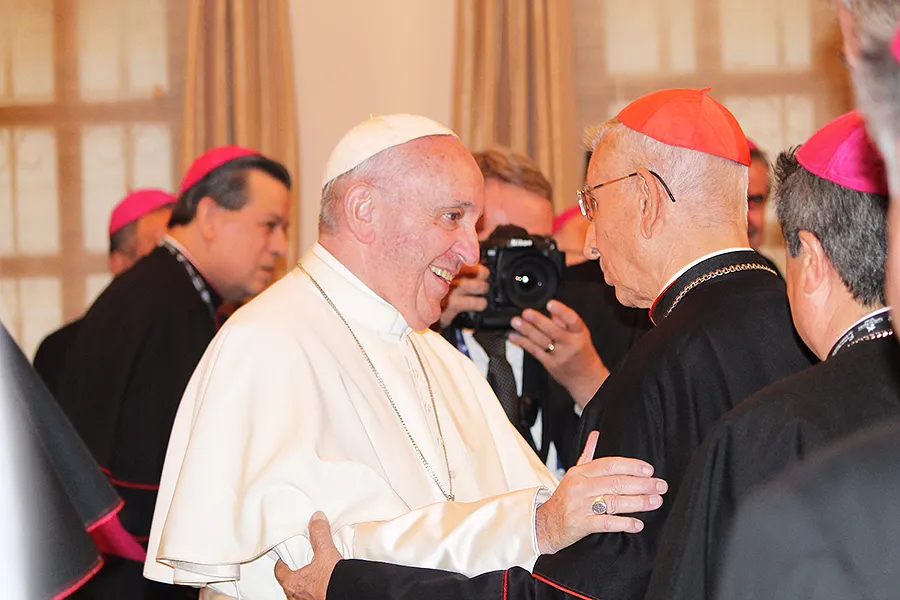
Bogotá, Colombia, Sep 7, 2017 / 03:09 pm (CNA/EWTN News).- What is likely one of the most important speeches of Pope Francis' visit to Colombia, political processes aside, and one which can offer key insights into his thinking, is his Thursday meeting with representatives of Latin America's bishops.
Francis' meeting with the continent-wide ecclesial body outlined not only vision for the Church in Latin America specifically, but his reflections also offer his key priorities for the universal Church.
In his Sept. 7 speech, the Pope said that since its foundation, the Episcopal Conferences of Latin America (CELAM) has become “a vital point of reference for the development of a deeper understanding of Latin American Catholicism.”
At the same time, he praised the entity for its efforts at becoming “a home at the service of communion and the mission of the Church in Latin America, as well as a center for fostering a sense of discipleship and missionary spirit.”
Given that he is himself Latin American, Francis obviously has strong ties to the ecclesial body, and in 2007, while Archbishop of Buenos Aires, he was charged with drafting the concluding document of their 5th General Conference in Aparecida, Brazil.
That document was taken by many as a compass of-sorts for Francis' pontificate after he was elected, and with good reason.
However, far beyond Latin America and the current Vicar of Christ, himself the first-ever South American Pope, CELAM has left a much bigger mark on the universal Church.
CELAM
The entity, which is composed of the 22 bishops' conferences of Latin America and the Caribbean, was established by Venerable Pius XII in 1955 as the first continent-wide bishops' conference.
The seven cardinals and 90 bishops who originally composed CELAM had met for their own conference during the Eucharistic Congress held in Rio de Janiero in 1955. The meeting was prompted by the Holy See itself, and Ven. Pius XII sent his own Cardinal legate, Adeodato Piazza, to attend the discussion.
One of the main reasons for the gathering was to create a new pastoral program for the region which addressed four major topics at the time: the shortage of priests, religious education, social problems, and the plight of Amerindian population.
Conclusions from the meeting were drafted and sent to Rome for approval before being published. Since then, CELAM members have met every few years to continue discussing major issues affecting the region, and theirs was a key voice on social issues during the Second Vatican Council.
However, though it was a novelty at the time, CELAM set the stage for the eventual creation of other continent-wide bishops conferences, all of which were established after Vatican II in a bid to foster greater unity and to encourage collegiality among local Churches.
Though still active, CELAM took a step back during the 1980s and '90s under St. John Paul II, who preferred a greater emphasis on bishops as shepherds of their local Church.
The last major conference CELAM held before the 2007 gathering in Aparecida was their 4th General Conference in Santo Domingo of the Dominican Republic in 1992.
However, when Benedict XVI was elected, he offered his full support and empowerment to CELAM, and personally inaugurated the 2007 gathering in Aparecida.
When asked on the flight there how Brazil had impacted his personal formation, Benedict said that while he was no expert, “I am convinced that it is here, at least in part – and a fundamental part – that the future of the Catholic Church is being decided. This has always been evident to me.”
And indeed it was during that gathering for CELAM in Aparecida that Cardinal Bergoglio would take the lead role in drafting a document that has become one of the most quoted and footnoted in his magisterial publications as Pope Francis.
Pope Francis and Aparecida
During his first international appointment as Pope, attending the 2013 World Youth Day in Rio de Janeiro, Francis made headlines for his vibrant style of communicating, his closeness to the people, and for dropping lines like the famous appeal for Argentine youth to get on the streets and “make a mess” with their love for Christ in spreading the Gospel.
But in addition to his official WYD commitments, he also met with CELAM leaders, telling them to embrace a “missionary spirit,” and referred them back to the 2007 concluding document from Aparecida, which he said launched a continent-wide mission aimed at Christ-centered service.
The document itself was a regional preview of what have become Francis' top priorities for the universal Church. Among other things, it places strong emphasis on popular religiosity and included an introduction on how to approach contemporary reality as “missionary disciples.”
It also focuses on giving thanks, and the “joy of being disciples and missionaries” of God, and places a strong emphasis on the Church's mission to evangelize.
The document is read through the lens of what it means to be a “missionary disciple” and how this should be the lens through which we read reality and its current challenges, including cultural trends and threats to the family and the environment.
Other topics mentioned that have come up frequently in Francis' pontificate are: indigenous peoples, technology, the role and dignity of women, the importance of fostering community amid the diversity of the Church's various charisms and spiritualities, interreligious dialogue, the role of the Holy Spirit, human dignity, and the need to go out of ourselves.
The document also dwells on marriage, the elderly, migrants, the poor, the need for solidarity and issues of social justice, emphasizing the Beatitudes, as Francis often does, as a road-map for how the Church's social teaching out to be lived out.
In his speech to CELAM leaders in Colombia this week, Pope Francis again referred back to the “pastoral legacy” of the 2007 Aparecida document, telling them it is “a treasure yet to be fully exploited.”
“I am certain that each of you has seen how its richness has taken root in the Churches you hold in your hearts,” he said, and outlined the signs of hope found in the region. Namely, he said hope in Latin America is found primarily in the youth, in women – who “keep patiently kindling the flame of faith” – and in the laity.
These are all issues brought up at some point in the Aparecida document, and which that have become familiar to the eyes of Vatican-watchers throughout the world.
While the Pope certainly doesn't shy away from these topics when conversing in other forums and with other demographics, he understandably feels more at home among his fellow Latin Americans, especially since he understands their reality so well.
That being said, we can expect to continue hearing the same messages from Pope Francis even from Rome. But if there's one thing we can take away from his audiences with CELAM, it's that they have played a significant role in his own life and pontificate, and will undoubtedly continue to do so. If we want to keep tabs on his vision for the universal Church, his meetings with them are a good place to start.

Browse Our Archives
Select a Category Americas Asia - Pacific Europe Middle East - Africa Uncategorized US Vatican
Select a Month November 2017 October 2017 September 2017 August 2017 July 2017 June 2017 May 2017 April 2017 March 2017 February 2017 January 2017 December 2016 November 2016 October 2016 September 2016 August 2016 July 2016 June 2016 May 2016 April 2016 March 2016 February 2016 January 2016 December 2015 November 2015 October 2015 September 2015 August 2015 July 2015 June 2015 May 2015 April 2015 March 2015 February 2015 January 2015 December 2014 November 2014 October 2014 September 2014 August 2014 July 2014 June 2014 May 2014 April 2014 March 2014 February 2014 January 2014 December 2013 November 2013 October 2013 September 2013 August 2013 July 2013 June 2013 May 2013 April 2013 March 2013 February 2013 January 2013 December 2012 November 2012 October 2012 September 2012 August 2012 July 2012 June 2012 May 2012
TAKE THE
Religious Wisdom Quiz
What Christian group traces its origins to the Azusa Street Revival?
Select your answer to see how you score.
Methodists Anglicans Lutherans Pentecostals
Related posts from Catholic News

Venezuela's hate crime law seeks to silence political...

Canadian doctors face questions over assisted suicide, euthanasia...
Caritas Venezuela warns that 280,000 children could die...

Bishop appointed for Canada's Chaldean eparchy
TRENDING AT PATHEOS Catholic

Creation, Preservation, and Teleology in Catholic Theology
As I write this, it is very early Monday morning. Like millions...

The Parable Of The Sower And The Word...
One of Christ’s most famous parables is that of the sower who...

Rejecting Doom: Christian Hope And Human Action
Christianity is a religion of hope. We are to have hope and...

Why I Choose the Eucharist Over the Sermon
Choose the Eucharist, Not the Sermon What are we supposed to get...

5 Design Elements Found in Spiritually Rooted Homes
Putting Spirituality Into Home Decor Our homes are more than our living...

Credo: A Story of God Told with the...
About 10 years ago, I began to imagine a personal "Credo" that...
view all Catholic blogs
Ad-Free & Subscriber Log-In Subscription Support
- About Us
- 2026 Calendar
- Videos
- Podcasts
- Library of World Religions
- Faith In Media Tracker
- Advertise With Us
- Write for Us
- Privacy Policy
- Terms of Service
- Do Not Sell My Data
- Contact Us
- Radiant Digital
- Manage Newsletter Subscriptions
- Unsubscribe From Notifications
- Sitemap
Copyright 2008-2026, Patheos. All rights reserved.
Subscription Support Ad-Free & Subscriber Log-In
Follow Patheos