
BuddhistCatholicContemplativeEvangelicalGeneral ChristianHinduJewishLatter-day SaintMuslimNew VisionsProgressive Christian
Beliefs
- Buddhist
- Catholic
- Contemplative
- Evangelical
- General Christian
- Hindu
- Jewish
- Latter-day Saint
- More Voices
- Muslim
- New Visions
- Pagan
- Progressive Christian
Topics
- Religion News
- Food and Religion
- Sports and Religion
- Religious Art
- Religious Music and Entertainment
- Religious Events
- History and Religion
- Style and Religion
- Politics and Religion
- Women in Religion
- Recreation Outdoors and Religion
- Business Finance and Religion
- Careers Workplace and Religion
- Education and Religion
- Family Parenting and Religion
- Health Fitness and Religion
- Home and Religion
- Relationships and Religion
- Technology and Religion
- Travel and Religion
Columnists
- Buddhist Columnists
- Business Finance and Religion Columnists
- Careers Workplace and Religion Columnists
- Catholic Columnists
- Contemplative Columnists
- Education and Religion Columnists
- Evangelists Columnists
- Family Parenting and Religion Columnists
- General Christian Columnists
- Health Fitness and Religion Columnists
- Hindu Columnists
- History and Religion Columnists
- Home and Religion Columnists
- Jewish Columnists
- More Voices Columnists
- Latter Day Columnists
- Muslim Columnists
- New Visions Columnists
- Nonreligious Columnists
- Pagan Columnists
- Politics and Religion Columnists
- Progressive Columnists
- Recreation Outdoors and Religion Columnists
- Relationships and Religion Columnists
- Religion News Columnists
- Religious Art Columnists
- Religious Events Columnists
- Religious Music and Entertainment Columnists
- Sports and Religion Columnists
- Style and Religion Columnists
- Technology and Religion Columnists
- Travel and Religion Columnists
- Women in Religion Columnists
Resource Library
- 2026 Calendar
- Library of World Religions
- The 100 Most Holy Places on Earth
- Patheos Answers
- Podcasts
- Videos
- Faith Leaders Database
- Anglican Episcopalian
- Bahai
- Baptist
- Buddhism
- Christianity
- Confucianism
- Eastern Orthodoxy
- Hinduism
- Holiness and Pentecostal
- ISKCON
- Islam
- Judaism
- Lutheran
- Methodist
- The Church of Jesus Christ of Latter-day Saints
- New Age
- Paganism
- Presbytarian and Reformed
- Protestantism
- Religion Behind the Scenes
- Roman Catholic
- Scientology
- Shia Islam
- Sikhism
- Sufism
- Sunni Islam
- Taoism
- Zen
- See all religions
Research Tools
 Ad-Free & Subscriber Log-In Subscription Support
Ad-Free & Subscriber Log-In Subscription Support
Follow Patheos 

- Trending:
- Forgiveness
- |
- Marriage
- |
- Consciousness
- |
- Death Penalty
- |
- Election
- |
- Halloween
 Catholic News
- Home
- Catholic
- Religion News
- Pope Francis: When it comes to evangelization, don’t be stuck in your ways
Pope Francis: When it comes to evangelization, don’t be stuck in your ways
Last updated on: September 14, 2017 at 6:00 pm by CNA Daily News
Pope Francis: When it comes to evangelization, don’t be stuck in your ways 2017-09-14T18:00:00+00:00 CNA Daily News
Patheos Explore the world's faith through different perspectives on religion and spirituality! Patheos has the views of the prevalent religions and spiritualities of the world.
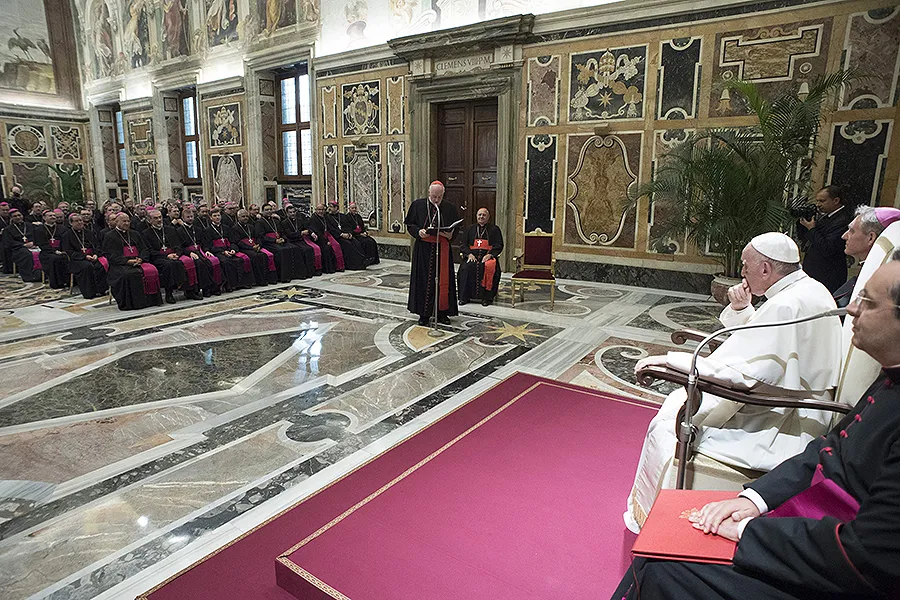
Vatican City, Sep 14, 2017 / 12:00 pm (CNA/EWTN News).- Pope Francis met with new bishops at the end of their training course at the Vatican, reminding them to be both humble in their work and open to better ways of evangelizing other than just “the way it's always been.”
“Discernment is a remedy for the immobility of 'it has always been so' or 'we take time,'” the Pope said Sept. 14.
“It's a creative process that is not limited to the application of methods. It is an antidote against rigidity, because the same solutions are not good everywhere. Do not be imprisoned by the nostalgia of having only one answer to apply in all cases.”
He continued, warning that to have an easy, one-size-fits-all answer might soothe our performance anxiety, but it threatens to make our lives “dried up.”
Pope Francis spoke in an audience with participants in the annual training course for new bishops held in Rome and organized by the Congregation of Bishops and the Congregation of Eastern Churches.
He reminded them how important it is that they have humility, especially for the work of the Holy Spirit.
“Remember that God was already present in your dioceses when you arrived and will still be there when you are gone,” he said.
“And, in the end, we will all be measured not on the accounting of our works but on the growth of God's work in the heart of the flock that we keep in the name of the 'Shepherd and keeper of our souls' (cf. 1 Pt. 2:25).”
Discernment, the Pope continued, requires humility and obedience. “Humility with regard to your own projects.”
“Obedience with regard to the Gospel, the ultimate standard; to the Magisterium, who guards it; to the norms of the universal Church, which serve it; and to the concrete situation of people,” who are looking to draw from the Church what will be most fruitful to their salvation,” he said.
In achieving this, Francis encouraged the bishops to “cultivate an attitude of listening, growing in the freedom to give up your point of view (when it is partial and inadequate), to assume that of God.”
Listening is necessary, because the bishop’s discernment is always a community action, he said, it does not disregard “the richness of the opinion of his priests and deacons, of the People of God, and of all those who can offer him a useful contribution” – even those which are more concrete than formal.
Discernment is a gift of the Spirit to our Church, the Pope noted. So although bishops may have many personal responsibilities in their job, they are also called to live their own discernment “of Pastor as a member of the People of God, or in ever-ecclesial dynamics, at the service of the koinonìa,” the Christian community.
“The bishop is not the self-sufficient ‘father’ and not even the frightened and isolated ‘Lone shepherd.’”
This is why the bishop must be aware of the great gift, the “Spiritus Principalis” entrusted to him at his ordination, the Pope said.
It is perhaps for this reason that the Church, in the episcopal consecration prayer, derived an expression from the Miserere in which the person praying, after exposing his failure, implores the Spirit to grant him immediate and spontaneous generosity in obedience to God, “so fundamental to those who lead a community.”
“Discernment, therefore, is born in the heart and mind of the bishop through his prayer when he meets people and situations entrusted to him with the Divine Word pronounced by the Spirit,” he said.
It is in the intimacy of prayer that a bishop grows his inner freedom to make good decisions, both in ecclesial and personal matters. “Only in the silence of prayer can one learn the voice of God, perceive the traces of his language, access his truth.”
He explained that bishops and leaders in the church must strive to grow in the kind of discernment which dialogues with the faithful “in a patient and courageous accompanying process.”
Then it can “mature the capacity of each – faithful, families, priests, communities, and societies – all called to advance in the freedom to choose and accomplish the good that God wants.”
Because discernment isn’t just for the wise, clear-sighted, or perfect, he said. God often shows himself to the most humble, in fact.
So true discernment, he continued, is an open and necessary process. It’s not about set formulas or repetition. “The Shepherd is called to make available to the flock the grace of the Spirit, who knows how to penetrate the folds of the real and to take account of its nuances to reveal what God wants to achieve at all times.”

Browse Our Archives
Select a Category Americas Asia - Pacific Europe Middle East - Africa Uncategorized US Vatican
Select a Month November 2017 October 2017 September 2017 August 2017 July 2017 June 2017 May 2017 April 2017 March 2017 February 2017 January 2017 December 2016 November 2016 October 2016 September 2016 August 2016 July 2016 June 2016 May 2016 April 2016 March 2016 February 2016 January 2016 December 2015 November 2015 October 2015 September 2015 August 2015 July 2015 June 2015 May 2015 April 2015 March 2015 February 2015 January 2015 December 2014 November 2014 October 2014 September 2014 August 2014 July 2014 June 2014 May 2014 April 2014 March 2014 February 2014 January 2014 December 2013 November 2013 October 2013 September 2013 August 2013 July 2013 June 2013 May 2013 April 2013 March 2013 February 2013 January 2013 December 2012 November 2012 October 2012 September 2012 August 2012 July 2012 June 2012 May 2012
TAKE THE
Religious Wisdom Quiz
Who was the last apostle to die?
Select your answer to see how you score.
Peter Paul James John
Related posts from Catholic News

How do we help trafficking victims re-enter society?...

More than just giving – World Day of...

New book reveals details of John Paul I’s...

Despite reports, Pope Francis isn’t opening the door...
TRENDING AT PATHEOS Catholic

Creation, Preservation, and Teleology in Catholic Theology
As I write this, it is very early Monday morning. Like millions...

The Parable Of The Sower And The Word...
One of Christ’s most famous parables is that of the sower who...

Rejecting Doom: Christian Hope And Human Action
Christianity is a religion of hope. We are to have hope and...

Why I Choose the Eucharist Over the Sermon
Choose the Eucharist, Not the Sermon What are we supposed to get...

5 Design Elements Found in Spiritually Rooted Homes
Putting Spirituality Into Home Decor Our homes are more than our living...

Credo: A Story of God Told with the...
About 10 years ago, I began to imagine a personal "Credo" that...
view all Catholic blogs
Ad-Free & Subscriber Log-In Subscription Support
- About Us
- 2026 Calendar
- Videos
- Podcasts
- Library of World Religions
- Faith In Media Tracker
- Advertise With Us
- Write for Us
- Privacy Policy
- Terms of Service
- Do Not Sell My Data
- Contact Us
- Radiant Digital
- Manage Newsletter Subscriptions
- Unsubscribe From Notifications
- Sitemap
Copyright 2008-2026, Patheos. All rights reserved.
Subscription Support Ad-Free & Subscriber Log-In
Follow Patheos