
BuddhistCatholicContemplativeEvangelicalGeneral ChristianHinduJewishLatter-day SaintMuslimNew VisionsProgressive Christian
Beliefs
- Buddhist
- Catholic
- Contemplative
- Evangelical
- General Christian
- Hindu
- Jewish
- Latter-day Saint
- More Voices
- Muslim
- New Visions
- Pagan
- Progressive Christian
Topics
- Religion News
- Food and Religion
- Sports and Religion
- Religious Art
- Religious Music and Entertainment
- Religious Events
- History and Religion
- Style and Religion
- Politics and Religion
- Women in Religion
- Recreation Outdoors and Religion
- Business Finance and Religion
- Careers Workplace and Religion
- Education and Religion
- Family Parenting and Religion
- Health Fitness and Religion
- Home and Religion
- Relationships and Religion
- Technology and Religion
- Travel and Religion
Columnists
- Buddhist Columnists
- Business Finance and Religion Columnists
- Careers Workplace and Religion Columnists
- Catholic Columnists
- Contemplative Columnists
- Education and Religion Columnists
- Evangelists Columnists
- Family Parenting and Religion Columnists
- General Christian Columnists
- Health Fitness and Religion Columnists
- Hindu Columnists
- History and Religion Columnists
- Home and Religion Columnists
- Jewish Columnists
- More Voices Columnists
- Latter Day Columnists
- Muslim Columnists
- New Visions Columnists
- Nonreligious Columnists
- Pagan Columnists
- Politics and Religion Columnists
- Progressive Columnists
- Recreation Outdoors and Religion Columnists
- Relationships and Religion Columnists
- Religion News Columnists
- Religious Art Columnists
- Religious Events Columnists
- Religious Music and Entertainment Columnists
- Sports and Religion Columnists
- Style and Religion Columnists
- Technology and Religion Columnists
- Travel and Religion Columnists
- Women in Religion Columnists
Resource Library
- 2026 Calendar
- Library of World Religions
- The 100 Most Holy Places on Earth
- Patheos Answers
- Podcasts
- Videos
- Faith Leaders Database
- Anglican Episcopalian
- Bahai
- Baptist
- Buddhism
- Christianity
- Confucianism
- Eastern Orthodoxy
- Hinduism
- Holiness and Pentecostal
- ISKCON
- Islam
- Judaism
- Lutheran
- Methodist
- The Church of Jesus Christ of Latter-day Saints
- New Age
- Paganism
- Presbytarian and Reformed
- Protestantism
- Religion Behind the Scenes
- Roman Catholic
- Scientology
- Shia Islam
- Sikhism
- Sufism
- Sunni Islam
- Taoism
- Zen
- See all religions
Research Tools
 Ad-Free & Subscriber Log-In Subscription Support
Ad-Free & Subscriber Log-In Subscription Support
Follow Patheos 

- Trending:
- Forgiveness
- |
- Marriage
- |
- Consciousness
- |
- Death Penalty
- |
- Election
- |
- Halloween
 Catholic News
- Home
- Catholic
- Religion News
- Pope Francis lays out his vision for Church’s mission in Latin America
Pope Francis lays out his vision for Church’s mission in Latin America
Last updated on: September 7, 2017 at 8:55 pm by CNA Daily News
Pope Francis lays out his vision for Church’s mission in Latin America 2017-09-07T20:55:00+00:00 CNA Daily News
Patheos Explore the world's faith through different perspectives on religion and spirituality! Patheos has the views of the prevalent religions and spiritualities of the world.
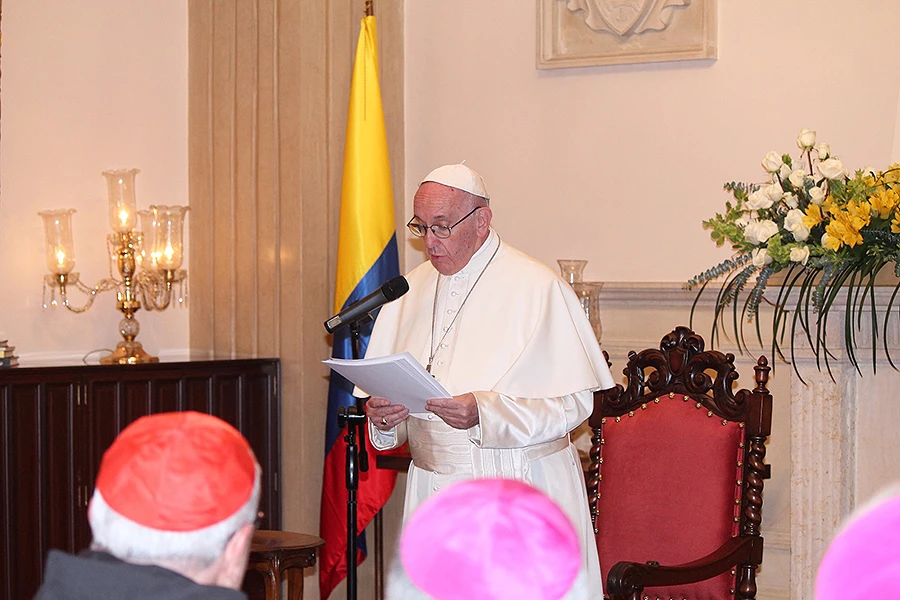
Bogotá, Colombia, Sep 7, 2017 / 02:55 pm (CNA/EWTN News).- The Catholic Church must avoid a sense of superiority and clericalism and instead teach forgiveness, reconciliation, and justice, Pope Francis said in forceful comments Thursday to a gathering of Latin American bishops.
“The Church is not present in Latin America with her suitcases in hand, ready, like so many others over time, to abandon it after having plundered it,” he said Sept. 7.
“Such people look with a sense of superiority and scorn on its mestizo face; they want to colonize its soul with the same failed and recycled visions of man and life; they repeat the same old recipes that kill the patient while lining the pockets of the doctors. They ignore the deepest concerns present in the heart of its people, the visions and the myths that give strength in spite of frequent disappointments and failures.”
He warned against those who “manipulate politics and betray hopes, leaving behind scorched land and a terrain ready for more of the same, albeit under a new guise.”
“Powerful figures and utopian dreams have promised magic solutions, instant answers, immediate effects,” he said.
The Pope spoke to the executive committee of the Latin American Episcopal Conference, known also by its Spanish acronym CELAM. He spoke at the apostolic nunciature in Bogota during his visit to Colombia.
“The Church, without human pretensions, respects the varied face of the continent, which she sees not as an impediment but rather a perennial source of wealth. She must continue working quietly to serve the true good of the men and women of Latin America,” Pope Francis said. “She must work tirelessly to build bridges, to tear down walls, to integrate diversity, to promote the culture of encounter and dialogue, to teach forgiveness and reconciliation, the sense of justice, the rejection of violence. No lasting construction in Latin America can do without this invisible, yet essential, foundation.”
“The Church appreciates like few others the deep-rooted shared wisdom that is the basis of every reality in Latin America,” the Pope continued. “She lives daily with that reserve of moral values on which the life of the continent rests.”
He advocated continued dialogue with this reality. The Church cannot lose contact with this moral foundation, this “vital humus which resides in the heart of our people.” In this soil, he said, “we see the subtle yet eloquent elements that make up its mestizo face – not merely indigenous, Hispanic, Portuguese or African, but mestizo: Latin American.”
He warned against the habitual traps this part of the world faces: a lack of focus, the squandering of the continent’s diversity, and “a constant process of disintegration.”
“To speak to this deepest soul, to speak to the most profound reality of Latin America, the Church must continually learn from Jesus. The Gospel tells us that Jesus spoke only in parables. He used images that engaged those who heard his word and made them characters in his divine stories. God’s holy and faithful people in Latin America understand no other way of speaking about him,” he said. “We are called to set out on mission not with cold and abstract concepts, but with images that keep multiplying and unfolding their power in human hearts, making them grain sown on good ground, yeast that makes the bread rise from the dough, and seed with the power to become a fruitful tree.”
The Pope warned of a “deficit of hope” in Latin America, but also pointed to Christians’ supernatural hope.
“Once you think hope is gone, it returns where you least expect it,” he said. “Our people have learned that no disappointment can crush it. It follows Christ in his meekness, even under the scourge. It knows how to rest and wait for the dawn, trusting in victory, because – deep down – it knows that it does not belong completely to this world.”
In Latin America, hope has a youthful face, he said. Some people point to young people’s alleged shortcomings and lack of motivation, and others see them as potential customers or seek to enlist them in violence and trafficking.
“Pay no attention to these caricatures of young people. Look them in the eye and seek in them the courage of hope,” Pope Francis said. “Look them in the eye and seek in them the courage of hope.”
“It is not true that they want to return to the past,” he claimed.
“It is our task us to present the young with lofty ideals and to encourage them to stake their lives on God, in imitation of the openness shown by Our Lady.”
Hope in Latin America also has a woman’s face, the Roman Pontiff reflected.
“From their lips we learned the faith, and with their milk we took on the features of our mestizo soul and our immunity to despair,” he explained. “I think of indigenous or black mothers, I think of mothers in our cities working three jobs, I think of elderly women who serve as catechists, and I think of consecrated woman and those who quietly go about doing so much good. Without women, the Church of this continent would lose its power to be continually reborn. It is women who keep patiently kindling the flame of faith.”
He stressed the grave obligation to understand, respect, appreciate, and promote women’s impact on society and the Church. He invoked the example of the women who accompanied Christ and did not abandon him at the foot of the cross.
“Please, do not let them be reduced to servants of our recalcitrant clericalism,” he said, declaring that women are on “the front lines” of the Church.
He stressed that hope must pass through the hearts, minds, and arms of the laity. He challenged a clericalism that treats the laity as children and impoverishes the identity of clerics.
Hope must also look at the world with “the eyes of the poor.”
“Hope is poor, like the grain of wheat that dies, yet has the power to disseminate God’s plans,” said the Pope.
Wealth frequently blinds us to “both the reality of the desert and the oases hidden therein,” and offers “textbook answers and repeats platitudes,” he said.
“It babbles about its own empty ideas and concerns, without even coming close to reality. I am certain that in this difficult and confused, yet provisional moment that we are experiencing, we will find the solutions to the complex problems we face in that Christian simplicity hidden to the powerful yet revealed to the lowly. The simplicity of straightforward faith in the risen Lord, the warmth of communion with him, fraternity, generosity, and the concrete solidarity that likewise wells up from our friendship with him.
The Pope stressed that God does not speak to us as if we were strangers or as if he were a solicitor delivering a personal summons, nor does he “lay down rules to be followed like certain functionaries of the sacred.”
Rather, “God speaks with the unmistakable voice of the Father to his children; he respects the mystery of man because he formed us with his own hands and gave us a meaningful purpose.”
“Our great challenge as a Church is to speak to men and women about this closeness of God, who considers us his sons and daughters, even when we reject his fatherhood,” the Pope told the bishops. “For him, we are always children to be encountered anew.”
The Gospel cannot be reduced to “a programme at the service of a trendy gnosticism, a project of social improvement, or the Church conceived as a comfortable bureaucracy, any more than she can be reduced to an organization run according to modern business models by a clerical caste.”
“The Church is the community of Jesus’ disciples. The Church is a Mystery and a People. Better yet, the Church the Mystery becomes present through God’s People,” he said.
Missionary discipleship is “a call from God for today’s busy and complicated world.” In this discipleship, the Christian is constantly setting out with Christ “in order to know how and where the Master lives.”
“Only a Church which is Bride, Mother and Servant, one that has renounced the claim to control what is not her own work but God’s, can remain with Jesus, even when the only place he can lay his head is the cross,” he said.
Closeness and encounter are the means that God uses, with the mystery of the Church being “the perennial place of this encounter.”
He told the bishops that the most essential and urgent activities are to pray and foster their relationship with the living Christ, where unity is always found: “How greatly we need to be alone with the Lord in order to encounter anew the heart of the Church’s mission … How greatly we need to be recollected, within and without! Our crowded schedules, the fragmentation of reality, the rapid pace of our lives: all these things might make us lose our focus and end up in a vacuum. Recovering unity is imperative.”
“If we do not we set out with [Christ] on our mission, we quickly become lost and risk confusing our vain needs with his cause. If our reason for setting out is not Jesus, it becomes easy to grow discouraged by the fatigue of the journey, or the resistance we meet, by constantly changing scenarios or by the weariness brought on by subtle but persistent ploys of the enemy,” he said.
Yielding to discouragement is not part of the Christian mission, and Christ “does not feed our fears.”
“The Gospel is always concrete, and never an exercise in sterile speculations. We know well the recurring temptation temptation to get lost in the byzantinism of the doctors of the law, to wonder how far we can go without losing control over our own demarcated territory or our petty portion of power.”
He stressed the importance of Christ's encounter with persons, and how he draws near to them, talks to them, touches them, and brings them healing and salvation.
“His aim in constantly setting out is to lead the people he meets to the Father,” the Pope said. “We must never stop reflecting on this. The Church has to re-appropriate the verbs that the Word of God conjugates as he carries out his divine mission. To go forth to meet without keeping a safe distance; to take rest without being idle; to touch others without fear … We cannot let ourselves be paralyzed by our air-conditioned offices, our statistics and our strategies. We have to speak to men and women in their concrete situations.”
He summed up his message by saying the bishops must serve with passion: We need to have the passion of young lovers and of wise elders, a passion that turns ideas into viable utopias, a passion for the work of our hands, a passion that makes us constant pilgrims in our Churches … My brothers, please, I ask you for passion, the passion of evangelization.”
He commended the bishops, their local Churches, and all the people of Latin America and the Caribbean to Our Lady of Guadalupe and to Our Lady of Aparecida, the patron saint of Brazil.
“I do so, in the serene certainty that God who spoke to this continent with the mestizo and black features of his Mother, will surely make his kindly light shine in the lives of all.”
Previous Post

September 7, 2017
On plane, Pope gets a gift from his 'spiritual friend' Saint Therese
Next Post
September 7, 2017 The significance of Pope Francis' speech to Latin America's bishops
Browse Our Archives
Select a Category Americas Asia - Pacific Europe Middle East - Africa Uncategorized US Vatican
Select a Month November 2017 October 2017 September 2017 August 2017 July 2017 June 2017 May 2017 April 2017 March 2017 February 2017 January 2017 December 2016 November 2016 October 2016 September 2016 August 2016 July 2016 June 2016 May 2016 April 2016 March 2016 February 2016 January 2016 December 2015 November 2015 October 2015 September 2015 August 2015 July 2015 June 2015 May 2015 April 2015 March 2015 February 2015 January 2015 December 2014 November 2014 October 2014 September 2014 August 2014 July 2014 June 2014 May 2014 April 2014 March 2014 February 2014 January 2014 December 2013 November 2013 October 2013 September 2013 August 2013 July 2013 June 2013 May 2013 April 2013 March 2013 February 2013 January 2013 December 2012 November 2012 October 2012 September 2012 August 2012 July 2012 June 2012 May 2012
TAKE THE
Religious Wisdom Quiz
Which Psalm expresses confession: "Against you, you only, have I sinned"?
Select your answer to see how you score.
Psalm 73 Psalm 24 Psalm 100 Psalm 51
Related posts from Catholic News

Venezuela's hate crime law seeks to silence political...

Canadian doctors face questions over assisted suicide, euthanasia...

Caritas Venezuela warns that 280,000 children could die...
Bishop appointed for Canada's Chaldean eparchy
TRENDING AT PATHEOS Catholic

Rejecting Doom: Christian Hope And Human Action
Christianity is a religion of hope. We are to have hope and...

It’s What Comes From Within Which Matters
One of the most difficult things for us to understand is why...

Why I Choose the Eucharist Over the Sermon
Choose the Eucharist, Not the Sermon What are we supposed to get...

5 Design Elements Found in Spiritually Rooted Homes
Putting Spirituality Into Home Decor Our homes are more than our living...

Credo: A Story of God Told with the...
About 10 years ago, I began to imagine a personal "Credo" that...

The Anatomy of Divine Revelation in Catholic Thought
The claim that God has made Himself known to human beings is...
view all Catholic blogs
Ad-Free & Subscriber Log-In Subscription Support
- About Us
- 2026 Calendar
- Videos
- Podcasts
- Library of World Religions
- Faith In Media Tracker
- Advertise With Us
- Write for Us
- Privacy Policy
- Terms of Service
- Do Not Sell My Data
- Contact Us
- Radiant Digital
- Manage Newsletter Subscriptions
- Unsubscribe From Notifications
- Sitemap
Copyright 2008-2026, Patheos. All rights reserved.
Subscription Support Ad-Free & Subscriber Log-In
Follow Patheos