
BuddhistCatholicContemplativeEvangelicalGeneral ChristianHinduJewishLatter-day SaintMuslimNew VisionsProgressive Christian
Beliefs
- Buddhist
- Catholic
- Contemplative
- Evangelical
- General Christian
- Hindu
- Jewish
- Latter-day Saint
- More Voices
- Muslim
- New Visions
- Pagan
- Progressive Christian
Topics
- Religion News
- Food and Religion
- Sports and Religion
- Religious Art
- Religious Music and Entertainment
- Religious Events
- History and Religion
- Style and Religion
- Politics and Religion
- Women in Religion
- Recreation Outdoors and Religion
- Business Finance and Religion
- Careers Workplace and Religion
- Education and Religion
- Family Parenting and Religion
- Health Fitness and Religion
- Home and Religion
- Relationships and Religion
- Technology and Religion
- Travel and Religion
Columnists
- Buddhist Columnists
- Business Finance and Religion Columnists
- Careers Workplace and Religion Columnists
- Catholic Columnists
- Contemplative Columnists
- Education and Religion Columnists
- Evangelists Columnists
- Family Parenting and Religion Columnists
- General Christian Columnists
- Health Fitness and Religion Columnists
- Hindu Columnists
- History and Religion Columnists
- Home and Religion Columnists
- Jewish Columnists
- More Voices Columnists
- Latter Day Columnists
- Muslim Columnists
- New Visions Columnists
- Nonreligious Columnists
- Pagan Columnists
- Politics and Religion Columnists
- Progressive Columnists
- Recreation Outdoors and Religion Columnists
- Relationships and Religion Columnists
- Religion News Columnists
- Religious Art Columnists
- Religious Events Columnists
- Religious Music and Entertainment Columnists
- Sports and Religion Columnists
- Style and Religion Columnists
- Technology and Religion Columnists
- Travel and Religion Columnists
- Women in Religion Columnists
Resource Library
- 2026 Calendar
- Library of World Religions
- The 100 Most Holy Places on Earth
- Patheos Answers
- Podcasts
- Videos
- Faith Leaders Database
- Anglican Episcopalian
- Bahai
- Baptist
- Buddhism
- Christianity
- Confucianism
- Eastern Orthodoxy
- Hinduism
- Holiness and Pentecostal
- ISKCON
- Islam
- Judaism
- Lutheran
- Methodist
- The Church of Jesus Christ of Latter-day Saints
- New Age
- Paganism
- Presbytarian and Reformed
- Protestantism
- Religion Behind the Scenes
- Roman Catholic
- Scientology
- Shia Islam
- Sikhism
- Sufism
- Sunni Islam
- Taoism
- Zen
- See all religions
Research Tools
 Ad-Free & Subscriber Log-In Subscription Support
Ad-Free & Subscriber Log-In Subscription Support
Follow Patheos 

- Trending:
- Forgiveness
- |
- Marriage
- |
- Consciousness
- |
- Death Penalty
- |
- Election
- |
- Halloween
 Catholic News
- Home
- Catholic
- Religion News
- Hong Kong bishop talks Church-state relations, hopes for the future
Hong Kong bishop talks Church-state relations, hopes for the future
Last updated on: September 3, 2017 at 10:08 pm by CNA Daily News
Hong Kong bishop talks Church-state relations, hopes for the future 2017-09-03T22:08:00+00:00 CNA Daily News
Patheos Explore the world's faith through different perspectives on religion and spirituality! Patheos has the views of the prevalent religions and spiritualities of the world.
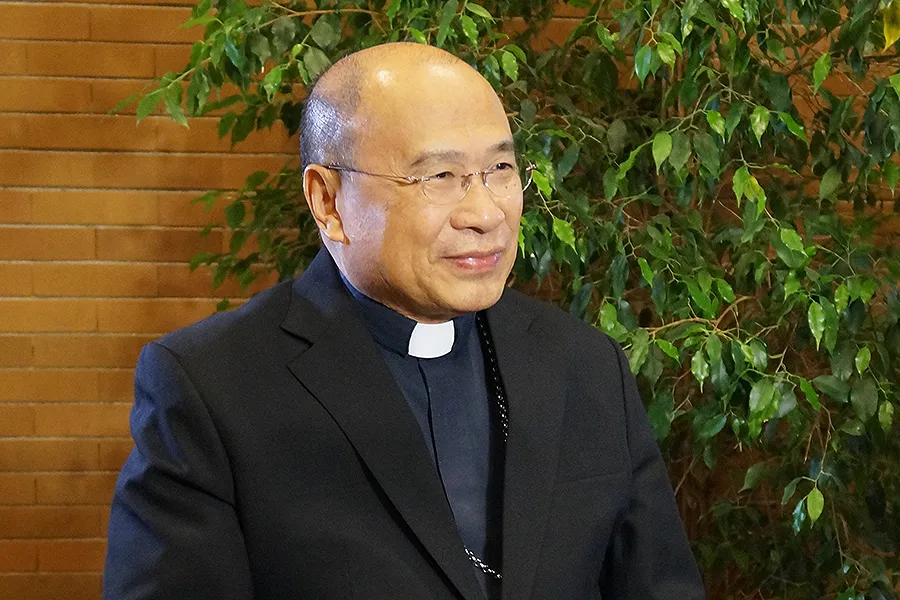
Hong Kong, China, Sep 3, 2017 / 04:08 pm (CNA).-
The challenges endured by Catholics in China are complex, said Bishop Michael Yeung Ming-cheung of Hong Kong, but there are reasons to be hopeful about the future of the Church in China.
In an interview with CNA, Bishop Yeung explained the state of religious freedom and Church-state relations in China, outlined major challenges, and stressed the importance of the Church’s work amidst the Chinese people, especially the elderly, sick, and poor.
Appointed Aug. 1 as Bishop of Hong Kong after serving briefly as coadjutor, Bishop Yeung succeeded Cardinal John Tong Hon at the helm of an influential Chinese diocese, where the Holy See has based its mission to study the situation of Catholics in mainland China.
Bishop Yeung stressed that despite political challenges, the Church in China continues to “discover the face of Jesus in the faces of the poor. There is no motivation other than serving Christ by serving the least of His brethren without excluding others from His love and embrace. This is true of the Church in China as it is anywhere else.”
The Holy See and China have no diplomatic relations, and the Chinese government has tried to control the Catholic Church in China ever since 1949, when the Chinese Communist party took control of the state. This has resulted in a progressively difficult and complex relationship over the last 70 years.
Chinese Catholic Patriotic Association
In 1957, the Chinese government established the Chinese Catholic Patriotic Association (CCPA), and required all bishops to join it. The Chinese Catholic Church split, with many bishops and priests going underground.
With time, the Holy See and the Chinese government have developed realpolitik solutions to the appointment of bishops, which the Chinese government claims the right to control. However, the Chinese government has still appointed bishops within the CCPA which are not recognized by the Holy See, and the Pope has appointed bishops which the CCPA has refused to recognize.
Talks for a possible agreement between the Holy See and the Chinese government regarding the appointment of bishops have been underway in recent years. The CCPA celebrated its 60th anniversary with no fanfare, thus raising hopes that an agreement would be finalized. In fact, though, things are at the moment stuck.
Bishop Yeung explained that “the Chinese authorities define the CCPA’s role as acting as a bridge between the Church and its own internal governance offices,” but that “it is how that role is played out in practice that can make an enormous difference.”
The bishop said that “not too much can be read” into the “lack of fanfare of the CCPA’s 60th anniversary celebration” because “the CCPA does not appear to me to be poised to write itself off.”
He explained that CCPA was created by the National Congress of Chinese Catholic Representatives (NCCCR), an organization founded to supplant the Bishops’ Conference of the Catholic Church in China (BCCCC), which was established by the Holy See.
“The very existence of these three entities, their composition and their relationships among themselves and with the Church are presumably all part of the challenges to be met in negotiations between the Holy See and Chinese administration.”
However, Bishop Yeung stressed that these are not “new challenges,” as “Pope Benedict XVI has himself identified and recognized these and various other issues in his 2007 letter to Chinese Catholics which cannot be washed away if there is going to be any sustainable ‘healing of relationships’.”
Bishop Yeung’s predecessors held strong views about the possible agreement among Chinese Church leaders: his predecessor Cardinal John Tong Hon has supported it, while the previous influential Cardinal Joseph Zen has been highly critical of the possible agreement.
Bishop Yeung recalled what the Vatican Secretary of State, Cardinal Pietro Parolin, said in a July 27 interview granted to the Italian newspaper Il Sole 24 Ore. Cardinal Parolin said that “dialogue in itself is already a positive fact,” and that the Holy See was facing it “in a spirit of healthy realism.”
“A healthy realism,” Bishop Yeung commented, “is indeed required to guard against false hopes and unrealistic expectations on the one hand and premature closing of doors to further dialogue on the other.”
The Level of Reality
He stressed that “things aren’t always what they seem to be,” and that “what is happening at the practical level of reality is often more significant than what has or has not been achieved at the formal level.”
Talking about the situation of religious freedom in mainland China, he said that “signals are often mixed and the situation varies from religion to religion, from locality to locality and from time to time.”
Bishop Yeung said that “the Chinese Constitution speaks of ‘freedom of religious belief’ and protection of ‘normal religious activities,’ but what truly matters is how governmental control is exercised…in practice.”
He noted that control is particularly important during this “sensitive time in the run-up to the 19th National Congress of the Chinese Communist Party scheduled for November.”
“I'm not too surprised that Yu Zhengsheng, one of the seven members of the Politburo Standing Committee and Chairman of the Chinese People's Political Consultative Conference (CPPCC), is reported to have, in July this year, stressed that Beijing intends to keep ‘a tight rein’ to ensure that the Chinese Catholic Church is held firmly in the hands of those who ‘love the nation and the religion,” namely Chinese communists.
Bishop Yeung explained that part of the strategy of the State Administration for Religious Affairs (SARA) “was to reinforce its regulation of religious affairs and control over religions, minorities and any potential source of social disruption.”
Increased regulatory restrictions require registration of all religious workers – including Catholic priests, both official and unofficial, through the CCPA – and certification of all religious sites.
Bishop Yeung recalled that “President Xi Jinping himself insisted in April last year, when addressing a National Conference on Religious Work, that religious groups must adhere to the leadership of the Party (with him as its helm), support the socialist system and socialism with Chinese characteristics, retain the principle of ‘religious independence’ and ‘self-administration’ and that there must be ‘Chinazation of Religion’.”
The Chinese government, Bishop Yeung said, “has since at least last year increasingly pushed for what it calls the ‘five transformations,’ namely localizing religion, standardizing management, indigenizing theology (by contextualizing doctrine), showing financial transparency and adapting Christian teachings so as to mold them into institutions that reflect the objectives of the Communist Party.”
One of the official reasons why the Chinese government set up the CCPA was because they required all priests to be “patriotic” and to be connected to the Chinese administration.
Bishop Yeung reflected on the Chinese government’s seeming reluctance to accept that Catholic bishops are not inherently unpatriotic, and that the faithful can be good Catholics as well as good citizens and patriots.
“Chinese authorities appear to have different definitions of ‘patriotism’ for different purposes at different times,” he said. “The Chinese communist party seeks to bar party members from becoming Christians but it is perfectly content to appoint the Honorable Carrie Lam, a Catholic, who is not a member of the party, as Chief Executive of the Hong Kong governmental administration. No one suggests that she cannot love the country and love Hong Kong because of her religion.”
“Indeed,” Bishop Yeung explained, “our religion teaches us, among other things, to love God and neighbor, to have civic responsibility, to respect authority (at the same time insisting that authority is a form of service to be responsibly exercised), to be compassionate, to serve the poor and the sick and all those in need – and to love the country, people and planet. Indeed, you can't be a good Catholic without truly striving to be a good person and a good citizen. That holds true for bishops as it is for any ordinary lay person”.
Serving the Poor
From the very first homily after his installation, Bishop Yeung talked about serving the poor, the sick and the needy, because, in his words, “the well-being of society requires the fostering of genuine ecology and unceasing efforts to bring about integral human development.”
Speaking about the challenges the Church faces in its ministry as “Church of the poor and for the poor,” Bishop Yeung said that “the Chinese government has generally encouraged the religious sector to participate more in social and charitable services.”
Bishop Yeung explained that in 2012, several government bureaus issued a policy document called Opinions Concerning the Encouragement and Regulation of Social Services Conducted by the Religious Sector to create a legal framework for such services, and that “by that time, thanks to Deng's Open Door Policy, the Church had already established several hundred medical clinics and hospitals located mostly in provincial cities, village towns and urban centres.”
“Unfortunately, the Church, with few exceptions could only provide private medical services because the reforms of the medical insurance system generally did not cover Catholic medical institutions,” although he explained that in recent years, this has begun to change.
Catholic hospitals attract many clients, because of “the quality of patient care they offer.”
“Many religious personnel as well as dedicated lay people are frontline workers,” he said. “You find them also serving as caregivers in homes for the elderly, the handicapped, abandoned babies and orphans, not only in urban but also remote rural areas.”
Challenges that these personnel face include “difficulties in obtaining formal registration” and, more seriously, “sustainability of such services, particularly when there has been an overall fall in vocations to the religious life.”
Hope for the Future
Chinese Catholics hope for more equitable treatment in the years to come, Bishop Yeung said. He recalled the words of Cardinal Parolin: “The Catholic Church asks that people are guaranteed the right to freely profess their faith for the benefit of everyone and for harmony in society. Catholics wish to live their faith serenely in their respective countries as good citizens, working toward the positive development of the national community.”
“I think,” Bishop Yeung reflected, “these are points worth underlining, and (they) resonate with civic responsibility, social harmony and developmental goals in the Chinese mainland context.”
Previous Post

September 3, 2017
Pope Francis: To follow Christ means also to accept the cross
Next Post
September 3, 2017 Pope's Colombia trip about faith, not politics, Vatican official says
Browse Our Archives
Select a Category Americas Asia - Pacific Europe Middle East - Africa Uncategorized US Vatican
Select a Month November 2017 October 2017 September 2017 August 2017 July 2017 June 2017 May 2017 April 2017 March 2017 February 2017 January 2017 December 2016 November 2016 October 2016 September 2016 August 2016 July 2016 June 2016 May 2016 April 2016 March 2016 February 2016 January 2016 December 2015 November 2015 October 2015 September 2015 August 2015 July 2015 June 2015 May 2015 April 2015 March 2015 February 2015 January 2015 December 2014 November 2014 October 2014 September 2014 August 2014 July 2014 June 2014 May 2014 April 2014 March 2014 February 2014 January 2014 December 2013 November 2013 October 2013 September 2013 August 2013 July 2013 June 2013 May 2013 April 2013 March 2013 February 2013 January 2013 December 2012 November 2012 October 2012 September 2012 August 2012 July 2012 June 2012 May 2012
TAKE THE
Religious Wisdom Quiz
Which Christian group is known for not celebrating holidays or birthdays?
Select your answer to see how you score.
Methodists Orthodox Episcopalians Jehovah's Witnesses
Related posts from Catholic News

Filipino Bishops begin rosary campaign against violent drug...

Filipino seminarians to drug war victims: we remember...

China's president seeks more control over religion
Cardinal Vidal Remembered as a Peacemaker, Pastor
TRENDING AT PATHEOS Catholic

Rejecting Doom: Christian Hope And Human Action
Christianity is a religion of hope. We are to have hope and...

It’s What Comes From Within Which Matters
One of the most difficult things for us to understand is why...

Why I Choose the Eucharist Over the Sermon
Choose the Eucharist, Not the Sermon What are we supposed to get...

5 Design Elements Found in Spiritually Rooted Homes
Putting Spirituality Into Home Decor Our homes are more than our living...

Credo: A Story of God Told with the...
About 10 years ago, I began to imagine a personal "Credo" that...

The Anatomy of Divine Revelation in Catholic Thought
The claim that God has made Himself known to human beings is...
view all Catholic blogs
Ad-Free & Subscriber Log-In Subscription Support
- About Us
- 2026 Calendar
- Videos
- Podcasts
- Library of World Religions
- Faith In Media Tracker
- Advertise With Us
- Write for Us
- Privacy Policy
- Terms of Service
- Do Not Sell My Data
- Contact Us
- Radiant Digital
- Manage Newsletter Subscriptions
- Unsubscribe From Notifications
- Sitemap
Copyright 2008-2026, Patheos. All rights reserved.
Subscription Support Ad-Free & Subscriber Log-In
Follow Patheos