
BuddhistCatholicContemplativeEvangelicalGeneral ChristianHinduJewishLatter-day SaintMuslimNew VisionsProgressive Christian
Beliefs
- Buddhist
- Catholic
- Contemplative
- Evangelical
- General Christian
- Hindu
- Jewish
- Latter-day Saint
- More Voices
- Muslim
- New Visions
- Pagan
- Progressive Christian
Topics
- Religion News
- Food and Religion
- Sports and Religion
- Religious Art
- Religious Music and Entertainment
- Religious Events
- History and Religion
- Style and Religion
- Politics and Religion
- Women in Religion
- Recreation Outdoors and Religion
- Business Finance and Religion
- Careers Workplace and Religion
- Education and Religion
- Family Parenting and Religion
- Health Fitness and Religion
- Home and Religion
- Relationships and Religion
- Technology and Religion
- Travel and Religion
Columnists
- Buddhist Columnists
- Business Finance and Religion Columnists
- Careers Workplace and Religion Columnists
- Catholic Columnists
- Contemplative Columnists
- Education and Religion Columnists
- Evangelists Columnists
- Family Parenting and Religion Columnists
- General Christian Columnists
- Health Fitness and Religion Columnists
- Hindu Columnists
- History and Religion Columnists
- Home and Religion Columnists
- Jewish Columnists
- More Voices Columnists
- Latter Day Columnists
- Muslim Columnists
- New Visions Columnists
- Nonreligious Columnists
- Pagan Columnists
- Politics and Religion Columnists
- Progressive Columnists
- Recreation Outdoors and Religion Columnists
- Relationships and Religion Columnists
- Religion News Columnists
- Religious Art Columnists
- Religious Events Columnists
- Religious Music and Entertainment Columnists
- Sports and Religion Columnists
- Style and Religion Columnists
- Technology and Religion Columnists
- Travel and Religion Columnists
- Women in Religion Columnists
Resource Library
- 2026 Calendar
- Library of World Religions
- The 100 Most Holy Places on Earth
- Patheos Answers
- Podcasts
- Videos
- Faith Leaders Database
- Anglican Episcopalian
- Bahai
- Baptist
- Buddhism
- Christianity
- Confucianism
- Eastern Orthodoxy
- Hinduism
- Holiness and Pentecostal
- ISKCON
- Islam
- Judaism
- Lutheran
- Methodist
- The Church of Jesus Christ of Latter-day Saints
- New Age
- Paganism
- Presbytarian and Reformed
- Protestantism
- Religion Behind the Scenes
- Roman Catholic
- Scientology
- Shia Islam
- Sikhism
- Sufism
- Sunni Islam
- Taoism
- Zen
- See all religions
Research Tools
 Ad-Free & Subscriber Log-In Subscription Support
Ad-Free & Subscriber Log-In Subscription Support
Follow Patheos 

- Trending:
- Forgiveness
- |
- Marriage
- |
- Consciousness
- |
- Death Penalty
- |
- Election
- |
- Halloween
 Catholic News
- Home
- Catholic
- Religion News
- Forgiveness is the first step to ending cycle of violence, Pope says
Forgiveness is the first step to ending cycle of violence, Pope says
Last updated on: September 8, 2017 at 9:46 pm by CNA Daily News
Forgiveness is the first step to ending cycle of violence, Pope says 2017-09-08T21:46:00+00:00 CNA Daily News
Patheos Explore the world's faith through different perspectives on religion and spirituality! Patheos has the views of the prevalent religions and spiritualities of the world.
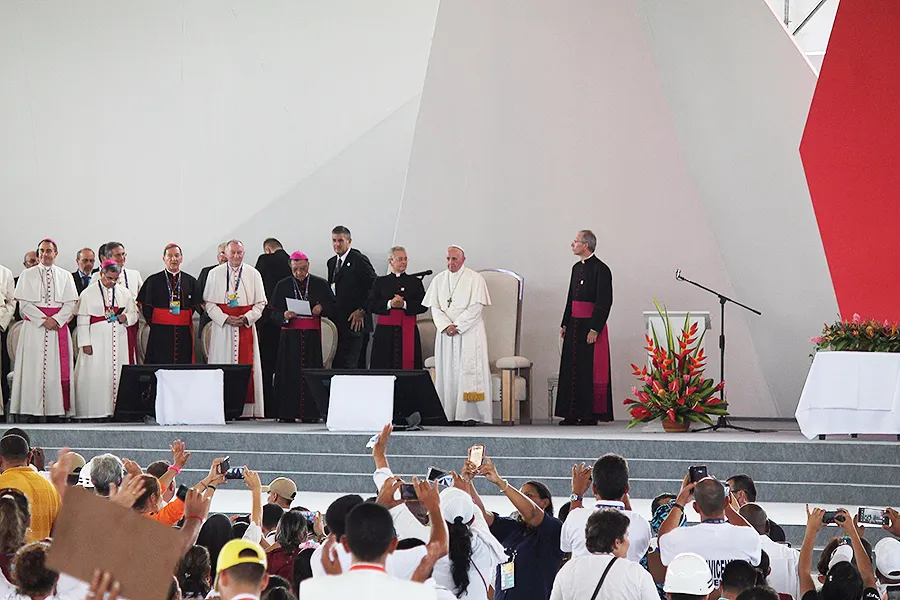
Villavicencio, Colombia, Sep 8, 2017 / 03:46 pm (CNA/EWTN News).- Pope Francis told the Colombian people Friday that while it will be challenging, they must let go the anger caused by years of painful suffering and break the cycle of violence through a process of genuine forgiveness.
“Violence leads to more violence, hatred to more hatred, death to more death. We must break this cycle which seems inescapable,” the Pope said Sept. 8. “This is only possible through forgiveness and reconciliation.”
Pope Francis spoke during a prayer gathering in Villavicencio for national reconciliation as part of his Sept. 6-11 visit to Colombia.
The trip, which marks his third tour of South America since his election, is largely the result of the country's ongoing peace process between the government and Colombia's largest guerrilla group, the Revolutionary Armed Forces of Colombia (FARC).
After more than six decades of conflict, a peace deal was finally struck in August 2016, de-escalating a conflict which since 1964 has left some 260,000 people dead and an estimated 7 million displaced.
Archbishop Oscar Urbina Ortega of Villavicencio greeted the Pope, offering his own brief reflection on the need for reconciliation.
In his comments, the archbishop stressed that “you cannot have true conversion of heart that does not also produce social and political resonances. Because of this reconciliation is offered to everyone.”
Reconciliation among the Colombian people “is a process, not only a goal or a perfect state,” Archbishop Urbina said, pointing to the strong desire of Colombians to overcome the pain caused by different forms of violence such as kidnapping, extortion, displacement, forced disappearance, forced recruitment, threats against life, and murders.
These, he said, “have destroyed projects of life from thousands of families and communities,” and it will take time to help so many people rebuild their lives.
“The search and constant effort to listen to each other, forgive each other and to try again will be the basis for generating a culture of fraternity,” Archbishop Urbina said, praying that that God would give them “a fruitful seed so that the tree of forgiveness, justice, reconciliation and peace blooms in this land.”
Pope Francis then listened to four testimonies from victims of the violence, including former FARC fighters and former members of other paramilitary groups.
The first testimony was given by Juan Carlos Murcia Perdomo, who was part of FARC forces for 12 years, and reflected on truth. After being recruited at 16, he lost his left had working with explosives.
He eventually ascended the ranks and was named commander of his own squad. However, Murcia said at the same time he felt used and had a strong sense of nostalgia for home, and little by little understood that violence wasn't the right path. He left FARC and later launched the “Funddrras Foundation,” which is dedicated to sports in a bid to offer youth an alternative to drugs and violence.
Deisy Sanchez Rey, who at 16 was recruited by her brother to join the United Self-Defense Forces of Colombia (AUC) paramilitary and drug trafficking group, spoke on justice. She shared her story of how she was eventually arrested and, after two years in prison, wanted to change her life. She began attending Mass and studying psychology, and now offers counseling to victims of drugs and violence.
A third testimony, given by Luz Dary Landazury, the victim of an explosion set off by guerrilla forces, regarded mercy. In addition to nearly losing her left leg and suffering wounds all over her body, Landazury's 7-month-old daughter also suffered significant injuries to her face.
Despite her anger, Landazury said she eventually understood that hate would only lead to more violence, and so began visiting other victims in order to help them learn to let go of their own anger and move forward with their lives.
The final testimony, focused on peace, was given by Pastora Mira Garcia, whose father was killed by guerrillas when she was just 6-years-old. She also lost her first husband, her daughter, and her son to guerrilla violence.
However, with what she describes as grace and the help of Our Lady, she was able not only to work with other families who had experienced similar losses, but eventually, in different moments, met and cared for both her father's killer, who was sick and abandoned, and her son's murderer, who was wounded.
In his address following the testimonies, Pope Francis said he had been looking forward to the encounter “since my arrival in your country.”
“You carry in your hearts and your flesh the signs of the recent, living memory of your people which is marked by tragic events, but also filled with heroic acts, great humanity, and the noble spiritual values of faith and hope,” he said.
Colombia has sadly become “a land watered by the blood of thousands of innocent victims and by the heart-breaking sorrow of their families and friends,” he said, adding that these wounds “hurt us all, because every act of violence committed against a human being is a wound in humanity’s flesh.”
The Pope said he didn't come to speak, but rather “to be close to you and to see you with my own eyes, to listen to you and to open my heart to your witness of life and faith. And if you will allow me, I wish also to embrace you and weep with you.”
“I would like us to pray together and to forgive one another – I also need to ask forgiveness – so that, together, we can all look and walk forward in faith and hope.”
He pointed to the Crucifix of Bojayá, where on May 2, 2002, 119 civilians, including 45 children, were killed by guerrilla forces in an effort to take the Atrato River region from the AUC. Victims had taken refuge in the town's church, but were all killed when the militants began launching gas cylinder bombs inside.
Pope Francis noted how the crucifix pulled from the carnage shows a Christ “mutilated and wounded,” with no arms and no body. “But his face remains, with which he looks upon us and loves us.”
To see Christ this way challenges us, he said, and reminds us of the “immense suffering, the many deaths and broken lives, and all the blood spilt in Colombia these past decades.”
“Christ broken and without limbs is for us even more Christ, because he shows us once more that he came to suffer for his people and with his people,” Francis said. “He came to show us that hatred does not have the last word, that love is stronger than death and violence.”
Turning to the testimonies given, the Pope said he was moved when listening to them, because they are stories that speak of pain and suffering, “but also, and above all, they are stories of love and forgiveness that speak to us of life and hope; stories of not letting hatred, vengeance or pain take control of our hearts.”
“Thank you, Lord, for the witness of those who inflicted suffering and who ask for forgiveness; for the witness of those who suffered unjustly and who forgive,” he said, adding that “this is only possible with your help and presence.”
Francis recalled how in her testimony, Mira Garcia had said that she wanted to place her suffering and that of all victims of the conflict at the feet of Christ Crucified, “so that united to his suffering, it may be transformed into blessing and forgiveness so as to break the cycle of violence that has reigned over Colombia.”
“And you, dear Pastora, and so many others like you, have shown us that this is possible,” he said, adding that “with the help of Christ alive in the midst of the community, it is possible to conquer hatred, it is possible to conquer death and it is possible to begin again and usher in a new Colombia.”
Noting how in her testimony Luz Dary shared that the wounds in her heart were deeper and harder to heal than the ones that scarred her body, he acknowledged that this is true, and commended her for realizing that “it is not possible to live with resentment, but only with a love that liberates and builds.”
By going out of herself to help other victims heal and rebuild their lives, Dary found the peace and serenity needed to keep going, he said. And while physical wounds remain, “your spiritual gait is fast and steady, because you think of others and want to help them.”
Turning to Deisy and Juan Carlos, the former FARC and AUC fighters, Pope Francis said their testimony helps one to understand that they, too, are victims.
“In the end, in one way or another, we too are victims, innocent or guilty, but all victims,” he said. “We are all united in this loss of humanity that means violence and death.”
“There is also hope for those who did wrong; all is not lost,” he said, noting that while justice requires that those who do wrong “undergo moral and spiritual renewal,” we must all “make a positive contribution to healing our society that has been wounded by violence.”
Francis recognized that it might be hard to believe change is possible given the sheer amount of suffering and violence perpetrated by those pursuing their own agenda. However, “even when conflicts, violence and feelings of vengeance remain, may we not prevent justice and mercy from embracing Colombia’s painful history,” he said.
“Let us heal that pain and welcome every person who has committed offenses, who admits their failures, is repentant and truly wants to make reparation, thus contributing to the building of a new order where justice and peace shine forth.”
As part of the reconciliation process, “it is also indispensable to come to terms with the truth.” This, he said, “is a great challenge, but a necessary one,” because “truth is an inseparable companion of justice and mercy.”
Both truth and justice are essential in building peace, he said, explaining that each prevents the other from being manipulated and transformed into “instruments of revenge against the weakest.”
Truth, the Pope said, “means telling families torn apart by pain what happened to their missing relatives,” and “confessing what happened to minors recruited by violent people.” It also means “recognizing the pain of women who are victims of violence and abuse.”
Pope Francis closed his address offering his perspective as “a brother and a father,” telling Colombia to “open your heart as the People of God and be reconciled. Fear neither the truth nor justice.”
“Do not be afraid of asking for forgiveness and offering it. Do not resist that reconciliation which allows you to draw near and encounter one another as brothers and sisters, and surmount enmity,” he said.
“Now is the time to heal wounds, to build bridges, to overcome differences. It is time to defuse hatred, to renounce vengeance, and to open yourselves to a coexistence founded on justice, truth, and the creation of a genuine culture of fraternal encounter.”
Francis then led attendees in a prayer for peace to the “Christ of Bojayá,” in “Lord, make me an instrument of your peace,” a 20th century prayer which is often attributed to St. Francis of Assisi, and in the Hail Mary. Before departing, the Pope blessed all present.
Previous Post

September 8, 2017
Prisoners in Colombia unite in prayer for Pope Francis' visit
Next Post
September 8, 2017 NY court unanimously rejects assisted suicide in major pro-life victory
Browse Our Archives
Select a Category Americas Asia - Pacific Europe Middle East - Africa Uncategorized US Vatican
Select a Month November 2017 October 2017 September 2017 August 2017 July 2017 June 2017 May 2017 April 2017 March 2017 February 2017 January 2017 December 2016 November 2016 October 2016 September 2016 August 2016 July 2016 June 2016 May 2016 April 2016 March 2016 February 2016 January 2016 December 2015 November 2015 October 2015 September 2015 August 2015 July 2015 June 2015 May 2015 April 2015 March 2015 February 2015 January 2015 December 2014 November 2014 October 2014 September 2014 August 2014 July 2014 June 2014 May 2014 April 2014 March 2014 February 2014 January 2014 December 2013 November 2013 October 2013 September 2013 August 2013 July 2013 June 2013 May 2013 April 2013 March 2013 February 2013 January 2013 December 2012 November 2012 October 2012 September 2012 August 2012 July 2012 June 2012 May 2012
TAKE THE
Religious Wisdom Quiz
Which Christian group is known for not celebrating holidays or birthdays?
Select your answer to see how you score.
Methodists Orthodox Episcopalians Jehovah's Witnesses
Related posts from Catholic News

Venezuela's hate crime law seeks to silence political...

Canadian doctors face questions over assisted suicide, euthanasia...

Caritas Venezuela warns that 280,000 children could die...

Bishop appointed for Canada's Chaldean eparchy
TRENDING AT PATHEOS Catholic

Rejecting Doom: Christian Hope And Human Action
Christianity is a religion of hope. We are to have hope and...

It’s What Comes From Within Which Matters
One of the most difficult things for us to understand is why...

Why I Choose the Eucharist Over the Sermon
Choose the Eucharist, Not the Sermon What are we supposed to get...

5 Design Elements Found in Spiritually Rooted Homes
Putting Spirituality Into Home Decor Our homes are more than our living...

Credo: A Story of God Told with the...
About 10 years ago, I began to imagine a personal "Credo" that...

The Anatomy of Divine Revelation in Catholic Thought
The claim that God has made Himself known to human beings is...
view all Catholic blogs
Ad-Free & Subscriber Log-In Subscription Support
- About Us
- 2026 Calendar
- Videos
- Podcasts
- Library of World Religions
- Faith In Media Tracker
- Advertise With Us
- Write for Us
- Privacy Policy
- Terms of Service
- Do Not Sell My Data
- Contact Us
- Radiant Digital
- Manage Newsletter Subscriptions
- Unsubscribe From Notifications
- Sitemap
Copyright 2008-2026, Patheos. All rights reserved.
Subscription Support Ad-Free & Subscriber Log-In
Follow Patheos