
BuddhistCatholicContemplativeEvangelicalGeneral ChristianHinduJewishLatter-day SaintMuslimNew VisionsProgressive Christian
Beliefs
- Buddhist
- Catholic
- Contemplative
- Evangelical
- General Christian
- Hindu
- Jewish
- Latter-day Saint
- More Voices
- Muslim
- New Visions
- Pagan
- Progressive Christian
Topics
- Religion News
- Food and Religion
- Sports and Religion
- Religious Art
- Religious Music and Entertainment
- Religious Events
- History and Religion
- Style and Religion
- Politics and Religion
- Women in Religion
- Recreation Outdoors and Religion
- Business Finance and Religion
- Careers Workplace and Religion
- Education and Religion
- Family Parenting and Religion
- Health Fitness and Religion
- Home and Religion
- Relationships and Religion
- Technology and Religion
- Travel and Religion
Columnists
- Buddhist Columnists
- Business Finance and Religion Columnists
- Careers Workplace and Religion Columnists
- Catholic Columnists
- Contemplative Columnists
- Education and Religion Columnists
- Evangelists Columnists
- Family Parenting and Religion Columnists
- General Christian Columnists
- Health Fitness and Religion Columnists
- Hindu Columnists
- History and Religion Columnists
- Home and Religion Columnists
- Jewish Columnists
- More Voices Columnists
- Latter Day Columnists
- Muslim Columnists
- New Visions Columnists
- Nonreligious Columnists
- Pagan Columnists
- Politics and Religion Columnists
- Progressive Columnists
- Recreation Outdoors and Religion Columnists
- Relationships and Religion Columnists
- Religion News Columnists
- Religious Art Columnists
- Religious Events Columnists
- Religious Music and Entertainment Columnists
- Sports and Religion Columnists
- Style and Religion Columnists
- Technology and Religion Columnists
- Travel and Religion Columnists
- Women in Religion Columnists
Resource Library
- 2026 Calendar
- Library of World Religions
- The 100 Most Holy Places on Earth
- Patheos Answers
- Podcasts
- Videos
- Faith Leaders Database
- Anglican Episcopalian
- Bahai
- Baptist
- Buddhism
- Christianity
- Confucianism
- Eastern Orthodoxy
- Hinduism
- Holiness and Pentecostal
- ISKCON
- Islam
- Judaism
- Lutheran
- Methodist
- The Church of Jesus Christ of Latter-day Saints
- New Age
- Paganism
- Presbytarian and Reformed
- Protestantism
- Religion Behind the Scenes
- Roman Catholic
- Scientology
- Shia Islam
- Sikhism
- Sufism
- Sunni Islam
- Taoism
- Zen
- See all religions
Research Tools
 Ad-Free & Subscriber Log-In Subscription Support
Ad-Free & Subscriber Log-In Subscription Support
Follow Patheos 

- Trending:
- Forgiveness
- |
- Marriage
- |
- Consciousness
- |
- Death Penalty
- |
- Election
- |
- Halloween
 Catholic News
- Home
- Catholic
- Religion News
- Concerns of ‘anti-Catholic bigotry’ as judicial nominee questioned about faith
Concerns of ‘anti-Catholic bigotry’ as judicial nominee questioned about faith
Last updated on: September 7, 2017 at 3:25 pm by CNA Daily News
Concerns of ‘anti-Catholic bigotry’ as judicial nominee questioned about faith 2017-09-07T15:25:00+00:00 CNA Daily News
Patheos Explore the world's faith through different perspectives on religion and spirituality! Patheos has the views of the prevalent religions and spiritualities of the world.
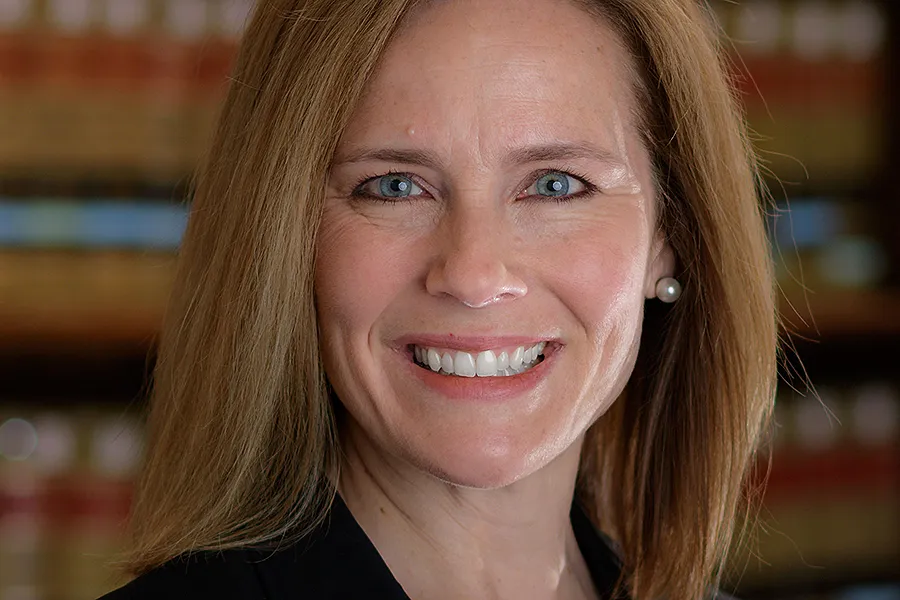
Washington D.C., Sep 7, 2017 / 09:25 am (CNA/EWTN News).- A Catholic nominee to a federal circuit court faced hostile questions about her faith from U.S. senators on Wednesday, prompting outrage from Catholic leaders.
“This smacks of the worst sort of anti-Catholic bigotry,” Dr. Chad Pecknold, a theology professor at The Catholic University of America, told CNA of questions asked by Sen. Dianne Feinstein (D-Calif.) of Amy Comey Barrett, a Catholic lawyer nominated to be a federal circuit court judge.
“Senator Feinstein's shockingly illegitimate line of questioning sends the message that Catholics need not apply as federal judges,” added Ashley McGuire, senior fellow with The Catholic Association.
WATCH: Sen. Feinstein to appeals court nominee Amy Barrett, @NotreDame law prof/#Catholic mother of 7: "The dogma lives loudly within you." pic.twitter.com/mpDgNZGRsa
— Jason Calvi (@JasonCalvi) September 6, 2017
Barrett, a professor at Notre Dame Law School, appeared before the Senate Judiciary Committee on Wednesday at her confirmation hearing to be a United States Circuit Judge for the Seventh U.S. Court of Appeals.
In the past, Barrett had clerked for Supreme Court Justice Antonin Scalia, and has twice been honored as “Distinguished Professor of the Year” at Notre Dame.
However, as she appeared before the Senate Judiciary Committee on Wednesday, some of the pointed questions directed at her by Democratic senators focused on how her Catholic faith would influence her decisions as a judge on cases of abortion and same-sex marriage.
Sen. Dianne Feinstein (D-Calif.), ranking member of the committee, told Barrett outright that her Catholic beliefs were concerning, as they may influence her decisions as a judge on abortion rights.
“Why is it that so many of us on this side have this very uncomfortable feeling that dogma and law are two different things, and I think whatever a religion is, it has its own dogma. The law is totally different,” Feinstein said.
“And I think in your case, professor, when you read your speeches, the conclusion one draws is that the dogma lives loudly within you. And that’s of concern.”
Feinstein began her round of questions by personally complimenting Barrett that she was “amazing to have seven children and do what you do,” but then called her “controversial” when she began to address Barrett’s record in law, “because you have a long history of believing that your religious beliefs should prevail” over the law.
“You’re controversial because many of us that have lived our lives as women really recognize the value of finally being able to control our reproductive systems,” she said. “And Roe entered into that, obviously.”
Barrett repeatedly said that as a judge, she would uphold the law of the land and would not let her religious beliefs inappropriately alter her judicial decisions.
At the beginning of the hearing, Senator Chuck Grassley (R-Iowa), chair of the committee, asked Barrett: “When is it proper for a judge to put their religious views above applying the law?”
“Never,” Barrett answered. “It’s never appropriate for a judge to impose that judge’s personal convictions, whether they derive from faith or anywhere else, on the law.”
Feinstein’s “anti-Catholic bigotry” in her questions to Barrett “is especially chilling because it defames and slanders such an accomplished woman in the legal guild,” Pecknold said.
Feinstein “reveals herself to be the sort of ideologue who never considers the substance of her interlocutor’s actual legal decisions, but rather projects false ideologies onto everyone who disagrees with her party on any point,” Pecknold charged.
In 1998, Barrett co-authored an article in the Marquette Law Review with then-Notre Dame law professor John Garvey, now the president of The Catholic University of America. The article focused on Catholic judges in death penalty cases.
Catholic judges, if their consciences oppose the administering of the death penalty, should, in accordance with federal law, recuse themselves from capital cases where a jury recommends a death sentence, Garvey and Barrett wrote. They should also recuse themselves from cases without a jury where they have the option of granting a death sentence, they wrote.
On Wednesday, Barrett was asked repeatedly about this article, published 19 years ago, and whether she still agreed with it today. Barrett answered that she was still a third-year law student during the article’s publication, and “was very much the junior partner” in writing it with her professor.
“Would I, or could I, say that sitting here today, that article in its every particular, reflects how I think about these questions today with, as you say, the benefit of 20 years of experience and also the ability to speak solely in my own voice? No, it would not,” she answered Senator Grassley’s opening question on the article.
She added that she still upholds “the core proposition of that article which is that if there is ever a conflict between a judge’s personal conviction and that judge’s duty under the rule of law, that it is never, ever permissible for that judge to follow their personal convictions in the decision of a case rather than what the law requires.”
Senator Grassley asked her later how she would recuse herself as a judge in a case, if necessary.
“Senator, I would fully and faithfully apply the law of recusal, including the federal recusal statute, 28 U.S.C. § 455, the canons of judicial conduct,” she replied, but added that “I can’t think of any cases or category of cases in which I would feel obliged to recuse on grounds of conscience.”
Garvey, in a Thursday op-ed in the Washington Examiner, explained the article’s conclusion in cases where judges face a conflict of interest between their own conscience and the law.
“Law professors less scrupulous than Prof. Barrett have suggested that sometimes judges should fudge or bend (just a little bit) laws that every right-thinking person would find immoral. In our article we rejected that course of action,” he said, pointing instead to the federal recusal statute.
Sen. Dick Durbin (D-Ill.) then grilled Barrett over her use of the term “orthodox Catholic” in the article, implying that she did not think persons who dissent from Church teaching on marriage to be real Catholics.
“I’m a product of 19 years of Catholic education. And every once in a while, Holy Mother the Church has not agreed with a vote of mine. And has let me know,” he told Barrett. “You use a term in that article – or you both use a term in that article — I’d never seen before. You refer to ‘orthodox Catholics.’ What’s an orthodox Catholic?”
Barrett pointed to a footnote in the article that admitted it was “an imperfect term,” and that the article was talking about the hypothetical case of “a judge who accepted the Church’s teaching” on the death penalty and had a “conscientious objection” to it.
“Do you consider yourself an orthodox Catholic?” Durbin asked Barrett, who replied that “I am a faithful Catholic,” adding that “my personal Church affiliation or my religious belief would not bear in the discharge of my duties as a judge.”
Durbin then said that “there are many people who might characterize themselves ‘orthodox Catholics,’ who now question whether Pope Francis is an ‘orthodox Catholic.’ I happen to think he’s a pretty good Catholic.”
“I agree with you,” Barrett replied, to which Durbin responded, “Good. Then that’s good common ground for us to start with.”
He also asked Barrett how she would rule on a case involving a “same-sex marriage,” given the late Supreme Court Justice Antonin Scalia’s dissent from the 2013 Obergefell decision that legalized same-sex marriage.
“From beginning to end, in every case, my obligation as a judge would be to apply the rule of law, and the case that you mentioned would be applying Obergefell, and I would have no problem adhering to it,” she said.
Durbin’s questions of Barrett’s faith were also disturbing, Pecknold said.
“So faithful Catholic is interchangeable with Orthodox Catholic. The fact that one definition is acceptable to Sen Durbin but one is not tells you that he thinks one can dissent from the Church's teaching and be orthodox and faithful.”
“But why is a politician interested in that question when the only concern should be whether the nominee is a superb interpreter of the law? How has this become a religious inquisition rather than an adjudication of legal competence for the bench?” he asked.
“I submit that the real dogmatists in the room are the ones mounting an inquisition against one of the nation's great legal scholars.”
Other Catholic leaders decried the questioning of Barrett’s faith.
“Such bigotry has no place in our politics and reeks of an unconstitutional religious test for qualification to participate in the judiciary. What these Senators did today was truly reprehensible,” said Brian Burch, president of CatholicVote.org.
“Imagine the universal outrage had a nominee of a different faith been asked the same questions; there is clearly a double standard at work,” commented Maureen Ferguson, senior policy advisor with The Catholic Association.
Garvey, in his op-ed for the Examiner, wrote that “I suspect what really troubled” Durbin and Feinstein “was that, as a Catholic, her [Barrett’s] pro-life views might extend beyond criminal defendants to the unborn.”
“If true, the focus on our law review article is all the more puzzling,” he wrote. “After all, our point was that judges should respect the law, even laws they disagree with. And if they can't enforce them, they should recuse themselves.”
Next Post

September 7, 2017 Peace can start by grabbing drinks, Pope tells Colombian youth
Browse Our Archives
Select a Category Americas Asia - Pacific Europe Middle East - Africa Uncategorized US Vatican
Select a Month November 2017 October 2017 September 2017 August 2017 July 2017 June 2017 May 2017 April 2017 March 2017 February 2017 January 2017 December 2016 November 2016 October 2016 September 2016 August 2016 July 2016 June 2016 May 2016 April 2016 March 2016 February 2016 January 2016 December 2015 November 2015 October 2015 September 2015 August 2015 July 2015 June 2015 May 2015 April 2015 March 2015 February 2015 January 2015 December 2014 November 2014 October 2014 September 2014 August 2014 July 2014 June 2014 May 2014 April 2014 March 2014 February 2014 January 2014 December 2013 November 2013 October 2013 September 2013 August 2013 July 2013 June 2013 May 2013 April 2013 March 2013 February 2013 January 2013 December 2012 November 2012 October 2012 September 2012 August 2012 July 2012 June 2012 May 2012
TAKE THE
Religious Wisdom Quiz
Who was the last apostle to die?
Select your answer to see how you score.
Peter Paul James John
Related posts from Catholic News

US bishops' new child protection program aims to...

Wealthy foundation aims to redefine religious freedom—and Christianity,...

Victims of Islamic State in focus at UN...

Catholic University of America offers free tuition to...
TRENDING AT PATHEOS Catholic

Creation, Preservation, and Teleology in Catholic Theology
As I write this, it is very early Monday morning. Like millions...

The Parable Of The Sower And The Word...
One of Christ’s most famous parables is that of the sower who...

Rejecting Doom: Christian Hope And Human Action
Christianity is a religion of hope. We are to have hope and...

Why I Choose the Eucharist Over the Sermon
Choose the Eucharist, Not the Sermon What are we supposed to get...

5 Design Elements Found in Spiritually Rooted Homes
Putting Spirituality Into Home Decor Our homes are more than our living...

Credo: A Story of God Told with the...
About 10 years ago, I began to imagine a personal "Credo" that...
view all Catholic blogs
Ad-Free & Subscriber Log-In Subscription Support
- About Us
- 2026 Calendar
- Videos
- Podcasts
- Library of World Religions
- Faith In Media Tracker
- Advertise With Us
- Write for Us
- Privacy Policy
- Terms of Service
- Do Not Sell My Data
- Contact Us
- Radiant Digital
- Manage Newsletter Subscriptions
- Unsubscribe From Notifications
- Sitemap
Copyright 2008-2026, Patheos. All rights reserved.
Subscription Support Ad-Free & Subscriber Log-In
Follow Patheos