
BuddhistCatholicContemplativeEvangelicalGeneral ChristianHinduJewishLatter-day SaintMuslimNew VisionsProgressive Christian
Beliefs
- Buddhist
- Catholic
- Contemplative
- Evangelical
- General Christian
- Hindu
- Jewish
- Latter-day Saint
- More Voices
- Muslim
- New Visions
- Pagan
- Progressive Christian
Topics
- Religion News
- Food and Religion
- Sports and Religion
- Religious Art
- Religious Music and Entertainment
- Religious Events
- History and Religion
- Style and Religion
- Politics and Religion
- Women in Religion
- Recreation Outdoors and Religion
- Business Finance and Religion
- Careers Workplace and Religion
- Education and Religion
- Family Parenting and Religion
- Health Fitness and Religion
- Home and Religion
- Relationships and Religion
- Technology and Religion
- Travel and Religion
Columnists
- Buddhist Columnists
- Business Finance and Religion Columnists
- Careers Workplace and Religion Columnists
- Catholic Columnists
- Contemplative Columnists
- Education and Religion Columnists
- Evangelists Columnists
- Family Parenting and Religion Columnists
- General Christian Columnists
- Health Fitness and Religion Columnists
- Hindu Columnists
- History and Religion Columnists
- Home and Religion Columnists
- Jewish Columnists
- More Voices Columnists
- Latter Day Columnists
- Muslim Columnists
- New Visions Columnists
- Nonreligious Columnists
- Pagan Columnists
- Politics and Religion Columnists
- Progressive Columnists
- Recreation Outdoors and Religion Columnists
- Relationships and Religion Columnists
- Religion News Columnists
- Religious Art Columnists
- Religious Events Columnists
- Religious Music and Entertainment Columnists
- Sports and Religion Columnists
- Style and Religion Columnists
- Technology and Religion Columnists
- Travel and Religion Columnists
- Women in Religion Columnists
Resource Library
- 2026 Calendar
- Library of World Religions
- The 100 Most Holy Places on Earth
- Patheos Answers
- Podcasts
- Videos
- Faith Leaders Database
- Anglican Episcopalian
- Bahai
- Baptist
- Buddhism
- Christianity
- Confucianism
- Eastern Orthodoxy
- Hinduism
- Holiness and Pentecostal
- ISKCON
- Islam
- Judaism
- Lutheran
- Methodist
- The Church of Jesus Christ of Latter-day Saints
- New Age
- Paganism
- Presbytarian and Reformed
- Protestantism
- Religion Behind the Scenes
- Roman Catholic
- Scientology
- Shia Islam
- Sikhism
- Sufism
- Sunni Islam
- Taoism
- Zen
- See all religions
Research Tools
 Ad-Free & Subscriber Log-In Subscription Support
Ad-Free & Subscriber Log-In Subscription Support
Follow Patheos 

- Trending:
- Forgiveness
- |
- Marriage
- |
- Consciousness
- |
- Death Penalty
- |
- Election
- |
- Halloween
 Catholic News
- Home
- Catholic
- Religion News
- Why the Knights of Columbus will resettle Iraqi Christians
Why the Knights of Columbus will resettle Iraqi Christians
Last updated on: August 4, 2017 at 8:55 pm by CNA Daily News
Why the Knights of Columbus will resettle Iraqi Christians 2017-08-04T20:55:00+00:00 CNA Daily News
Patheos Explore the world's faith through different perspectives on religion and spirituality! Patheos has the views of the prevalent religions and spiritualities of the world.
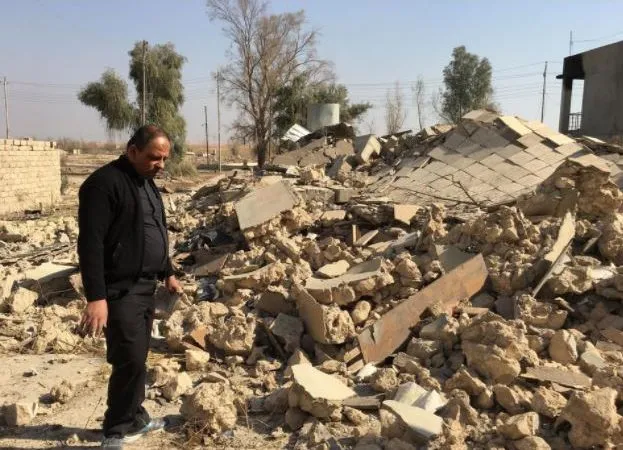
St. Louis, Mo., Aug 4, 2017 / 02:55 pm (CNA/EWTN News).- The urgency of the problems facing displaced Iraqi Christians has driven a new campaign by the Knights of Columbus to resettle an entire village in their homes, says a spokesman for the Knights.
The roughly 200,000 Christians still in Iraq – down from 1.5 million in 2003 – “are increasingly feeling a sense of hopelessness over the situation,” Andrew Walther, vice president of communications for the Knights of Columbus, told CNA on Thursday.
Even with Islamic State swept out of most of Iraq, many Christian families who lived in Mosul or on the nearby Nineveh Plain are not yet able to return to their homes, three years after being displaced by the group.
With their lives as internally displaced persons surpassing the three-year mark, “it was made very clear that if there weren’t concrete steps that showed people that moving home was possible in the next 30 to 60 days, there was a very good chance that many of them would just leave for other countries in the region, for wherever they could go,” Walther said.
The Knights of Columbus announced this week that it was beginning a $2 million drive to raise and donate money to resettle an entire village of families in Karemlesh, a town on the Nineveh Plain 18 miles outside Mosul. Most of the families are Chaldean or Syriac Christians, with some Shabak families, Walther said.
Supreme Knight Carl Anderson announced the drive during his annual remarks on Tuesday at the 135th annual international convention of the Knights of Columbus. The group is an international Catholic men’s organization with over 1.9 million members in councils all over the world.
“Now we will ensure that hundreds of Christian families driven from their homes can return to these two locations and help to ensure a pluralistic future for Iraq,” Anderson said on Tuesday announcing the drive. 100 percent of the funds raised would go to help Christians rebuild their homes.
The Islamic State swept through large swathes of Syria and Iraq in 2014, giving families of Christians and other religious and ethnic minorities an ultimatum – convert to Islam, die, or leave.
“When ISIS took the town, everybody fled,” Walther said, and militants began their campaign of cultural genocide: burning homes, desecrating parishes, destroying Christian symbols, and even digging up the body of a local priest to desecrate his grave.
“They wanted not just to erase the Christians from the town, they wanted to erase whatever was reminiscent of Christianity from the town as well,” Walther said.
Many Christians fled eastward to the Kurdistan region of Iraq, where around 70,000 Christians were living in and around the city of Erbil, dependent upon aid groups for their basic needs.
Since 2014, the Knights have already provided over $13 million in aid to Christians in Iraq and Syria who have suffered persecution, most notably at the hands of Islamic State.
The Knights also helped produce a report for the U.S. State Department, which requested it, detailing the violence and forced displacement inflicted upon Christians in Syria and Iraq. The report helped lead to the State Department declaring in March of 2016 that Islamic State was committing genocide against Christians, Yazidis, and Shia Muslims in Iraq and Syria.
The Islamic State has since been forced back from much of the territory it gained, including the Nineveh Plain and Mosul. “With the departure of ISIS as a meaningful military force, you have a lot of new opportunities, in terms of rebuilding and resettling, that you didn’t have six months ago, three months ago,” Walther said.
Now, however, many Christians have still not been able to return to their homes, which were vandalized, damaged, or destroyed by Islamic State militants. Their future is in question as they are currently living as displaced persons in Kurdistan. The situation is so bleak that local Church leaders are saying that if something is not done to remedy the problem, Christians could leave Iraq for good.
If that is the case, it would be an ideological victory for Islamic State, whose “program was the de-Christianization of Iraq, the total obliteration of any religious minorities,” Walther said.
Furthermore, with Christians gone, it could further destabilize Iraq by helping eliminate religious pluralism. “Christians are an enormous example of forgiveness, and they’ve been praised by imams in Iraq, by television commentators in Egypt, for this capacity of forgiveness,” Walther said.
And if the Christians have no more roots in the land where they have lived for centuries, a priceless cultural vestige could be gone as well.
The government of Hungary has already given $2 million to move around 1,000 families back to the town of Telskuf, Walther said, providing a working example that such a plan can be successful.
“We have a proof of concept, we know this can work, and we know that if it worked in Telskuf, there’s no reason that it wouldn’t work in a town also in Nineveh that is also predominately Christian that also has its population in Erbil,” he said.
The money would go to provide materials for Christians to repair their homes from the destruction that Islamic State inflicted. “The families are actually putting their own lives back together with a little bit of assistance,” Walther said. “The idea is to make these houses habitable.”
And although a goal of $2 million is lofty, it is entirely within reach if parishes and communities all over the world pitch in, Walther said.
“An individual can do this,” he said. “A prayer group can do this. 20 people put in $100, you can send somebody home. This is one of those things where people can do a concrete, tangible action that is a meaningful step in saving Christianity in the Middle East.”
“It’s a model that can allow Christianity to be transplanted back to where it was,” Walther said. “It’s an early step, but it’s an important step if Christianity is going to survive in Iraq.”
Donations to the project can be made at www.christiansatrisk.org or via phone at 1-800-694-5713. Donations are tax deductible to the extent allowed by law, the Knights said.
Next Post

August 4, 2017 Chile's bishops lament lifting of abortion ban
Browse Our Archives
Select a Category Americas Asia - Pacific Europe Middle East - Africa Uncategorized US Vatican
Select a Month November 2017 October 2017 September 2017 August 2017 July 2017 June 2017 May 2017 April 2017 March 2017 February 2017 January 2017 December 2016 November 2016 October 2016 September 2016 August 2016 July 2016 June 2016 May 2016 April 2016 March 2016 February 2016 January 2016 December 2015 November 2015 October 2015 September 2015 August 2015 July 2015 June 2015 May 2015 April 2015 March 2015 February 2015 January 2015 December 2014 November 2014 October 2014 September 2014 August 2014 July 2014 June 2014 May 2014 April 2014 March 2014 February 2014 January 2014 December 2013 November 2013 October 2013 September 2013 August 2013 July 2013 June 2013 May 2013 April 2013 March 2013 February 2013 January 2013 December 2012 November 2012 October 2012 September 2012 August 2012 July 2012 June 2012 May 2012
TAKE THE
Religious Wisdom Quiz
True or False: Song of Solomon is also called Song of Songs.
Select your answer to see how you score.
FALSE TRUE
Related posts from Catholic News

US bishops' new child protection program aims to...

Wealthy foundation aims to redefine religious freedom—and Christianity,...

Victims of Islamic State in focus at UN...

Catholic University of America offers free tuition to...
TRENDING AT PATHEOS Catholic

Creation, Preservation, and Teleology in Catholic Theology
As I write this, it is very early Monday morning. Like millions...

The Parable Of The Sower And The Word...
One of Christ’s most famous parables is that of the sower who...

Rejecting Doom: Christian Hope And Human Action
Christianity is a religion of hope. We are to have hope and...

Why I Choose the Eucharist Over the Sermon
Choose the Eucharist, Not the Sermon What are we supposed to get...

5 Design Elements Found in Spiritually Rooted Homes
Putting Spirituality Into Home Decor Our homes are more than our living...

Credo: A Story of God Told with the...
About 10 years ago, I began to imagine a personal "Credo" that...
view all Catholic blogs
Ad-Free & Subscriber Log-In Subscription Support
- About Us
- 2026 Calendar
- Videos
- Podcasts
- Library of World Religions
- Faith In Media Tracker
- Advertise With Us
- Write for Us
- Privacy Policy
- Terms of Service
- Do Not Sell My Data
- Contact Us
- Radiant Digital
- Manage Newsletter Subscriptions
- Unsubscribe From Notifications
- Sitemap
Copyright 2008-2026, Patheos. All rights reserved.
Subscription Support Ad-Free & Subscriber Log-In
Follow Patheos